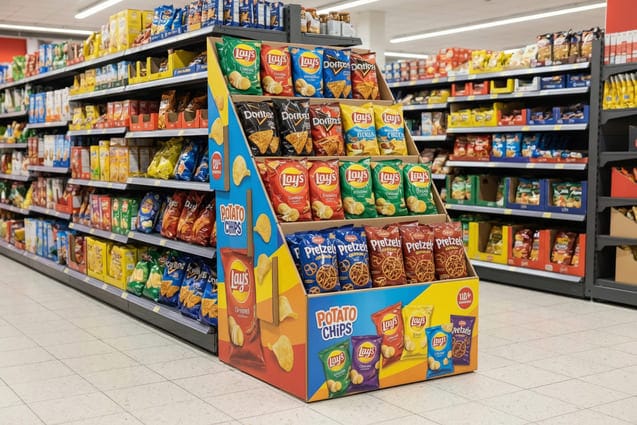
Is your product getting lost on the messy bottom shelf of a retail aisle? A custom tiered display is the fastest way to lift your brand out of the "dead zone" and right into the shopper's face.
Yes, we offer tiered floor display stands that can be customized to specific retail requirements. These fixtures typically feature reinforced corrugated shelves designed to support heavy loads ranging from 20 to 50 lbs (9–23 kg) per tier, ensuring structural integrity during high-traffic promotional cycles.
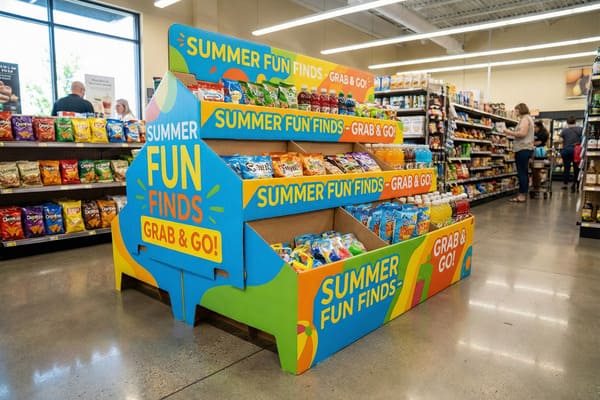
Tiered displays are the workhorses of retail, but getting the terminology right is the first step to getting a quote that makes sense.
What are storefront displays called?
Confusion over industry jargon is the number one reason for delayed quotes. If you ask for one thing but mean another, we lose days clarifying the specs.
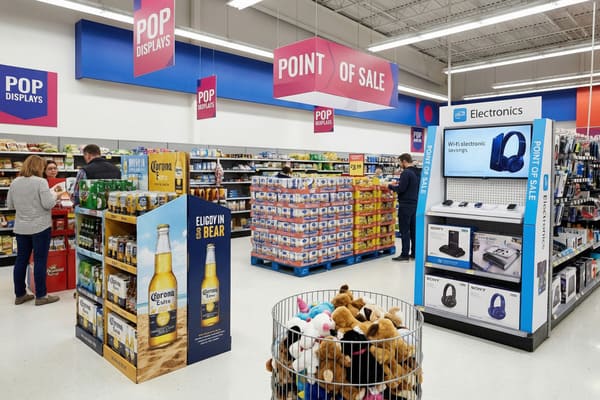
Storefront displays are called POP (Point of Purchase) displays or POSM (Point of Sales Materials) in the retail industry. These units encompass various formats, including floor stands, endcaps, and counter trays, specifically engineered to maximize product visibility and drive impulse purchases in brick-and-mortar environments.
The Vocabulary of Retail Execution
I see this happen constantly. A buyer from London asks for an "FSDU" (Free Standing Display Unit), while a buyer from Texas asks for a "Floor Shipper." They are talking about the exact same cardboard box, but the language barrier creates friction. In the North American market, specifically for retailers like Walmart or Target, we generally stick to "Floor Displays" or "Quarter Pallets." But names matter because they often imply structural expectations.
When you say "Shipper Display," I immediately assume you want a unit that is pre-filled with product at my factory in China and shipped directly to the store floor. This changes the engineering entirely. A "Shipper" needs to pass ISTA 3A drop tests1 because it holds the weight of your product across the ocean. We have to upgrade the material from a standard 32ECT B-Flute to a heavy-duty 44ECT or 48ECT BC-Flute2 (Double Wall) to survive the vibration. A simple "POS Stand," however, might just be a flat-packed marketing piece assembled in-store, which allows us to use lighter materials.
We also see huge confusion with "Endcaps." In the US, an Endcap3 is prime real estate at the end of an aisle. The standard width is roughly 36 inches (91 cm), but the usable space is often tight due to the metal uprights of the gondola shelving. I always design to a 34.5-inch (87 cm) max width. Why? Because if I make it exactly 36 inches, it might jam. I learned this the hard way years ago when a batch was rejected by a store manager because it scratched their permanent fixtures. Now, we build in that "Float Tolerance4" to ensure it fits any Lozier or Madix fixture universally.
| Term | Region/Context | Meaning | Structural Implication |
|---|---|---|---|
| POP Display | Global (General) | Point of Purchase | Any display near the checkout or decision area. |
| FSDU | UK / Europe | Free Standing Display Unit | Usually flat-packed, assembled in-store. |
| Shipper / Pre-pack | USA / Canada | Pre-filled Display | Heavy-duty (44ECT+), must survive shipping fully loaded. |
| Endcap | USA Retail | End of Aisle Unit | Must fit 36" (91 cm) gondola widths strictly (target 34.5"). |
| PDQ / CDU | USA / Global | Product Display Quick | Counter unit, strictly for impulse/checkout zones. |
My advice is simple: don't worry about the fancy acronyms. Just tell me where it goes in the store and if we are packing the product inside it here in China. I will figure out the correct engineering name for it.
What is the purpose of a display stand?
Many brands think a display is just a fancy shelf. It is not. It is a survival tool in a hostile environment where your product is invisible 90% of the time.
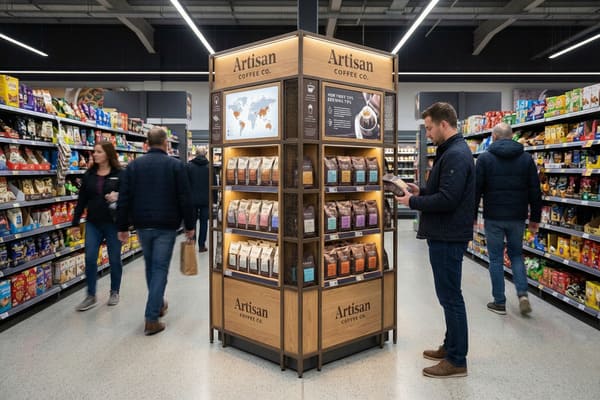
The purpose of a display stand is to isolate products from crowded shelves and disrupt the shopper's visual journey. By positioning items in high-traffic aisles, these fixtures effectively arrest attention, communicate brand value, and facilitate immediate product interaction.
Visual Disruption and Structural Survival
The primary job of a display is "Visual Disruption." Shoppers in US megastores suffer from severe decision fatigue. When they walk down an aisle, their brain filters out the noise of thousands of products on standard metal shelves. A standalone cardboard display breaks that pattern. It forces the eye to stop. But here is the messy reality: cardboard is fragile, and retail floors are wet.
If a display looks trashed after five customers touch it, it actually hurts your brand. We call this the "Brand Equity Paradox5." You spend money to look premium, but a flimsy display makes you look cheap. I had a client once who insisted on using cheap recycled paper for the base of a floor display to save $0.50 per unit. I warned him. Two weeks into the program, the store mopped the floors. The water seeped into the raw cardboard, the bottom turned to mush, and the whole tower leaned over like a dying tree.
That is why the purpose of a display isn't just to show product; it is to survive the retail floor. Now, I refuse to build a floor display without a "Mop Guard6." We apply a clear, biodegradable water-resistant coating or a varnish barrier to the bottom 2 to 4 inches (5–10 cm) of the kick-plate. This keeps the structure rigid even when the janitor hits it with a wet mop. It ensures your billboard remains standing tall for the entire 4-week promotion cycle. Furthermore, we differentiate between Virgin Kraft Liner7 and Recycled Testliner8. For the structural load-bearing walls, I only use Virgin Kraft because its long fibers resist cracking at the fold lines, whereas recycled fibers are short and burst easily under pressure.
| Feature | Purpose | Failure Consequence |
|---|---|---|
| Mop Guard | Protects base from floor water | "Soggy Bottom" effect; display collapse. |
| Virgin Kraft Liner | Provides tensile strength | Bursting/Cracking at fold lines after 1 week. |
| Header Card | Billboard for brand message | Curling forward in humidity; unreadable text. |
| False Bottom | Adds weight/stability | Display tips over when product is sold. |
I always tell my clients that a display has to work harder than the product itself. If the structure fails, the customer never even gets the chance to see what you are selling.
How do display stands increase sales?
It is not magic; it is physics and psychology working together. A well-engineered stand removes the friction between "seeing" and "buying."
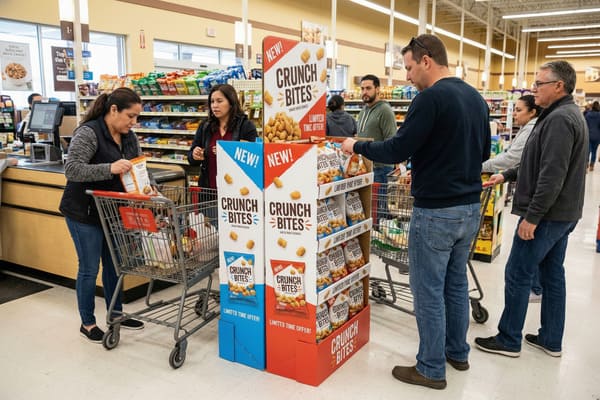
Display stands increase sales by leveraging the psychology of impulse buying and reducing decision fatigue. By presenting a curated selection of products at eye level, these units simplify the purchasing process, leading to a measurable uplift in sell-through rates compared to standard shelf placement.
The Mechanics of "Chin-Up" Velocity and Friction
We often talk about the "3-Second Lift." Data shows that a floor display increases sell-through by roughly 400% compared to home-shelf placement. But how? It comes down to ergonomics. On a standard bottom shelf, your product is facing the customer's knees. To read the label, they have to step back and crouch. Nobody does that. They just keep walking.
To fix this, I use a design technique called the "Chin-Up Angled Shelf9." We angle the bottom two shelves upwards by about 15 degrees. It sounds minor, but the physics are undeniable. The product label is now "looking up" at the customer's eyes. This increases label readability by 100% for a shopper standing 3 feet (0.9 meters) away. If they can read it without bending over, they are ten times more likely to pick it up. This is especially critical for tiered displays where lower shelves are often "dead zones."
Another massive sales driver is the "Gravity Feed10" system, but it is tricky to get right. If the angle is too shallow, cans get stuck. If it is too steep, they smash into the front lip. I don't guess with this. We calculate the "Coefficient of Friction11" based on your specific packaging material—glass slides differently than aluminum. For boxed items, we often need a 16-18 degree angle. We test this with your actual product in the factory. A smooth feed means the next unit is always ready to buy. An empty face means zero sales. We also use "Shop-Through12" architecture for pallet displays, cutting windows in the internal supports so shoppers can see products from all sides, reducing visual blockage in the aisle.
| Design Element | Psychological Trigger | Sales Impact |
|---|---|---|
| Chin-Up Angle | Ergonomic Ease | Increases label readability on lower tiers by 100%. |
| Die-Cut Shape | Novelty / Disruption | Grabs attention faster than square metal shelves. |
| Isolated Stock | Focus / Confidence | Reduces decision fatigue; faster pick-up. |
| Gravity Feed | Abundance / Availability | Ensuring product is always front-faced. |
Don't look at the unit price of the display as a cost. Look at the margin. If this structure helps you sell 50 extra units in the first two days because the customer could actually see the label, the cardboard has already paid for itself.
What is the best height to showcase a product?
Height is the most critical dimension in retail. Too low, it's invisible. Too high, it's illegal (or at least, against retailer rules).
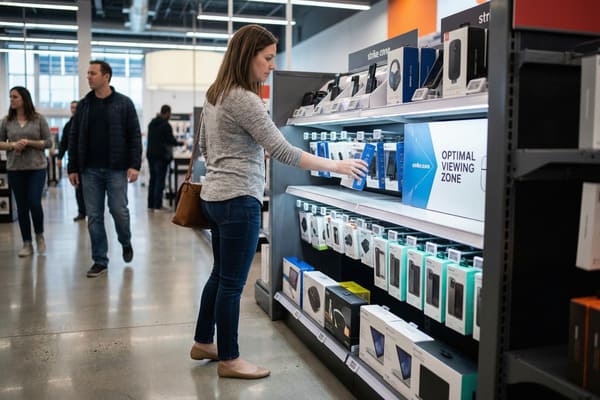
The best height to showcase a product is between 50 and 54 inches (127–137 cm) from the floor. This vertical range aligns with the average shopper's eye level, known as the "Strike Zone," which statistically generates the highest engagement and sales conversion rates.
Navigating the "Strike Zone13" and Logistics Limits
We call the area between 50 and 54 inches (127–137 cm) the "Strike Zone" because the average American female shopper is around 5'4" (163 cm). This is where your highest-margin item belongs. But designing for height is a constant battle between marketing desires and logistical reality. Marketing always wants "Taller! Bigger!" But the supply chain has a hard ceiling.
A standard US semi-trailer door is about 100 to 110 inches (254–279 cm) high. LTL (Less Than Truckload) carriers love to double-stack pallets to maximize their profit. If your display pallet is 60 inches (152 cm) tall, it cannot be double-stacked. This forces you into a "Non-Stackable" freight class, which can literally double your shipping cost. I usually advise clients to keep the "Shippable Pallet Height14" (Display + Pallet) under 48 to 50 inches (122–127 cm) if possible. This allows for efficient double-stacking in the truck. If you need height in the store, we can use a "Pop-Up Header" that folds down for shipping but extends up once it hits the retail floor.
Also, we must respect the "Sightline Rules15" of retailers like Walgreens or CVS. They often mandate lower heights (around 54-60 inches / 137-152 cm) to prevent theft, so security cameras can see over the displays. If we build it too tall, the store manager simply won't put it up. Additionally, for government or public buildings, we have to consider ADA (Americans with Disabilities Act)16 compliance. The reachable range for a wheelchair user is generally between 15 inches (38 cm) and 48 inches (122 cm). If your main product is sitting at 60 inches, you are excluding a portion of your customer base and potentially violating accessibility standards.
| Height Zone | Range (Imperial) | Range (Metric) | Strategic Use |
|---|---|---|---|
| The Header | 60"+ | 152cm+ | Brand signaling (Beware of theft/sightline rules). |
| Strike Zone | 50" – 54" | 127cm – 137cm | Hero Products. High margin, impulse buys. |
| Touch Zone | 30" – 50" | 76cm – 127cm | Core inventory. Easy reach for most adults. |
| Stoop Zone | 0" – 20" | 0cm – 50cm | Bulk items, heavy refills, or kids'products. |
I balance these factors every day. I start by asking "Which retailer?" If you say Walmart, I know the limits. If you say a mom-and-pop shop, maybe we can go taller. But we never ignore the truck height.
Conclusion
Tiered floor displays are powerful tools, but only if they survive the supply chain and the mop bucket. From optimizing grain direction for strength to hitting that perfect 54-inch (137 cm) visual sweet spot, the details matter.
If you are unsure if your current design will survive a cross-country trip or fit a Walmart endcap, let me help you verify it. Get a Free Structural 3D Rendering or request a Physical White Sample to test your product fit before you commit to production.
Understanding ISTA 3A drop tests is crucial for ensuring product safety during shipping, especially for heavy-duty displays. ↩
Learn about 44ECT and 48ECT BC-Flute to understand how it enhances packaging durability for shipping. ↩
Discover the significance of Endcaps in retail strategy and how they can boost product visibility. ↩
Exploring Float Tolerance can help you design displays that fit various retail fixtures without issues. ↩
Understanding the Brand Equity Paradox can help you avoid costly mistakes in display design and maintain your brand's premium image. ↩
Learn how a Mop Guard can protect your displays from water damage, ensuring they remain effective throughout promotions. ↩
Discover why Virgin Kraft Liner is essential for maintaining the structural integrity of your retail displays. ↩
Explore the limitations of Recycled Testliner to make informed choices for your display materials. ↩
Explore this link to understand how the Chin-Up Angled Shelf can significantly enhance product visibility and sales. ↩
Discover the intricacies of the Gravity Feed system and how it can improve product accessibility and sales. ↩
Learn about the Coefficient of Friction to optimize your product displays for better sales performance. ↩
Find out how Shop-Through architecture can enhance shopper experience and visibility in retail environments. ↩
Understanding the Strike Zone can enhance your retail strategy, maximizing sales and customer engagement. ↩
Discovering optimal pallet heights can significantly reduce shipping costs and improve logistics efficiency. ↩
Exploring Sightline Rules helps ensure your displays are effective and compliant, preventing theft and enhancing visibility. ↩
Learn how ADA compliance can broaden your customer base and ensure accessibility for all shoppers. ↩