Brands constantly lose margins due to damaged freight and collapsed retail displays. The core culprit often lies in fundamentally misunderstanding the structural materials protecting your products during domestic transit.
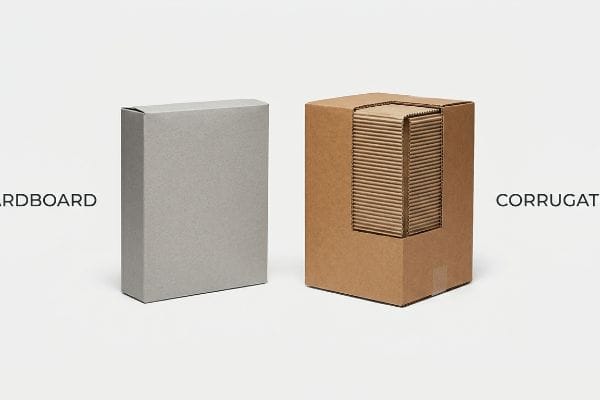
The difference between cardboard and corrugated packaging comes down to internal architecture. Cardboard refers to a single layer of heavy paper pulp, like a cereal box. Corrugated consists of a fluted paper sheet sandwiched between two flat liners, creating immense structural rigidity capable of surviving intense global shipping conditions.
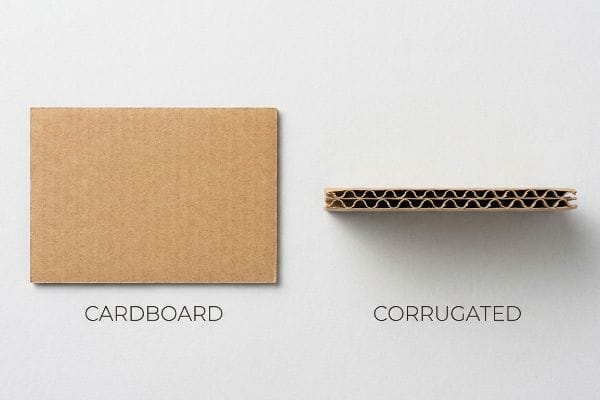
Understanding this material distinction on the factory floor is the first step to eliminating unnecessary structural bloat and preventing sudden pallet collapses at retail locations.
What's the difference between corrugated and cardboard?
To engineer high-performance retail displays, you must look past the visual aesthetics and analyze the raw physical construction of the paper substrate beneath the printed graphics.
Corrugated and cardboard differ fundamentally in their internal architecture. Cardboard is a single layer of thick paper pulp used for lightweight cartons. Corrugated features a wavy, fluted paper sheet sandwiched between two rigid flat liners, creating immense structural rigidity capable of surviving intense global supply chain shipping conditions.
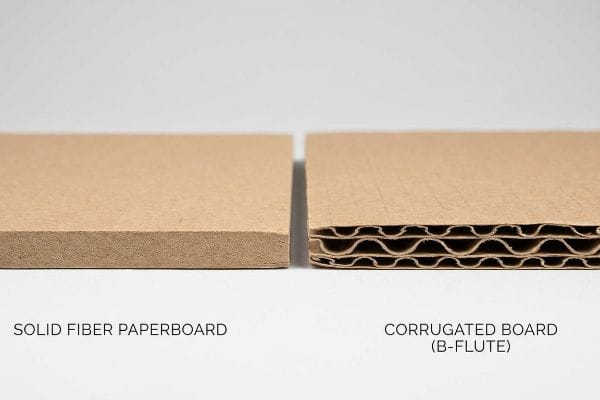
When structural engineers design retail end-caps, they leverage these precise material mechanics to balance weight limits against available floor space.
The Micro-Flute vs. Solid Fiber Reality
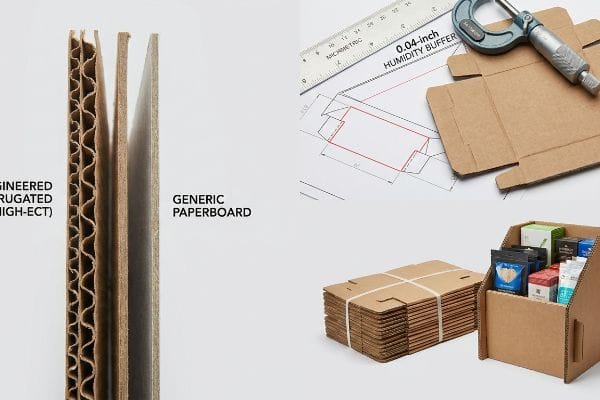
Solid fiber paperboard, typically known as SBS (Solid Bleached Sulfate), behaves like a uniform sheet of dense plastic. It bends easily across wide spans because it lacks internal reinforcement, making it suitable only for small cosmetic folding cartons. In contrast, corrugated board operates exactly like steel I-beams in bridge construction1. The continuous arches of the fluted medium trap air and distribute downward force outward toward the vertical corners, completely changing the material's physical load-bearing capacity.
As a structural engineer, I approach substrate selection entirely based on dynamic span limits and unsupported weight. A common baseline is that unreinforced paperboard begins to warp under its own weight when a shelf spans wider than 12 inches (30.4 cm)2. By introducing an engineered E-flute or B-flute corrugated board, we mathematically multiply the span tolerance without adding excessive weight. This allows us to construct robust, free-standing structural displays that maintain crisp, straight lines over an 8-week retail lifecycle without bowing or losing geometric integrity on the floor.
| Structural Metric | Generic Paperboard (Cardboard) | Engineered Corrugated |
|---|---|---|
| Internal Architecture | Single solid fiber layer | Fluted arches between liners3 |
| Dynamic Span Limit | Bends past 12 inches (30.4 cm) | Supports spans up to 48 inches (121.9 cm)4 |
| Impact Dispersion | Absorbs direct surface force | Disperses force via flutes |
I always specify fluted materials for floor-standing units because physics dictates that a solid sheet will eventually bow. Relying on single-layer fiber for structural shelving mathematically guarantees visual distortion under prolonged retail friction.
🛠️ Harvey's Desk: Are your heavy checkout trays actively bowing and crushing your profit margins before they even reach the retail shelf? 👉 Get a Free Ratio Calculator ↗ — I review every structural file personally within 24 hours.
What is the difference between corrugated and non corrugated boxes?
Comparing standard cartons to heavy-duty shipping containers requires analyzing how surface tension behaves when high-quality commercial inks interact with underlying raw material textures.
Corrugated and non-corrugated boxes differ primarily in surface smoothness and compression strength. Non-corrugated folding cartons provide a perfectly flat, solid surface ideal for highly detailed cosmetic printing. Corrugated boxes utilize internal fluting for superior BCT (Box Compression Test) strength but require specialized prepress techniques to maintain pristine graphic fidelity.
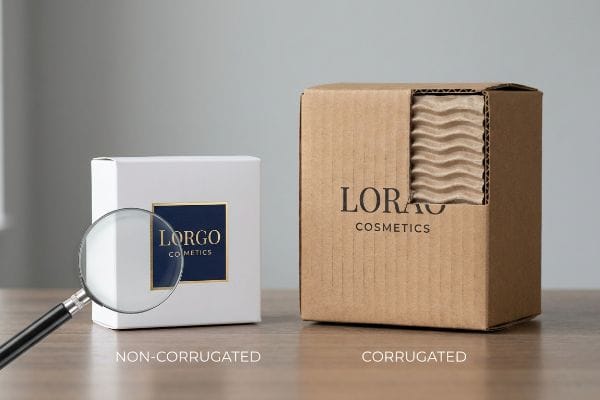
Understanding the tension between impact protection and print clarity allows engineers to merge the best properties of both materials into a single premium package.
The Substrate Tension and Surface Deflection
Non-corrugated packaging, such as high-grade duplex board, offers an unbroken canvas for lithographic printing presses, ensuring razor-sharp ink registration. However, when we build large corrugated structures, the outer liner is physically glued to the undulating peaks of the internal flutes. This creates alternating bands of supported and unsupported paper. When ambient moisture interacts with water-based adhesives during manufacturing, the outer liner shrinks slightly between the flutes.
This physical reaction creates what I refer to as the "washboard effect," where the vertical lines of the internal fluting become visibly telegraphed through the outer printed surface5. In our prepress workflows, we counteract this by specifying micro-flutes—specifically E-flute or F-flute—which tighten the frequency of the arches and reduce the unsupported gaps6. For ultra-premium FMCG (Fast-Moving Consumer Goods) packaging, we bypass direct printing entirely and utilize a litho-lamination process, marrying a perfectly smooth printed non-corrugated sheet directly onto a rigid corrugated base to achieve both structural integrity and flawless aesthetic fidelity.
| Performance Variable | Non-Corrugated Carton | Corrugated Container |
|---|---|---|
| Print Surface Smoothness | Flawless, unbroken plane | Subject to washboard effect7 |
| Compression Metrics | Minimal vertical strength | High compression resistance8 |
| Optimal Application | Primary consumer product boxes | Master shippers and POP (Point of Purchase) displays |
I view the integration of smooth paperboard topsheets onto fluted bases as the ultimate engineering compromise. You secure the extreme vertical strength required for logistics while maintaining the immaculate aesthetic presence demanded by top-tier cosmetic buyers.
🛠️ Harvey's Desk: Is the washboard effect actively destroying the perceived value of your premium printed graphics on the retail floor? 👉 Request a Structural Dieline Audit ↗ — 100% confidential. Your unreleased retail designs are safe with us.
What is a corrugated box?
Before launching a mass production run, procurement teams must look past the generic material label and demand specific laboratory-certified engineering parameters for their supply chain.
A corrugated box is constructed using three distinct layers of kraft paper: an inner liner, an outer liner, and a centralized rippled fluting medium. This engineered sandwich structure provides superior ECT (Edge Crush Test) parameters, allowing the container to withstand extreme vertical pressure during heavy palletized warehousing and global distribution.
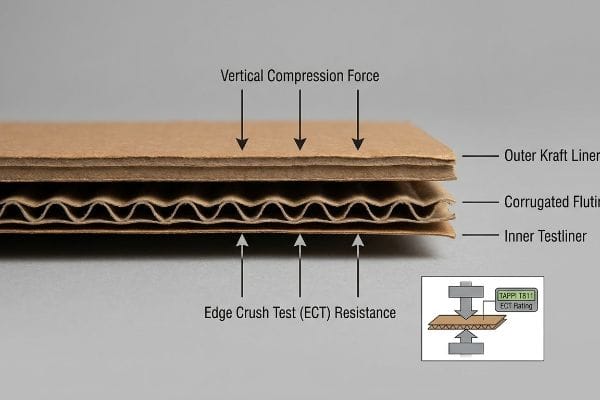
By isolating these distinct paper layers, packaging engineers can dial the exact performance specifications up or down based on specific geographic transit routes.
The Tri-Wall Architecture and ECT Physics
Think of a corrugated box not as paper, but as an engineered composite material. The outer liners act as the tension and compression skins9, similar to the carbon fiber shell of an aircraft wing. The central fluting acts as the core, absorbing lateral shock and maintaining a precise distance between the liners to prevent the walls from buckling under heavy dynamic loads.
When I map out a packaging strategy for global distribution, the generic term "box" is meaningless without certified performance metrics. We measure a corrugated box's true capability through its TAPPI T811 Edge Crush Test rating, which mathematically proves how much top-down weight a specific board combination can hold before the flutes collapse. A standard 32ECT board will perform adequately for lightweight domestic shipping, but if a client is loading 40HQ ocean containers heading into high-humidity ports, I must adjust the liner thickness to a 44ECT grade to prevent the ambient moisture from compromising the paper fibers10 and causing a catastrophic bottom-tier compression failure.
| Component Layer | Engineering Function | Failure Result if Compromised |
|---|---|---|
| Outer Kraft Liner | Tension skin and puncture resistance11 | Exterior tear or moisture breach |
| Corrugated Fluting | Vertical compression support12 | Wall buckling under pallet load |
| Inner Testliner | Structural anchor for internal padding | Internal cargo shift and damage |
I explicitly refuse to build master cartons without running exact bursting and crush calculations first. Guessing the required board grade based on visual thickness is a mathematical gamble that always results in unacceptable freight damage rates.
🛠️ Harvey's Desk: Are your heavy checkout units secretly failing the vertical pressure thresholds during extended warehouse storage? 👉 Claim Your Free Freight Density Audit ↗ — No account managers in the middle. You talk directly to structural engineers.
Is corrugated cardboard stronger than regular cardboard?
Assuming a thicker, solid material will automatically outperform a lightweight, hollow structure is a cognitive bias that frequently leads to severe downstream logistical and financial penalties.
Yes. Corrugated cardboard is stronger than regular paperboard due to geometric physics. While regular cardboard relies purely on density, corrugated utilizes internal fluted arches that drastically multiply structural rigidity. This engineering allows lightweight corrugated displays to comfortably support thousands of pounds during intense double-stacked retail pallet shipping.
While permanent materials boast superior theoretical strength, the brutal reality of a brief retail campaign quickly exposes the logistical inefficiency of rigid, non-collapsible components.
The Capillary Action Crush Constraint
When I audit client dielines, I constantly see procurement teams instinctively specifying thick, solid boards or even heavy plastics for POS (Point of Sale) systems because they assume generic corrugated will easily tear. This is a critical misunderstanding of the material's application. A high-ECT engineered corrugated board will easily outperform a solid paperboard of the exact same thickness13, but only if the structural engineers mathematically account for ambient environmental interference during the transit phase.
A frequent systemic trap occurs when buyers blindly dictate standard die-cutting tolerances for interlocking tabs, completely ignoring the chemical properties of 32ECT testliner. In my facility, we routinely see paper fibers swell when shipped across humid regions like Florida14. A slot that fit perfectly in the CAD (Computer-Aided Design) software suddenly becomes 0.11 inches (2.79 mm) too tight, causing the co-packing team to crush the flutes during assembly. I pulled the micrometer readings and proved we didn't need to switch to expensive, heavy plastics. We just needed to implement a 0.04-inch (1.01 mm) humidity buffer into the CNC (Computer Numerical Control) routing parameters. By enforcing this micro-adjustment on the ArtiosCAD file, I ensured the co-packing assembly time dropped by an estimated 30%, easily saving the brand massive labor fees without resorting to over-engineered materials.
| Material Constraint | Generic Paperboard Approach | Engineered Corrugated Reality |
|---|---|---|
| Flat-Pack Logistics | Ships fully assembled | Ships flat (4x container density)15 |
| Assembly Friction | Prone to ripping at tight slots | Smooth lock via humidity buffers16 |
| TCO (Total Cost of Ownership) | High shipping and material fees | Optimized freight and fast co-packing |
I will never allow a buyer to downgrade to cheap generic cardboard or upgrade to wasteful plastics when a mathematically precise, climate-adjusted corrugated structure delivers vastly superior logistics logic.
🛠️ Harvey's Desk: Is your current counter display design at risk of tipping over under real-world retail friction and complex assembly swelling? 👉 Request a Sightline Analysis ↗ — I review every structural file personally within 24 hours.
Conclusion
Mastering the internal architecture of your packaging prevents heavy checkout trays from actively bowing and crushing your margins before they even reach the retail shelf. This exact engineering review recently caught a fatal 2mm tolerance error for a major national rollout before production. To eliminate these destructive physical blind spots, let me personally run your structural files through a Free Structural Dieline Audit ↗ to ensure your next global campaign survives the brutal reality of supply chain physics.
"[PDF] The Bending Stiffnesses of Corrugated Board", https://www.fpl.fs.usda.gov/documnts/pdf1992/luo92a.pdf. Research on corrugated fiberboard describes it as a sandwich-like structure in which separated linerboards and a fluted core increase bending stiffness and load resistance relative to a single sheet of comparable mass; the I-beam comparison is an engineering analogy rather than a literal equivalence. Evidence role: mechanism; source type: paper. Supports: Corrugated board uses its fluted core and separated faces to increase stiffness and load-bearing capacity in a way analogous to beam or sandwich-panel mechanics.. Scope note: The source would support the structural principle, but not the phrase "exactly like" or any specific display-design performance claim. ↩
"Bending Stiffness of Honeycomb Paperboard – PMC – NIH", https://pmc.ncbi.nlm.nih.gov/articles/PMC9821995/. Studies or design references on paperboard bending stiffness and creep can support that unsupported paperboard deflects under self-weight as span length increases; any 12-inch threshold should be treated as design-context dependent because deflection varies with board grade, caliper, humidity, load, and support conditions. Evidence role: statistic; source type: paper. Supports: Unreinforced paperboard can sag or warp under its own weight over wider unsupported spans, with span limits governed by material stiffness and environmental conditions.. Scope note: A neutral source may support the relationship between span and deflection, but is unlikely to prove a universal 12-inch cutoff for all unreinforced paperboard. ↩
"Corrugated fiberboard – Wikipedia", https://en.wikipedia.org/wiki/Corrugated_fiberboard. A technical definition of corrugated fiberboard describes it as a fluted corrugated sheet bonded to one or more flat linerboards, supporting the stated internal architecture. Evidence role: definition; source type: encyclopedia. Supports: Engineered corrugated material has fluted arches between liner layers.. ↩
"Bending Stiffness Testing | Center for Packaging and Unit Load …", https://www.unitload.vt.edu/facilities/corrugated-packaging-lab/bending-stiffness-testing.html. Experimental testing data on corrugated board span, bending stiffness, and deflection would substantiate whether a corrugated panel can support a 48-inch span under the tested board grade, orientation, humidity, and load conditions. Evidence role: statistic; source type: paper. Supports: Engineered corrugated can support spans up to 48 inches.. Scope note: This would support the span only for the tested material and loading conditions, not as a universal capacity for all engineered corrugated products. ↩
"manufacturing defects in corrugated board/ boxes, their causes and …", https://www.academia.edu/27553688/MANUFACTURING_DEFECTS_IN_CORRUGATED_BOARD_BOXES_THEIR_CAUSES_AND_REMEDIES. Technical literature on corrugated board identifies flute-line marking or washboarding as a surface/print defect in which the flute profile of the corrugated medium becomes visible through the liner, especially under printing or coating conditions. Evidence role: mechanism; source type: paper. Supports: The internal fluting in corrugated board can become visible through the outer printed liner as a washboard or flute-line effect.. Scope note: The source would support the general defect mechanism; it may not verify the article's specific manufacturing conditions or terminology. ↩
"Corrugated box design – Wikipedia", https://en.wikipedia.org/wiki/Corrugated_box_design. Published flute-profile tables for corrugated fiberboard list E-flute and F-flute as having smaller flute heights and closer flute spacing than common larger flutes, supporting the assertion that these micro-flutes reduce the distance between liner support points. Evidence role: mechanism; source type: institution. Supports: E-flute and F-flute are micro-flute corrugated profiles with closer flute spacing, which reduces unsupported liner gaps compared with larger flute profiles.. Scope note: Such tables support the geometric basis for reduced unsupported spans, but they do not by themselves prove a specific visual-quality outcome for every package design. ↩
"Washboarding and print quality of corrugated board", https://onlinelibrary.wiley.com/doi/abs/10.1002/%28SICI%291099-1522%28199807/08%2911%3A4%3C145%3A%3AAID-PTS426%3E3.0.CO%3B2-6. Technical literature on corrugated printing describes "washboarding" as a print-quality defect associated with the uneven surface profile created by corrugated flutes beneath the liner, supporting the claim that corrugated containers can be prone to this effect. Evidence role: mechanism; source type: paper. Supports: Corrugated containers are subject to the washboard effect on printed surfaces.. Scope note: The degree of washboarding depends on board grade, flute profile, liner properties, printing process, and press settings; it is not inevitable in all corrugated printing. ↩
"[PDF] 1 The Box Compression for Copy Paper Boxes – Applying McKee's …", https://research.gatech.edu/sites/default/files/rbi/pdfs/The%20Box%20Compression%20for%20Copy%20Paper%20Boxes%20-%20edited%202020.pdf. Packaging engineering sources identify corrugated fiberboard box compression strength as a central performance property and relate it to board construction, edge-crush strength, perimeter, and formulas such as the McKee equation, supporting the general claim that corrugated containers are designed for substantial vertical stacking loads. Evidence role: mechanism; source type: paper. Supports: Corrugated containers have high compression resistance compared with non-corrugated cartons.. Scope note: This supports the general material and design principle; actual compression resistance varies by flute type, board grade, box dimensions, humidity, and handling damage. ↩
"(PDF) Buckling Analysis of Corrugated Core Sandwich Panels", https://www.academia.edu/7028252/Buckling_Analysis_of_Corrugated_Core_Sandwich_Panels. Literature on sandwich structures and corrugated board mechanics describes the facings or liners as the elements that carry much of the tensile and compressive stress, while the core maintains separation and contributes to bending stiffness. Evidence role: mechanism; source type: paper. Supports: In corrugated board, the outer liners function similarly to skins in a sandwich structure, carrying tension and compression while the fluted core separates them.. Scope note: This supports the structural analogy in general terms; it does not establish equivalence between corrugated fiberboard and aircraft-grade carbon-fiber composites. ↩
""Relative Humidity Effects on the Compression Strength of …", https://open.clemson.edu/all_theses/3225/. Experimental studies of corrugated fiberboard report that higher relative humidity and moisture content reduce paperboard stiffness and compression-related strength properties, providing a mechanism for lower stacking performance in humid environments. Evidence role: mechanism; source type: paper. Supports: Moisture and high humidity can weaken corrugated paper fibers and increase the risk of compression failure in stacked shipping conditions.. Scope note: The evidence supports the humidity–strength relationship, but it does not by itself prove that a 44ECT specification is sufficient for every ocean-container route or loading pattern. ↩
"[PDF] Papermaking Factors That Influence The Strength Of Linerboard …", https://www.govinfo.gov/content/pkg/GOVPUB-A13-PURL-gpo124597/pdf/GOVPUB-A13-PURL-gpo124597.pdf. A packaging-materials or paper-engineering source should support that kraft linerboard forms the facing layers of corrugated board and contributes tensile strength and puncture resistance; this supports the material-function relationship generally, not the durability of any specific carton construction. Evidence role: mechanism; source type: education. Supports: The outer kraft liner serves as a tension skin and contributes to puncture resistance in corrugated packaging.. Scope note: The source may describe linerboard properties in general terms and may not directly address moisture breach unless it also discusses liner damage, water exposure, or barrier performance. ↩
"[PDF] effect of loading rate on the edgewise compressive", https://www.fpl.fs.usda.gov/documnts/fplrn/fplrn121.pdf. A source on corrugated fiberboard mechanics should support that the fluted medium contributes substantially to out-of-plane compression and stacking strength in corrugated board structures; this is contextual support for the table's engineering-function summary rather than a test result for a specific board grade. Evidence role: mechanism; source type: paper. Supports: Corrugated fluting functions as vertical compression support in corrugated packaging.. Scope note: Support will be general to corrugated board design and may not quantify performance for a particular flute profile, liner weight, adhesive, humidity level, or pallet configuration. ↩
"Full-Field Measurements in the Edge Crush Test of a Corrugated …", https://pmc.ncbi.nlm.nih.gov/articles/PMC8199211/. Sources on corrugated fiberboard mechanics and the Edge Crush Test support that fluted corrugated structures are designed for edgewise compressive strength and can provide high structural efficiency relative to sheet thickness or basis weight. Evidence role: mechanism; source type: paper. Supports: High-ECT engineered corrugated board can outperform solid paperboard of the same thickness in relevant structural applications.. Scope note: This would support the engineering rationale generally, but it would not prove that every high-ECT corrugated grade outperforms every solid paperboard at the same thickness under all loading conditions. ↩
"[PDF] Dimensional Stability of Paper: Papermaking Methods and …", https://www.fpl.fs.usda.gov/documnts/pdf1988/caulf88a.pdf. Research on paper and corrugated board hygroscopicity supports that cellulose fibers absorb moisture at elevated relative humidity, causing dimensional change and reduced mechanical performance; climate data can contextualize Florida as a high-humidity region. Evidence role: mechanism; source type: paper. Supports: Paper fibers can swell during shipment through humid regions such as Florida.. Scope note: Such sources would support the moisture-swelling mechanism and regional humidity context, but not the specific 0.11-inch dimensional change reported in this facility. ↩
"[PDF] The Influence of Package Size and Flute Type of Corrugated Boxes …", https://vtechworks.lib.vt.edu/bitstream/10919/97636/1/pts.2279.pdf. A logistics or packaging engineering source should support that flat-packed corrugated units can substantially increase container utilization compared with assembled units; any cited figure should be treated as design- and product-specific rather than a universal 4× ratio. Evidence role: statistic; source type: research. Supports: Engineered corrugated packaging ships flat and can achieve approximately four times the container density of fully assembled packaging.. Scope note: The exact density multiplier depends on package geometry, palletization, and container loading method. ↩
"Influence of humidity and temperature on mechanical properties of …", https://bioresources.cnr.ncsu.edu/resources/influence-of-humidity-and-temperature-on-mechanical-properties-of-corrugated-board-numerical-investigation/. A paper or packaging-materials source should document that corrugated board's mechanical behavior and dimensional stability are affected by moisture and humidity, providing context for why humidity control or buffering could influence slot fit and locking performance. Evidence role: mechanism; source type: paper. Supports: Humidity buffering can reduce assembly friction and help corrugated locking features engage smoothly.. Scope note: Such a source would support the material mechanism generally, not necessarily prove that this specific lock design performs smoothly under all humidity conditions. ↩