A wobbly, generic display kills your sales faster than bad pricing. If your product blends into the shelf, shoppers walk right past it. You need a structural advantage.
Custom packaging for products is a specialized marketing and structural solution designed to increase brand visibility and protect specific items. It utilizes tailored dimensions and materials to ensure physical integrity and drive impulse purchases in competitive retail environments.
I see brands burn marketing dollars driving traffic to stores, only to lose the customer in the final 3 feet (0.9 meters). Let's break down exactly why off-the-shelf boxes are sabotaging your retail rollout and how purpose-built structures fix it.
Why customize packaging is necessary?
Standard shelves are boring and cluttered. Shoppers suffer from decision fatigue. You have to physically disrupt their walking pattern to get noticed on the floor.
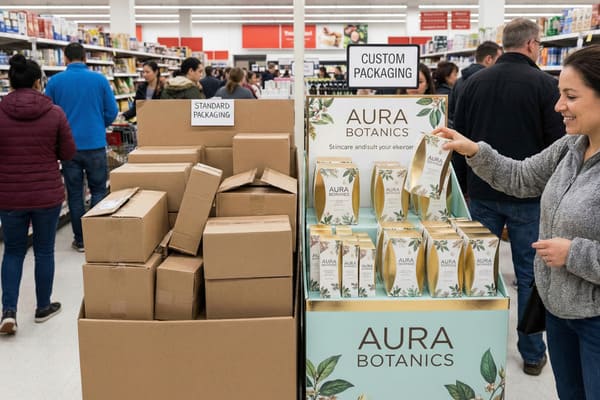
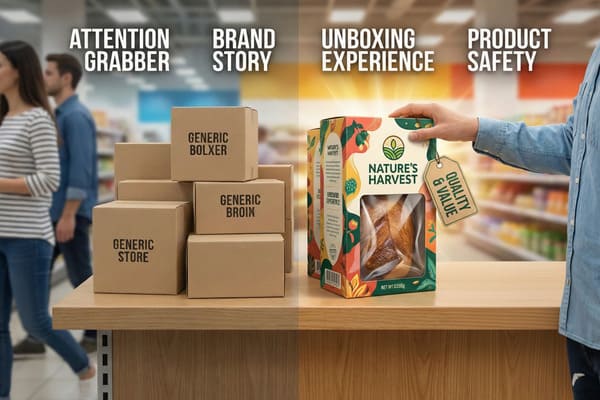
Custom packaging is necessary to differentiate products, increase visual disruption, and guide impulse buying. Tailored POP (Point of Purchase) displays isolate merchandise from cluttered shelves, capturing shopper attention within seconds and significantly boosting retail sell-through rates globally.
The Psychology of Visual Disruption and Shelf Impact
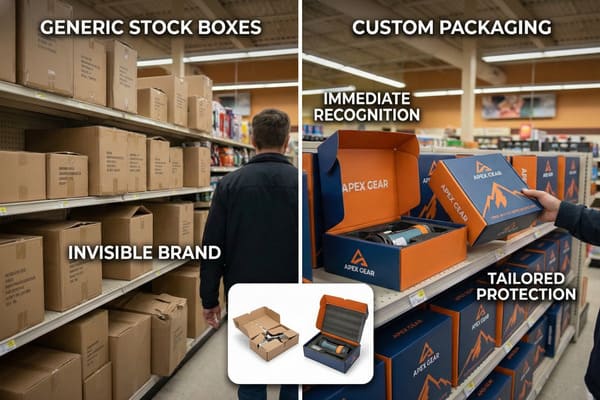
I learned this the hard way. A few years ago, a client from New York insisted on using standard brown boxes with a cheap sticker for their new beverage launch. They thought they could save $0.50 per unit. I warned them, but they pushed forward. The result? Total disaster. The boxes blended perfectly into the dark shadows of the store aisle. The product didn't move, and the retailer threatened to pull their SKU (Stock Keeping Unit). That is exactly why I force my clients to focus on visual disruption1. We completely redesigned their next batch using a custom floor display2 with curvy, die-cut shapes. Cardboard does these complex shapes better and cheaper than metal.
When you isolate a product on a standalone display, the customer picks it up faster and with more confidence. A confident pick-up leads to a smoother placement on the conveyor belt. We look at the "3-Second Lift" formula. A well-designed custom unit increases sell-through by 400% compared to a product rotting on the home shelf. Plus, in high-traffic US stores like Walmart, a display has to capture attention from 10 feet (3 meters) away. If your packaging is generic, you are invisible. You need vibrant Litho printing and an angled shelf—what I call the "Chin-Up" orientation—so the product literally looks up at the customer. It forces engagement.
| Display Feature | Generic Box Packaging | Custom Cardboard Display |
|---|---|---|
| Visual Disruption | Low (Blends into shelf) | High (Die-cut shapes, vibrant graphics3) |
| Product Isolation | Zero (Lost in clutter) | Complete (Standalone focal point) |
| Shopper Ergonomics | Flat, hard to read labels | Angled 15 degrees for immediate readability |
| Sales Velocity | Baseline shelf movement | Up to 400% sell-through lift4 |
My structural engineers fix invisible products every day. If you are struggling to get noticed on a crowded shelf, I can run your product dimensions through our system and cut a physical white sample in 24 hours. You can test the exact footprint before spending a dime on artwork.
Who needs custom packaging?
If you sell high-volume, impulse-driven goods, you need this. Small brands fighting for shelf space or massive corporations launching seasonal campaigns rely on customized structures.
FMCG (Fast-Moving Consumer Goods) brands, cosmetics companies, and electronics manufacturers need custom packaging to stand out. Retailers utilize these tailored displays to highlight seasonal promotions, maximize limited floor space, and align with growing consumer demands for sustainable materials.
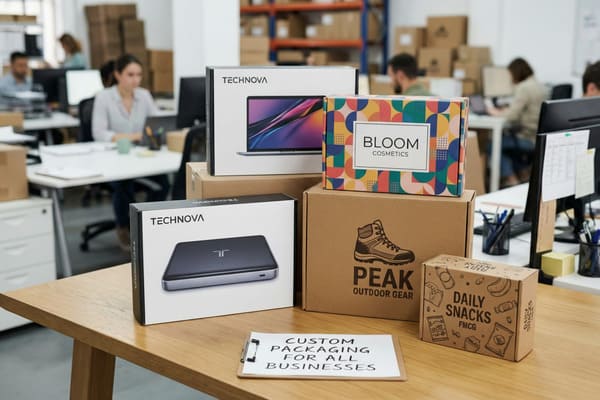
Identifying High-Velocity Retail Candidates
Not every single item belongs in a standalone unit. A hardware client once tried to put heavy, slow-moving industrial wrenches into a temporary countertop display. It drove me crazy. The display sat there for six months, got covered in dust, and eventually collapsed because it wasn't meant for permanent, multi-year use. Custom cardboard packaging is an explosive tool for high-velocity FMCG brands, beauty products, and quick-turn tech gadgets. If your product is tied to a holiday, a movie release, or a limited-time flavor, you absolutely need rapid-deployment custom packaging. The timeline is everything here.
Big box retailers like Target and Costco want constant visual rotation. They don't want the same boring aisle all year. Custom packaging allows a brand to achieve "Planogram Agility5." We use modular dividers so a brand can shift from displaying four rows of chocolate in winter to two rows of chocolate and two of vanilla in summer without buying a whole new structure. Also, younger shoppers are drastically shifting the market. They hate excess plastic. Brands targeting these demographics need custom packaging because it allows them to transition to 100% recyclable, mono-material corrugated board6. We engineer origami-style paper locks to replace those ugly plastic corro-clips. It gives the brand a massive green marketing angle while keeping the display curbside recyclable in US municipalities.
| Industry Sector | Primary Use Case | Structural Requirement |
|---|---|---|
| FMCG / Food & Bev | High-volume seasonal pushes | Moisture resistant, heavy load-bearing base7 |
| Cosmetics & Beauty | Premium product launches | Anti-scuff matte finishes, tight E-flute board8 |
| Tech & Electronics | Highlighting new features | Theft-deterrent lips, wire-routing cutouts |
| Toys & Games | Movie releases, holiday promos | Bright Litho colors, interactive QR code zones |
I see brands miss out on huge seasonal spikes because they wait too long to start their packaging design. Do not wait until October to plan for Christmas. Ask me for a free 3D rendering of your concept today, and we can lock in the dieline early.
What does custom packaging mean?
It means stopping the guesswork. It means engineering a structure that perfectly fits your exact product, your brand colors, and the retailer's strict physical requirements.
Custom packaging means creating highly specific structural and visual designs tailored to a single product. It involves precision engineering, exact color matching, and retailer-specific dimensional compliance to ensure the display functions perfectly in a retail environment while maximizing brand visibility.
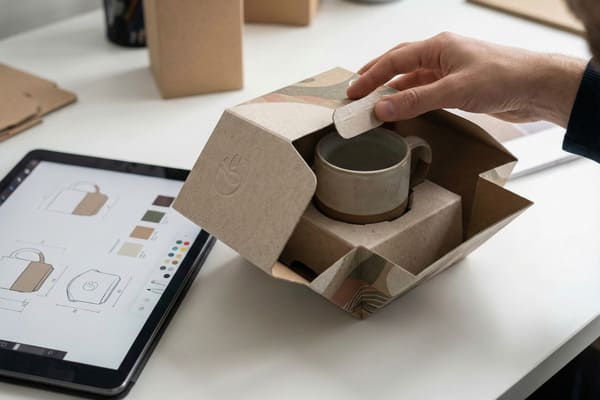
Beyond the Logo: Structural Integrity and Brand Equity
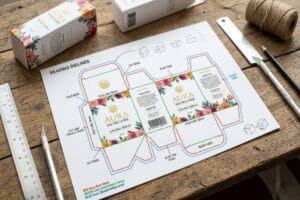
Most amateur designers think custom packaging just means slapping a CMYK logo on a generic square box. I have to correct this misconception weekly. Last summer, a client sent me artwork on a flat PDF and told me to "just print it." I refused to print it that way because their artwork didn't account for the folding bleed or the structural grain direction9. If I had listened to them, the logo would have been sliced in half across a fold line, and the vertical load-bearing walls would have buckled immediately. Custom packaging means extreme structural physics.
It means looking at the "Strike Zone." The average shopper needs the hero product presented right at 50 to 54 inches (127 to 137 cm) from the floor. We literally engineer the shelves to hit that eye-level buy level. It also means perfect brand consistency. You want your brand red to look right, not like a muddy brown. We utilize GMG Color Proofing systems10 and spectrophotometers to hit a strict Delta-E tolerance. It means your brand looks identical whether the display is sitting in a brightly lit pharmacy or a dim grocery aisle. True customization merges visual appeal with mechanical perfection, ensuring the store staff can actually assemble it without throwing it in the trash out of frustration.
| Customization Element | Factory Execution Strategy | Benefit to Brand |
|---|---|---|
| Ergonomic Sizing | Shelf height locked at 50-54 inches (127-137 cm) | Hits the consumer "Strike Zone" for impulse buying |
| Color Management | GMG Color Proofing & Spectrophotometer matching11 | Prevents muddy colors, ensures global brand consistency |
| Grain Orientation | Vertical flute alignment on load-bearing walls12 | Maximizes Box Compression Test (BCT) strength |
| No-Text Assembly | IKEA-style visual guides & QR code video links | Ensures correct build by retail staff, avoiding trash |
Stop using bad dielines that guarantee production delays. I provide standardized, structurally sound dieline templates before your graphic designer even starts working. It saves days of frustrating back-and-forth emails and ensures your artwork fits perfectly the first time.
Why is custom packaging so expensive?
Sticker shock hits hard when you ignore the hidden mechanics. You are not just paying for paper; you are paying for logistics survival and high-fidelity tooling.
Custom packaging is expensive because it requires specialized structural engineering, dedicated cutting dies, and high-fidelity lithographic printing plates. Optimized custom designs heavily reduce long-term ocean freight expenses by maximizing container volumetric efficiency, offsetting the higher initial manufacturing setup costs.
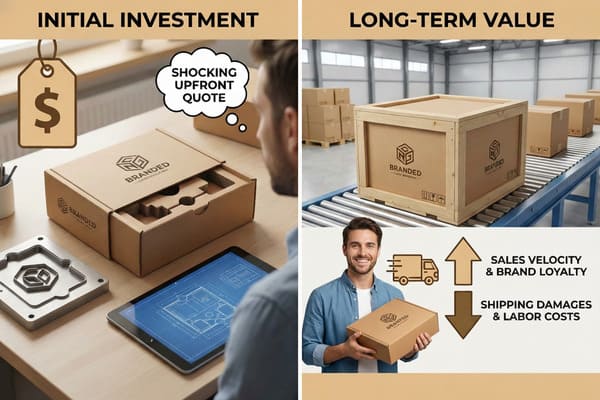
The Hidden Costs of Volumetric Weight and Tooling
Buyers always obsess over the unit price. A guy called me last month complaining that my custom pallet display was $3 higher per unit than a competitor's quote. Clients hate hearing this, but I told him to look at his freight bill. The competitor's cheap, badly engineered design didn't fold flat. It was shipping mostly air. His high volumetric weight13 meant his ocean freight costs were going to absolutely destroy his profit margin. I redesigned the structure, changing the header to a bi-fold and nesting the internal trays inside the hollow base. This Matryoshka doll strategy increased our container load capacity by 40%, dropping his landed cost significantly. Custom packaging is expensive upfront because of the "Fresh Tooling14" protocol.
I never reuse old, warped wooden cutting dies. Reusing an old die board means the blades are dull, which causes fuzzy edges and inaccurate folds. I build new printing plates and new cutting dies for every single batch to guarantee razor-sharp edges. You also pay for Lithographic printing, which uses wet ink plates instead of digital toner, to get that glossy magazine look on rough cardboard. It carries a high setup cost. But once you amortize that over 500 units, the price drops drastically. You are investing in structural durability—like high-grade virgin kraft liner that resists the 50-touch rule—so your display doesn't look like trash after three days on a Walmart floor.
| Cost Driver | Standard "Cheap" Alternative | Harvey's Custom Standard | Resulting ROI |
|---|---|---|---|
| Tooling (Dies & Plates) | Re-used, dull wooden die boards | Fresh cutting dies for every single batch15 | Razor-sharp edges, zero assembly friction |
| Printing Method | Digital printing (Grainy, muddy colors) | High-fidelity Lithographic (Offset) printing | Premium luxury appearance, high color accuracy |
| Material Grade | Recycled testliner (Cracks easily) | High-grade Virgin Kraft liner | Withstands the 50-touch rule in store |
| Volumetric Weight | Ships bulky, wastes container space | Nested structural design (Matryoshka strategy)16 | Drops landed cost per unit by maximizing freight |
I never let my clients pay to ship empty space. I run every single custom design through our container optimization software. Let me look at your current structural file, and I will show you how to save thousands on your next freight invoice.
Conclusion
Custom displays are your final defense on the retail floor. Don't let bad structures ruin your product launch. Reach out to me to get a free quote today.
Understanding visual disruption can help you learn how to make your product stand out on crowded shelves and significantly boost sales. ↩
Exploring custom floor displays will show you proven strategies to enhance product visibility and drive higher sell-through rates in stores. ↩
Learn how creative design elements like die-cut shapes and vibrant graphics can make your product stand out and attract more customers. ↩
Discover the proven impact of custom displays on sales and how you can leverage this strategy to dramatically increase your product's sell-through rate. ↩
Learn how Planogram Agility can help your brand adapt quickly to seasonal changes and retailer demands, maximizing shelf impact and sales. ↩
Discover the environmental and marketing benefits of using fully recyclable, mono-material corrugated board for your product packaging. ↩
Learn how to select packaging that protects products from moisture and supports heavy loads, crucial for high-volume FMCG and food & beverage shipments. ↩
Discover why these features are essential for premium cosmetics packaging, ensuring products arrive in pristine condition and enhance brand appeal. ↩
Understanding structural grain direction is crucial for ensuring packaging strength and durability, preventing costly design errors and product damage. ↩
Learning about GMG Color Proofing systems helps guarantee your brand colors remain consistent across all packaging, boosting brand recognition and trust. ↩
Learn how advanced color management techniques like GMG Color Proofing & Spectrophotometer matching can ensure your brand colors remain consistent worldwide. ↩
Discover how vertical flute alignment on load-bearing walls can significantly improve packaging strength and protect your products during shipping. ↩
Understanding volumetric weight can help you avoid hidden shipping costs that can erode your profit margins, especially for bulky or poorly designed packaging. ↩
Learning about Fresh Tooling explains why upfront costs are higher but ensures quality, durability, and a professional finish for your custom packaging solutions. ↩
Learn how using fresh cutting dies for every batch can improve product quality and reduce assembly issues, leading to better customer satisfaction. ↩
Discover how the Matryoshka strategy can optimize shipping, reduce costs, and improve efficiency in packaging logistics. ↩