Retail competition is tougher than ever, and relying solely on standard shelves often leaves your products unnoticed. You need a dynamic marketing solution that grabs attention and highlights your brand's value immediately.
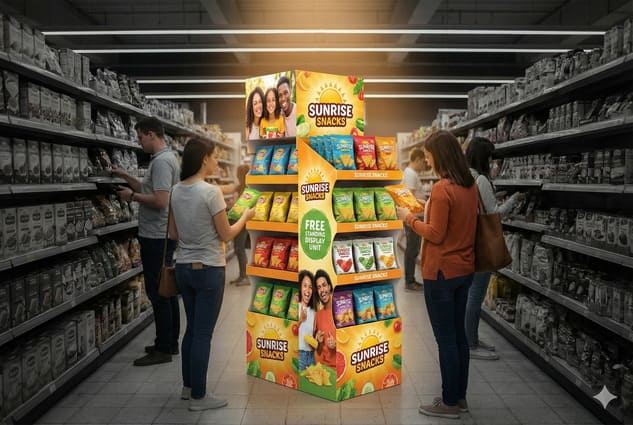
FSDUs (Free Standing Display Units) offer a versatile, cost-effective way to boost product visibility and drive sales. They maximize retail floor space, allow for high-impact branding, and can be customized for any product size, making them essential for impulse purchases and seasonal promotions.
Let us look closer at the specific advantages these displays bring to your business strategy and how they solve common retail challenges.
What are the benefits of Fsdu?
Are you worried that your high-quality products are getting lost in the visual noise of crowded aisles? You need a standalone solution that physically separates your inventory from competitors.
The primary benefits of FSDUs include increased brand visibility, cost-effective marketing, and flexible placement options. They separate your merchandise from competitors, provide large printable areas for branding, and are lightweight enough to be moved to high-traffic areas, significantly increasing impulse buy potential.
The Structural Anatomy of Profitability
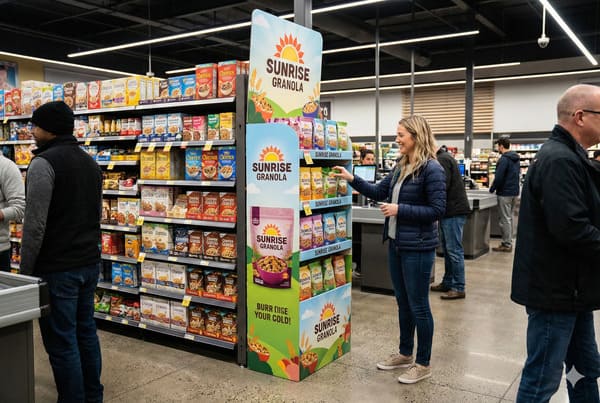
When we look at the retail landscape, Floor Displays1 command a massive presence, accounting for over 43% of the POP market share. This is not a coincidence. The core benefit lies in the combination of structural integrity and marketing agility. Unlike metal or wood fixtures, cardboard FSDUs allow for rapid prototyping and production. This means if you have a new hunting product launch or a seasonal campaign, you do not have to wait months for permanent fixtures. You can roll out a campaign that perfectly matches your packaging within weeks.
Furthermore, the cost efficiency of corrugated cardboard2 allows you to allocate more budget toward the graphic design and print quality, which are the actual drivers of consumer attention. Advanced digital printing technology now enables us to create high-definition visuals that tell a story, rather than just holding stock. For heavy items, modern engineering techniques, such as double-wall reinforcement and strategic weight distribution, ensure these stands are just as robust as they are beautiful. This balance of strength, speed, and visual appeal makes FSDUs the most logical choice for brands looking to scale their physical retail presence quickly.
| Feature | FSDU (Cardboard) | Standard Retail Shelf |
|---|---|---|
| Visibility | 360-degree branding potential | Limited to front-facing strip |
| Placement | Any open floor space (flexible) | Fixed location |
| Cost | Low (Cost-effective materials) | High (Rental/Slotting fees) |
| Customization | 100% Tailored to product shape | Standardized/Rigid |
| Speed to Market | Weeks (Design to Store) | Months (Planogram updates) |
I know that durability is a major concern for clients dealing with heavy inventory, such as outdoor gear or tools. At my factory, we address this by running rigorous load-bearing tests3 before mass production ever begins. My team creates a physical prototype and we stack it with your actual product weight—and then we add more to be safe. We do not just guess; we engineer the internal support structures4 to ensure the display stands tall in a busy retail environment. This way, you get the marketing benefits of cardboard without worrying about structural failure.
What are the benefits of point of sale display?
Do shoppers leave your store without adding those final small, high-margin items to their cart? You might be missing the most critical moment to influence their purchasing decision right at the checkout.
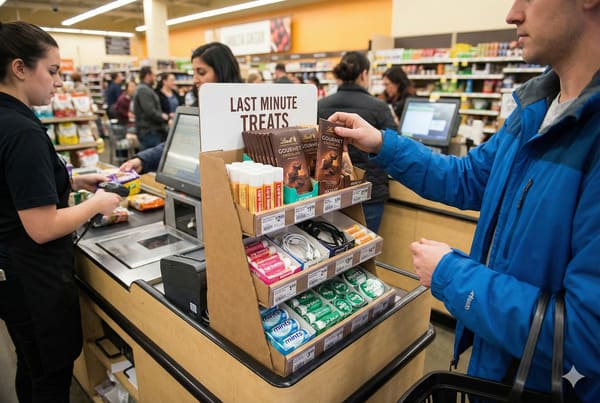
Point of Sale (POS) displays capitalize on the psychology of impulse buying by placing products right at the cash register. Their benefits include boosting average transaction values, launching new items effectively, and utilizing previously dead counter space to generate additional revenue with minimal investment.
Capturing the Impulse Buyer
The checkout counter is the final frontier of the shopping journey. Here, the consumer's wallet is already out, and their resistance to spending is at its lowest. Countertop displays (PDQs)5 are engineered to exploit this specific psychological state. They are compact, highly visible, and usually contain lower-priced items that require little deliberation. For a brand, this is the ideal spot to introduce a new accessory or a trial-sized product. The barrier to entry is low, but the volume of traffic is the highest in the entire store.
From a manufacturing perspective, these units are incredibly efficient. Because they are smaller, we can produce them in larger batches with less material waste. This efficiency translates to a lower unit cost for you, improving your overall profit margin. However, because they sit right under the customer's nose, the print quality must be flawless. There is no room for pixelation or color drift when the product is twelve inches from the customer's eyes. Digital printing advances now allow us to produce vibrant, sharp images even on smaller batches, ensuring your brand looks premium even on a small footprint.
| Aspect | Countertop Display (PDQ) | Aisle Shelf |
|---|---|---|
| Target Behavior | Impulse / Last-minute add-on | Planned purchase |
| Footprint | Minimal (Checkout/Service Desk) | Large (Aisle sections) |
| Design Focus | Speed / "Grab and Go" | Comparison / Variety |
| Setup Time | Seconds (Pre-packed options) | Minutes to Hours |
I emphasize strict color management in my production lines because I know how frustrating it is when the final print does not match your brand guidelines. We use advanced color matching systems6 to ensure the red on your countertop display matches the red on your product packaging exactly. My team and I also focus on the "unboxing" experience for the retailer. We design these PDQs to be "retail ready7"—meaning the store clerk simply opens the box and places it on the counter. This ease of use ensures your display actually makes it onto the counter rather than staying in the back room.
What are the advantages of display board?
Is your product complex, requiring more explanation than a simple price tag or small box can provide? You need a medium that educates the customer while simultaneously showcasing the physical item securely.
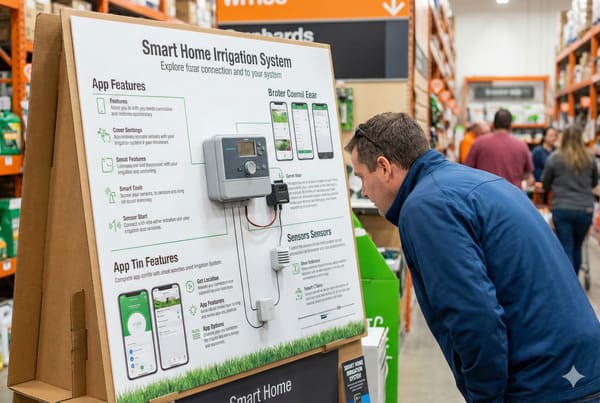
Display boards offer a large canvas for storytelling, allowing brands to communicate key features, usage instructions, and promotional messages clearly. They provide structural support for heavier items while serving as an educational tool that builds consumer trust and highlights value propositions effectively.
Educational Marketing and Structural Support
For products that require technical explanation—like electronics, hardware, or hunting equipment—visual appeal is not enough; you need to convey information. Display boards act as a silent salesperson. They provide a dedicated vertical surface where you can print detailed infographics, technical specifications, or lifestyle imagery that shows the product in use. This is crucial because a confused customer rarely buys. By answering questions directly on the display, you remove barriers to purchase.
Technically, display boards8 are fascinating because they must be rigid enough to hold the product but light enough to hang or stand. We often use specific grades of corrugated board9, such as E-flute or B-flute, which offer a smooth surface for high-quality printing while maintaining stiffness. Unlike a bin where products are jumbled together, a display board presents the item in a fixed, heroic position. This presentation implies quality. It suggests that the item is worth examining individually. Additionally, these boards are often designed with specific die-cut holes or inserts that lock the product in place, preventing the "messy shelf" look that degrades brand value over time.
| Feature | Display Board | Standard Hanging Tag |
|---|---|---|
| Information Space | High (Full back panel) | Low (Small tag area) |
| Product Security | High (Custom inserts/Ties) | Low (Loose hanging) |
| Visual Impact | Dominant / Premium feel | Standard / Generic |
| Material | Rigid Corrugated Board | Thin Paper/Plastic |
We understand that shipping damage10 is a massive pain point, especially for displays that hold heavy items. That is why my design team focuses heavily on how these boards are packed for transit. We design flat-pack solutions11 that protect the edges and corners of the board so it arrives at the retailer in pristine condition. I offer free modifications on prototypes because I want to make sure the fit is perfect. If the product wobbles on the board, we adjust the die-cut lines until it sits tight. We do not move to mass production until the safety and presentation are flawless.
What is the purpose of in store display?
Are you struggling to maintain a consistent brand image across thousands of different retail locations and layouts? You need a controlled environment that presents your products exactly as you intended, regardless of the store.
The fundamental purpose of in-store displays is to disrupt the shopper's visual field and direct focus to specific products. They organize inventory, reinforce brand identity through consistent design, and create an immersive shopping experience that standard shelving simply cannot achieve.

Creating a Brand Ecosystem
In-store displays serve a much larger purpose than just holding stock; they create a "micro-store" within the larger retail environment. When a customer walks into a massive big-box retailer, they are bombarded with choices. An in-store display acts as a beacon. It organizes your products into a cohesive unit, blocking out the visual noise of competitors. This is vital for brand recognition12. Whether it is a pallet display in a wide aisle or a sidekick display hanging off a shelf, these units claim territory. They tell the consumer: "This space belongs to this brand."
Moreover, the industry is seeing a massive shift toward sustainability13, driven by younger consumers like Gen Z. The purpose of modern displays is now dual: sell the product and demonstrate corporate responsibility. Using recyclable cardboard materials signals to the shopper that your brand is eco-conscious. This adds a layer of emotional connection to the purchase. The trend is moving toward "smart" structures that use less material but offer more strength, reducing the carbon footprint of logistics. Retailers also prefer these displays because they are easy to dispose of and recycle once the promotion ends, unlike bulky metal fixtures that require storage.
| Objective | In-Store Display Solution | Result |
|---|---|---|
| Brand Consistency14 | Uniform Design across all stores | Stronger Brand Recall |
| Shopper Engagement15 | Interactive / 3D Elements | Longer Dwell Time |
| Inventory Control | Pre-loaded options (Pallets) | Faster Restocking |
| Sustainability | 100% Recyclable Materials | Positive Brand Image |
I pride myself on helping business owners navigate these trends without getting bogged down in technical difficulties. With three production lines running, we can handle the volume required for large retail rollouts while maintaining the agility to make quick changes. I know that timing is everything—missing a launch date means missing revenue. That is why my team works to align our production schedule with your marketing calendar. We handle the structural design, the 3D rendering, and the strength testing so you can focus on your sales strategy. We make sure your display does its job: selling your product and building your brand.
Conclusion
Choosing the right display solution—whether it is an FSDU, a POS unit, or a display board—is about more than just holding products; it is about controlling the customer experience. At PopDisplay, we combine robust engineering with high-quality design to ensure your products stand out and sell out.
Explore how Floor Displays can enhance your retail strategy and boost sales through effective marketing. ↩
Learn about the advantages of using corrugated cardboard for cost-effective and visually appealing retail displays. ↩
Understanding load-bearing tests can help you ensure your displays are durable and reliable, especially for heavy inventory. ↩
Exploring internal support structures will reveal how they can significantly improve the stability and longevity of your displays. ↩
Explore how PDQs can enhance product visibility and boost impulse buying at checkout. ↩
Explore this link to discover top color matching systems that ensure your prints align perfectly with brand guidelines. ↩
Learn about the concept of 'retail ready'displays and how they enhance product visibility and sales. ↩
Explore how display boards can enhance product visibility and customer engagement, making them a vital tool in marketing strategies. ↩
Learn about different grades of corrugated board and their advantages for creating effective and appealing displays. ↩
Explore this link to learn effective strategies for minimizing shipping damage, ensuring your displays arrive safely. ↩
Discover how flat-pack solutions can enhance shipping efficiency and protect your products during transit. ↩
Understanding brand recognition can help you enhance your marketing strategies and improve customer loyalty. ↩
Exploring sustainability in retail can provide insights into consumer preferences and innovative practices that boost brand image. ↩
Learn how maintaining brand consistency can enhance customer loyalty and drive sales in your retail business. ↩
Explore this link to discover innovative techniques that can boost shopper engagement and increase sales. ↩