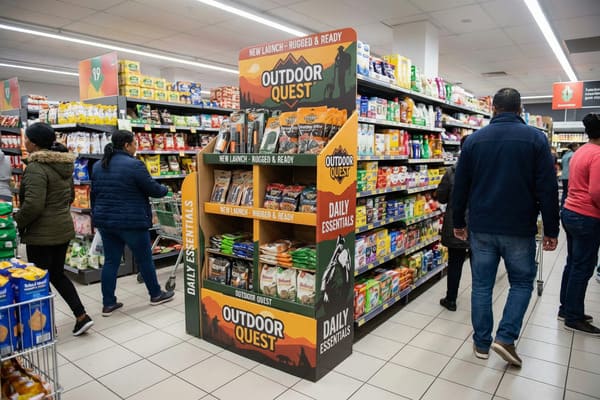
Retail floors are becoming increasingly crowded, and grabbing a customer's attention is harder than ever. You need a solution that balances cost, durability, and visual impact without draining your marketing budget or failing during transport.
The best point of purchase display depends on your product weight, retail footprint, and campaign duration. Floor displays offer maximum visibility for new launches, while countertop units drive impulse buys. For most FMCG and hunting gear brands, corrugated cardboard floor stands provide the optimal balance of structural integrity and cost-efficiency.
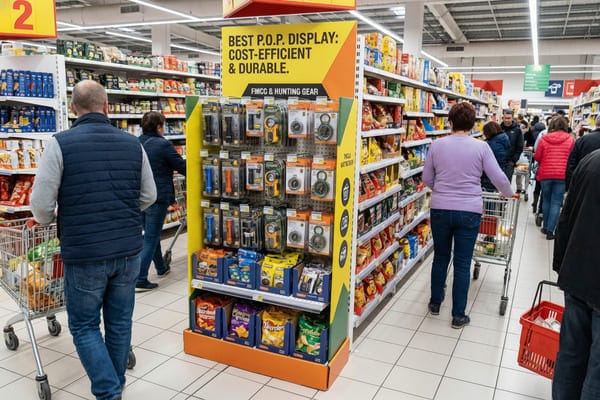
Choosing the right format can feel overwhelming with so many options available in the market today. Let's break down the specific functions and rules to help you make the right choice for your inventory.
What should effective point-of-purchase pop displays do?
A pretty display that stays full is a failure because it means no one is buying the product. You need a structure that actually moves inventory and withstands the chaos of a busy retail environment.
Effective POP displays must interrupt the shopper's journey, communicate value instantly, and simplify the buying process. They need sufficient structural strength to hold heavy inventory without buckling and must align with retailer compliance standards like Costco or Walmart requirements to ensure they actually make it onto the floor.

The Mechanics of Visual Disruption and Structural Integrity
Creating an effective display is not just about graphic design; it is a complex engineering challenge that balances visual disruption with physical physics. When we analyze the effectiveness of a display, we first look at the "5-second rule." The header card and main body must convey the brand story and price point instantly. If a customer has to guess what you are selling, the display has failed. However, the often-overlooked aspect is the structural substrate1. For heavier items, such as outdoor gear, beverages, or hunting tools, standard cardboard is insufficient. We must utilize specific corrugated grades, such as BC-flute or double-wall reinforcement, to ensure load-bearing capacity.
Data indicates that floor displays command over 43% of the POP market share because they act as independent billboards within the store. But this visibility comes with risks. Retailers like Walmart and Target have strict compliance guides regarding dimensions and weight. If a display bulges or leans due to humidity—a common issue with paper-based products in varied climates—store managers will discard it immediately. Furthermore, the design must accommodate the "shopability2" factor. Products must be easy to remove without destabilizing the rest of the stock. An effective display also accounts for the supply chain, utilizing flat-pack designs that minimize shipping volume, thereby reducing the carbon footprint and logistics costs which are currently volatile.
| Feature | Technical Requirement | Business Benefit |
|---|---|---|
| Visual Impact | High-resolution digital or offset printing3 | Captures attention from 10 feet away. |
| Load Bearing | Reinforced B-flute or BC-flute corrugated board | Prevents collapse under heavy product weight. |
| Logistics | Flat-pack engineering (KD – Knock Down)4 | Reduces shipping volume and freight costs. |
| Durability | Aqueous or UV coating / Varnish | Protects against moisture and shop wear. |
I know that a collapsed display damages your brand reputation instantly and can lead to retailers delisting your products. I insist on using reinforced BC-flute corrugated board for heavy items like crossbows to ensure absolute stability. My team runs vertical compression tests on every prototype before we ever authorize a full production run to guarantee it holds the weight.
What is the rule of three in merchandising?
Cluttered shelves confuse customers and kill sales, causing them to walk away rather than figure out your offer. Implementing a simple psychological strategy can organize your presentation and guide the shopper's eye exactly where you want it.
The rule of three in merchandising suggests that products arranged in groups of three are more visually appealing and memorable to consumers. This asymmetry forces the eye to move around the display, creating a dynamic visual path that highlights product hierarchy, pricing tiers, or complementary items more effectively than even numbers.

Applying Psychological Symmetry to Structural Design
The rule of three5 is deeply rooted in how the human brain processes patterns. One item is a single entity, two is a pair, but three is a collection or a pattern. In the context of cardboard display design, this principle dictates both the structural layout and the graphic hierarchy. Structurally, we often design floor stands with three main tiers or shelves. This vertical triptych allows brands to segment their offering: the top shelf for premium or new items, the middle for best-sellers, and the bottom for bulk or heavy stock. This aligns with the natural scanning motion of the human eye.
From a graphic standpoint, the rule of three applies to the messaging: the Brand Name (Header), the Key Benefit (Body), and the Call to Action (Base). If you overcrowd a display with ten different bullet points, the consumer absorbs nothing. Furthermore, color consistency is vital here to maintain the pattern. If the print color on the header varies from the tray lip, the visual "collection" is broken, and the display looks cheap. This is a major pain point in the industry, where the transition from digital proof to mass production offset printing often results in color shifts. Advanced color management systems6 are required to ensure that the "Red" on your packaging matches the "Red" on the display structure perfectly, maintaining the visual integrity of the merchandise arrangement.
| Application | Implementation Strategy | Outcome |
|---|---|---|
| Product Layout | Grouping SKUs in sets of three (Good, Better, Best) | Increases average order value7 by showing upgrades. |
| Visual Flow | Header, Shelf Lip, Base | Creates a cohesive narrative from top to bottom. |
| Messaging | Brand, Benefit, Price | Reduces cognitive load8 for the shopper. |
| Structure | Three-tiered shelf systems | Optimizes product density and accessibility. |
I have seen many designs fail because they try to cram too much information into one space, confusing the buyer. We use 3D rendering software to model your product arrangement in groups of three during the design phase to check the visual balance. I allow free modifications to these renderings until the layout looks perfect to you before we cut a single piece of paper.
What are the pros and cons of point of sale display?
Every marketing investment carries risk, and you need to be realistic about what paper-based structures can and cannot do. Understanding the specific trade-offs of cardboard displays ensures you don't face unexpected costs or durability issues once the goods arrive.
The pros of point of sale displays include high customization, speed to market, and significant cost savings compared to permanent metal fixtures. However, the cons involve lower durability against moisture and potential assembly challenges in-store if the engineering is not intuitive for retail staff to set up quickly.

Evaluating ROI Against Material Limitations
When analyzing the Return on Investment (ROI)9 for Cardboard Displays, the primary advantage is cost-efficiency and flexibility. Cardboard displays are significantly cheaper to produce than metal, wood, or acrylic permanent fixtures. This low barrier to entry allows brands to run short-term promotions, seasonal campaigns, or trial new product launches without a massive capital expenditure. Digital printing technology has further enhanced this by allowing for short production runs without expensive setup plates. This is ideal for brands that need to pivot quickly based on market trends.
However, the material limitations must be critically addressed. The inherent weakness of cellulose-based material is moisture absorption10. In high-humidity environments or if a store floor is mopped aggressively, a standard cardboard base can wick water and collapse. This reduces the lifespan of the unit to typically 3 to 6 months. Another critical disadvantage is the "Last Mile" execution. If a display is designed with complex folding patterns, retail store employees—who are often rushed—may damage it during assembly or simply refuse to set it up. Additionally, transport damage is a frequent issue; unlike metal, cardboard dents easily if the outer packaging is not robust. The friction between flat-packed components during ocean freight can also cause scuffing, ruining the print quality before it even reaches the store.
| Factor | Pros (Advantages) | Cons (Disadvantages) |
|---|---|---|
| Cost | Low material and tooling costs11 | Shorter lifespan requires frequent replacement. |
| Flexibility | Easy to print, cut, and customize shape | Structural limits on extremely heavy loads. |
| Sustainability | 100% Recyclable and biodegradable12 | Vulnerable to moisture and water damage. |
| Logistics | Lightweight and flat-packed | Potential for damage during rough transport. |
I understand that receiving damaged goods or having color inconsistencies is a nightmare for your launch schedule. We design custom outer cartons that rigorously protect the edges of your flat-packed displays during ocean freight to prevent transport damage. I also offer pre-assembled options (shippers) so your products arrive at the retailer ready to sell immediately, eliminating assembly headaches.
What is an example of a point of purchase display?
Abstract concepts are fine, but seeing real-world applications helps visualize how these units will look with your specific products. Let's look at a specific format that consistently delivers high volume sales for heavy or bulky items.
A classic example of a point of purchase display is the floor-standing dump bin used for discounted items or seasonal goods. Another prominent example is the quarter-pallet display often seen in wholesale clubs, which arrives pre-loaded with product and requires minimal setup time for store employees.

Case Study of High-Volume Retail Execution
To understand the best application, consider the "Pallet Display13" or "quarter-pallet" unit. This is a heavy-duty format often used in big-box retailers like Costco or Sam's Club. Unlike a standard light-duty floor stand, a pallet display is engineered to survive the supply chain while fully loaded with merchandise. For a company selling hunting gear, crossbows, or heavy beverages, this is often the only viable cardboard option. The structure utilizes a "shroud" or "skirt" that wraps around the bottom to hide the wooden pallet, providing a massive branding surface. Inside, it uses high-strength dividers and layer pads (often double-wall corrugated) to support hundreds of pounds of vertical pressure.
Another strong example is the "Sidekick" or "Power Wing" display. These are smaller units designed to hang off the side of existing metal shelving end-caps. They are brilliant for cross-merchandising—for example, hanging a display of broadheads or hunting accessories right next to the permanent rack of bows. This captures the "add-on" sale. The engineering challenge here is the hanging mechanism; the cardboard must be reinforced with plastic clips or adhesive tape to prevent tearing at the attachment points. These examples demonstrate that the "best" display is entirely dictated by the retail environment (club store vs. specialty shop) and the product's physical characteristics.
| Display Type | Ideal Product Application | Key Structural Feature |
|---|---|---|
| Quarter Pallet | Bulk items, Heavy gear, Beverages14 | Pre-loaded, forklift ready, high weight capacity. |
| Floor Stand | New launches, Boxed goods15 | Eye-level headers, shelves with support bars. |
| Sidekick / Wing | Accessories, Small impulse items | Hanging clips, compact footprint. |
| Dump Bin | Loose items, Discounted/Sale goods | Open top, deep volume, reinforced walls. |
I know you have strict deadlines for new product launches and cannot afford production delays or quality fade. We operate three distinct production lines to separate urgent sample making from mass production to ensure speed. I guarantee that the sample I send you matches the final production quality exactly, preventing any nasty surprises when you open the container.
Conclusion
Selecting the right display requires balancing structural engineering with high-impact design. By focusing on load-bearing quality and smart visual layouts, you can drive sales while protecting your inventory.
Understanding structural substrate is crucial for creating displays that can support heavier items and maintain integrity. ↩
Exploring shopability can enhance your display strategies, ensuring products are accessible and appealing to customers. ↩
Explore this link to understand how high-resolution printing can enhance your marketing materials and attract more customers. ↩
Discover the advantages of flat-pack engineering in logistics and how it can significantly lower your shipping expenses. ↩
Understanding the rule of three can enhance your design skills and improve how you engage audiences. ↩
Exploring color management systems can help ensure your designs maintain visual integrity across different mediums. ↩
Discover effective strategies to boost your average order value and enhance your retail performance. ↩
Learn how minimizing cognitive load can lead to a better shopping experience and increased customer satisfaction. ↩
Understanding ROI is crucial for brands to evaluate the effectiveness of their marketing strategies and make informed decisions. ↩
Exploring moisture absorption helps brands understand the limitations of cardboard displays and how to mitigate potential damage. ↩
Understanding the benefits of low costs can help businesses optimize their production budgets. ↩
Exploring this topic highlights the environmental impact and sustainability of materials. ↩
Explore this link to understand how Pallet Displays can enhance visibility and sales in retail environments. ↩
Explore this link to learn effective strategies for showcasing bulk items and heavy gear, maximizing visibility and sales. ↩
Discover innovative display techniques for new launches and boxed goods that can enhance customer engagement and drive sales. ↩