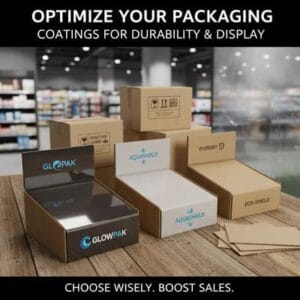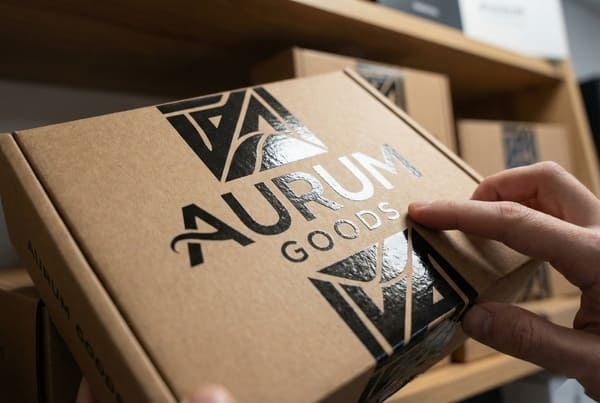
Your premium product deserves better than a flat, boring box. Without contrast, brands blend in. Spot UV adds the tactile luxury that forces shoppers to stop, look, and touch.
Spot UV printing (Spot Ultraviolet) is a finishing technique applying clear, high-gloss polymer coating to specific design areas. This liquid varnish cures instantly via ultraviolet light, creating a high-contrast, tactile difference between glossy elements and the matte background, with coating thicknesses typically ranging from 4 to 15 microns (0.004–0.015 mm).
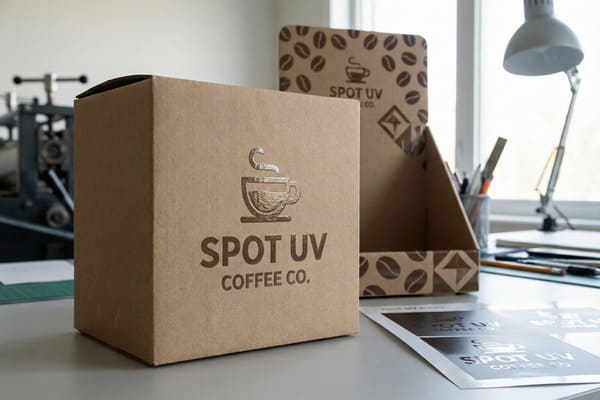
Spot UV is the secret weapon for brands that understand visual hierarchy. It guides the shopper's eye exactly where you want it—usually the logo or the product name—by creating a texture that demands to be touched.
What is the difference between UV and spot UV?
Many brands confuse protection with decoration, resulting in dull packaging. Don't pay for "gloss" that disappears. You need to understand the strategic difference between shielding a box and highlighting a brand.
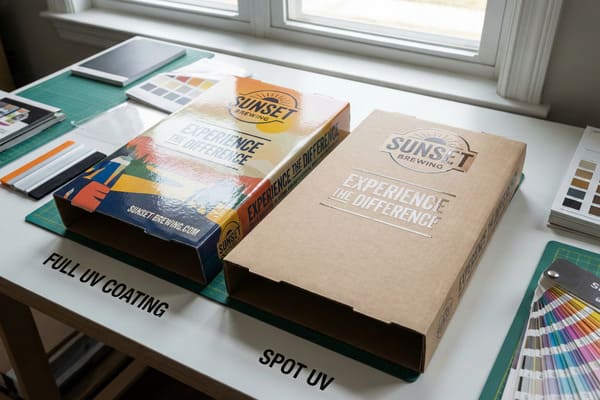
The difference between UV and spot UV is coverage area. UV coating (Flood UV) protects 100% of the surface against scratches, while spot UV applies varnish only to targeted design elements—like logos—creating a visual distinction between the glossy highlight and the surrounding matte substrate.
The Strategic Anatomy of Contrast
The fundamental difference lies in purpose: Flood UV is your shield, while Spot UV is your sword. In my factory, I often see designs come in from US agencies where they request "UV Coating" on the whole box, thinking it will make the logo pop, but it actually does the opposite. If you coat the whole box in high-gloss UV, the logo disappears into a sea of shine, creating a visual effect similar to shouting in a room where everyone else is screaming—nothing stands out. To make Spot UV work effectively, you need a "contrast carrier," which is why I almost always insist on pairing Spot UV with a specific Anti-Scuff Matte PP Lamination1 rather than a standard aqueous coating.
Here is the messy reality of manufacturing that most sales reps won't tell you: standard matte lamination is a nightmare for scratches. If a store employee at Walmart drags a fingernail across a standard matte box, it leaves a permanent white mark known as "burnishing2," and when we apply Spot UV over a standard matte base, the mechanical handling during the UV curing process itself can scratch the matte areas. That is why we switched to Anti-Scuff Matte; it creates a bulletproof, velvet-like background that absorbs light while the Spot UV reflects it, maximizing the "Refractive Index3" difference. We also have to strictly manage Dyne Levels4 (surface energy); if the matte laminate has a low Dyne level (below 38 dynes/cm), the liquid UV varnish will "bead up" like water on a waxed car, creating a bumpy texture we call "reticulation" or "orange peel." We have to corona-treat the surface immediately before printing to ensure the varnish lays down flat, because if you try to save money by using a standard coating on recycled clay-coated news back (CCNB), the Spot UV will soak into the paper fibers and your "premium" logo will look like a grease stain.
| Feature | Flood UV (Overall Coating) | Spot UV (Targeted Coating) |
|---|---|---|
| Primary Purpose | Protection (Scuff/Rub Resistance) | Aesthetic Appeal & Branding |
| Coverage Area | 100% of the print surface | 5% – 20% specific elements |
| Visual Effect | Uniform Gloss or Matte finish | High Contrast (Gloss on Matte) |
| Cost Driver | Low (Inline with printing) | Moderate (Requires separate screen/plate) |
| Tactile Feel | Smooth, consistent | Varied (Raised texture vs. smooth) |
I tell clients this every day: Don't waste money on Spot UV if you aren't willing to pay for the matte lamination underneath it. Without the matte base, the UV varnish has nothing to fight against, and you lose 80% of the visual impact. It's a package deal.
What does spot UV look like?
It isn't just shiny ink; it is a physical texture. Imagine a wet raindrop on a velvet stone. That high-contrast, liquid look is what defines true luxury packaging.
Spot UV looks like a wet, high-gloss layer floating above the paper surface, reflecting light intensely against a matte background. The treated area appears deeper in color and offers a smooth, tactile texture that creates a tangible 3D effect, typically raised by 10 to 20 microns (0.01–0.02 mm).
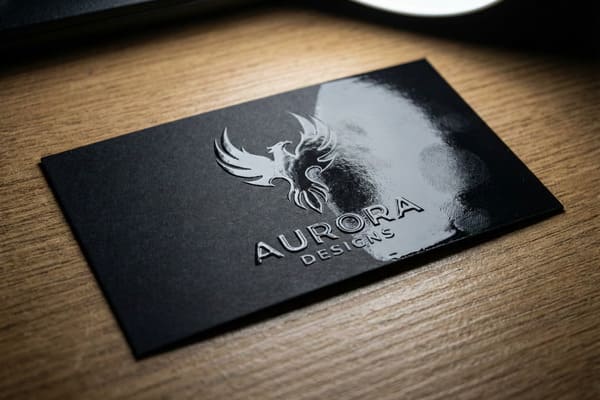
The Visual Physics of Luxury
When done correctly, Spot UV screams "luxury," but getting it to look right on corrugated cardboard is incredibly difficult compared to printing on a rigid iPhone box because the biggest enemy of a good Spot UV finish is the "Washboard Effect5." Corrugated board is made of flutes (waves), and if you use a standard B-Flute (which has about 47 flutes per linear foot), the surface is inherently wavy. When we print a solid black color and apply Spot UV, the light catches every single one of those waves, making your logo look like a crinkled potato chip rather than a smooth glass surface. I've had to scrap entire production runs in the past because the client didn't listen to my advice on material selection, so now I usually force clients into one of two options: either we switch to E-Flute6 (Micro-flute), which has a much tighter wave pattern (about 90 flutes per linear foot), or we use a "Litho-Lam on SBS" method where we print on a thick, smooth cardstock first and then glue it to the cardboard. The smoother the substrate, the higher the Gloss Unit (GU)7 reading; a standard paper might measure 15 GU, while a good Spot UV on SBS hits 90+ GU.
Another massive issue we fight daily is Registration Drift8. Cardboard is an organic material that expands and contracts with humidity, meaning if the screen printing mesh for the Spot UV shifts by even 0.02 inches (0.5mm) during the run, the gloss won't line up with the printed logo underneath. It creates a "Ghosting" effect that looks like a bad 3D movie without glasses—blurry and amateur. To fix this, I use "High-Viscosity Screen Printing" and build in a specific "Trapping" allowance in the artwork. We intentionally make the Spot UV layer slightly smaller (choking) or larger (spreading) depending on the design complexity, so even if the paper moves slightly during the high-speed run, the gloss still hits the target area without spilling over the edges.
| Visual Characteristic | Standard Print | Spot UV Enhanced |
|---|---|---|
| Reflectivity | Low to Medium | Ultra-High (90+ Gloss Units) |
| Color Saturation | Standard CMYK | Deepened, Richer Tones |
| Texture | Flat paper feel | Smooth, slightly raised, tacky |
| Light Interaction | Diffuses light | Specular reflection (Mirror-like) |
I refuse to run Spot UV on "Raw Kraft" or standard recycled testliner materials. The varnish just sinks into the porous paper like water into a sponge, turning a dark gray instead of a shiny black. If you want the look, you have to prep the canvas.
What does UV spot mean?
Marketers talk about the "look," but factories care about the chemistry. Misunderstanding this curing process leads to sticky, smelly displays that get rejected by retailers.
UV spot means applying a liquid monomer varnish that is hardened instantly via high-intensity ultraviolet lamps. This photochemical reaction turns the liquid into a solid polymer in less than 0.2 seconds, allowing for immediate handling and stacking of packaging materials without smearing or blocking.
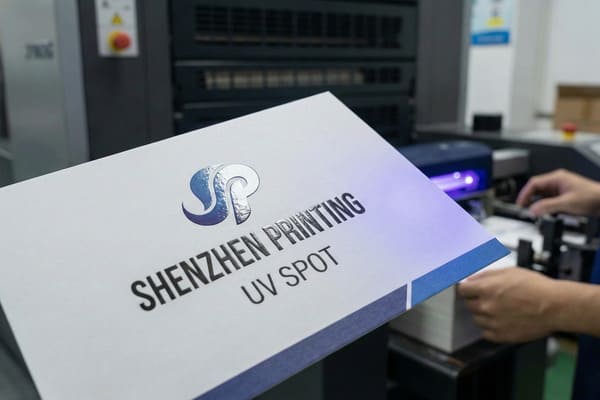
The Curing Process and Production Velocity
Why do we call it "UV"? It's not just about the shine; it's about the speed. In the old days of oil-based varnishes, we had to let sheets dry for hours in racking systems, but in a modern high-speed factory like mine, we rely on a chemical reaction called photopolymerization9. The varnish contains photoinitiators, and when the UV light (at a specific wavelength, usually 200-400 nm) hits these photoinitiators, they trigger the oligomers to cross-link instantly. This is critical for Speed to Market10 because I can print 5,000 sheets, run them through the Spot UV machine, and load them onto the die-cutter five minutes later without any drying time.
However, this process has a dark side: "The Odor." I learned this the hard way with a client selling premium chocolate; we used a cheap, standard UV varnish, and when they opened the shipping container in Los Angeles, the heat had caused the residual, uncured photoinitiators to off-gas. The displays smelled like burnt plastic, and the scent tainted the chocolate, leading to a massive claim. Now, for any food or sensitive retail environment (like Sephora or Ulta), I strictly use Benzophenone-free11 or "Low Migration" UV inks. We also run a "Cure Test" on the line—rubbing the surface with a solvent (MEK rub test). If the varnish dissolves after 50 double rubs, it wasn't cured properly. We also have to choose between Mercury Vapor Lamps12 (which are hot and can warp the cardboard) and LED UV (which is cool but requires expensive, specific inks). It's technical, but if you don't respect the chemistry, you end up with sticky, smelly displays that retailers will reject.
| Technical Spec | Standard Varnish | UV Cured Varnish |
|---|---|---|
| Drying Method | Evaporation / Oxidation | Photopolymerization (UV Light) |
| Drying Time | Minutes to Hours | < 1 Second |
| Solvent Content | High (VOC emissions) | Zero (100% Solids) |
| Abrasion Resistance | Low | Very High |
Speed is money, but safety is longevity. I force my production team to log the UV lamp hours every shift. If a lamp is too old, it doesn't cure deep enough, and the varnish peels off in the store. We swap them out early to sleep better at night.
What is the difference between spot UV and raised foil?
Both shine, but one is paint and the other is metal. Confusing Spot UV with Hot Foil creates recycling nightmares and breaks your budget. Choose the right weapon.
The difference between spot UV and raised foil is material opacity. Spot UV uses clear varnish to enhance underlying ink with gloss, whereas raised foil (hot stamping) applies a solid metallic film that completely blocks the paper, typically adding a thickness of 20 to 60 microns (0.02–0.06 mm).
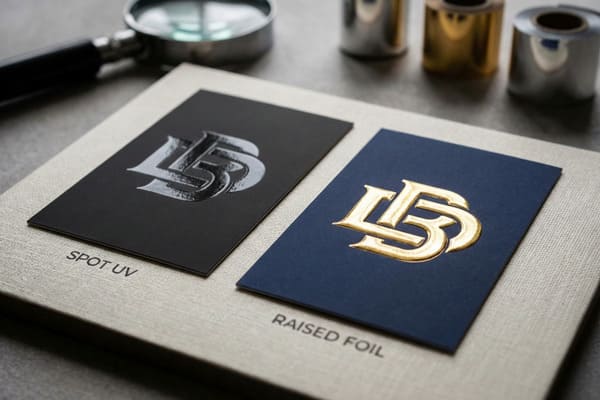
Texture vs. Bling: A Material Science Breakdown
The choice between Spot UV13 and Foil isn't just aesthetic; it's structural and environmental. Raised Foil (Hot Stamping)14 is the heavy hitter, using a heated magnesium or copper die to press a metallic film onto the board, which looks incredible—like real gold or silver bullion—but it has a major flaw: Recyclability15. Many US municipalities struggle to recycle cardboard that has significant amounts of hot foil stamping because the metallic film is plastic-based and fused to the fibers, contaminating the pulp. Spot UV, on the other hand, is generally more friendly to the repulping process, especially if we use modern eco-friendly varnishes. It doesn't have the mirror-like reflection of gold foil, but it offers sophistication.
From a manufacturing standpoint, Foil is a headache for "Agile" brands because to do hot stamping, I have to mill a physical metal die. If you change your logo size by 0.04 inches (1mm), I have to throw that metal die in the trash and carve a new one (costing $200-$500 and taking 3 days), whereas Spot UV uses a mesh screen or a polymer plate, which is cheap and fast to remake. There is also a "Hybrid" nightmare I see often: The "Mixed Material" Trap. Brands ask for both Gold Foil and Spot UV. While possible, registration becomes exponentially harder because if the foil is off by 0.02 inches (0.5mm) and the UV is off by 0.02 inches in the other direction, the design looks broken (the "Halo Effect"). I usually advise clients to pick a hero: either let the Gold Foil scream or let the Spot UV whisper. We also experiment with Cold Foil, which is applied like ink and is more recyclable, but it lacks the tactile "pop" of hot stamping.
| Feature | Spot UV | Raised Foil (Hot Stamping) |
|---|---|---|
| Visual Effect | Glossy, Wet, Transparent | Metallic, Opaque, Mirror-like |
| Setup Cost | Low (Screen/Plate) | High (Metal Die Engraving) |
| Flexibility | High (Easy to change design) | Low (Requires new die) |
| Recyclability | Good (with correct varnish) | Poor (Plastic film contamination) |
If you want my honest advice: Use Spot UV for large patterns or subtle branding on a black background. Use Foil only for small, high-value accents like a crest or a seal. And if you are selling to Whole Foods or strict "Green" retailers, skip the hot foil entirely—it creates a recycling hurdle they hate.
Conclusion
Spot UV is the most cost-effective way to turn a standard cardboard box into a luxury retail fixture, but only if the foundation is right. It requires a smooth E-flute base, a high-quality matte lamination for contrast, and a factory that understands the chemistry of curing.
If you are worried about your design looking "muddy" or the varnish drifting off your logo, let me handle the engineering. Would you like a Free Structural 3D Rendering of your display with the Spot UV effects visualized before we print?
Explore this link to understand how Anti-Scuff Matte PP Lamination enhances durability and aesthetics in printing. ↩
Find out how to avoid burnishing to maintain the quality of your printed materials. ↩
Discover the significance of Refractive Index in achieving stunning visual effects in print design. ↩
Learn about Dyne Levels to ensure optimal adhesion and finish in your printing projects. ↩
Understanding the Washboard Effect is crucial for achieving a flawless Spot UV finish on corrugated materials. ↩
Explore the advantages of E-Flute for packaging to ensure a smoother finish and better print quality. ↩
Learn about Gloss Units to understand how they impact the quality and appearance of printed materials. ↩
Preventing Registration Drift is essential for maintaining print accuracy and quality; discover effective strategies. ↩
Understanding photopolymerization is key to grasping how UV curing works, enhancing your knowledge of modern printing techniques. ↩
Exploring Speed to Market can reveal strategies to improve efficiency and competitiveness in your production processes. ↩
Discovering the advantages of Benzophenone-free inks can help you make safer choices for sensitive products and environments. ↩
Learning about Mercury Vapor Lamps will inform you about their impact on production and environmental considerations in UV curing. ↩
Discover the advantages of Spot UV to see why it's a preferred choice for many brands looking for flexibility and aesthetics. ↩
Explore the benefits of Raised Foil to see how it can enhance your design while considering its environmental impact. ↩
Understanding recyclability issues can help you make informed choices about sustainable printing options. ↩