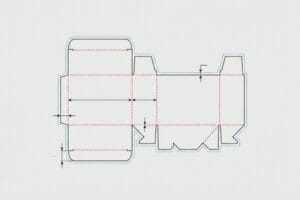
Getting your product into Walmart or Target is a dream, but getting rejected because your display is half an inch too wide? That's a nightmare you can avoid.
The standard retail aisle dieline specifications range from 30 to 48 inches (76–122 cm) in width, with strict height caps enforced by store planograms. These structural dimensions must adhere to localized safety protocols and shelf-depth constraints, often derived from standard gondola fixture anthropometric data to ensure shopper accessibility.
Understanding the exact specs is just the start; the real challenge lies in the engineering nuances that prevent costly chargebacks.
What Are the Dieline Specs for Walmart and Target's Baby Aisle in the US?
If you guess the dimensions for a baby aisle display, you are gambling with a potential lawsuit. Safety rules here are brutal.
The dieline specs for Walmart and Target's baby aisle generally mandate a maximum height of 54 inches (137 cm) and strict width tolerances to accommodate standard 36-inch (91 cm) gondola endcaps. These specifications also require safety-compliant structural designs, such as rounded edges, to prevent consumer injury in high-risk infant product zones.
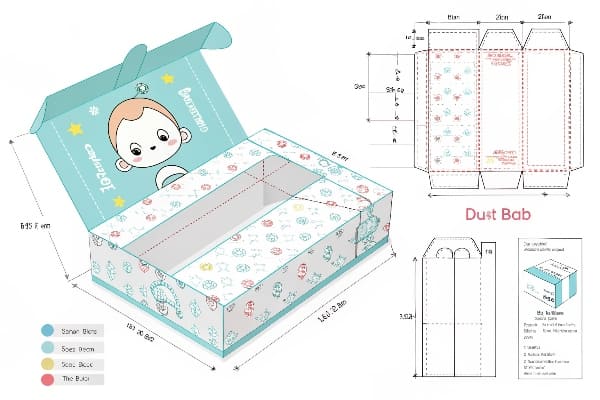
The Structural Anatomy of Compliance and Safety
You wouldn't believe how many "print-ready" files I get that are totally useless. A client sends a PDF from Adobe Illustrator, thinking it's ready to cut. But Illustrator is 2D. Cardboard is 3D. When you fold a 32 ECT (Edge Crush Test1) board, the material thickness consumes space. If the designer didn't account for that "gain," the box won't close, or worse, it creates sharp, jagged corners. In the baby aisle at Target or Walmart, a sharp corner is a liability lawsuit waiting to happen. Moms and toddlers are touching these displays constantly, so the scrutiny is higher than anywhere else in the store.
I use ArtiosCAD2 software to catch these geometry errors before we cut a single sheet. For the baby aisle specifically, we have to talk about the "Safety Edge." Standard die-cutters leave a raw edge that can slice a finger like a paper cut. Walmart hates this. So, we use a specific "Wave Cut3" blade on our Kongsberg cutting tables for all hand-access areas. It creates a microscopically scalloped edge that is impossible to cut skin on. It shows you care about the mom buying the diapers. I actually had a client last year whose entire shipment was rejected because they used a standard straight knife on a diaper bin lip. It was a disaster. Now, I force that wave-cut blade on every baby product project, whether they ask for it or not.
Also, size matters—down to the millimeter. A standard US End-Cap is roughly 36 inches (91 cm) wide, but the upright metal posts steal about an inch. If you design to exactly 36 inches, your display will jam. I learned this the hard way years ago when a batch got rejected at a Distribution Center. Now, I enforce a "Float Tolerance4." We design to a max width of 34.5 inches (87.6 cm). This ensures the unit slides into the fixture perfectly every time, whether it's a Walmart in Texas or a Target in Melbourne. Plus, for government compliance like the ADA (Americans with Disabilities Act), we ensure the product sits within the 15-to-48-inch (38–122 cm) reach range so you don't get flagged for accessibility issues. Furthermore, humidity plays a massive role here. Cardboard is a sponge. If you ship to a humid distribution center in Florida, the board can swell, increasing the overall width by up to 0.25 inches (0.6 cm). My "Float Tolerance" accounts for this expansion, saving you from a total rejection at the dock.
| Compliance Factor | Generic "risky" Design | Walmart/Target Approved Standard |
|---|---|---|
| Edge Finish | Standard Straight Cut (Sharp) | Wave Cut / Safety Edge (Non-sharp) |
| Max Width | 36.00 inches (91.4 cm) | 34.50 inches (87.6 cm) (Float Tolerance) |
| Material Grade | 32 ECT Standard Kraft | 44 ECT High-Performance Kraft (Shatter-proof) |
| Reach Range | Product at 60 inches (152 cm) | 15–48 inches (38–122 cm) (ADA Compliant) |
I don't just ask "What size do you want?" I check my internal database of Retailer Specifications. If you tell me it's for the baby aisle, I automatically apply the Safety Edge tooling to your mold, so you don't even have to ask for it.
How to Design a Sidekick with Floor Stand for Both the Australian and US Markets?
A Sidekick display that falls off the shelf isn't just embarrassing; it's a "Do Not Order" flag in the retailer's system.
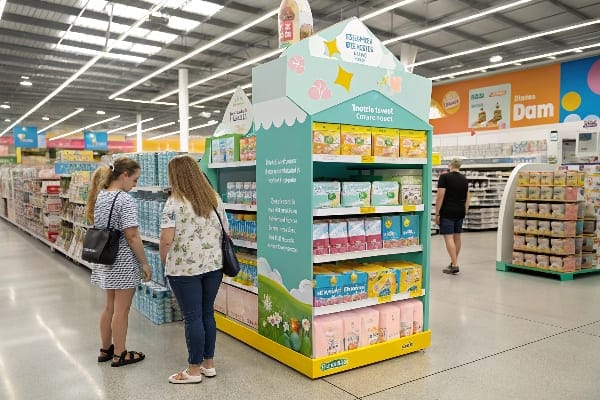
Designing a sidekick with floor stand capabilities for Australian and US markets requires utilizing a universal metal bracket system compatible with varying gondola slot pitches. The design must also incorporate a modular base and a trapezoidal back panel to ensure structural stability and compliance with diverse retailer fixture dimensions.
Engineering Universal Fit for Diverse Fixtures
Here is the headache: US retailers use specific gondola shelving (like Lozier or Madix) with 1-inch (2.54 cm) vertical slotting. Australia often uses different systems. If you use a simple cardboard tab to hang your Sidekick (also called a Power Wing), it will likely tear under the weight or not fit the holes. I've seen brands try to save $0.40 by skipping the hardware, and their displays end up on the floor, trampled by carts. The humidity difference is also a killer; Australian summers are hot and humid, while a US warehouse in Arizona is bone dry. Cardboard reacts differently to both, affecting the shear strength of the hang tab.
My solution is the "Universal Metal Bracket5." We don't rely on cardboard for suspension. We install a reinforced S-Clip or metal bracket that fits 95% of global retail fixtures. But the bracket is only half the battle. The real killer is "Parasitic Weight Distribution6." When a Sidekick is full of heavy product—say, batteries or shampoo—the center of gravity pulls away from the wall. This creates a lever arm effect that rips the back panel. A cardboard tab will fail here 100% of the time, especially if the internal glue bond has weakened due to heat.
I fix this with physics, not more glue. We engineer a "Trapezoidal Back Panel7" with a double-layer corrugated spine using EB-Flute for maximum density. This structure forces the center of gravity to hug the gondola wall tight. Also, we have to respect the "Standardization Height." In the US, we lock the Sidekick body to exactly 48 inches (122 cm) high by 14 inches (35.5 cm) wide. Why? because this leaves exactly enough clearance for the bottom mop guard (so floor cleaners don't soak your product) and the top shelf header. It's about fitting into the ecosystem, not just standing out. And regarding material—always check the grain direction. We orient the corrugated flutes vertically on the back panel to handle the tensile stress of hanging. If the grain is horizontal, the weight of the product will cause the cardboard to elongate and eventually tear at the hook point. I have seen entire campaigns fail because a designer rotated the grain to save 5% on paper scrap. I don't let that happen. We also use a "Mop Guard8" coating on the bottom 4 inches (10 cm) if it's a floor-stand conversion, ensuring the base doesn't turn to mush when the janitor cleans the aisle.
| Feature | Domestic/Local Standard | Global/Universal Standard |
|---|---|---|
| Hanging Mechanism | Die-cut Cardboard Tab | Reinforced Universal Metal Bracket |
| Back Panel | Single Wall (B-Flute) | Double Wall Spine (EB-Flute) |
| Gravity Center | Forward Leaning (Risk of tear) | Trapezoidal Taper (Hugs the wall) |
| Height Limit | Variable / Random | Strict 48 inches (122 cm) |
I advise clients: "Spend the extra pennies on the metal bracket." It prevents your display from ending up in the trash bin before it sells a single unit.
How to Ensure Your Baby Aisle Product Design Meets Walmart and Target Standards?
Moms are the most scrutinized shoppers on earth. If your packaging smells like chemicals, it stays on the shelf.
Ensuring baby aisle product design meets Walmart and Target standards necessitates the exclusive use of non-toxic, soy-based inks and water-based varnishes compliant with CPSIA regulations. Compliance further requires rigorous testing for sharp edges and the elimination of prohibited substances like PFAS to adhere to evolving state-level environmental safety laws.
The Non-Toxic Mandate and Chemical Reality
In the US baby aisle, "Clean" isn't just a marketing buzzword; it's a legal requirement. We are dealing with CPSIA (Consumer Product Safety Improvement Act9) regulations here. A few years ago, a client from New York wanted a super shiny, glossy finish for a teething toy display. They asked for standard UV coating to make the colors pop. I refused. Why? Because standard UV coatings can crack during transit, and worse, they often emit a strong chemical odor due to VOCs (Volatile Organic Compounds). If a mom walks down the aisle and smells "factory chemicals," she walks away. It triggers an instinctual "unsafe" reaction.
Instead, for anything in the baby or pet aisle, I exclusively use Soy-Based Inks10 and water-based varnishes. They are heavy-metal free and odorless. We verify this using an in-house spectrophotometer to ensure color consistency without adding toxic solvents. But the new big issue for 2025 is PFAS11 (Per- and Polyfluoroalkyl Substances). States like California and New York are aggressively banning these "forever chemicals" in packaging. Many traditional water-resistant coatings—the stuff that keeps your display from getting soggy—are loaded with PFAS. If your display is tested and found positive, you could face massive fines and a recall. It's scary stuff for a brand owner.
I switched our factory to verified PFAS-Free coatings. It costs a little more, but it protects you from state-level lawsuits. Also, think about disposal. Walmart wants "Curbside Recyclable12" displays. If you use "Hot Stamping" (gold foil) on your header card, you just made that cardboard non-recyclable because the plastic foil won't separate in the pulping process. I steer my clients toward "Cold Foil" or metallic soy inks. You get the shine, but the box can still go into the blue bin. It's an honest "100% Recyclable" claim you can print on the back. Furthermore, we perform a "Sharp Point Test" (16 CFR 1500.48) on every structural prototype. Cardboard can actually be sharp enough to fail this test if cut improperly. By using the wave-cut blade mentioned earlier, we ensure compliance not just with visual standards, but with federal safety laws. This isn't just about printing; it's about strict legal liability protection for your brand.
| Safety Component | Standard Industrial Practice | Baby Aisle / Walmart Compliant |
|---|---|---|
| Ink Base | Petroleum/Solvent Based | Soy/Vegetable Based (Non-Toxic) |
| Coating | UV High-Gloss (High VOC) | Water-Based Varnish (Low VOC) |
| Water Resistance | PFAS-laden Chemical Coat | PFAS-Free Barrier Coating |
| Foil Effect | Hot Stamp (Non-recyclable) | Cold Foil / Metallic Ink (Repulpable) |
I provide a signed "Non-Toxic Declaration" with every baby aisle shipment. It's the paper shield you need when the safety auditors come knocking.
How do you put your products on a Walmart shelf?
The "Last Mile" is where most brands fail. Your product arrives, but if the box is annoying to open, the stocker will hide it in the back.
Putting products on a Walmart shelf successfully relies on strict adherence to Retail Ready Packaging (RRP) protocols, specifically utilizing tear-away PDQ trays with precise perforation strength. Success also depends on the accurate placement of UCC-128 shipping labels to ensure seamless automated scanning and inventory induction at distribution centers.
Optimizing for the Stocker and the Scanner
You might think you are designing for the customer, but first, you are designing for the 19-year-old stocking shelves at 2 AM. If he needs a box cutter to open your case, he might slice your product. Or worse, he might just ignore your box because it looks complicated. This is why "Retail Ready Packaging13" (RRP) or "Shelf Ready Packaging" (SRP) is critical. If it takes more than 5 seconds to open and shelve, you have already lost. This is where engineering meets psychology.
We have to perfect the "Perforation Nicking Strength." It's a tricky balance. The box needs to be strong enough to survive a truck ride from Long Beach to Chicago without popping open (vibration test), but weak enough that a human can tear the top off cleanly by hand. We calculate the nicking ratio—usually 3mm cut to 1mm tie—based on the board grade. I test this personally by ripping samples apart in the factory. If I struggle, I know the stock boy will struggle, and he will just rip the whole box apart, destroying the branding. We often reference ISTA 3A14 testing standards to simulate these transit vibrations to ensure the nicks don't fail prematurely.
Then there is the "Lip Height" rule. Inexperienced designers make the front lip of the tray 3 inches (7.6 cm) high to print a big logo. But if your product is small, you just hid 30% of it. Shoppers can't buy what they can't see. I enforce a strict visibility rule: the tray is a fence, not a billboard. And don't forget the UCC-128 Label15. This is the barcode tracking sticker on the shipping case. Walmart has strict rules: it must be on the long side and the short side, at least 1.25 inches (3.2 cm) from the bottom. If it's in the wrong spot, the automated scanners at the Distribution Center miss it, and you get hit with a "Repacking Fee." These fees can wipe out your margin. I've seen brands lose thousands because a sticker was wrapped around a corner. I operate a fully "Audit-Ready" facility. We place these labels robotically or with templates so you never see a chargeback invoice for a sticker error. Also, for Pallet Displays, we always design an internal "H-Divider16" or "Belly Band." This prevents the "Dump Bin Bulge." When you dump 50 lbs (22 kg) of product into a bin, it wants to turn into a circle. The divider keeps the walls straight, ensuring your brand looks premium, not sloppy.
| Execution Standard | The "Amateur" Mistake | The "Pro" Protocol |
|---|---|---|
| Opening Method | Tape & Knife required | Clean Tear-Away Perforation |
| Front Lip | High (Obstructs product) | Low Profile / Clear Window |
| Labeling | Random placement | UCC-128 Strict Zone Compliance |
| Stacking | Crushes under weight | Reinforced Corners / H-Divider |
I operate a fully "Audit-Ready" facility. We place these labels robotically or with templates so you never see a chargeback invoice for a sticker error.
Conclusion
Navigating the compliance mazes of Walmart, Target, and cross-border markets like Australia is less about "creativity" and more about rigid engineering discipline. From safety edges in the baby aisle to universal brackets for sidekicks, the details determine your success.
Would you like a [Free Structural 3D Rendering] or a [Physical White Sample] to test your compliance before you commit to production?
Understanding the Edge Crush Test is crucial for ensuring packaging strength and safety, especially in retail environments. ↩
Explore how ArtiosCAD software can enhance your packaging design process by catching geometry errors before production. ↩
Learn about the benefits of using a Wave Cut blade for safer packaging designs, especially for products aimed at children. ↩
Discover the importance of Float Tolerance in ensuring your packaging fits perfectly in retail spaces, avoiding costly rejections. ↩
Explore how the Universal Metal Bracket enhances display stability and fits various retail fixtures. ↩
Learn about Parasitic Weight Distribution and its impact on display design and product safety. ↩
Discover the benefits of a Trapezoidal Back Panel in maintaining product integrity and display strength. ↩
Find out how a Mop Guard protects displays from cleaning damage and enhances durability. ↩
Understanding CPSIA is crucial for compliance in product safety, especially for children's items. ↩
Explore the advantages of soy-based inks for eco-friendly printing and their impact on health and safety. ↩
Learn about PFAS, their risks, and the ongoing efforts to ban these harmful substances in consumer products. ↩
Discover the importance of curbside recyclable packaging and how it affects sustainability and consumer choices. ↩
Explore this link to understand how RRP can enhance product visibility and sales in retail environments. ↩
Learn about ISTA 3A standards to ensure your packaging withstands transit challenges and maintains product integrity. ↩
Discover the significance of UCC-128 Labels in logistics and how they can prevent costly errors in distribution. ↩
Find out how H-Dividers can improve the presentation of your products and maintain brand integrity during shipping. ↩