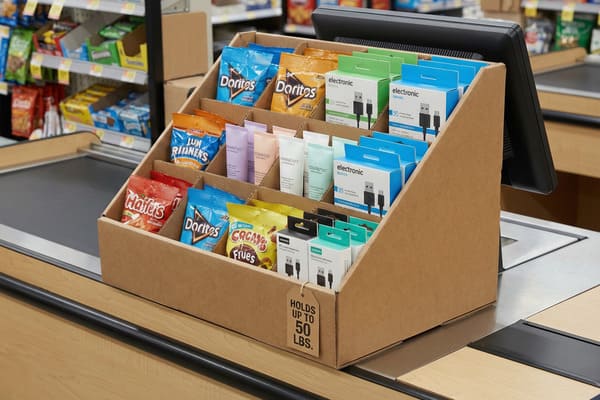
Struggling to fit all your stock on a flimsy counter unit? A collapsing display damages product safety and your brand reputation in seconds, turning a promotional opportunity into a liability.
A standard cardboard counter display typically holds between 15 to 30 pounds of merchandise, depending on the corrugation grade (E-flute vs. B-flute) and structural design. Custom reinforced units can support up to 50 pounds, accommodating 20 to 50 individual product units based on their dimensions and weight distribution.
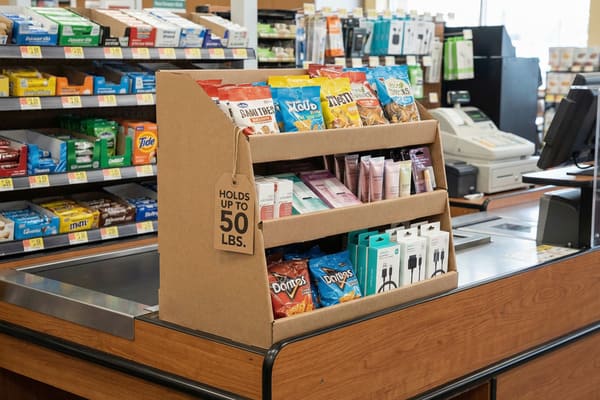
Choosing the right capacity is not just about preventing a collapse. It is about maximizing the retail space efficiency and ensuring your product remains visually appealing throughout the sales cycle. Let us break down the technical details to ensure your next display is safe and effective.
What are cardboard displays called?
Confused by the endless industry jargon when ordering supplies? Using the wrong terminology can delay your production timeline and result in receiving a prototype that does not match your vision.
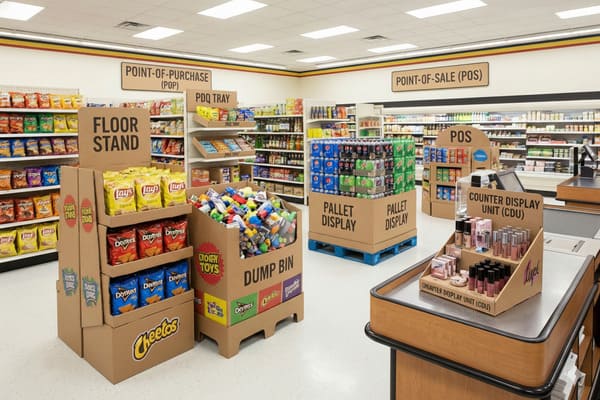
Cardboard displays are professionally known as Point-of-Purchase (POP) displays or Point-of-Sale (POS) displays. Specific variations include floor stands, counter display units (CDUs), dump bins, and pallet displays (quarter or full pallets). Retailers often refer to them by their function, such as "shippers" or "PDQ trays" for quick stocking.
The Terminology Matrix and Industry Standards
Understanding the specific names for cardboard displays is crucial for accurate sourcing, especially when bridging the gap between Western brands and Chinese manufacturing. While "cardboard display" is the generic term, the industry distinguishes heavily between the material and the function. Technially, we rarely use standard "cardboard" (which refers to cereal box thickness). Instead, we use "corrugated fiberboard1." When you ask for a POP display, you are asking for a marketing tool designed to disrupt the shopper's journey. When you ask for a POS display, it usually refers to smaller units placed exactly where the transaction happens, like the checkout counter.
In the North American market, you will frequently hear the term "PDQ2." This stands for "Pretty Darn Quick" (or Product Display Quickly). Major retailers like Walmart and Costco have strict guidelines for these. A PDQ is essentially a tray or counter unit that arrives pre-packed with goods. The store employee simply removes the shipping lid and slides the tray onto the shelf. If you order a standard "Counter Display" but actually need a "PDQ," you might receive a unit that requires assembly in-store. This is a critical error because most large retailers refuse to let their staff assemble displays due to labor costs. Knowing the difference between a "Shipper Display" (ships with product inside) and a "Knock-Down" display (ships flat, requires assembly) affects your logistics budget and your relationship with the retailer.
The table below clarifies these terms to help you communicate effectively with your factory.
| Term | Full Name | Primary Use | Retail Context |
|---|---|---|---|
| POP | Point of Purchase3 | Grabbing attention in aisles | Floor stands, Pallets |
| POS | Point of Sale | Impulse buys at checkout | Counter units, small bins |
| PDQ | Product Display Quick | High-volume shelf stocking | Walmart/Target shelves |
| SRP | Shelf Ready Packaging4 | Fast restocking efficiency | Supermarkets, Grocery |
| FSDU | Free Standing Display Unit | Standalone floor promotion | Aisle ends, Entrances |
I know that miscommunication leads to delays, and for a product launch, missing a deadline is not an option. My team and I scrutinize every inquiry to ensure we are speaking the exact same language as your retail partners. We confirm whether you need a flat-packed unit or a pre-filled shipper before we even start the CAD drawings, ensuring your timeline stays on track.
What is a display carton?
Do you need a box for shipping or a box for selling? Confusing these two distinct packaging types wastes money on materials and creates stocking nightmares for busy retail staff.
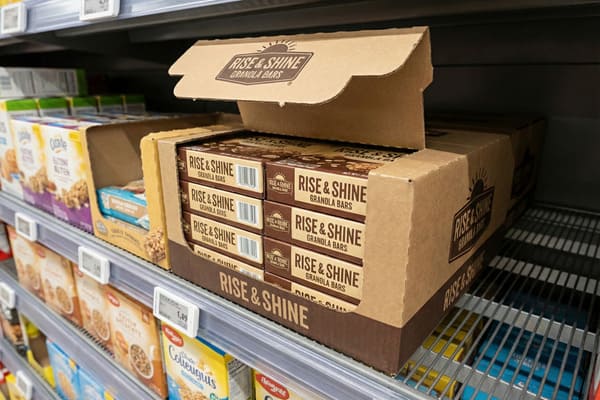
A display carton, often called a Shelf Ready Packaging (SRP) or Retail Ready Packaging (RRP) unit, acts as both a shipping container and a merchandise dispenser. It features a perforation or tear-away section that allows store staff to open it quickly and place it directly onto the shelf without unpacking individual items.
Dual-Function Packaging Engineering
A display carton represents a complex engineering challenge because it must serve two opposing masters: logistics and marketing. From a logistics perspective, the carton must be robust. It needs to withstand the Edge Crush Test (ECT)5 standards, usually requiring an ECT-32 or ECT-44 rating depending on the pallet stacking weight. It has to protect the product inside from moisture, vibration, and compression during the journey from a factory in Shenzhen to a warehouse in the United States. If the box is too weak, the product arrives damaged.
However, from a marketing perspective, the carton must be "weak" in specific areas. It requires precision-cut perforations6 that allow a store clerk to rip off the hood or front panel in seconds without using a knife. If the cardboard is too thick or the perforation is not deep enough, the tear will be ragged, making the display look cheap and potentially damaging the graphics. Conversely, if the perforation is too deep, the box might split open prematurely during transit. Achieving this balance requires precise die-cutting machinery and strict quality control. We often see brands try to save money by using standard shipping boxes and just printing a logo on them, but this fails to secure prime shelf space. Retailers prioritize display cartons that reduce their labor costs. If your box takes more than 15 seconds to stock, it might not make it to the shelf.
The following comparison highlights why specialized engineering is required for display cartons.
| Feature | Standard Shipping Carton | Display Carton (SRP/RRP) |
|---|---|---|
| Material Focus | Maximum protection only | Protection + Visual presentation7 |
| Opening Mechanism | Tape and knife required | Perforated tear-away zones8 |
| Graphics | Basic flexo (1-2 colors) | High-quality offset or digital |
| Retailer Labor | High (unpacking required) | Low (place and go) |
| Stacking Strength | High | High (until opened) |
I recognize that finding a supplier who can balance protection with presentation is difficult. My factory runs specific perforation tests on every batch of display cartons to guarantee they survive the ocean freight but yield easily to the store clerk's hand. We adjust the die-cut pressure to the micron level so you never have to worry about crushed corners or ragged edges.
What are the 4 types of merchandise?
Are you placing the right products in the wrong display zones? Misunderstanding merchandise categories leads to poor placement strategy and significantly lower sell-through rates for your brand.
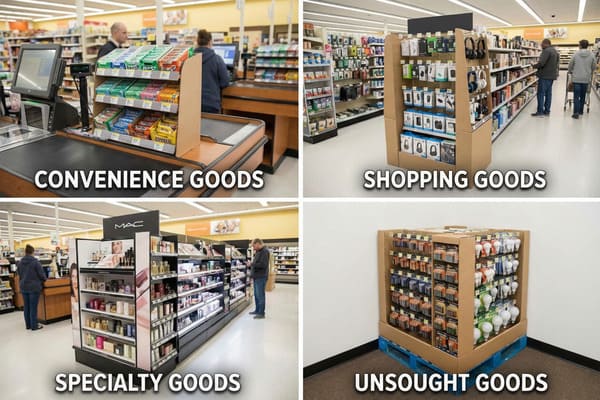
The four main types of merchandise relevant to display strategies are convenience goods, shopping goods, specialty goods, and unsought goods. In the context of cardboard displays, the focus is primarily on convenience (impulse buys) and shopping goods, as these benefit most from high-visibility structural placement like counter units and floor stands.
Merchandising Strategy and Structural Correlation
To build an effective display, we must analyze the psychology behind the four types of merchandise. First, Convenience Goods9 are low-effort, frequent purchases like candy, batteries, or lip balm. These require Counter Display Units (CDUs) placed at the checkout. The structural requirement here is a small footprint but high product density. The goal is to interrupt the waiting time at the register.
Second, Shopping Goods10 are items consumers compare, such as electronics, cosmetics, or sporting gear (like hunting accessories). These require Floor Displays or Pallet Displays. The structure must be larger to hold more information, as the customer needs education before buying. For example, a display for a crossbow needs to show the specs and durability, requiring a large header card and a sturdy base.
Third, Specialty Goods have high brand loyalty, like high-end perfumes. Cardboard displays for these must utilize premium treatments—think foil stamping, UV coating, and unique shapes. A standard brown box structure will devalue a luxury product. Finally, Unsought Goods are things people do not think to buy, like fire extinguishers or new insurance products. Displays for these must be aggressive and informational, often using "wing" structures attached to existing shelves to grab attention where it is least expected. Using the wrong display type for your merchandise category means your product becomes invisible to the shopper.
This table aligns your product type with the most effective cardboard structure.
| Merchandise Type | Buying Behavior11 | Recommended Display12 | Structural Key |
|---|---|---|---|
| Convenience | Impulse / Habitual | Counter Display / Clip Strip | Small footprint, easy grab |
| Shopping | Comparison / Research | Floor Stand / Pallet Display | Large billboard area, sturdy |
| Specialty | Brand Loyalty / High Cost | Custom Shape / High-End Print | Premium finish, unique shape |
| Unsought | Need Awareness | Sidekick / Power Wing | Disruptive placement |
I always analyze your product type before my team draws a single line. We look at whether your customer buys on impulse or logic. If you are selling high-value hunting gear, I will steer you toward a robust floor unit with ample space for educational graphics, ensuring the display does the selling for you when store staff are busy.
How to make a cardboard display stand up?
Nothing kills a sale faster than a display leaning over in a busy aisle. Structural failure creates safety hazards and makes your high-quality product look cheap, neglected, and unworthy of purchase.
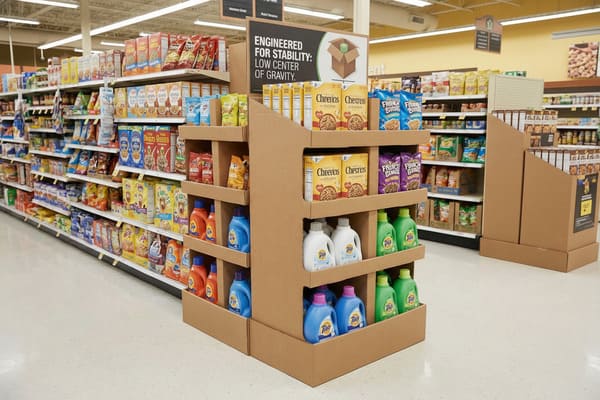
To make a cardboard display stand up securely, engineers use specific structural designs like internal dividers, triangulated support columns, and easel backs. Using the correct flute profile, such as double-wall (BC-flute) for bases, ensures stability. Weight distribution is critical; heavier items must be placed at the bottom to lower the center of gravity.
Engineering Stability and Load-Bearing Physics
Making paper stand up like wood or metal is a feat of engineering that relies on physics and material science. The first factor is the Flute Profile13. We cannot use standard single-wall board for a floor display that holds 50 pounds of product. We typically use "BC-flute," which is a double-wall structure combining two layers of corrugated medium. This provides the vertical crush resistance needed to prevent the display from buckling under its own weight over time. Humidity is the silent killer of stability; cardboard absorbs moisture, losing up to 50% of its strength. Therefore, we often apply a thin poly-coating or varnish to seal the paper fibers.
The second factor is Geometry14. A simple square box is weak. We add strength through internal dividers that act as load-bearing walls, transferring the weight of the products directly to the floor rather than the outer walls of the display. For counter displays, we use "easel backs"—angled supports glued to the rear that create a tripod effect. For floor displays, we often utilize a "waterfall" design where the shelves are slightly angled back, forcing the center of gravity toward the rear of the unit so it does not tip forward when a customer grabs an item. We also calculate the "tipping point." If a display is tall and narrow, we must add a weighted base or widen the footprint to ensure it passes the 15-degree tilt test required by major retailers.
Below are the critical components we use to ensure your display remains upright.
| Component | Function | Best Application |
|---|---|---|
| Double-Wall (BC-Flute)15 | Maximum vertical strength | Floor display bases |
| Internal Dividers | Weight transfer & organization | Heavy products (liquids/tools) |
| Easel Back | Anti-tip support | Counter displays |
| Weighted Base16 | Lowers center of gravity | Tall, narrow displays |
| Triangulated Columns | Rigid corner support | Pallet displays |
I take stability seriously because I know a collapsed display means a lost client for you. My factory performs rigorous load-bearing tests, simulating months of shelf life and high-humidity environments. We add reinforcement bars where necessary, so you can be confident that your display will stand tall and professional until the very last product is sold.
Conclusion
Selecting the right cardboard display involves understanding weight limits, terminology, and merchandise strategy. By focusing on structural integrity and correct categorization, you ensure your products sell faster and safer.
Explore this link to understand the benefits and applications of corrugated fiberboard in packaging, enhancing your sourcing decisions. ↩
Discover the significance of PDQ in retail and how it can streamline your display logistics and improve sales. ↩
Understanding Point of Purchase can enhance your retail strategy and improve customer engagement. ↩
Exploring Shelf Ready Packaging can help streamline your stocking process and boost sales. ↩
Understanding the Edge Crush Test (ECT) is crucial for ensuring packaging durability and product safety during transport. ↩
Exploring precision-cut perforations can reveal how they improve user experience and product presentation in retail environments. ↩
Understanding visual presentation can enhance your packaging strategy, making products more appealing to consumers. ↩
Exploring this topic can reveal innovative packaging solutions that save time and enhance user experience. ↩
Understanding Convenience Goods can enhance your merchandising strategy, ensuring effective product placement and increased sales. ↩
Exploring Shopping Goods will provide insights into effective display strategies that can boost customer engagement and sales. ↩
Understanding buying behavior can enhance marketing strategies and improve sales. ↩
Exploring display strategies can help optimize product visibility and increase customer engagement. ↩
Understanding Flute Profile is crucial for creating stable displays; explore this link to learn how it enhances load-bearing capacity. ↩
Geometry plays a vital role in structural integrity; check this resource to see how it influences design and stability. ↩
Explore this link to understand how Double-Wall (BC-Flute) enhances vertical strength for displays. ↩
Learn about the advantages of a Weighted Base in lowering the center of gravity for tall displays. ↩