Vous passez des semaines à peaufiner les illustrations, pour finalement voir l'usine expédier des boîtes avec des languettes déchirées. Le véritable problème réside généralement dans le tracé de découpe structurel sous-jacent.
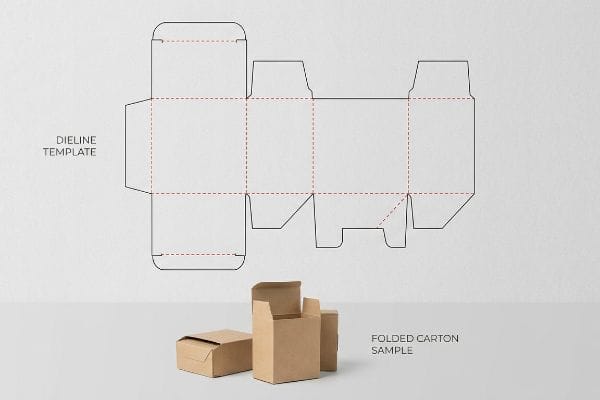
Le travail avec les gabarits d'emballage implique l'exécution d'un modèle vectoriel 2D précis qui définit les découpes et les pliages de la boîte. Ces plans structurels servent de guide aux machines de fabrication, garantissant la transformation de matériaux plats en structures 3D homogènes pour la vente au détail, sans défaillance mécanique.
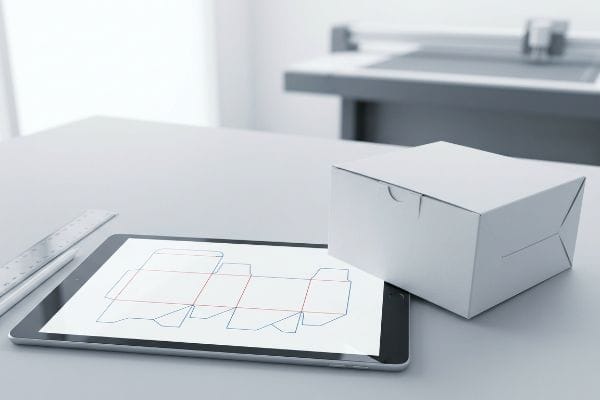
Obtenir des lignes correctes dans un logiciel est une chose, mais faire en sorte qu'elles résistent à la table de découpe physique exige un ensemble de règles complètement différent.
Comment créer un gabarit de découpe pour un emballage ?
Élaborer un plan de structure à partir de zéro exige bien plus que de simples tracés de rectangles. Une précision mathématique est indispensable pour garantir que le carton épais se plie exactement là où il le doit.
La réalisation d'un gabarit d'emballage nécessite un logiciel de CAO (Conception Assistée par Ordinateur) spécialisé pour calculer avec précision les tolérances de pliage du matériau. Les concepteurs définissent des jeux de pliage spécifiques en fonction du calibre exact de la cannelure, générant ainsi une trajectoire vectorielle précise que les tables de découpe automatisées des usines lisent pour produire des languettes de verrouillage sans frottement et des structures de vente au détail parfaitement carrées.
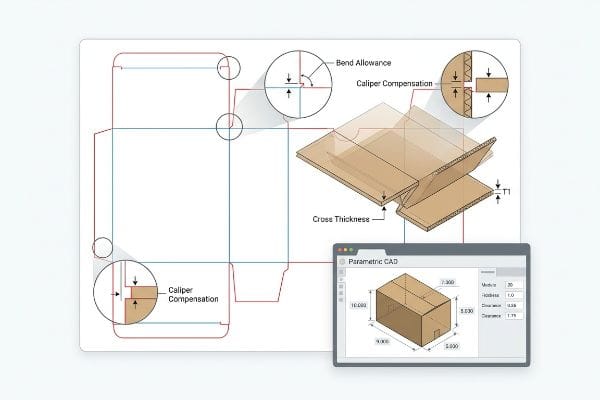
Dessiner une boîte plate dans un logiciel est facile, mais forcer les fibres rigides du papier à se plier parfaitement sans se déchirer est ce qui pose problème à la plupart des gabarits.
Pourquoi la compensation d'étrier est importante en ingénierie du carton
Même les concepteurs les plus expérimentés supposent souvent pouvoir créer des languettes d'emboîtement et des fentes de pliage dans des logiciels d'illustration basiques en les dessinant à la même largeur que le panneau correspondant. Ils traitent le carton ondulé épais comme s'il s'agissait d'une feuille de papier plate microscopique. Cette approche théorique ignore complètement l' épaisseur réelle du supportplié¹.
Je constate ce problème chaque semaine lors de l'assemblage des présentoirs par les marques. Un carton ondulé de type B de 2,8 mm d'épaisseur (0,11 pouce)consomme de la matière lorsqu'il est plié à 90 degrés. Si la rainure de réception sur la découpe n'est pas élargie pour compenser(3) , le présentoir se déforme fortement. Le mois dernier, un client a fourni une découpe plate sans cette compensation, ce qui a contraint un opérateur à transpirer pendant quinze minutes dans l'entrepôt pour assembler une seule base. On entendait clairement la résistance du carton kraft vierge se déchirer lorsque les languettes se verrouillaient. Nous avons dû entièrement recréer les rainures dans notre logiciel, en ajoutant les tolérances de pliage spécifiques pour garantir un assemblage sans frottement des présentoirs pré-remplis. Cela leur a permis d'éviter une baisse de 30 % de la vitesse de leur chaîne de montage.
| Erreurs courantes des débutants | La solution pro | Avantage du magasin |
|---|---|---|
| Dessiner les languettes exactement à l'échelle 1:1 avec les largeurs des fentes | Application des tolérances de pliage mathématiques du pied à coulisse4 | Réduit le frottement lors de l'assemblage par co-emballeur |
| Utilisation des outils web raster de base | Exportation de fichiers PDF structurels paramétriques5 | Garantit que les angles structurels restent parfaitement d'équerre |
| En négligeant l'épaisseur du panneau plié | Ajout de butées de dégagement de 1 mm aux fentes6 | Élimine les déchirures des feuilles supérieures lors de l'installation |
Se fier à un simple fichier d'illustration pour garantir l'intégrité structurelle est une erreur. Je traite systématiquement la géométrie brute avec un logiciel d'ingénierie spécialisé afin de calculer la consommation de papier avant même que la première lame ne touche le panneau.
🛠️ Le bureau d'Harvey : Vous hésitez sur le jeu de pliage de vos languettes d'assemblage pour la cannelure B ? 👉 Demandez un audit gratuit de vos gabarits ↗ — Accès direct à mon bureau. Zéro spam commercial automatisé, promis.
Qu'est-ce qu'une ligne de découpe dans le domaine de l'emballage ?
Nombreux sont les responsables de marques qui contemplent les fichiers structurels de leurs fabricants et se demandent comment un fouillis de traits colorés se traduit en une boîte de vente au détail physique capable de contenir des marchandises lourdes.
Un tracé de découpe pour emballage est un fichier vectoriel de couleur spécifique qui indique précisément les découpes et les pliages nécessaires aux machines CNC (Commande Numérique par Calculateur). Au lieu d'encre, ce sont ces traits colorés qui indiquent au laser de l'usine où découper ou rainer le carton ondulé brut.
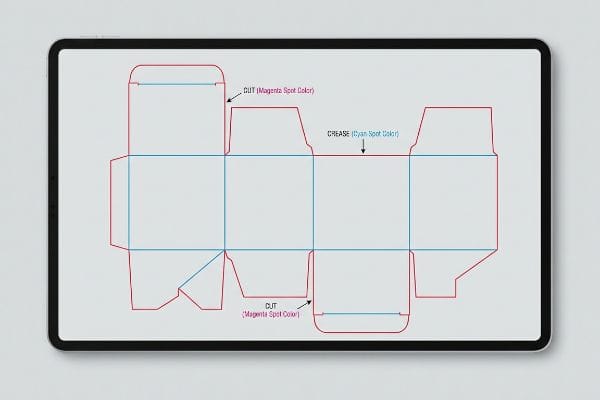
Ces lignes colorées sur votre écran ne signifient absolument rien si les machines de l'usine ne peuvent pas lire les commandes mécaniques intégrées.
Le langage mécanique de l'outillage de couleur d'accompagnement
Les graphistes soumettent fréquemment leurs gabarits structurels finaux en utilisant des lignes CMJN (Cyan, Magenta, Jaune, Noir) standard pour indiquer les découpes et les pliages. Ils partent du principe que la table de découpe automatisée saura naturellement comment procéder s'ils visualisent le contour sur leur écran. Cette approche néglige la logique logicielle fondamentale qui pilote les machines de prépresse industrielles .
Les machines de gravure laser automatisées pour carton ne lisent pas les lignes CMJN visuelles ; elles reconnaissent uniquement les noms de couleurs d'accompagnement spécifiques attribués aux contours vectoriels.Il m'arrive fréquemment de recevoir des fichiers où les tracés structurels sont laissés en noir standard, ce qui signifie que le logiciel de prépresse de la machine fusionne directement les lignes de découpe avec la couche d'impression. On se retrouve alors avec une boîte imprimée présentant des contours noirs visibles et disgracieux, mais sans aucune découpe physique, ce qui nous oblige à arrêter la ligne. On ne sent même pas la poussière de découpe, car la lame ne s'engage jamais. Nous résolvons ce problème en convertissant tous les tracés structurels en couleurs d'accompagnement mécaniques absolues(par exemple, 100 % de magenta pour les découpes), ce qui garantit l'engagement des lames sur le carton tout en préservant la qualité de l'impression et vous évite des frais de réimpression importants.
| Erreurs courantes des débutants | La solution pro | Avantage du magasin |
|---|---|---|
| Utilisation du noir CMJN pour les tracés structurels | Attribution de couleurs magenta à 100 %10 | Élimine les contours noirs imprimés sur les boîtes |
| Fusion des couches graphiques et structurelles | Isoler les coupures mécaniques sur une couche verrouillée11 | Accélère les délais de validation prépresse |
| Se fier aux contours visuels | traits vectoriels spécifiques à l'outil de programmation12 | Garantit une découpe automatisée précise |
Considérer les lignes structurelles comme des éléments de design visuel est une erreur. J'impose l'utilisation de couleurs d'accompagnement isolées afin de garantir que les tables de découpe exécutent des commandes mécaniques précises sans altérer votre identité visuelle.
🛠️ Le bureau d'Harvey : Vos lignes de découpe structurelles sont-elles fusionnées par erreur avec votre calque d'impression CMJN ? 👉 Téléchargez votre guide d'installation ↗ — Téléchargement sécurisé. Ma boîte de réception reste ouverte si vous avez des questions.
Quelles sont les 7 étapes fondamentales de la conception d'un emballage ?
Le déploiement commercial d'un produit en magasin nécessite une approche systématique, allant de la stratégie de conception initiale jusqu'à la validation physique avant le début de la production de masse.
Les 7 étapes fondamentales de la conception d'emballage comprennent la définition des exigences du produit, la conception du gabarit structurel, la création de la mise en page graphique, l'application des marges de fond perdu prépresse, le prototypage d'un échantillon physique, l'exécution des tests de conformité au transport et enfin la production en série.
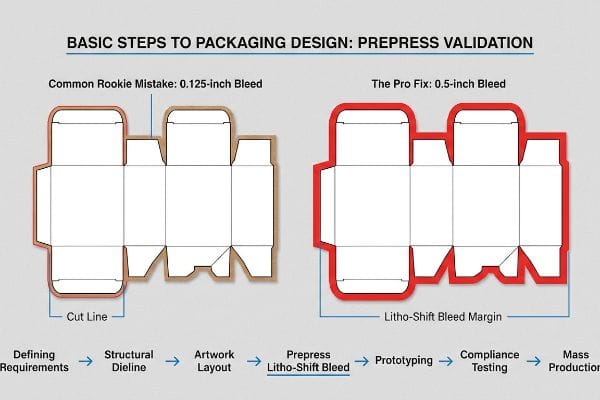
Si les phases de conception créative monopolisent toute l'attention, c'est l'étape technique de prépresse qui détermine si la plupart des campagnes réussissent ou échouent de façon catastrophique sur la chaîne de production.
L'étape de marge de débordement Litho-Shift
Lors de la mise en page, la plupart des graphistes appliquent un fond perdu standard de 3,1 mm (0,125 pouce) à leurs fichiers pour présentoirs en carton ondulé . Ils traitent les présentoirs épais pour la vente au détail comme des cartes de visite ou des brochures classiques, partant du principe qu'une marge réduite suffit à compenser les éventuelles variations mécaniques lors de la découpe finale.
Le procédé physique de collage des feuilles imprimées sur des cartons épais de type B implique intrinsèquement une tolérance mécanique plus large lors du montage automatisé. Avec un fond perdu standard, le décalage inévitable du carton pendant la lithographie-lamination provoque des bavures, où les bords bruts du carton brun apparaissent soudainement sur le présentoir final plié. J'ai vu une fois un magnifique présentoir cosmétique être mis au rebut car un décalage de 2 millimètres avait laissé un bord de papier brut très visible juste à côté d'un logo métallisé haut de gamme. L'odeur de colle PVA (acétate de polyvinyle) à base d'eau, encore humide, était forte et nous avons réalisé que tout le lot avait une apparence bon marché. Désormais, nous appliquons rigoureusement une marge de fond perdu minimale de 12,7 mm (0,5 pouce)14 pouces au-delà de la ligne de coupe, créant ainsi une marge de sécurité qui enveloppe complètement chaque bord exposé et évite les rejets qualitatifs de la marque en magasin.
| Erreurs courantes des débutants | La solution pro | Avantage du magasin |
|---|---|---|
| Utilisation de marges de fond perdu standard de 0,125 pouce15 | Obligation d'un débordement de 0,5 pouce pour la lithographie16 | Empêche les bords de carton brun exposés |
| Ignorer les tolérances de montage automatisées | Extension des graphismes d'arrière-plan au-delà de la ligne de flottaison | Maintient une image de marque visuelle de premier ordre |
| Traiter le carton comme du papier plat | Filets de sécurité d'ingénierie pour le changement de tableau de bord17 | Élimine les refus immédiats des détaillants |
L'étirement poussé des fonds d'illustrations en prépresse est indispensable. Je préfère refuser un fichier d'emblée plutôt que de voir toute une palette d'écrans souffrir d'un effet de bord disgracieux.
🛠️ Le bureau d'Harvey : Vos fichiers graphiques actuels ont-ils suffisamment de fond perdu pour résister aux décalages lors de la lithographie automatisée ? 👉 Demandez votre checklist prépresse ↗ — Pas de formulaires interminables qui vous incitent à passer des heures au démarchage. Uniquement de la valeur ajoutée.
Quels sont les quatre C du design d'emballage ?
L'évaluation de l'agencement d'un emballage de vente au détail nécessite un cadre équilibré afin de s'assurer que l'on ne conçoit pas simplement un bel extérieur qui échoue aux tests de résistance logistiques de base.
Les quatre C de la conception d'emballages correspondent au coût, au concept, à la praticité et à la communication. Ce cadre stratégique garantit que votre structure de vente physique optimise les budgets de matières premières en fonction de la durabilité des emballages, de l'efficacité de l'assemblage sur la chaîne de distribution et de l'impact visuel de la marque auprès du consommateur.
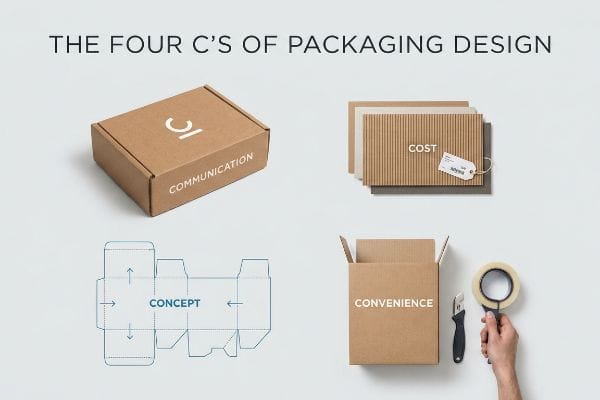
Mais connaître la théorie ne suffit pas lorsque les machines se mettent en marche dans une usine en activité.
Pourquoi une politique d'approvisionnement axée sur les coûts ruine les quatre C
Les équipes marketing utilisent fréquemment ce cadre¹⁸pour orienter le déploiement de leurs points de vente physiques, mais les services achats ont souvent tendance à se focaliser exclusivement sur le critère principal du « coût ». Ils cherchent à réduire la qualité des panneaux departicules¹⁹ pour réaliser des économies immédiates, en supposant que les trois autres piliers du projet resteront, comme par magie, totalement insensibles à cette dégradation des matériaux.
Dans mon atelier, je constate régulièrement les dégâts causés par ce déséquilibre lorsque les acheteurs optent pour un substitut 26ECT (test de compression des bords) au lieu d'une carte 32ECTafin de financer un laminage en feuille coûteux. Lors de la mesure dynamique de la géométrie finale sur nos tables de test, je constate que cette réduction des coûts diminue considérablement la densité des fibres du noyau. La structure se déforme littéralement sous le poids d'une palette de 85 kg (187,5 lbs), et la facilité d'assemblage est compromise car les découpes déformées se déchirent au pliage. J'effectue des mesures micrométriques et démontre qu'en rétablissant mathématiquement la structure à la norme 32ECT initiale et en remplaçant la feuille par un vernis aqueux brillant à haute teneur en solides, nous récupérons la résistance à la compression perdue. En garantissant cet équilibre des matériaux, je réduis le temps d'assemblage pour le conditionnement de 35 secondes par unité,ce qui permet à mes clients d'économiser des milliers d'euros en frais de main-d'œuvre et d'éviter tout dommage pendant le transport.
| Erreurs courantes des débutants | La solution pro | Avantage du magasin |
|---|---|---|
| Réduction de la puissance du circuit imprimé pour réduire les coûts unitaires | Obligation de 32ECT vierges pour les charges utiles lourdes22 | Empêche le flambage de la base sous le poids de la palette |
| Obsession strictement axée sur le prix des matériaux | Lier le coût structurel à l'efficacité d'assemblage | Réduit les coûts globaux de main-d'œuvre liés à l'exécution des commandes |
| Sacrifier la résistance pour des finitions esthétiques | Passage aux revêtements aqueux brillants23 | Préserve l'intégralité des capacités de charge dynamique |
Les équipes d'approvisionnement ne peuvent pas considérer le coût unitaire brut comme un indicateur isolé. J'établis un lien mathématique direct entre les dépenses structurelles et la fluidité de la chaîne d'approvisionnement en aval, garantissant ainsi la fiabilité du système tout au long du transport, sans refacturation catastrophique.
🛠️ Le bureau d'Harvey : Vos réductions de coûts d'approvisionnement nuisent-elles secrètement à la capacité de charge dynamique de vos emballages ? 👉 Envoyez-moi votre fichier de gabarit ↗ — Je vérifierai la robustesse des calculs avant que vous ne gaspilliez votre budget en production de masse.
Conclusion
Vous pouvez choisir un fournisseur moins cher, mais si cette carte 26ECT de qualité inférieure se détériore dans un entrepôt humide, cela provoque des frottements importants, ralentissant la chaîne de montage d'environ 30 % et anéantissant la marge bénéficiaire du projet. Voici la fiche technique exacte utilisée par mes 10 principaux clients du secteur de la vente au détail pour garantir zéro rejet d'impression. Ne vous fiez plus aux tolérances structurelles : laissez-moi analyser vos fichiers grâce à mon Audit de Moulage Gratuit ↗ afin de détecter les défauts de bavures critiques avant le lancement de la production en série.
« Influence des lignes de pliage analogiques et numériques sur les propriétés mécaniques… », https://pmc.ncbi.nlm.nih.gov/articles/PMC9268991/ . Un manuel de référence en ingénierie d'emballage expliquerait comment l'épaisseur du substrat (calibre) influe sur les jeux de pliage et l'ajustement des languettes. Rôle de la preuve : vérification technique ; type de source : norme de conception industrielle. Justifie : la nécessité de prendre en compte l'épaisseur du matériau dans les plans de structure. Note relative au champ d'application : concerne spécifiquement les matériaux ondulés et les cartons épais.
« Carton ondulé et qualités de matériaux | 30/06/2021 », https://www.packagingstrategies.com/articles/96269-corrugated-board-and-material-grades . Les spécifications techniques des matériaux ondulés attestent de l'épaisseur standard du carton cannelure B. Rôle de la preuve : vérification ; type de source : manuel technique ; Appuie : allégation relative à l'épaisseur du matériau. Remarque: de légères variations peuvent survenir selon le fabricant.
« Détermination analytique de la rigidité en flexion d'un emballage à cinq couches… », https://pmc.ncbi.nlm.nih.gov/articles/PMC8777652/ . Les recommandations en ingénierie des structures d'emballage expliquent comment le fait de ne pas tenir compte de l'épaisseur du matériau aux points de pliage entraîne une déformation. Rôle de la preuve : appui théorique ; type de source : guide d'ingénierie ; Justification : nécessité d'élargir les fentes. Note relative au champ d'application : s'applique aux matériaux rigides pliés.
« Guide de calcul des tolérances et déductions de pliage – SendCutSend », https://sendcutsend.com/blog/guide-to-calculating-bend-allowance-and-bend-deduction/?srsltid=AfmBOopVfqWzL62k22DkXdgChwXEZuKjjj0r9ECFe-fCEe5MVFOsTbjn . Brève explication de la manière dont une source externe faisant autorité appuie cette affirmation. Rôle de la preuve : spécification technique ; type de source : manuel d’ingénierie d’emballage. Justifie : l’exigence de tolérances de pliage pour tenir compte de l’épaisseur du matériau dans les plans de structure. Note relative au champ d’application : applicable aux matériaux en carton ondulé et en carton pliant.
« Qu'est-ce qu'une ligne de découpe en emballage et impression ? – PopDisplay », https://popdisplay.me/what-is-a-dieline-in-packaging-print/. Brève explication de la manière dont une source externe faisant autorité appuie cette affirmation. Rôle de la preuve : norme logicielle ; type de source : documentation technique. Appuie : l'utilisation de fichiers paramétriques vectoriels pour maintenir la précision géométrique lors de la découpe. Note de portée : compare avec les alternatives basées sur des images matricielles .
« Résistance à la compression des emballages en carton ondulé à faible épaisseur… », https://pmc.ncbi.nlm.nih.gov/articles/PMC10054506/. Brève explication de la manière dont une source externe faisant autorité appuie cette affirmation. Rôle de la preuve : validation métrique ; type de source : guide de fabrication. Appuie : l’utilisation de marges de sécurité spécifiques pour prévenir la rupture du matériau lors de l’assemblage. Remarque sur la portée : 1 mm est une valeur de référence courante, mais peut varier selon la qualité du carton .
« Couleurs d'accompagnement vs CMJN : différences essentielles expliquées », https://unicopacking.com/en/new/spot-color-vs-process-color.html. Documentation technique expliquant comment les tables de découpe CNC utilisent les couleurs d'accompagnement ou les calques techniques plutôt que les couleurs quadri CMJN pour distinguer les lignes de découpe/rainurage mécaniques. Rôle de la preuve : validation technique ; type de source : manuel industriel. Conforme aux exigences de formatage de fichiers spécifiques dans l'outillage industriel. Remarque sur le champ d'application : s'applique aux logiciels de découpe numérique et de fabrication de matrices .
« CutContour et PerfCutContour — La norme de couleur d'accompagnement pour l'impression et la découpe », https://pb.pressria.com/blog/cut-contour-spot-color-standard/. La documentation technique du logiciel de découpe laser CNC explique la nécessité de la séparation des couleurs d'accompagnement pour distinguer les tracés de découpe des couches d'impression. Rôle de la preuve : vérification technique ; type de source : manuel de logiciel industriel. Justifie : la nécessité des couleurs d'accompagnement pour la reconnaissance par la machine. Remarque : les spécificités peuvent varier selon le fournisseur du logiciel .
« Guide graphique – DeLine Box et présentoirs », https://www.delinebox.com/graphic-guidelines/. Les normes industrielles de prépresse pour l’emballage préconisent l’utilisation de couleurs d’accompagnement non imprimables pour définir les lignes de découpe structurelles afin d’éviter leur fusion avec les couches d’encre CMJN. Rôle de la preuve : vérification des pratiques industrielles ; type de source : guide de conception d’emballage. Appui : la méthode permettant d’assurer la reconnaissance des lignes de découpe. Remarque : certains choix de couleurs, comme le magenta, sont courants mais non universels .
« De la conception à l’épreuve : Guide des lignes de découpe pour emballages », https://admiralpkg.com/post/dielines . Vérification des normes industrielles concernant l’utilisation de couleurs d’accompagnement distinctes pour différencier les lignes de découpe structurelles des éléments graphiques imprimables. Rôle de la preuve : spécification technique ; type de source : manuel de prépresse. Appui : utilisation de la couleur magenta pour éviter l’impression accidentelle des lignes de découpe. Remarque : le choix précis des couleurs peut varier selon les normes des imprimeries.
« Guide du processus complet de prépresse d'emballage », https://www.esko.com/en/blog/a-guide-to-the-full-packaging-prepress-process. Confirmation que la séparation des données structurelles sur des calques dédiés et verrouillés optimise la validation prépresse et évite les modifications accidentelles. Niveau de preuve : bonnes pratiques de processus ; type de source : guide de l'industrie du graphisme. Contribue à : l'efficacité des délais de validation prépresse. Remarque : s'applique principalement aux logiciels vectoriels comme Adobe Illustrator .
« Machine de découpe série RT | Visual Packaging Machinery », https://visualpackaging.com/die-cutting-machine-rt . Preuve que les machines de découpe automatisées nécessitent des définitions vectorielles précises (épaisseur et type) pour interpréter correctement les trajectoires de découpe. Rôle de la preuve : exigence technique ; type de source : spécification matérielle de fabrication. Contribue à : la précision de la découpe automatisée. Remarque : dépend du logiciel CNC ou de traçage utilisé.
« Les progrès de l’impression et du graphisme façonnent… », https://popdisplay.me/what-advances-in-printing-and-graphics-are-shaping-the-look-and-feel-of-corrugated-packaging/. Vérification des dimensions de fond perdu standard pour les fichiers d’emballages en carton ondulé commerciaux. Type de preuve : spécification technique ; source : manuel de l’industrie de l’imprimerie. Confirme : l’affirmation selon laquelle une marge de fond perdu de 0,125 pouce est couramment utilisée. Précision : spécifique à l’impression pour la vente au détail .
Impression directe sur les inserts de boîtes ? – Carton personnalisé PopDisplay… », https://popdisplay.me/printing-directly-on-box-inserts/ . Validation de la marge de fond perdu standard requise pour compenser les décalages mécaniques lors du montage de carton cannelé B. Type de preuve : spécification technique ; source : recommandations d’impression/emballage. Confirme la nécessité d’une marge de sécurité de 12,7 mm (0,5 pouce). Remarque : peut varier selon la précision de l’équipement.
« Comment déterminer la marge de fond perdu à utiliser ? », https://graphicdesign.stackexchange.com/questions/55905/how-can-i-determine-how-much-bleed-to-use . Les normes industrielles pour l'impression offset et numérique spécifient généralement une marge de fond perdu de 3,2 mm (1/8 pouce) comme base pour la marge de coupe. Rôle de la preuve : spécification de référence ; type de source : manuel de production d'impression. Supporte : la mesure standard de fond perdu pour les impressions commerciales à plat. Remarque sur la portée : s'applique aux travaux d'impression standard non laminés.
« Litho-lamination vs. Impression numérique : Guide d'achat industriel… », https://mdmpkg.com/litho-laminited-vs-digital-printing-premium-corrugated-packaging-2/. Les directives techniques relatives aux emballages en carton ondulé expliquent la nécessité de prévoir des fonds perdus plus importants afin de compenser les décalages de repérage lors de la lamination de l'impression sur le carton. Élément de preuve : exigence technique ; type de source : guide d'ingénierie de l'emballage. Justifie : l'exigence spécifique de 12,7 mm (0,5 pouce) pour la litho-lamination. Note relative au champ d'application : spécifique au processus de montage par litho-lamination .
« Le pelliculage lithographique améliore l’image des emballages de toner », https://www.packagingdigest.com/packaging-design/litho-laminating-gives-toner-cartons-an-enhanced-image . La documentation technique relative au montage automatisé des feuilles imprimées sur carton ondulé détaille le phénomène de décalage du carton et les stratégies de conception mises en œuvre pour l’atténuer. Rôle de la preuve : validation de processus ; type de source : livre blanc de fabrication. Appuie : la nécessité de prévoir des mécanismes de sécurité pour compenser le décalage du carton. Note de portée : concerne l’alignement physique des matériaux pendant la production.
« Comment les 4 C de l'emballage stimulent la croissance des entreprises », https://www.linkedin.com/posts/gauravchheda-thebaxsaaco_what-are-the-4-cs-of-packaging-the-baxsaa-activity-7307752054314229762-sr8h . Vérification que le cadre des 4 C est une norme industrielle reconnue et utilisée par les équipes marketing pour le déploiement des emballages de vente au détail. Rôle de la preuve : validation ; type de source : manuel sectoriel ou guide professionnel. Appuie : validité du cadre. Note de portée : pratique générale de l'industrie.
« Étude de l’effet des perforations sur la capacité portante de… », https://pmc.ncbi.nlm.nih.gov/articles/PMC11396172/. Preuves techniques démontrant comment la réduction de la qualité du carton (poids du matériau ou cannelure) nuit à la durabilité structurelle. Rôle de la preuve : explication technique ; type de source : manuel d’ingénierie de l’emballage. Justification : risque structurel lié à la réduction des coûts. Note relative à la portée : spécifique aux matériaux en carton ondulé .
« Comprendre la résistance des cartons d'expédition – EcoEnclose », https://www.ecoenclose.com/blog/understanding-shipping-box-strength/?srsltid=AfmBOoqZJdt_DR05gXPss7nU3Lvd0ulG4F-RU6sYRbljbFH6w3hxRd4b . Les normes techniques relatives au carton ondulé spécifient les différences de capacité de charge entre les différents niveaux de résistance à l'écrasement des bords (ECT). Preuve : spécification technique ; source : norme industrielle. Confirme : l'affirmation selon laquelle une réduction du niveau de résistance à l'écrasement des bords diminue la résistance structurelle. Remarque : les spécificités peuvent varier en fonction de la taille des cannelures et de la qualité du carton.
« Emballages en carton ondulé de conception innovante pour une durabilité accrue… », https://bioresources.cnr.ncsu.edu/resources/corrugated-board-packaging-with-innovative-design-for-enhanced-durability-during-transport/ . Des études d'ingénierie industrielle établissent une corrélation entre la constance des matériaux, leur pliabilité et l'efficacité de l'assemblage en co-emballage. Type de preuve : indicateur de performance ; type de source : étude logistique. Confirme : l'affirmation selon laquelle des normes de matériaux plus élevées réduisent le temps de main-d'œuvre par unité. Remarque : les gains de temps réels dépendent de la géométrie spécifique de la boîte et du niveau d'automatisation.
« Comprendre la résistance des cartons d'expédition », https://www.ecoenclose.com/blog/understanding-shipping-box-strength/?srsltid=AfmBOoopLaGc69i783slMZfiolVObznGbXQVR6mNNLkNMAg7ALohmQBG. Les normes industrielles relatives au carton ondulé démontrent que la valeur 32ECT (Edge Crush Test) garantit la résistance à la compression verticale nécessaire pour éviter le flambage du fond sous de lourdes charges palettisées. Preuve : spécification technique ; source : norme industrielle. Constat : l'efficacité de la norme 32ECT pour l'intégrité structurelle sous charges importantes. Précision : s'applique spécifiquement aux emballages en carton ondulé .
« Revêtement aqueux pour emballages : comment il améliore l’attrait et… », https://www.thecustomboxes.com/blog/aqueous-coating-for-packaging/?srsltid=AfmBOorkRPo9pYOl0rggzyJw5UdbKXWo8ZbCf_mNH4VGaUvAY-ve_Vm5. Les données techniques sur les finitions d’emballage indiquent que les revêtements aqueux offrent une surface protectrice qui préserve la résistance aux charges dynamiques du carton plus efficacement que certains stratifiés épais ou finitions à base de solvants. Preuve : validation des propriétés des matériaux ; type de source : fiche technique. Appuie : l’affirmation selon laquelle les revêtements aqueux préservent la résistance structurelle. Note relative au champ d’application : concerne les applications d’emballage prêtes à la vente .