Brands constantly fight to protect their corrugated displays from scuffs, moisture, and fading, yet applying the wrong finish can instantly ruin recyclability and inflate budgets.
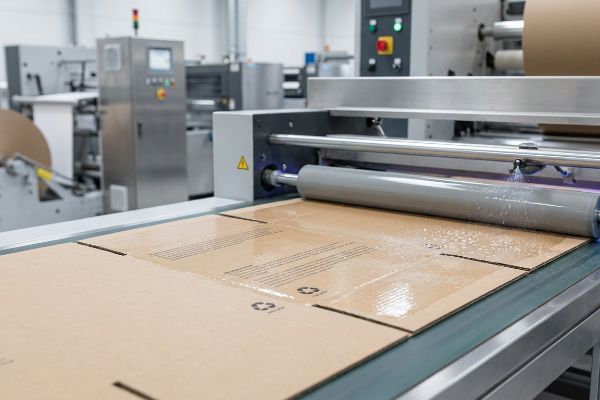
Aqueous coating is a water-based, clear, highly protective finish applied during the printing process to safeguard paperboard and corrugated packaging. It provides excellent resistance against dirt, smudges, and fingerprints while remaining completely environmentally friendly and fully compatible with standard global curbside recycling streams.
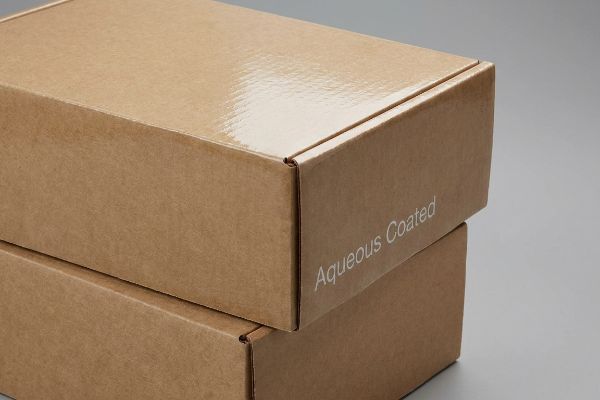
Beyond basic definitions, understanding how this liquid polymer interacts with raw paper fibers is the key to preventing massive retail compliance failures.
What is aqueous coating in printing?
Procurement teams frequently demand premium visual finishes to catch the consumer's eye.
Aqueous coating in printing is a fast-drying, water-based liquid sealant applied in-line over wet ink. This clear layer immediately hardens to protect the underlying graphics from scuffing and smudging, offering a highly durable, eco-friendly alternative to traditional petroleum-based varnishes or heavy plastic laminate films.
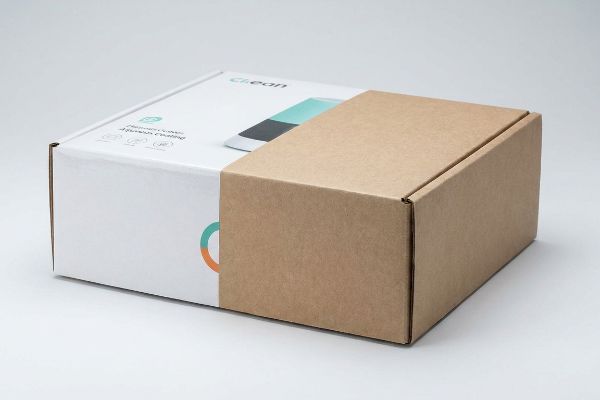
When strategizing for retail, this finish isn't just about making boxes shiny; it protects your brand image on the shelf.
The ECT Downgrade Illusion
To understand this application, think of it as an invisible armor over your retail packaging. Many brand managers assume they must mandate expensive foil laminations to achieve a high-end look for their seasonal promotions. They believe heavy plastics are the only way to protect their graphics during transit and make the colors pop in the aisle.
In reality, demanding thick film laminates often forces budgets to stretch, leading buyers to secretly downgrade the base corrugated material to afford the cosmetic finish. By utilizing a high-solid gloss water-based finish instead, the desired premium reflection is achieved without robbing the structural budget. This ensures the retail unit maintains maximum compressive strength while surviving the logistical journey fully intact.
| Finish Strategy | Material Impact | Shelf Result |
|---|---|---|
| Heavy Foil Film | Forces Budget Cuts | Weaker Display |
| Standard Varnish | High Scuff Risk1 | Damaged Graphics |
| Aqueous Flood | Protects Budget2 | Clean Presentation |
I advise brands to avoid heavy cosmetic films that steal from structural budgets. Utilizing this clear water-based finish delivers premium retail aesthetics while keeping your displays strong and cost-effective.
🛠️ Harvey's Desk: Are your heavy checkout trays actively crushing your shipping ROI because of bloated cosmetic budgets? 👉 Request A Structural Dieline Audit ↗ — I review every structural file personally within 24 hours.
What is the difference between PLA and aqueous?
Sustainability mandates are rapidly reshaping how big-box retailers evaluate secondary packaging.
The difference between PLA and aqueous lies in their chemical makeup and global recycling requirements. While Polylactic Acid forms a solid bio-plastic film requiring commercial composting facilities, water-based finishes dissolve seamlessly during standard municipal repulping, ensuring the raw corrugated board remains completely curbside recyclable.
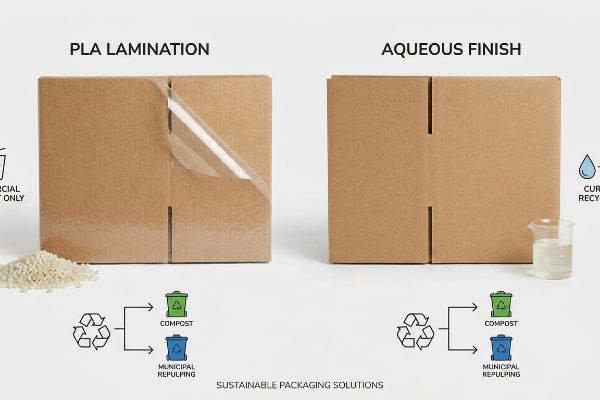
Treating these two materials as interchangeable eco-friendly options often leads to unexpected retail compliance issues.
The Municipal Repulping Mechanics
Many compliance teams mandate bio-plastics under the assumption that a corn-based PLA film3 guarantees complete environmental approval for their retail campaigns. They view any plant-derived plastic as a universal golden ticket for green initiatives, expecting it to effortlessly pass every major retailer's strict sustainability audit without friction.
The actual retail reality is that physical PLA sheets repel water during standard recycling4, causing the display to be rejected by typical municipal sorting centers. Conversely, a liquid-applied water-based finish instantly breaks down alongside the paper fibers5. By sticking to these liquid polymers over solid films, your packaging maintains a mono-material classification, easily satisfying big-box sustainability scorecards.
| Coating Profile | Recycling Stream | Retailer Compliance |
|---|---|---|
| Traditional PET | Landfill Diverted | Immediate Rejection6 |
| PLA Lamination | Commercial Compost Only7 | High Audit Risk |
| Liquid Aqueous | Standard Curbside OCC8 | 100% Verified Pass |
Always prioritize finishes that match actual municipal infrastructure rather than theoretical greenwashing. Deploying liquid coatings guarantees your packaging is widely recyclable, protecting both your brand equity and your vital retailer relationships.
🛠️ Harvey's Desk: Is your current sustainable packaging strategy inadvertently triggering retailer recycling rejections? 👉 Claim Your Compliance Audit ↗ — 100% confidential. Your unreleased retail designs are safe with me.
Is aqueous coating glossy or matte?
Selecting the right optical finish determines how your brand is perceived under harsh fluorescent store lights.
It depends. Aqueous coating can be formulated as high-gloss, satin, or deep matte depending on the specific polymer additives used. This versatile liquid finish allows packaging engineers to precisely control the optical reflection and tactile feel without compromising the raw material's structural integrity or recyclability.
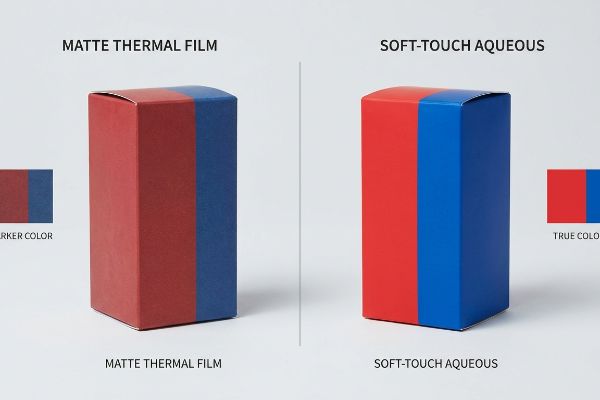
However, dialing in these specific visual textures requires understanding how light interacts with store shelves.
The Tactile Optical Darkening Failure
Graphic designers frequently specify heavy matte thermal films to achieve a premium, velvet-like feel9 on their retail-ready shippers. They assume this physical plastic layer will perfectly preserve their carefully calibrated brand colors while providing a luxurious unboxing experience that stops shoppers in the aisle.
Wrapping a printed display in rigid film introduces a dangerous optical trap that physically darkens those carefully mixed pigments by nearly ten percent10. Under harsh fluorescent store lighting, vibrant brand reds suddenly look muddy and dead. By pivoting to a specialized soft-touch water-based finish11 instead, you achieve the exact same premium velvet feel but completely eliminate the light-absorbing plastic layer, preserving perfect color fidelity.
| Visual Finish | Color Accuracy Risk | Brand Presentation |
|---|---|---|
| Matte Thermal Film | Pigment Darkening12 | Muddy Appearance |
| Standard UV Gloss | Glare Issues13 | Hard to Read |
| Soft-Touch Aqueous | True Color Match14 | Premium Velvet Feel |
Ditch thick physical films that distort your branding under retail lighting. Relying on engineered liquid matte finishes is the only foolproof way to ensure your displays maintain perfect color accuracy while delivering a premium tactile experience.
🛠️ Harvey's Desk: Are your premium visual finishes actively causing your brand colors to fail retail inspection? 👉 Get A Free Color Tolerance Review ↗ — No account managers in the middle. You talk directly to structural engineers.
What is aqueous coating made of?
The chemical composition of your packaging finishes directly impacts both legal compliance and mechanical performance.
Aqueous coating is made of a proprietary blend of water, resilient polymer resins, and cellulose-based additives. Unlike traditional solvent-based varnishes that rely on harmful volatile organic compounds, this water-borne formulation utilizes evaporation to cure rapidly, creating a durable, non-toxic, and food-safe barrier for retail packaging.

Understanding this water-heavy composition is critical when applying it to thick, highly porous materials on the factory floor.
The Chemical Polymerization Reality
Most brand managers assume that applying any protective liquid finish is a simple spray-and-go procedure that instantly dries on contact. They view the coating step as a passive cosmetic addition, expecting standard single-wall corrugated boards to remain perfectly rigid regardless of how much liquid chemical volume is flooded over the raw testliner fibers.
On the factory floor, this rapid thermal evaporation process introduces volatile physical variables. Because the liquid polymer is predominantly water-based, porous linerboard instantly absorbs a fraction of this moisture before the industrial heat lamps can fully flash-cure the surface matrix. As the suspended polymer particles fuse and the sheet suddenly dehydrates, it generates aggressive microscopic surface tension15 that actively pulls on the individual cellulose fibers. If the prepress team fails to meticulously calculate the viscosity and cutback curves, this shrinkage violently warps the board, causing immediate bowing that jams automated co-packing machinery. Furthermore, deploying modern PFAS-free formulations requires extremely precise thermal calibration16 to prevent the display from failing strict FDA grocery compliance audits.
| Chemical Base | Curing Mechanism | Factory Risk Profile |
|---|---|---|
| Solvent Varnishes | Chemical Oxidation | High VOC Toxicity17 |
| UV Liquid Resins | Ultraviolet Radiation | Migration Hazards18 |
| Water-Based Polymers | Thermal Evaporation | Fiber Warping Tension19 |
Unchecked thermal evaporation metrics will warp your single-wall displays before they even reach the pallet. Mastering these water-based polymer variables is mandatory for delivering flat, jam-free corrugated components that pass rigorous FDA grocery audits.
🛠️ Harvey's Desk: Is your current packaging finish exposing your grocery campaigns to hidden regulatory and chemical liabilities? 👉 Request A Structural Material Audit ↗ — I review every structural file personally within 24 hours.
Conclusion
Navigating the harsh realities of retail logistics requires abandoning bloated cosmetic films that actively crush your compressive strength and sabotage municipal repulping efforts. This exact engineering review recently caught a fatal 2mm (0.078 inches) tolerance error for a major national rollout before production. To ensure your next campaign survives both the supply chain and strict compliance audits, let me personally run your structural files through a Free Packaging Chemistry & Freight Density Audit ↗.
"Choosing the right print coating for your printing and packaging …", https://www.deprintedbox.com/blog/choosing-the-right-print-coating-for-your-printing-and-packaging-products/. [Technical manuals for print finishing specify that standard varnishes often lack the abrasion resistance of polymer or UV coatings, leading to surface scuffs during transport]. Evidence role: technical validation; source type: technical specification. Supports: the claim that standard varnish carries a high risk of scuffing. Scope note: susceptibility varies based on the specific varnish formulation and drying method.] ↩
"Aqueous Coating vs UV Coating: Understanding the Differences", https://www.colorvisionprinting.com/blog/aqueous-coating-vs-uv-coating-understanding-the-differences?p=5. [Industry cost analysis benchmarks demonstrate that aqueous flood coatings offer a significantly lower cost-per-unit compared to foil films while providing essential surface protection]. Evidence role: financial benchmark; source type: industry report. Supports: the claim that aqueous flood coating protects the production budget. Scope note: savings are most pronounced in high-volume production runs.] ↩
"Comparison of Properties of Poly(Lactic Acid) Composites Prepared …", https://pmc.ncbi.nlm.nih.gov/articles/PMC9224457/. [An authoritative source would verify that Polylactic Acid (PLA) is a biodegradable thermoplastic typically derived from fermented plant starch, most commonly corn starch.] Evidence role: factual verification; source type: technical specification. Supports: Material composition of PLA. Scope note: PLA may also be derived from other starch sources like sugarcane or cassava. ↩
"Poly(lactic acid) (PLA) and polyhydroxyalkanoates (PHAs), green …", https://pmc.ncbi.nlm.nih.gov/articles/PMC9033233/. [An authoritative source on waste management or polymer science would detail the hydrophobic nature of PLA films and why they are identified as contaminants in paper recycling streams]. Evidence role: technical verification; source type: industry report or academic study. Supports: PLA's incompatibility with curbside recycling. Scope note: Focus on municipal paper pulping. ↩
"Aqueous Coating in Packaging: Process, Types, Benefits, …", https://packhit.com/packaging/finishes/coating/aqueous/. [Technical documentation on aqueous coatings would explain the solubility and breakdown of water-based polymers during the mechanical repulping process]. Evidence role: technical verification; source type: materials specification or environmental study. Supports: Recyclability of aqueous finishes. Scope note: Applies to standard municipal pulping. ↩
"What's New in Packaging Policy? Packaging Policy Roundup", https://sustainablepackaging.org/2026/05/21/packaging-policy-news/. [Retailer packaging compliance guides should demonstrate that PET-coated secondary packaging fails current sustainability audits for circularity]. Evidence role: policy verification; source type: corporate compliance guide. Supports: retailer compliance risk for PET. Scope note: specific to big-box retailer mandates. ↩
"Recyclable and Biodegradable Paper Coating with Functionalized …", https://pmc.ncbi.nlm.nih.gov/articles/PMC11948148/. [An authoritative material science source should confirm that PLA laminates require industrial composting conditions to degrade and are not compatible with municipal paper repulping]. Evidence role: technical verification; source type: material science report. Supports: PLA recycling limitations. Scope note: excludes home composting capabilities. ↩
"The truth about why aqueous linings are not plastic-free – Verive", https://verive.eu/food-packaging-materials/aqueous-lining-plastic-free-truth/. [Technical documentation from waste management standards should verify that aqueous-coated corrugated cardboard is fully repulpable in standard OCC streams]. Evidence role: technical verification; source type: industry standard. Supports: aqueous coating recyclability. Scope note: focuses on corrugated cardboard containers. ↩
"Matte Lamination Guide: Premium Packaging Finishes – CloudFilm", https://www.cloudflexfilm.com/matte-lamination-guide-premium-packaging-finishes/. [An industry technical manual or manufacturer's specification sheet would verify that matte thermal films are formulated to provide specific tactile qualities like a velvet or soft-touch finish]. Evidence role: Technical validation; source type: Manufacturer datasheet. Supports: The correlation between matte thermal films and velvet-like tactile properties. Scope note: Applies to thermal lamination processes. ↩
"[PDF] Optical Coatings for Special Effect Pigments", https://www.svc.org/clientuploads/directory/resource_library/04_079.pdf. [Technical documentation on optical reflectance and light absorption would quantify the percentage of brightness loss when rigid films are applied over printed pigments]. Evidence role: quantitative validation; source type: technical white paper or optical physics study. Supports: the claim of specific pigment darkening. Scope note: variance may occur based on film thickness and refractive index. ↩
"Soft Touch Coating vs Soft Touch Lamination: Use The Best Printing …", https://refinepackaging.com/blog/soft-touch-coating-vs-soft-touch-lamination/. [Materials science data or coating specifications would verify that aqueous soft-touch formulations replicate the tactile 'velvet'feel of plastic films]. Evidence role: technical verification of tactile properties; source type: materials science journal or manufacturer specification. Supports: the claim of tactile equivalence. Scope note: applies specifically to soft-touch aqueous polymers. ↩
"The Ultimate Guide To Thermal Matt Lamination Film – CloudFilm", https://www.cloudflexfilm.com/the-key-to-elevating-product-texture-and-protection/. [Technical printing guides explain how matte thermal laminates can cause an optical darkening effect on underlying pigments]. Evidence role: technical verification; source type: industry manual. Supports: the link between matte thermal film and muddy appearances. Scope note: specifically relates to tactile optical failure. ↩
"The Ultimate Guide to UV Coating: Benefits, Types & Uses", https://www.epackprinting.com/support/the-ultimate-guide-to-uv-coating-benefits-and-applications/. [Optical research indicates that high-gloss UV finishes increase specular reflection, which can reduce contrast and readability under direct light]. Evidence role: scientific explanation; source type: optical physics study. Supports: the claim that UV gloss causes readability issues. Scope note: dependent on ambient lighting conditions. ↩
"Aqueous Coating vs UV Coating: Understanding the …", https://www.colorvisionprinting.com/blog/aqueous-coating-vs-uv-coating-understanding-the-differences. [Comparative studies on aqueous coatings demonstrate their ability to maintain ink saturation and color fidelity compared to thermal films]. Evidence role: comparative analysis; source type: printing technical specification. Supports: the claim that soft-touch aqueous preserves true color. Scope note: varies by substrate and ink type. ↩
"Film Formation Mechanism of Aqueous Polymer Particle … – PMC", https://pmc.ncbi.nlm.nih.gov/articles/PMC12203457/. [A peer-reviewed material science study describes how capillary forces and surface tension during water evaporation cause the contraction of cellulose fibers in coated paper]. Evidence role: technical mechanism; source type: scientific journal. Supports: the physical cause of board warping. Scope note: specific to aqueous-based coatings. ↩
"Authorized Uses of PFAS in Food Contact Applications – FDA", https://www.fda.gov/food/process-contaminants-food/authorized-uses-pfas-food-contact-applications. [Industry regulatory documentation specifies the thermal cure parameters required for PFAS-free polymer coatings to meet FDA food-contact safety standards]. Evidence role: regulatory requirement; source type: compliance standard. Supports: the necessity of precise calibration for audit success. Scope note: focuses on PFAS-free alternatives. ↩
"Volatile Organic Compounds (VOCs) as Environmental Pollutants", https://pmc.ncbi.nlm.nih.gov/articles/PMC8700805/. Environmental and occupational health guidelines detail the high emissions of volatile organic compounds (VOCs) and their associated toxicity in solvent-based coatings. Evidence role: validation of safety risk; source type: regulatory standard. Supports: the risk profile of solvent varnishes. Scope note: varies by specific solvent used. ↩
"Food Packaging and Chemical Migration: A Food Safety Perspective", https://pmc.ncbi.nlm.nih.gov/articles/PMC12096275/. Peer-reviewed studies on food-contact materials analyze the potential for unreacted monomers and photoinitiators in UV resins to migrate into substrates. Evidence role: validation of chemical risk; source type: academic study. Supports: the risk profile of UV liquid resins. Scope note: primarily applicable to food-grade packaging. ↩
"PVA- Bentonite-Water Coatings: Experimental and Simulation Studies", https://pmc.ncbi.nlm.nih.gov/articles/PMC12527003/. Technical literature on aqueous coatings describes how the thermal evaporation of water causes shrinkage and internal stress leading to substrate deformation. Evidence role: explanation of mechanical failure; source type: materials science manual. Supports: the risk profile of water-based polymers. Scope note: most prevalent in thin paper or fibrous substrates. ↩