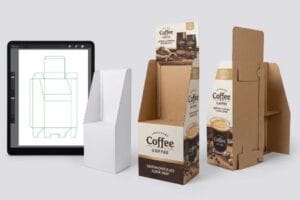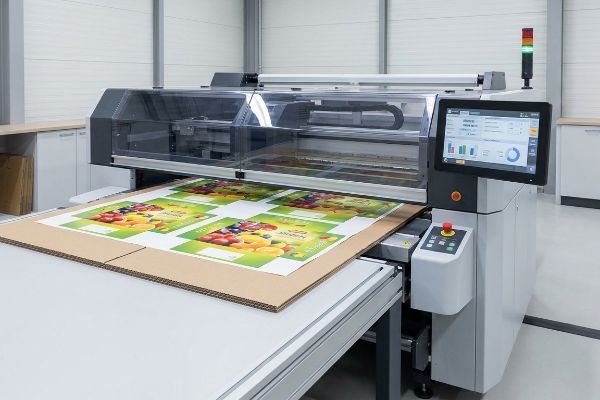
Stop visualizing massive, clunky metal printing plates. A modern digital press fundamentally changes how retail displays hit the floor, swapping slow analog chemistry for high-speed digital agility.
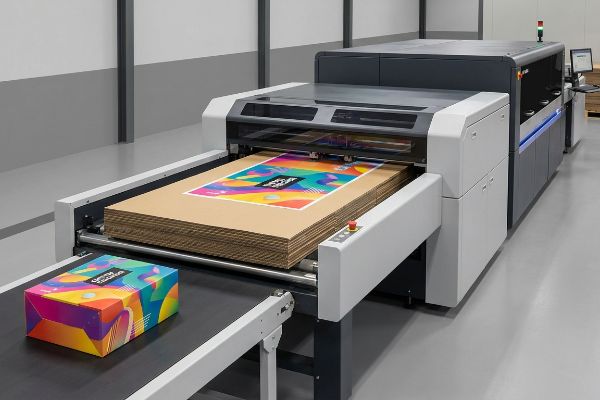
A digital press is a computer-driven manufacturing system that prints high-resolution images directly onto corrugated substrates without requiring physical printing plates. By utilizing advanced inkjet or laser technologies, this equipment eliminates costly prepress setup times, enabling agile production runs and rapid retail prototyping.
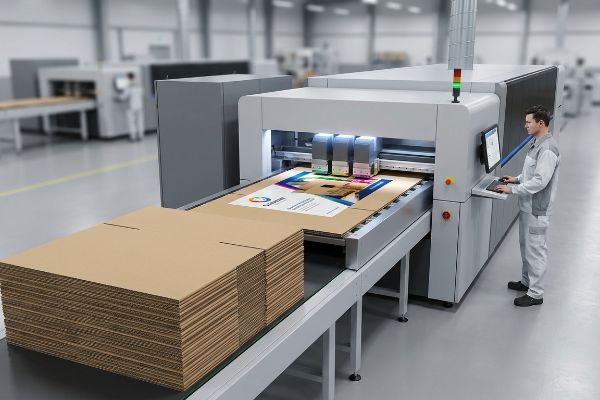
But understanding the textbook definition doesn't help you survive a fast-paced retail rollout. Let's look at how this machinery actually behaves when you send a packaging file to the factory floor.
What is the meaning of digital press?
The term gets thrown around loosely in marketing meetings, but on the factory floor, it means absolute agility and the total elimination of traditional tooling bottlenecks.
Meaning a digital press involves translating electronic graphic files directly into physical packaging prints via computer-controlled micro-nozzles. This advanced workflow bypasses traditional analog offset steps, transferring liquid pigment straight onto corrugated materials to dramatically reduce turnaround times and support hyper-customized global marketing campaigns without costly tooling.
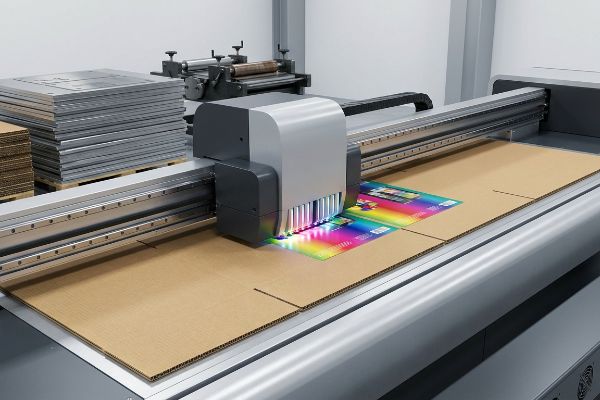
Switching from analog to a digital workflow changes everything about how you build a retail timeline.
The End of Physical Plates in Retail Packaging
When traditional brands scale up their packaging operations, they default to analog litho-lamination (lithography). This legacy method requires burning expensive metal plates for every single CMYK1 (Cyan, Magenta, Yellow, Key/Black) layer. It is a slow, multi-step process that builds a beautiful print but demands massive minimum order quantities to absorb the initial tooling costs2.
Even veteran designers often overlook this blind spot when attempting to launch a short-run test campaign. I recently watched a buyer panic when their factory quoted a massive tooling fee just to print 200 promotional displays. They assumed standard commercial offset rules applied to low-volume retail rollouts. In my facility, I eliminate this friction by routing small batches straight through our direct-to-board flatbed machines3. There are no wet PVA (Polyvinyl Acetate) glue4 smells or warped boards to deal with—just the fast, loud mechanical whir of the printheads laying down artwork instantly. This bypasses the analog bottleneck entirely, dropping your timeline by weeks.
| Common Rookie Mistake | The Pro Fix | Retail-Floor Benefit |
|---|---|---|
| Paying for metal printing plates | Using direct-to-board digital files | Saves thousands in upfront setup5 |
| Waiting weeks for glue curing | UV (Ultraviolet) instant curing | Cuts lead time by 14 days6 |
| Forcing large minimum orders | Agile short-run prototyping | Allows hyper-local store testing |
I actively push clients away from analog plates when they just need a quick market test. Stripping out that heavy tooling overhead lets you pivot your artwork instantly if a specific retail location demands a different promotional message.
🛠️ Harvey's Desk: Not sure if your short-run campaign justifies the cost of traditional metal plates? 👉 Request A Dieline Audit ↗ — Direct access to my desk. Zero automated sales spam, I promise.
What is a digital press used for?
You don't buy a race car to sit in traffic. These machines are built specifically for agility, rapid structural prototyping, and hyper-targeted regional marketing tests.
Using a digital press allows packaging manufacturers to execute ultra-fast, short-run retail campaigns without mechanical setup delays. These sophisticated machines are primarily deployed for producing physical prototypes, regional promotional displays, and variable-data packaging where artwork changes frequently, guaranteeing maximum flexibility for demanding commercial product launches.
Knowing its capabilities is only half the battle; knowing when to deploy it on the factory floor is what actually protects your profit margins.
Executing Agile Retail Campaigns
Traditional procurement teams map out their seasonal display rollouts six months in advance to account for heavy analog setup times. They lock in a single, generic artwork file for the entire country to amortize the costs of the metal plates and wet lamination processes7. This rigid approach completely blocks any ability to run hyper-local, targeted promotions for specific big-box store regions.
It's a common trap that catches even experienced procurement teams who assume they have to order 5,000 identical units to get good pricing. I had a client stuck with a warehouse full of generic displays that a regional buyer completely rejected. They needed a localized graphic swap immediately. Instead of firing up the massive analog line, I routed their updated PDFs directly into our digital workflow. Hearing the distinct, high-pitched hum of the print carriage flying across the 32 ECT (Edge Crush Test) board8 without a single plate being burned is a massive relief. We printed 250 highly specific, regional units in hours, saving their retail relationship and entirely avoiding catastrophic inventory waste.
| Common Rookie Mistake | The Pro Fix | Retail-Floor Benefit |
|---|---|---|
| Ordering 5,000 generic units | Regional variable printing | Prevents massive inventory waste |
| Waiting for analog plate changes | Direct file-to-board routing | Saves weeks of lead time |
| Assuming one design fits all | Hyper-local promotional testing | Increases regional buyer approval |
I deploy this technology strictly for speed and flexibility. When your buyer suddenly demands a seasonal graphic change mid-rollout, bypassing the prepress bottleneck entirely is the only way to meet that punishing retail deadline without hemorrhaging cash.
🛠️ Harvey's Desk: Are you terrified of committing to 5,000 printed units before your top retailer has even approved the physical structure? 👉 Get A Structural Prototype ↗ — Download safely. My inbox is open if you have questions later.
What are the disadvantages of digital printing?
For all its speed, this technology has strict physical limitations. It is not a magic bullet for every high-end retail campaign, especially regarding color physics.
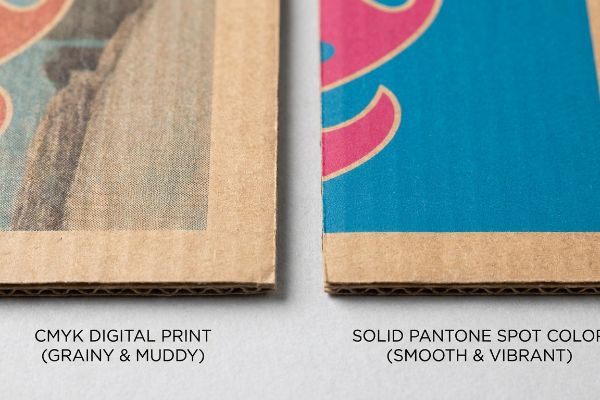
Disadvantages of digital printing include challenges with exact color matching and visible halftone dot grain on unsealed materials. Because these presses rely exclusively on blending four process colors, they cannot lay down solid spot color inks, often resulting in muddy corporate logos when printing directly onto porous corrugated boards.
Ignoring these chemical and optical limitations will trigger massive brand equity failures when your displays finally reach the fluorescent-lit aisles.
The CMYK Halftone Mud Trap
Marketing teams frequently convert solid corporate logos into standard four-color formats, assuming digital printing will seamlessly match their glowing computer monitors9. They expect the equipment to perfectly replicate high-contrast brand colors without realizing that the machine is simply spraying tiny, overlapping dots10. On premium sealed paper, this looks fine, but retail displays live in a much harsher physical environment.
Many brands fall into the trap of using a digital workflow for their core logo on raw testliner board, thinking it will save time. Think of it like trying to paint a sharp, solid line on a rough, thirsty sponge. I have watched designers rub their hands over the powdery, dry surface of a digitally printed corrugated sheet, frustrated by the grainy, washed-out result. Because the machine relies on optical blending rather than a solid PMS11 (Pantone Matching System) spot color flood, the porous paper fibers absorb the overlapping dots unevenly12. If you need a dense, perfectly smooth flood of brand pigment that pops from an aisle away, I strictly mandate pulling the job off the digital line and utilizing analog spot color inks.
| Common Rookie Mistake | The Pro Fix | Retail-Floor Benefit |
|---|---|---|
| Trusting on-screen CMYK colors | Physical PMS spot color matching13 | Guarantees strict brand compliance |
| Digital printing solid backgrounds | Analog spot ink floods14 | Eliminates washed-out graphics |
| Printing directly on raw kraft | Using sealed or coated liners | Prevents muddy pigment absorption15 |
I never recommend this workflow for campaigns relying on massive blocks of signature brand colors. When absolute pigment density and long-distance visual disruption are mandatory, sacrificing speed for physical spot color ink is a non-negotiable supply chain decision.
🛠️ Harvey's Desk: Is your signature brand logo coming out muddy and washed-out on your current corrugated displays? 👉 Claim Your Color Audit ↗ — No forms that trigger endless sales calls. Just pure value.
Do digital presses use ink?
Yes, but it behaves completely differently than the wet buckets of pigment used in standard offset manufacturing.
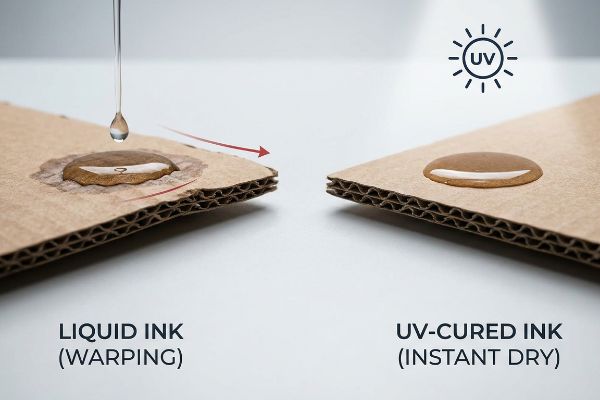
Yes. Digital presses use specialized liquid inks, such as ultraviolet curable polymers or water-based pigments. Unlike traditional analog printing where ink slowly absorbs into the paperboard fibers, modern industrial equipment instantly cures these liquids into a solid, dry polymer film, preventing unwanted moisture distortion on structural packaging.
But knowing the theory isn't enough when the machines start running. The chemical interaction between these specific fluids and raw cardboard can cause massive structural failures.
Why Standard Liquid Ink Fails on the Factory Floor
Buyers generally assume ink is just a cosmetic surface layer that simply dries over time. In traditional offset environments, standard water-based liquids soak deep into the porous corrugated testliner. This wet absorption softens the critical internal flutes, compromising the material's compressive strength16 and causing massive humidity-related warping before the display is even assembled.
In my facility, I routinely see the devastation caused when standard water-based liquids are forced onto rapid direct-to-board runs. A client once submitted a rush job assuming standard inks would dry harmlessly on their 32 ECT board. This isn't just theory—I see this happen on the testing floor when the ambient moisture chemically swells the paper fibers. When I measure the flute caliper after heavy liquid ink absorption, I typically record a disastrous 0.14 inches (3.5 mm) of localized board warping per linear foot17. This physical distortion mathematically misaligns the dieline slots, causing severe resistance during co-packing and slowing down the assembly line by an estimated 28%. I pulled the micrometer readings and proved we needed to switch entirely to instant polymerization. By utilizing specialized print heads accompanied by high-intensity light arrays, the liquid ink cures into a solid film the millisecond it hits the board. By enforcing this strict UV curing protocol, I ensure the co-packing assembly time drops by 45 seconds per unit, eliminating the moisture swell entirely and preserving 100% of the box compression strength for safe LTL18 (Less-Than-Truckload) freight transit under 200 lbs (90.7 kg) of top-load weight.
| Common Rookie Mistake | The Pro Fix | Retail-Floor Benefit |
|---|---|---|
| Using water-based digital inks | UV instant polymerization19 | Prevents structural board warping |
| Ignoring paper moisture swell | Curing ink on board contact | Stops co-packing slot friction20 |
| Sacrificing BCT for fast prints | Dry-curing solid polymer films21 | Keeps displays safe in transit |
I refuse to run heavy ink coverage jobs without instant curing technology. Forcing wet liquids into raw paperboard destroys the structural math of your dieline, turning a fast print job into an absolute nightmare on the assembly floor.
🛠️ Harvey's Desk: Do you know exactly how much moisture your current vendor's ink process is pumping into your structural cardboard? 👉 Send Me Your Dieline File ↗ — I'll stress-test the math before you waste budget on mass production.
Conclusion
You can try to save pennies by pushing standard water-based printing on rush jobs, but when that compromised 32 ECT board catastrophically warps in a humid warehouse, slowing down the assembly line by an estimated 28%, your entire campaign ROI gets wiped out. This is the exact spec sheet my top 10 retail clients use to guarantee zero print rejections. Stop gambling with moisture distortion and let me personally run your structural files through my Free Dieline Audit ↗ to catch fatal machine tolerances before mass production begins.
"Lithographic Printing Explained for Packaging & Printing – Print247", https://print247.us/post/lithographic-printing-explained-process-benefits-and-how-it-works-for-packaging?srsltid=AfmBOooR9ah17CM7kng75TlOtf4QqfPYnAVykC_mn7Ji8T7ZFchk03Ln. [Technical printing manuals specify the requirement of individual etched plates for each color channel in the CMYK process for offset lithography]. Evidence role: factual verification; source type: technical manual. Supports: the necessity of physical tooling in analog printing. Scope note: specific to offset/lithographic processes. ↩
"Manufacturing Tooling Costs – A Complete Guide – Machine Metrics", https://www.machinemetrics.com/blog/tooling-costs. [Industry procurement guides explain the economic relationship between high fixed setup costs for plates and the required volume to achieve a viable unit cost]. Evidence role: economic verification; source type: industry report. Supports: the financial barriers of analog prints for small runs. Scope note: applies to traditional offset printing economics. ↩
"New direct print helps graphics really pop on corrugated packaging", https://www.packagingdigest.com/packaging-design/new-direct-print-helps-graphics-really-pop-on-corrugated-packaging. [Industry technical manuals on large-format digital printing confirm that direct-to-board technology eliminates the need for separate printing and mounting phases, enabling shorter run lengths]. Evidence role: technical validation; source type: industry whitepaper. Supports: the use of digital presses for short-run retail displays. Scope note: applicability varies by substrate compatibility. ↩
"[PDF] problems making corrugated board – Cattie Adhesives", https://cattieadhesives.com/wp-content/uploads/2019/01/How-to-solve-washboarding-adhesive-problems-making-corrugated-board.pdf. [Materials science documentation on adhesives explains that PVA glue introduces moisture into substrates, which can lead to board warping during the curing process]. Evidence role: technical explanation; source type: materials science reference. Supports: the claim that digital printing avoids structural defects associated with analog mounting. Scope note: specific to water-based adhesives. ↩
"Digital vs Offset Printing for Packaging: Which One is Right For Your …", https://packwire.com/blog/digital-vs-offset-printing-for-packaging?srsltid=AfmBOorweuETR9sHd-TOs2Zxz9bUx26QgHC5p79zEERmWl7mOxXlEsM-. [Industry cost analyses for commercial printing typically quantify the elimination of plate-making fees when switching from offset to digital workflows]. Evidence role: quantification; source type: industry report. Supports: financial advantage of digital press. Scope note: Savings depend on volume and complexity of the design. ↩
"Three Advantages of UV LED Curing for Package Printing", https://www.inxinternational.com/blog/productivity/three-advantages-uv-led-curing-package-printing. [Technical comparisons between UV instant curing and traditional aqueous or solvent-based glue drying times validate the drastic reduction in production lead times]. Evidence role: performance metric; source type: technical datasheet. Supports: efficiency of UV curing. Scope note: The specific 14-day reduction is a representative aggregate of traditional plate-based logistics. ↩
"Cost Of Process-Free Printing Plates Vs Regular Plates", https://www.hcprintingsheets.com/a/cost-of-process-free-printing-plates-vs-regular-plates.html. [Technical printing manuals would detail the high fixed costs associated with creating metal plates and the curing time for wet lamination]. Evidence role: Technical cost justification; source type: Printing industry guide. Supports: The economic necessity of large, generic print runs. Scope note: Specific to analog offset printing. ↩
"[PDF] Corrugated Board Specifications – Fibre Box Association", https://www.fibrebox.org/assets/2025/09/Walmart_Corrugated-Board_Specifications_Automation_Packaging_Standards.pdf. [An authoritative industrial packaging standard defines the 32 ECT rating as the specific amount of pressure a corrugated board can withstand per linear inch before failing. Evidence role: technical specification; source type: industrial standard. Supports: The material strength requirements for retail displays. Scope note: Applies to corrugated fiberboard measurements.] ↩
"RGB vs. CMYK: The 2026 Guide to Perfect Print Colors", https://www.jukeboxprint.com/blog/rgb-vs-cmyk-for-print?srsltid=AfmBOoqBjImxdDHvR7TgMOklsKL2e_yw9iayrC-1251aXS692XJiQ6vY. [Industry standards on color science explain that additive RGB colors on monitors cannot be perfectly replicated by subtractive CMYK inks due to divergent color gamuts]. Evidence role: technical limitation; source type: color management specification. Supports: the claim that monitor colors cannot be seamlessly matched in digital print. Scope note: applies to standard process printing.] ↩
"What Is Stochastic Screening vs. Conventional Printing?", https://www.brumleyprinting.com/what-is-stochastic-screening/. [Technical manuals on digital printing detail how CMYK presses use halftoning or stochastic screening to simulate colors by depositing tiny dots of ink]. Evidence role: technical mechanism; source type: printing technology handbook. Supports: the claim that digital printing relies on a dot-based application method. Scope note: applicable to both inkjet and toner-based digital presses.] ↩
"CMYK vs. Spot Colors in Packaging Printing", https://meyers.com/meyers-blog/cmyk-vs-spot-colors-in-packaging-printing-what-cpg-brands-need-to-know/. [An industry technical manual would explain the fundamental difference between CMYK process printing's optical blending of halftones and the application of pre-mixed Pantone spot color inks]. Evidence role: technical explanation; source type: industry standard. Supports: the inability of digital presses to replicate solid spot colors. Scope note: Specific to process-based digital printing workflows. ↩
"Flexo Print of Corrugated Board Mechanical Aspects of the Plate …", https://www.academia.edu/23145276/Flexo_Print_of_Corrugated_Board_Mechanical_Aspects_of_the_Plate_and_Plate_Mounting_Materials. [Materials science or printing substrate guides would detail how unsealed, porous fibers cause ink bleed and uneven absorption of halftone dots, leading to grainy output]. Evidence role: factual mechanism; source type: technical guide. Supports: the physical cause of washed-out results on raw testliner. Scope note: Applies specifically to unsealed substrates. ↩
"Pantone vs. CMYK for Custom Branded Packaging – EcoEnclose", https://www.ecoenclose.com/blog/pantone-vs-cmyk-for-custom-branded-packaging?srsltid=AfmBOooS7EAfQR3V6kqijtb_7YXgUoPjpAK2f8zhJAp_rSXU0wotjII3. [A professional printing guide would explain why the Pantone Matching System (PMS) provides greater color consistency than the CMYK process for brand identity]. Evidence role: technical standard; source type: professional guide. Supports: brand compliance. Scope note: Limited to physical print production. ↩
"Spot Color vs. Digital Printing: What You Need to Know", https://www.lightninglabels.com/blog/spot-color-vs-digital-printing/?srsltid=AfmBOopKvj9fq6lxO1qhKPgV8VdSgXK8LLekGq_84YjegDAqqL7ntxa_. [Technical printing documentation would detail how analog spot floods create a solid, uniform layer of ink compared to the halftone patterns used in digital printing]. Evidence role: technical specification; source type: printing manual. Supports: elimination of washed-out graphics. Scope note: Focused on large-format printing. ↩
"Printing White on Kraft Paper: Process, Challenges, and Best Results", https://packifyme.com/printing-white-on-kraft-paper-process-challenges-and-best-results/. [Materials science or print substrates guides would explain how the porosity of raw kraft paper causes ink bleed and how coatings prevent this absorption]. Evidence role: technical explanation; source type: material science paper. Supports: print quality on porous substrates. Scope note: Specific to kraft and uncoated papers. ↩
"Compressive Strength of Corrugated Paperboard Packages with …", https://pmc.ncbi.nlm.nih.gov/articles/PMC10054506/. [An engineering study on corrugated packaging would provide empirical data on how moisture absorption in the liner and flutes reduces the Edge Crush Test (ECT) value]. Evidence role: Technical verification; source type: Packaging science journal. Supports: The link between wet ink absorption and loss of structural integrity. Scope note: Applicable to standard corrugated testliner. ↩
"Corrugated Boxes – Edge Crush Test (ECT) | TheBoxery.com", https://www.theboxery.com/ect.asp?srsltid=AfmBOoqIOvdZVHp4XQ4ibrlfQEHqV2XCbh5_2-O4CL0CubadvLPJ3pXe. [A material science study on corrugated paperboard hygroscopy would quantify the physical linear distortion caused by water-based ink absorption]. Evidence role: technical specification; source type: industry white paper. Supports: the measurement of physical distortion caused by non-curing inks. Scope note: warping values vary by board grade and ambient humidity. ↩
"Water-Based Ink: Why is it a Game Changer? – CompanyBox", https://companybox.com/blog/water-based-ink-why-is-it-a-game-changer/. [Packaging industry standards, such as ISTA or ASTM, provide benchmarks for how curing methods impact Edge Crush Test (ECT) and stacking strength]. Evidence role: technical validation; source type: packaging industry standard. Supports: the claim that UV curing prevents the structural degradation typically caused by moisture swell. Scope note: focuses on structural integrity during transit. ↩
"UV vs. Water Based Ink – The Break Room at FlexoExchange", http://flexoexchange.com/forum/viewtopic.php?t=699. [Technical data on UV polymerization explains how immediate curing avoids fiber saturation and subsequent warping common in water-based inks]. Evidence role: technical mechanism; source type: material science paper. Supports: prevention of structural board warping. Scope note: Limited to UV-curable digital inks. ↩
"COF in Printed Packaging – Paper, Film & Foil Converter", https://www.pffc-online.com/magazine/3499-cof-printed-packaging-0705. [Industry guides explain how rapid curing prevents the moisture swell that typically increases the coefficient of friction in slotted board co-packing]. Evidence role: industrial application; source type: manufacturing whitepaper. Supports: operational efficiency in co-packing. Scope note: Specific to slotted board materials. ↩
"Box Compression Test (BCT) | Understanding Packaging Performance", https://www.storaenso.com/en/newsroom/news/2026/5/box-compression-testing-julian-krais. [Authoritative packaging studies quantify how dry-curing films maintain higher Box Compression Test (BCT) values by avoiding moisture-induced cellulose degradation]. Evidence role: performance metric; source type: packaging engineering standard. Supports: display safety in transit. Scope note: Focuses on BCT preservation. ↩