Seen "FSDU" on a spec sheet? Misunderstanding this term risks a rejected shipment. Here is the exact definition that saves your retail launch from disaster.
FSDU (Free Standing Display Unit) means a standalone retail fixture designed to hold products independently from fixed store shelving. These temporary structures, typically constructed from corrugated cardboard, are strategically placed in high-traffic aisles to disrupt shopper patterns and drive impulse purchases without requiring permanent installation hardware.
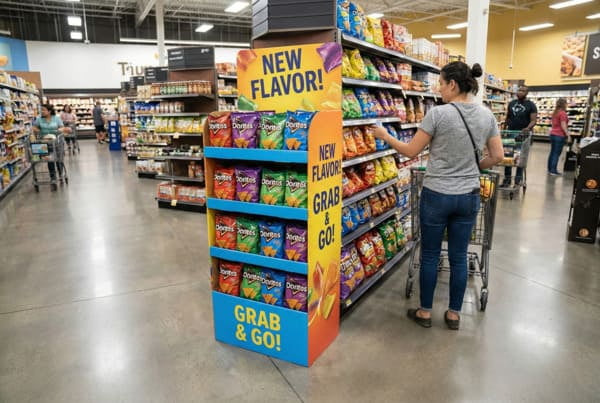
It's more than just a box; it's a tactical tool to claim floor space that doesn't belong to you.
What does fsdu mean?
Don't let the acronym confuse you; in the manufacturing world, this simply refers to a temporary structure that sells product off the shelf.
FSDU (Free Standing Display Unit) means a standalone promotional fixture used to display goods in retail environments distinct from standard gondola shelving. This specific term, often interchangeable with "Floor Display" in global markets, refers to temporary, lightweight structures engineered to maximize brand visibility and product accessibility in open floor areas.
The Structural Anatomy of an FSDU
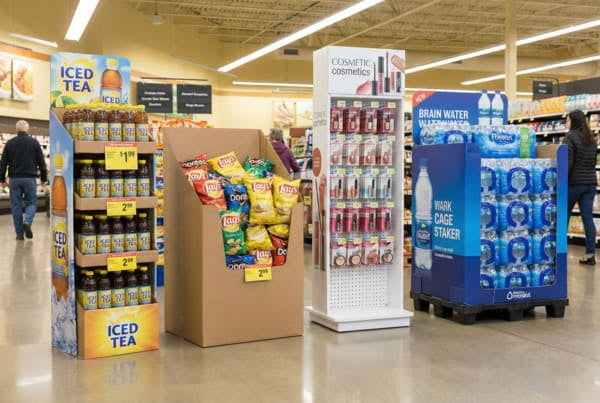
Let's strip away the marketing fluff and talk about the engineering reality. While the term "FSDU" is standard in the UK and Europe, here in the manufacturing hub supplying the US market, we often call them Floor Displays or POP (Point of Purchase) units. But the definition goes deeper than just the name—it's about the structural promise. An FSDU is defined by its ability to stand alone, usually around 60 inches (152 cm) high, without leaning on a wall.
This brings me to the messy reality of production. A lot of clients think "cardboard is cardboard." That's a lie. The defining characteristic of a functional FSDU is the Grain Direction1. In my factory, I see designs fail constantly because a graphic designer treated the FSDU like a folding carton. They run the corrugated flutes horizontally. But cardboard has a "grain" just like wood. If you run the grain horizontally on the load-bearing walls of an FSDU, it will buckle under its own weight within 48 hours of hitting the sales floor.
For a true FSDU entering the US market, specifically for retailers like Target or CVS, we have to define it by its material grade. We don't use standard shipping box material. We use high-performance EB-Flute2 or reinforced B-Flute with vertical grain orientation to maximize the Box Compression Test3 (BCT) score. I learned this the hard way years ago when a batch of displays "sat down" (collapsed) in a humid warehouse because we didn't account for the moisture weakening the fibers. So, when you ask "What does FSDU mean?", it means a temporary structure that requires structural engineering, not just graphic design. It is a balance of "Volumetric Weight" for shipping efficiency and "Stacking Strength" for retail survival.
| Feature | FSDU (Floor Display) | Standard Retail Shelf |
|---|---|---|
| Primary Goal | Impulse Buying & Interruption | Inventory Storage |
| Structural Basis | Corrugated Flute (Vertical Grain) | Steel / Wood / Plastic |
| Placement | Open Aisles / End-Caps | Fixed Gondola Aisles |
| Lifespan | 4–12 Weeks (Temporary) | Years (Permanent) |
| Common Failure | Buckling (Humidity/Weight) | Hidden Product |
Defining an FSDU is easy; building one that stays upright for 8 weeks in a busy store is the real job.
What are the different types of Fsdu?
One size definitely does not fit all. If you force a heavy beverage product into a light cosmetic display, you are creating a safety hazard, not a sales opportunity.
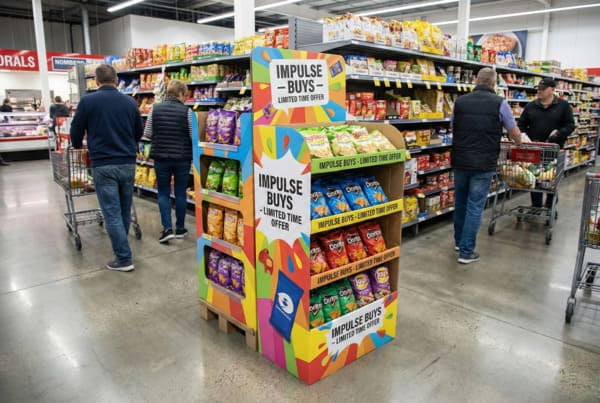
The different types of FSDUs (Free-Standing Display Units) include Standard Shelved Units for organized stacking, Dump Bins for loose impulse items, Peg Hook Displays for hanging blister packs, and Case Stackers for high-volume promotions. Each structural style is engineered to accommodate specific product weights, packaging shapes, and retail floor footprint requirements.
The Structural Style4 Guide: Matching Shape to Product
When a client asks for "an FSDU," I immediately ask: "What are you selling?" because the product dictates the Structural Style. We don't pick styles based on what looks cool; we pick them based on gravity.
The most common style is the Standard Shelved FSDU. This is the workhorse for cosmetics, snacks, and boxed goods. It typically has 3 to 5 shelves. But here is the "messy reality": Tier Sag. If you put heavy jars on a wide cardboard shelf, it bows in the middle. I've seen beautiful displays ruined because the designer didn't calculate the weight load. For these, we now automatically install Metal Support Bars5 hidden under the front lip if the weight exceeds 25 lbs (11 kg) per shelf.
Then you have Dump Bins. These are for loose, irregular items like dog toys or discount DVDs. The danger here is the "Bulge." As you fill a deep bin, the internal pressure pushes the walls out, making the square bin look round and "pregnant." It looks sloppy. We fix this by engineering an internal "H-Divider" or "Cross-Brace" that ties the walls together, keeping the unit perfectly square even when full.
For hanging items (blister packs), we use Peg Hook Displays (or Sidekicks). The failure point here is the "Tipping Point." If the hooks are too long, the center of gravity shifts forward, and the display falls on the customer. We have to calculate the "Moment Arm" and often add an extended base (easel back) to counterbalance the forward weight.
Finally, for heavy beverages, we use Case Stackers. These are simple trays that stack on top of each other. The trick here is "Interlocking Tabs6." Without them, the stack vibrates apart during shipping. We design tabs that lock the top tray into the bottom tray, creating a solid column that can survive a truck ride.
| FSDU Style | Best Application | The Structural Risk | My Factory Fix |
|---|---|---|---|
| Shelved Unit | Boxed Goods / Cosmetics | Shelf Bowing (Sag) | Hidden Metal Bars |
| Dump Bin | Loose / Bulk Items | Wall Bulging | Internal "H-Divider" |
| Peg Hook | Blister Packs | Tipping Forward | Extended Easel Base |
| Case Stacker | Beverages / Heavy Cans | Sliding / Toppling | Interlocking Tabs |
| End Cap | Aisle End Placement | Fitment Issues | 34.5" Width Limit |
Don't just pick a style because you saw it on Pinterest. Pick the style that physically supports your product's center of gravity.
What is the difference between Fsdu and Fsmp?
This is the classic debate between "Rent vs. Buy." Confusing these two will either destroy your marketing budget or leave you with a display that falls apart too soon.
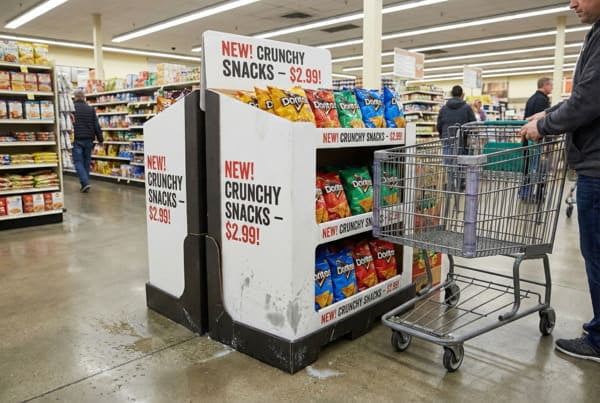
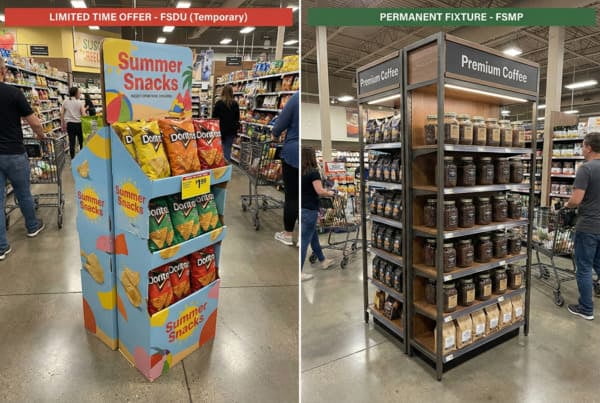
The difference between FSDU (Free Standing Display Unit) and FSMP (Free Standing Merchandising Point) lies primarily in material longevity and cost structure. FSDUs are temporary, cardboard-based units designed for short-term promotions of 4 to 12 weeks, whereas FSMPs are permanent fixtures made from metal, wood, or plastic intended for long-term retail use.
Material Science and Lifecycle Economics
The battle between FSDU and FSMP is really a battle between Agility and Durability. I often have to talk clients out of buying expensive permanent fixtures (FSMP) when what they really need is speed (FSDU).
FSDU (Cardboard): Think of this as "Fast Fashion" for retail. The massive advantage here is Fresh Tooling7 and speed. We can go from a PDF design to 5,000 units on a boat in 15 days. Because they are made of corrugated board, we can change the print, the shape, and the shelf height for every single order. This is critical for seasonal FMCG brands. If you are launching a Halloween candy in October and a Christmas cookie in December, you need FSDUs. But, they have a weakness: Moisture. In a humid distribution center or a store with aggressive mopping, cardboard softens. We use "Mop Guards" (plastic tape) on the bottom, but eventually, the paper wins.
FSMP (Permanent): These are built like tanks—metal, acrylic, wood. They last for years. But the downside is the "Tooling Trap." Once you pay $5,000 for a metal mold, you are stuck with that shape. I had a client who spent a fortune on permanent metal racks for a specific bottle size. Six months later, their marketing team changed the bottle shape. The metal racks were useless trash. FSDUs avoid this risk. Plus, there is the "Sustainability Tax." In places like California (SB 54), brands are responsible for waste. FSDUs are easily Curbside Recyclable8 (OCC). FSMPs are mixed materials that are hard to separate, often ending up in landfills if the store remodels.
| Feature | FSDU (Cardboard) | FSMP (Permanent) |
|---|---|---|
| Material | Corrugated Board (Recyclable) | Metal, Wood, Acrylic |
| Unit Cost | Low ($15 – $45) | High ($150 – $500+) |
| Speed to Market | Fast (10-15 Days) | Slow (45-60 Days) |
| Flexibility | High (Change every run) | Low (Fixed tooling) |
| Durability | 2-3 Months | 2-3 Years |
If your product packaging changes, or if you run seasonal promos, stick to FSDUs. Don't lock your capital into heavy metal fixtures that you can't adapt.
What is a free standing display unit for goods in a supermarket?
Supermarkets are not showrooms; they are high-speed warehouses with customers. Your display needs to survive wet floors, crashing carts, and strict retailer compliance rules.
A Free Standing Display Unit (FSDU) for goods in a supermarket is a temporary retail fixture placed in high-traffic aisles to promote products outside of standard gondola shelving. These units are designed to enhance product visibility, withstand the physical demands of grocery environments, and drive impulse purchases through strategic positioning.
Surviving the "Grocery Gauntlet"
Designing for a supermarket is the hardest test for any FSDU. It's an environment defined by two things: Moisture and Invisibility.
First, let's talk about the "Mop Guard" Protocol. Every night, supermarket cleaning crews run wet mops or industrial floor polishers down the aisles. The dirty water splashes onto the bottom 3 inches (7.6 cm) of your display. Standard cardboard acts like a wick—it sucks that dirty water up. I've seen displays turn brown, moldy, and collapse ("Soggy Bottom") within a week. It kills the brand image. That is why, for any supermarket order, I apply a clear water-resistant varnish9 or a polypropylene barrier tape to the kick-plate. It's non-negotiable if you want to stay on the floor.
Second, we have to fight Shopper Blindness. In a grocery store, people move fast. If your product is on the bottom shelf, it is invisible. We use a "Chin-Up" Angled Shelf design for the bottom tiers. We angle the shelf upwards by about 15 degrees. This makes the product "look up" at the shopper, increasing label readability by 100% for someone standing 3 feet away.
We also have to deal with the "Blue Pallet" problem. Most supermarkets use ugly, splintered blue wooden pallets (CHEP). If you put a beautiful FSDU on top of a dirty pallet, it looks terrible. We design integrated "Pallet Skirts"—panels that fold down to cover the wood completely. It turns a warehouse look into a showroom look.
| Supermarket Hazard | The Impact | My Factory Solution |
|---|---|---|
| Wet Floors | Base rot & collapse | Waterproof "Mop Guard" coating |
| Low Visibility | Shoppers ignore bottom shelf | "Chin-Up" 15° angled shelves |
| Ugly Pallets | Ruins brand aesthetic | Integrated Pallet Skirts |
| Shelf Darkness | Product looks dim | White inner liner to reflect light |
A supermarket FSDU isn't just a holder for goods; it's a defensive structure. It has to fight the mop, hide the pallet, and grab the eye—all while holding 50 lbs (22 kg) of product.
Conclusion
So, what is the reality of the FSDU? It is the most powerful weapon in your retail arsenal because it is temporary, agile, and disruptive. But it is also fragile if engineered poorly. The difference between a sales spike and a "store return" usually comes down to boring details like grain direction, water-resistant coatings, and proper pallet fit.
Would you like me to create a Free Structural 3D Rendering of your concept so we can verify the stability before you commit to production?
Understanding Grain Direction is crucial for ensuring the structural integrity of FSDUs, preventing failures in retail environments. ↩
EB-Flute offers superior strength and durability, making it essential for high-performance displays in retail settings. ↩
Learning about the Box Compression Test helps in understanding how to evaluate the strength and reliability of packaging solutions. ↩
Understanding Structural Style is crucial for effective product display design, ensuring stability and aesthetic appeal. ↩
Explore how Metal Support Bars can prevent sagging and improve the durability of your product displays. ↩
Discover how Interlocking Tabs ensure stability in stacked displays, preventing accidents during transport. ↩
Understanding Fresh Tooling can help you grasp the advantages of speed and flexibility in retail packaging. ↩
Exploring Curbside Recyclable options can enhance your knowledge of sustainable practices in packaging and waste management. ↩
Explore this link to understand how water-resistant varnish can protect your displays and enhance brand image in supermarkets. ↩