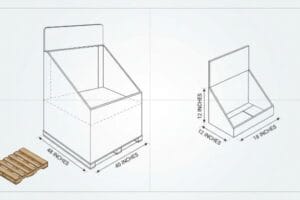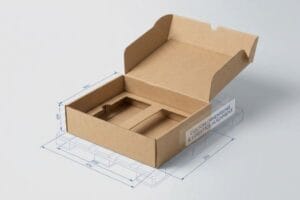
Struggling to get your product noticed in a crowded aisle? The register is your final opportunity to convert foot traffic into revenue, provided your merchandising structure actually performs.
Cardboard countertop display boxes are compact retail merchandisers engineered for high-visibility checkout areas. They secure impulse purchases while complying with strict global point-of-sale limits. By organizing loose inventory into branded structures, these units efficiently convert tight counter space into highly measurable, continuous brand revenue.

Understanding the definition is only the beginning. Moving from theoretical concepts to a physical retail environment requires a deep dive into how these structures actually survive the supply chain.
What are cardboard display boxes?
Most buyers view these simply as folded paper, but in reality, they are complex physical structures designed to hold weight.
Cardboard display boxes are standalone merchandisers manufactured from corrugated paperboard. They organize physical products on retail store shelves, floors, or pallets while acting as primary brand billboards. Global supply chain standards dictate their structural integrity, ensuring they survive rough transit and heavy physical inventory loads.
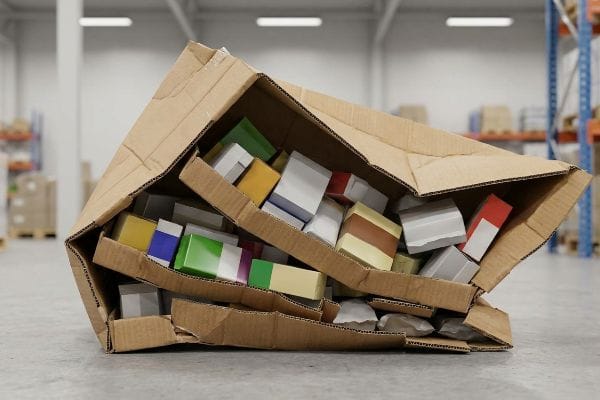
But knowing what they are doesn't explain why so many of them fail before they even reach the retail floor.
The Physics of Structural Cardboard
When brands first start designing retail structures, they typically focus entirely on the exterior graphics. The marketing team will spend weeks adjusting CMYK (Cyan, Magenta, Yellow, Key/Black) color profiles and approving logos, assuming the physical box itself is just a standard commodity. They often approve whatever basic dieline their graphic designer pulls from a generic template library, completely ignoring the mechanical physics of the paperboard.
Even veteran designers often overlook this blind spot. You might think a heavy 32ECT (Edge Crush Test) board guarantees strength, but if you don't engineer the structural math correctly, that material strength is entirely useless. I see this when clients try to design large floor bins without understanding "Grain Direction." Corrugated flutes act like tiny structural columns. If a graphic designer rotates the dieline 90 degrees to save printing space on the master sheet, those flutes now run horizontally. When I press down on the finished sample, I feel the stiff, unyielding resistance of virgin kraft board suddenly buckle under the pressure. Because the structural columns are sideways, the Box Compression Test drops to near zero1, causing massive friction, slowing down the assembly line by an estimated 30%2, and completely wiping out the project's profit margin when the bottom tier crushes under its own weight.
| Common Rookie Mistake | The Pro Fix | Retail-Floor Benefit |
|---|---|---|
| Rotating dielines for print space | Aligning flute grain strictly vertically3 | Prevents base tier crushing |
| Ignoring material flute direction | Mandating BCT modeling4 before printing | Sustains heavy dynamic loads |
| Assuming all thick board is strong | Utilizing vertical ECT physics5 | Reduces damaged goods chargebacks |
I completely reject dielines that compromise vertical flute alignment just to save a few cents on printing paper. I force the artwork layout to follow the structural engineering, not the other way around.
🛠️ Harvey's Desk: Not sure if your graphic designer accidentally rotated the grain direction on your master file? 👉 Get My Free Dieline Review ↗ — Direct access to my desk. Zero automated sales spam, I promise.
What are countertop displays?
Designing for the floor is one thing, but the register zone introduces an entirely different set of physical spatial constraints.
Countertop displays are compact, temporary merchandising units placed directly on retail checkout counters. They hold small impulse goods like cosmetics or candies. Engineered to maximize visibility within tight cashier zones, these units balance aesthetic presentation with strict structural stability to prevent tipping under customer interaction.

Securing placement at the register is a massive win, but keeping the unit standing upright under constant consumer interaction is the real challenge.
The Tipping Point Physics of POS
Standard register trays are often designed as simple, straight-backed boxes. Brands assume that because the unit is small, gravity will naturally keep it anchored to the surface. They focus heavily on making the header card as tall as possible to catch the shopper's eye from across the aisle, ignoring how that extra height shifts the physical center of gravity6.
It is a common trap that catches even experienced procurement teams. You design a tall, beautiful unit, load it with heavy cosmetics, and set it on the checkout counter. The moment a shopper bumps it, you feel the wobbly, uneven slide of an unbalanced base as the entire unit tips backward. To fix this, I utilize "Tipping Point Physics" by engineering an extended easel back or a false bottom into the CAD (Computer-Aided Design) file. This mathematically distributes the dynamic load backward, lowering the center of gravity7. This simple geometric adjustment eliminates the risk of toppling, preventing a messy spill that triggers an immediate retailer rejection and forces the store manager to throw your entire campaign into the recycling bin.
| Common Rookie Mistake | The Pro Fix | Retail-Floor Benefit |
|---|---|---|
| Designing tall, straight-backed trays | Adding an extended easel back support | Prevents backward tipping |
| Ignoring top-heavy center of gravity | Engineering a false bottom for balance | Withstands shopper bumps |
| Oversized headers on small bases | Using a 2:3 depth-to-height ratio | Keeps displays safely anchored |
I refuse to manufacture top-heavy register trays without an engineered back support. I build mathematical balance into the dieline before a single drop of ink touches the paper.
🛠️ Harvey's Desk: Are your register units tipping backward when fully loaded with heavy product? 👉 Download The Countertop Spec Guide ↗ — Download safely. My inbox is open if you have questions later.
What are custom display boxes?
When generic templates fail to secure your product safely, you must move away from off-the-shelf solutions and engineer a bespoke structure.
Custom display boxes are purpose-built packaging structures engineered to a specific product's physical dimensions. Unlike generic retail bins, they utilize proprietary dielines and structural math to ensure exact fitment, optimizing supply chain density and ensuring perfect visual alignment with specific brand marketing campaigns.
A bespoke structure looks incredible in a 3D rendering, but translating those custom digital lines into thick, physical material requires exact mathematical compensation.
The Caliper Compensation Dieline Shift
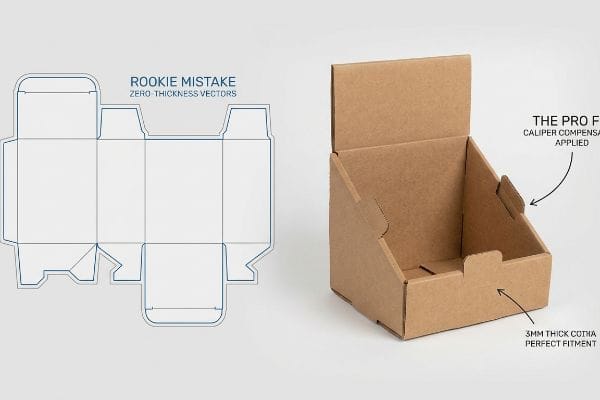
Think of standard packaging like buying a tailored suit off the rack; it works, but the fit is never perfect. Custom packaging is like having a master tailor measure every exact contour of your body. However, graphic designers often build custom interlocking tabs and folding slots in illustration software at the exact same width as the mating panel. They treat the digital lines as if they have zero thickness.
When you fold a real piece of 3 mm (0.11 inches) B-flute corrugated board8 90 degrees, that fold consumes physical material. If the receiving slot on the dieline isn't widened to compensate for the fold's outer radius, the physical reality breaks. I see this daily on the co-packing line; a worker tries to force the tab into a tight slot, and I hear the loud, destructive rip of a tearing slot as the paper fibers burst open. To fix this, I run the custom geometry through parametric software to automatically apply a "Caliper Compensation" algorithm. By adding specific bend allowance tolerances to the receiving slots, I guarantee a frictionless, zero-tear assembly for the co-packer, reducing manual labor costs by an estimated 15%9 and ensuring the final structure sits perfectly square.
| Common Rookie Mistake | The Pro Fix | Retail-Floor Benefit |
|---|---|---|
| Drawing slots exactly the same width as tabs | Applying mathematical caliper compensation10 | Enables zero-friction assembly |
| Ignoring the physical thickness of folded board | Widening receiving slots for bend radii11 | Prevents torn paperboard tabs |
| Treating CAD lines as zero-thickness vectors | Engineering parametric board tolerances12 | Speeds up co-packing labor |
I always completely rebuild flat illustration files using structural software. I factor the exact physical thickness of the board into every single fold before manufacturing begins.
🛠️ Harvey's Desk: Are your co-packers struggling to fold your custom interlocking tabs without tearing the paper? 👉 Request A Structural CAD Audit ↗ — No forms that trigger endless sales calls. Just pure value.
Why are cardboard boxes so expensive?
Investing in bespoke engineering inevitably raises questions about the bottom line and why properly manufactured structures cost more than standard shipping cartons.
Cardboard boxes are expensive because manufacturing them requires precise structural engineering, high-fidelity color calibration, and custom steel-rule tooling. You are paying for engineered moisture resistance, dynamic load capacity, and exact machine tolerances, ensuring the merchandiser survives extreme supply chain fatigue without collapsing.

Buyers often look at the final invoice and try to aggressively cut initial setup fees, not realizing that cheaping out on the manufacturing tools guarantees catastrophic failure on the back end.
The Tooling Degradation Trap
Procurement teams regularly push back against structural tooling fees13. They assume that a one-time payment buys a permanent, indestructible steel rule die14 that can be reused perfectly for years of display reorders. Because the initial run looked great, they demand the factory pull the old, dusty die out of storage 14 months later to run a second batch, expecting the exact same crisp folds to save a few hundred dollars.
They completely ignore the material reality of standard dies, which rely on metal blades embedded in raw, porous plywood boards15. When stored for months in a non-climate-controlled factory environment, the wood base absorbs ambient humidity and physically warps16. When I inspect a run using an aged die, I feel the powdery, messy feel of excessive die-cutting dust caused by a dull, misaligned blade chewing through the paper rather than slicing it. This creates jagged edges and weak score lines that cause the units to assemble crookedly. To prevent this, I mandate a "Fresh Tooling" protocol. I burn a brand new wood base and bend fresh steel blades for every single production batch. This guarantees absolute razor-sharp accuracy, eliminating poor cuts and drastically reducing the defect rate, saving clients thousands in wasted material and retailer rejection penalties.
| Common Rookie Mistake | The Pro Fix | Retail-Floor Benefit |
|---|---|---|
| Reusing old steel rule dies to save money | Mandating fresh tooling for every production run | Guarantees razor-sharp edges17 |
| Storing wood die boards in humid factories18 | Laser-burning new boards per batch | Prevents jagged, ugly cuts |
| Ignoring blade dulling over multiple reorders19 | Engineering new steel blades for crisp folds | Ensures perfectly square assembly |
I never reuse aging, moisture-compromised wood dies for retail reorders. I absorb the effort of creating fresh tooling because crisp execution is non-negotiable for high-end retail.
🛠️ Harvey's Desk: Are your repeat orders coming back with fuzzy edges and weak folding lines? 👉 Claim Your Free Tooling Assessment ↗ — Direct access to my desk. Zero automated sales spam, I promise.
What are display boxes called?
With the financial and structural stakes this high, accurately communicating your exact retail needs becomes paramount to survival.
Display boxes are called POP merchandisers or POS merchandisers depending on their specific placement. Industry terminology dictates formats like floor standees, sidekicks, or shelf-ready packaging. Accurate naming ensures manufacturers apply correct structural math and adhere strictly to specific regional retailer spatial safety regulations.
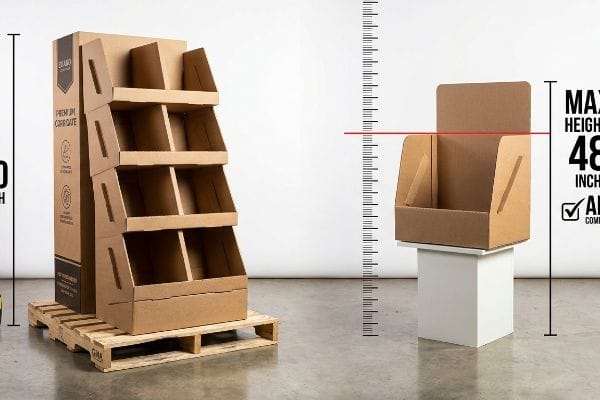
But knowing the correct terminology isn't enough when the physical dimensions clash with strict retail-floor zoning laws.
The ADA vs. GMA Spatial Constraint
Trading companies frequently pitch a "scalable" design where a large floor merchandiser can simply be reduced by 50% to serve as a register tray. They assume that shrinking the graphics and the box dimensions proportionally20 is a perfectly acceptable strategy for hitting two different zones in a single retail environment.
This isn't just theory—I see this happen on the testing floor when buyers attempt to force a POP (Point of Purchase) floor logic onto a POS (Point of Sale) counter reality. In my facility, I routinely see scaled-down structures that completely violate US retail spatial laws. The floor unit was anchored to a standard GMA (Grocery Manufacturers Association) pallet at 48×40 inches21 (121.9×101.6 cm). When shrunk blindly for the counter, the top shelf sits at exactly 52.3 inches (132.8 cm) off the ground. When I measure this against the rigid ADA (Americans with Disabilities Act) forward reach compliance window22, it completely misses the legal 15 to 48 inch (38.1 to 121.9 cm) maximum reach limit. To fix this, I completely separate the engineering pipelines. I mathematically lock all POS files directly to the strict ADA vertical limits. By enforcing this absolute spatial boundary, I ensure the client avoids massive non-compliance chargebacks and prevents store managers from immediately discarding the units to avoid legal liability.
| Common Rookie Mistake | The Pro Fix | Retail-Floor Benefit |
|---|---|---|
| Shrinking floor units proportionally for counters | Separating POP and POS engineering pipelines | Prevents retailer chargebacks |
| Ignoring legal forward reach limits | Locking register units to a 48-inch max height | Ensures ADA legal compliance |
| Using pallet dimensions for counter spaces | Designing specifically for tight register depths | Prevents store manager rejection |
I treat floor units and counter units as two entirely distinct engineering disciplines. I never allow scalable shortcuts to override hard legal retail dimensions.
🛠️ Harvey's Desk: Do you know if your current register unit mathematically violates the 48-inch forward reach limit? 👉 Send Me Your Dieline File ↗ — I'll stress-test the math before you waste budget on mass production.
Conclusion
You can try to save a few dollars by blindly scaling down floor dielines or reusing warped wood tooling, but when those jagged, misaligned tabs tear on the packing line, slowing down your co-packer by an estimated 30%, you will completely obliterate your campaign's profit margin. Over 500 brand managers use my prepress checklist to avoid these exact fatal early-stage mistakes. Stop guessing on complex board tolerances and let me personally run your structural files through my Free Dieline Audit ↗ to catch these physical friction points before your budget is locked into mass production.
"Compression Strength Estimation of Corrugated Board Boxes for a …", https://pmc.ncbi.nlm.nih.gov/articles/PMC9864211/. [Technical engineering guides on corrugated packaging explain how horizontal flute orientation eliminates the vertical load-bearing capacity of the board]. Evidence role: technical verification; source type: engineering manual. Supports: relationship between grain direction and structural failure. Scope note: refers specifically to vertical compression failure. ↩
"How Structural Packaging Design Reduces Waste and Costs", https://www.bcipkg.com/how-structural-packaging-design-reduces-waste-and-costs/. [Industry case studies on supply chain logistics quantify the labor delays and throughput reductions caused by defective point-of-purchase display assembly]. Evidence role: empirical data; source type: industry report. Supports: economic impact of design errors. Scope note: efficiency loss varies by specific assembly environment. ↩
"Estimation of the Compressive Strength of Corrugated Board Boxes …", https://pmc.ncbi.nlm.nih.gov/articles/PMC8467740/. [Engineering guides on corrugated packaging explain that vertical flute alignment maximizes load-bearing capacity to prevent structural collapse]. Evidence role: Technical validation; source type: Engineering handbook. Supports: The relationship between flute orientation and base tier stability. Scope note: Specific to corrugated cardboard. ↩
"A Simplified Dynamic Strength Analysis of Cardboard Packaging …", https://pmc.ncbi.nlm.nih.gov/articles/PMC10385285/. [Industry standards for Box Compression Testing (BCT) provide the mathematical modeling necessary to predict how packaging handles dynamic loads during transport]. Evidence role: Technical specification; source type: Industrial standard. Supports: The use of BCT to ensure load sustainability. Scope note: Applies to shipping and display containers. ↩
"Edge Crush Test: Essential Insights for Corrugated Packaging", https://www.testresources.net/blog/edge-crush-test-essential-insights-for-corrugated-packaging. [The Edge Crush Test (ECT) is a standardized metric used to measure the stacking strength of corrugated board when loaded vertically]. Evidence role: Metric verification; source type: Technical specification. Supports: The physics of ECT as a predictor of structural integrity. Scope note: Focuses on the vertical axis of corrugated material. ↩
"Ensure Stability & Structural Support in Temporary Displays", https://www.ud-direct.com/blog/tips-and-tricks-to-ensure-stability-and-structure-support-in-temporary-displays. [A structural engineering or physics source would explain how adding vertical mass to the top of a lightweight unit raises its center of gravity, thereby reducing its stability and increasing the likelihood of tipping]. Evidence role: Technical verification; source type: Physics textbook or engineering manual. Supports: The mechanical relationship between header height and structural balance. Scope note: Applicable to lightweight point-of-purchase materials]. ↩
"Standing Mirror Support Design: Easel Backs for Retail Display", https://www.dpmirror.com/blog/physics-standing-mirrors-designing-durable-easel-mirror-295.html. [An authoritative source on structural engineering or retail merchandising design would confirm that extending the base or adding an easel back shifts the center of mass to increase stability against tipping]. Evidence role: technical validation; source type: engineering manual or retail design guide. Supports: structural stability of POS displays. Scope note: Focuses on static and dynamic load distribution in lightweight display units. ↩
"Corrugated Board and Material Grades – flute – Packaging Strategies", https://www.packagingstrategies.com/articles/96269-corrugated-board-and-material-grades. [Industry packaging standards define the nominal thickness and flute profile for B-flute corrugated materials. Evidence role: technical specification; source type: industry standard. Supports: material dimensions. Scope note: Thickness may vary slightly by manufacturer.] ↩
"How Package Design Affects Shipping Costs – DCL Logistics", https://dclcorp.com/blog/shipping/package-design-affects-shipping-costs/. [Empirical data from packaging optimization studies quantify the reduction in labor hours when assembly friction and material failure are eliminated. Evidence role: performance metric; source type: industry case study. Supports: economic efficiency of caliper compensation. Scope note: Exact percentage varies by production scale.] ↩
"Curved Dielines & Warping Tutorial – Part 2 – Robert Campbell", https://tuckyhut.com/curved-dielines-and-warping-tutorial-part-2-create-dieline-for-cup-package/. [Industry standards for packaging engineering explain how accounting for material thickness, or caliper, is necessary to ensure tabs fit into slots without forcing]. Evidence role: Technical verification; source type: Professional packaging manual. Supports: The necessity of caliper adjustments for assembly. Scope note: Specific to foldable paperboard materials. ↩
"Sheet Metal Bend Radius Guidelines – Protolabs", https://www.protolabs.com/resources/design-tips/the-basics-of-bend-radii-in-sheet-metal/. [Engineering documentation on material deformation shows that slots must be widened to accommodate the outer radius created when thick board is folded]. Evidence role: Physical principle verification; source type: Material science textbook. Supports: The prevention of torn tabs during folding. Scope note: Applies primarily to high-caliper corrugated or folding carton board. ↩
"Use of Vectorial Tolerances for Direct Representation and Analysis …", https://www.sciencedirect.com/science/article/pii/S2212827115003339. [Technical guides on CAD for packaging detail how parametric tolerances account for manufacturing variances to ensure consistent assembly speed]. Evidence role: Process verification; source type: CAD software technical documentation. Supports: The link between tolerance engineering and co-packing efficiency. Scope note: Focuses on the use of parametric modeling software. ↩
"What are Set-Up Fees in Packaging?", https://www.howtobuypackaging.com/set-up-fees-in-packaging/. [Industry standards for packaging procurement define structural tooling fees as the costs for creating the physical dies used to cut and crease cardboard.] Evidence role: Definitional; source type: Industry glossary. Supports: The existence and nature of these fees in packaging. Scope note: N/A. ↩
"How to Care for Your Steel Rule Die Cuts – 2026 Maintenance Guide", https://lwleathers.com/blogs/news/how-to-care-for-your-steel-rule-die-cuts-2026-maintenance-guide?srsltid=AfmBOoqfgaR-cVrxIP5Ict0SSkf1Mp4QPnClVewyDPlXu1jrHp8A9Ozd. [Industrial engineering guides explain that steel rule dies suffer from material fatigue and edge dulling, contradicting the notion of permanence.] Evidence role: Technical verification; source type: Industrial manufacturing manual. Supports: The premise that tooling degrades over time. Scope note: Degradation is a function of impression count. ↩
"Unlocking the Mystery of the Steel Rule Die", https://appledie.com/just-unlocking-mystery-steel-rule-die/. [An authoritative source on packaging manufacturing would confirm that standard steel-rule dies are constructed by embedding hardened steel strips into a plywood base]. Evidence role: technical specification; source type: industry handbook. Supports: construction of standard dies. Scope note: refers specifically to analog steel-rule die cutting. ↩
"Cutting Board Warping – The Wood Whisperer", https://thewoodwhisperer.com/articles/cutting-board-warping/?srsltid=AfmBOooj3yh1ENuaIWO3SSJZG5LpR8d5voKccxWditRHDVPnYbXBdu0d. [Material science documentation on hygroscopic properties of wood would explain how porous plywood bases absorb atmospheric moisture, leading to dimensional instability and warping]. Evidence role: causal mechanism; source type: material science reference. Supports: the impact of environmental factors on tooling precision. Scope note: limited to non-climate-controlled storage environments. ↩
"What Is Steel Rule Die Cutting? – Advantage Converting", https://advantageconverting.com/what-is-steel-rule-die-cutting/. [Industry benchmarks quantify the difference in edge shear and fiber tearing between new and worn steel rule dies]. Evidence role: quality metric; source type: quality control manual. Supports: the benefit of new tooling for edge precision. Scope note: limited to corrugated materials. ↩
"Influence of humidity and temperature on mechanical properties of …", https://bioresources.cnr.ncsu.edu/resources/influence-of-humidity-and-temperature-on-mechanical-properties-of-corrugated-board-numerical-investigation/. [Technical literature on wood hygroscopy explains how moisture absorption leads to warping and loss of precision in die-cutting boards]. Evidence role: technical mechanism; source type: material science textbook. Supports: the premise that humidity causes cutting defects. Scope note: focuses on organic substrates in tooling. ↩
"Mounting Steel Rule Die – ELITE TAPE", https://elitetape.com/mounting-steel-rule-die/. [Engineering data demonstrates that blade radius increases over time due to friction, which compromises the crispness of creases and folds]. Evidence role: technical specification; source type: manufacturing whitepaper. Supports: the link between blade wear and assembly quality. Scope note: specific to steel rule dies. ↩
"CREATIVE STRUCTURAL DESIGN CAN NEVER BE …", https://www.bcipkg.com/creative-structural-design-can-never-be-ignored/. [An authoritative source on retail display engineering explains why proportional scaling is insufficient for different retail zones due to structural load, material thickness, and visibility standards]. Evidence role: technical validation; source type: industry design guide. Supports: the fallacy of scalable retail designs. Scope note: specific to POP/POS displays. ↩
"Heat Treated Wood GMA Pallet – 48 x 40" H-1260 – ULINE", https://www.uline.com/Product/Detail/H-1260/Pallets/Heat-Treated-Wood-GMA-Pallet-48-x-40. [Industry logistics standards confirm that the Grocery Manufacturers Association (GMA) standard pallet size is 48 by 40 inches]. Evidence role: technical verification; source type: industry standard. Supports: standard logistics dimensions. Scope note: Applies primarily to North American retail distribution. ↩
"ADA Standards for Accessible Design Title III Regulation 28 CFR …", https://www.ada.gov/law-and-regs/design-standards/1991-design-standards/. [The ADA Standards for Accessible Design specify the maximum and minimum height requirements for forward reach to ensure accessibility for wheelchair users]. Evidence role: legal verification; source type: government regulation. Supports: spatial compliance limits. Scope note: Specifically concerns reach ranges from a wheelchair position. ↩