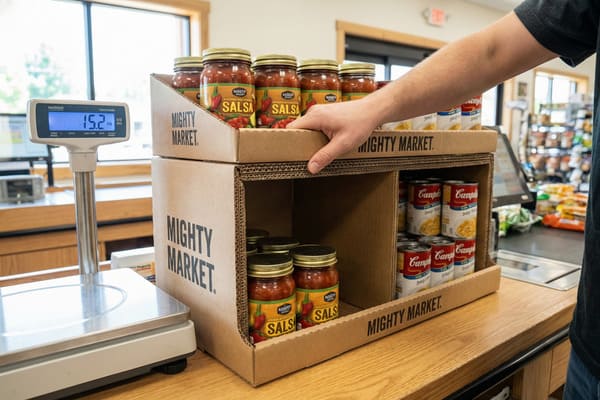
Are you worried that a cardboard box will collapse under the weight of your heavy products? Many brands hesitate to use counter displays for items like tools, canned food, or beverages because they fear the material is too weak.
Yes, counter display units can absolutely support heavy products when they are engineered correctly. By using reinforced corrugated board, such as double-wall B-flute material, and integrating strategic internal dividers to distribute weight, these units can hold significant loads without buckling. We regularly manufacture counter displays that safely support over 15 kilograms (33 lbs) of merchandise.

It is a common misconception that cardboard is only for chips or lightweight cosmetics. With the right structural design, we can turn paper into a display as sturdy as wood, but much cheaper. Let me show you exactly how we do this and what you need to know before ordering your next batch.
What is a display counter used for?
Every inch of retail space costs money, and the checkout counter is the most valuable real estate in the store. You need a way to grab the customer's attention right before they pay.
A display counter is a compact merchandising unit placed at the point of sale to drive impulse purchases and organize products. It is used to showcase small to medium-sized items directly at eye level, separating them from crowded shelves to increase visibility and brand awareness during the final moments of a shopping trip.

The Strategic Role of Counter Units
A display counter serves a much more complex role than just holding product. In the competitive retail landscape, specifically in big-box stores like Costco or Walmart, or specialized shops like hunting gear retailers, the counter unit acts as a silent salesman. When we look at the mechanics of this, we see that it solves three major problems for retailers and brands. First, it solves the organization problem. Without a display tray, heavy items like batteries, multitools, or glass beverage bottles would lie flat or cluttered on a counter. This looks messy and discourages sales.
Second, it allows for "off-shelf" placement. In my experience working with hardware brands, getting your product off the main gondola shelf and onto the service counter increases sell-through rates significantly. However, for heavy products, this is where the engineering becomes critical. If you are selling steel hunting tips or dense energy bars, the display must withstand the "shopability" factor. This means it must stay rigid even when half empty. A weak display that sags looks "expired" or low quality.
Finally, these units are used for rapid replenishment. In the industry, we often call these PDQ (Pretty Darn Quick) displays1. The retailer wants to take the shipping box, rip off the perforated top, and place it on the counter in ten seconds. If your product is heavy, the bottom of that tray cannot fall out during this transition. Therefore, the usage defines the structure: the heavier the product, the more we must focus on the tray's bottom integrity and sidewall stacking strength.
| Usage Function | Requirement for Heavy Products | Typical Weight Capacity |
|---|---|---|
| Impulse Buying2 | Eye-level header card, bold graphics | 5kg – 10kg |
| Organization | Internal dividers to prevent tipping | 10kg – 20kg |
| Brand Promotion | High-quality print (CMYK), distinct shape | Varies by size |
| Quick Restock (PDQ)3 | Tear-away perforation, reinforced bottom | Up to 25kg (reinforced) |
I have seen too many great products fail because the display collapsed in transit or at the store. I ensure my factory runs load-bearing tests that exceed your actual product weight by 30% to guarantee that when your heavy items hit the counter, the display remains rock solid.
What do you mean by counter display?
There is often confusion about the difference between a standard shipping box and a true counter display. You might hear terms like CDU or PDQ thrown around in meetings.
By counter display, we mean a specifically designed corrugated packaging unit that sits on a flat retail surface. It consists of a base tray to hold the product and often features a header card for branding. Unlike standard boxes, it is engineered to present the product openly while maintaining structural rigidity without a top lid.

The Structural Anatomy of a Heavy-Duty Unit
When we discuss what a counter display4 actually "is" in the context of heavy inventory, we have to look at the engineering anatomy. A standard counter display (CDU) is usually made of a single sheet of cardboard folded into a tray. For light items like gum, we use E-flute (very thin, about 1.5mm). However, when you ask me to design a display for heavy hunting gear or glass jars, "counter display" takes on a new meaning.
For these heavy applications, the "display" is actually a composite structure. We typically switch to B-flute5 (3mm thick) or even a BE-flute combination which is extremely tough. The definition of the unit also changes to include internal reinforcement. We do not just fold a box; we insert a secondary corrugated skeleton inside the outer shell. This is crucial. The outer shell carries your brand image with high-quality printing, while the inner skeleton carries the weight.
Furthermore, for heavy products, the definition of a counter display often includes a "false bottom" or a "tiered step" insert. This is not just for looks. If you have heavy bottles, stacking them directly behind each other can cause the front row to slide or tip. By creating steps inside the display, we shift the center of gravity back and distribute the load more evenly. So, when you ask "what do you mean by counter display," for heavy products, it means a highly engineered, double-walled presentation vehicle, not just a folded box. It represents the balance between a shipping container's strength and a marketing poster's beauty.
| Component | Standard Definition | Heavy-Duty Definition |
|---|---|---|
| Main Material | E-Flute (1.5mm) or CCNB6 | B-Flute (3mm) or Double Wall |
| Bottom Structure | Auto-lock bottom (standard) | Reinforced Snap-lock or Glued7 |
| Inserts | Optional or paper card | Corrugated Dividers & Steps |
| Assembly | Pop-up (1 second) | Manual fold (stronger integrity) |
I know that technical terms like "flute types" can be boring, but they are the difference between success and disaster. We provide free 3D renderings and white samples for you to physically test, so you can feel the difference between a standard display and the reinforced version we design for your heavy goods.
What is the food display counter?
Food products present a unique challenge because they are often dense, heavy, and packed in glass or metal. A display for snacks is simple, but a display for salsa jars is a heavy-duty project.
A food display counter is a specialized point-of-purchase unit designed to hold edible products. These displays must meet strict hygiene standards, use non-toxic materials, and possess high load-bearing capabilities to support dense items like liquid-filled jars, tins, or vacuum-packed goods without sagging due to moisture or weight.

Hygiene, Moisture, and Heavy Loads
Designing a food display counter involves more variables than standard retail packaging. The first major issue is density. Food items, especially liquids like sauces, beverages, or oils, are incredibly heavy for their size. A small footprint display might need to hold 12 glass jars, which could easily weigh 8 kilograms. If the cardboard absorbs moisture from the air—common in grocery environments—it loses strength. A standard paper display will turn into a soggy mess and collapse under that weight.
To combat this, we apply specific technical solutions. We use a process called "lamination" (glossy or matte PP lamination) on the cardboard surface. This not only makes the print look fantastic but acts as a mild moisture barrier8. For heavy food items, we also change the grain direction of the cardboard. During the manufacturing process, we ensure the "flutes" (the wavy inner paper) run vertically relative to the load. This acts like hundreds of tiny pillars supporting the weight of your jars.
Another critical aspect is safety. Since these displays hold food, even if packaged, the materials must be safe. We use soy-based inks9 or water-based inks rather than harsh chemical solvents. This ensures no chemical odors transfer to the food environment. We also have to consider the "shop-ability" of heavy food items. If a customer pulls a heavy jar from the front, the display must not tip forward. We often design the back panel to be slightly angled or weighted to counterbalance the heavy front stock. It is a mix of physics and material science.
| Factor | Challenge with Food | Our Technical Solution |
|---|---|---|
| Weight Density10 | Small items are very heavy (glass/liquid) | Vertical flute orientation & double walls |
| Environment | Humidity in grocery stores weakens paper | PP Lamination & Varnish |
| Safety11 | Direct or indirect food contact | Vegetable/Soy-based inks |
| Stability | Heavy items shift center of gravity | Extended rear support stabilizers |
I understand the strict requirements of the food industry. We use certified safe materials and my team calculates the exact load capability you need. I can send you a sample that has been weight-tested to hold your specific jar or can count, ensuring it survives the journey from the warehouse to the grocery counter.
What are the three types of display?
To understand where your heavy product fits best, you need to look at the three main categories of cardboard displays. Each handles weight differently.
The three primary types of cardboard displays are Floor Displays, Counter Displays, and Pallet Displays. Floor displays stand freely in aisles for high volume; Counter displays sit on checkout surfaces for impulse buys; and Pallet displays are bulk-shipping units that drop directly onto the sales floor for maximum inventory loading.

Choosing the Right Vessel for Heavy Inventory
When you have a heavy product, choosing between these three types depends on your volume and the retailer's rules. Let's analyze them strictly from a weight and stability perspective.
1) Floor Displays: These are the tall, independent towers you see in aisles. For heavy products, these are risky if not designed well. If you put heavy car parts or gallons of liquid on the top shelf of a floor display, the center of gravity becomes too high, and it becomes unstable. To make these work for heavy goods, we have to use "metal support bars" under the shelves or extremely thick corrugated board. They are great for visibility but require expensive reinforcement.
2) Counter Displays (CDU)12: As we discussed, these are for the checkout. They are actually the safest option for heavy items if the item count is low. Because the unit sits on a solid fixture (the shop counter), the display itself doesn't need to support its own height, only the product weight. The risk of tipping is lower because the center of gravity is low. For a brand selling heavy hunting accessories or premium tools, the counter display offers the highest security per unit.
3) Pallet Displays13: These are the beasts of the industry. They are essentially quarter-pallets or full-pallets dressed up in cardboard. For extremely heavy products (like cases of soda, large bags of dog food, or bulk hardware), this is the only choice. The product weight rests directly on the wooden pallet, not the cardboard. The cardboard is just a "skirt" or wrapper for branding. However, they take up massive space and many smaller retailers cannot accept them.
If you are launching a new heavy product, the Counter Display is often your best entry point. It allows you to get a heavy, high-value item right in front of the customer without the engineering nightmare and high cost of a reinforced floor display.
| Display Type | Best For Heavy Products? | Structural Cost | Retail Placement |
|---|---|---|---|
| Counter Display14 | Yes (Excellent) | Low – Medium | Checkout / Shelf |
| Floor Display | Yes (Needs reinforcement) | High | Aisles / Endcaps |
| Pallet Display15 | Yes (Best for Bulk) | Medium | Open Floor Space |
I recommend starting with a robust counter display if you are testing a new market with heavy items. My design team can create a structure that holds the weight perfectly while keeping your costs down, and we can easily scale up to floor displays once your sales volume increases.
Conclusion
You do not need to avoid cardboard just because your product is heavy. With the right engineering—specifically using double-wall materials, vertical grain direction, and internal dividers—counter displays can easily support heavy tools, jars, or parts. It comes down to choosing a manufacturer who understands structural integrity, not just printing.
Exploring PDQ displays can help streamline your product replenishment process, making it more efficient and effective. ↩
Explore this link to discover proven techniques that can boost sales through impulse buying. ↩
Learn how quick restock methods can streamline inventory management and enhance customer satisfaction. ↩
Explore this link to understand the engineering behind counter displays and their importance in showcasing heavy products. ↩
Learn about B-flute's role in packaging design and how it enhances the strength of displays for heavy items. ↩
Explore this link to understand why E-Flute is a popular choice for lightweight and durable packaging solutions. ↩
Discover the advantages of reinforced packaging structures for enhanced durability and reliability. ↩
Understanding moisture barriers is crucial for maintaining food quality and safety in packaging. ↩
Explore the advantages of soy-based inks for eco-friendly and safe food packaging solutions. ↩
Understanding weight density challenges can help improve packaging solutions and reduce costs. ↩
Exploring the benefits of vegetable/soy-based inks can lead to safer food packaging practices. ↩
Explore this link to understand why Counter Displays are the safest and most effective choice for showcasing heavy items. ↩
Learn about Pallet Displays and why they are essential for handling extremely heavy products efficiently. ↩
Explore the advantages of Counter Displays, especially for heavy products, to enhance your retail strategy. ↩
Learn how Pallet Displays can optimize space and sales for bulk products in your store. ↩