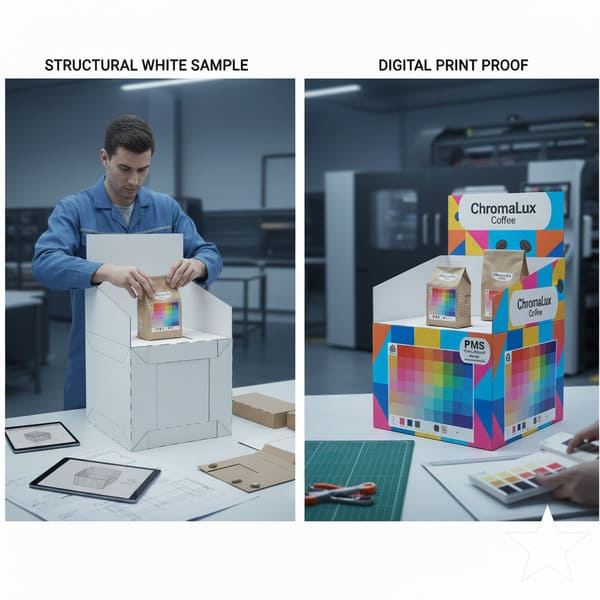
You wouldn't buy a car without a test drive, so why risk thousands of dollars on a cardboard display you haven't touched? Getting a physical prototype is the only way to stop a production disaster before it starts.
Yes, you can obtain a physical prototype, known as a "White Sample," before mass production. This critical step allows verification of structural integrity and print color accuracy (Delta E). It mitigates manufacturing risk by ensuring the unit fits your specific product dimensions exactly.
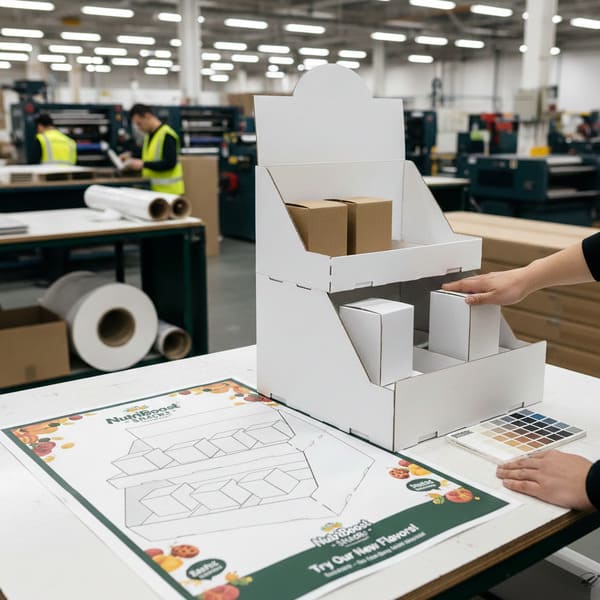
Most buyers think getting a sample is just about seeing if it looks pretty. But honestly, it's about physics. A sample proves that your heavy product won't crush the cardboard flute after three days in a humid store.
What is a countertop display?
Small products often get lost on big shelves, so putting them right under the shopper's nose at checkout is the oldest trick in the book. It captures that loose change impulse buy.
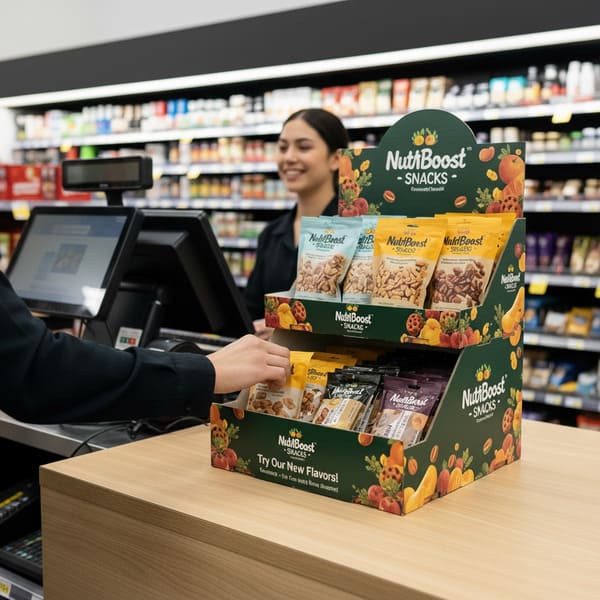
A countertop display is a compact POS (Point of Sale) fixture placed on retail checkout surfaces to drive impulse purchases. Typically measuring 8 to 14 inches (20–35 cm) in height, these units isolate small, high-margin products from aisle clutter, capturing consumer attention during the transaction process.
The Psychology of "Visual Disruption" & Speed
When we talk about countertop displays in the factory, we aren't just talking about a box; we are talking about interrupting "Decision Fatigue1." I've seen it happen dozens of times—shoppers wander the aisles, overwhelmed by 50 options of the same thing, and they just shut down. Then they get to the counter, see a single, isolated product in a bright cardboard tray, and grab it because the decision was made for them. But here is the messy reality: most brands design these wrong by treating the display like a billboard. I had a client last year who insisted on a 5-inch high front lip for his energy shots to print a giant logo, but sales tanked because the shopper had to crane their neck just to see the bottle. We follow the strict "Product First2" rule where the front lip acts as a fence, not a wall, ensuring maximum visibility.
Beyond visibility, we have to fight the physics of the "Tipping Point3." Lightweight displays are a nightmare in busy retail environments; when the first three customers buy the front products, the center of gravity shifts back, and the whole thing flips over. It is embarrassing for the brand and annoying for the cashier. To fix this, I often force clients to use a "False Bottom" with a heavy double-thick corrugated pad hidden underneath or an extended easel back. It anchors the unit firmly. It's not about marketing theory; it's about keeping the thing upright when a busy mom bumps it with her purse. I refuse to ship a countertop unit until we pass the "Empty Front Test4," where I remove 80% of the product from the front row to ensure it stays rock solid.
| Feature | Standard Shelf Stocking | Countertop Display (POS) |
|---|---|---|
| Shopper Mindset | Comparison Shopping (High Friction) | Impulse Buying (Low Friction) |
| Product Visibility | Low (Lost among competitors) | High (Isolated "Hero" placement) |
| Lip Height Rule | N/A | Max 2 inches (5 cm) for visibility |
| Sales Velocity | Standard turnover | 400% Lift (Avg. 3-Second Lift) |
| Stocking Speed | Slow (Individual placement) | Fast (One-step tray placement) |
I refuse to ship a countertop unit until we pass the Empty Front Test. I take 80% of your product out of the front row. If the display wobbles or tips backward, we redesign the base immediately. It saves you from angry phone calls from store managers later.
What is a counter display unit?
Sometimes people confuse the marketing term with the physical object. A Counter Display Unit (CDU) is the actual engineered structure, and choosing the right material—cardboard, plastic, or wood—is critical for your budget and sustainability goals.
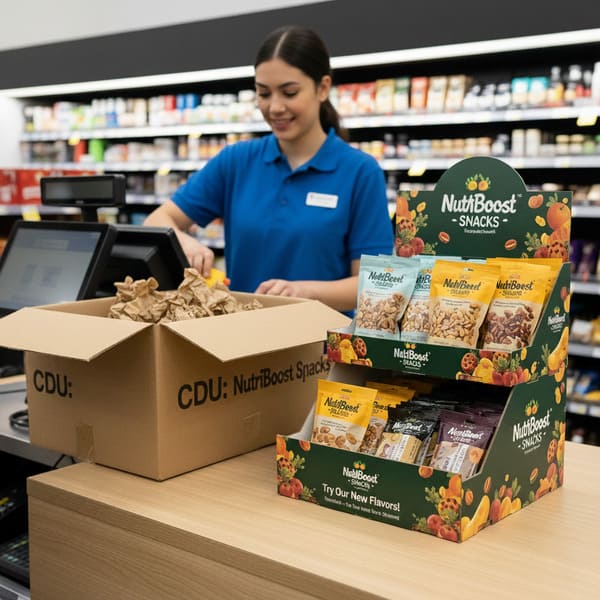
A Counter Display Unit (CDU) is a freestanding retail fixture placed on checkout tills to showcase products and encourage impulse buys. Constructed from cardboard, plastic, or wood, CDUs utilize high-traffic placement to drive last-minute sales for small items like snacks, cosmetics, or seasonal goods.
Structural Integrity & Material Science
Let's get technical because this is where projects fail. While wood and plastic are options, 90% of the market uses cardboard because it's cost-effective and recyclable, but you have to decide between 32ECT, 44ECT, B-Flute, or E-Flute5. A major pain point I deal with constantly is the "Washboard Effect6." Standard B-flute cardboard has those wavy lines running through it, and if you print a high-end cosmetic face or a complex logo directly onto it, the waves show through the ink. It looks cheap, like a pizza box. Clients hate this, but they often try to save money by using it until I step in. For any CDU holding premium items, I switch to E-Flute (Micro-flute) or a Litho-laminated finish where the flutes are so tight they are invisible, giving you a surface as smooth as a magazine cover.
We also have to talk about "Grain Direction7," which is the secret strength of any display. Corrugated board has a grain, just like wood. I once saw a competitor's display collapse because they ran the grain horizontally on the load-bearing walls, causing it to buckle immediately under the weight of glass jars. My engineers are trained to orient the grain vertically for maximum stacking strength (BCT). It seems like a small detail until your display collapses at Walmart. Additionally, I recommend starting with a "White Sample8" cut on our Kongsberg table. We don't print artwork on it; we just cut the structure so you can load it with your actual product and shake it. If it holds, then we worry about the pretty colors; if it buckles, we add a support brace.
| Material Spec | Best Use Case | Cost Impact | Print Quality |
|---|---|---|---|
| B-Flute | Heavy items (Canned goods, Tools) | Low | Medium (Washboard visible) |
| E-Flute | Cosmetics, Tech, Pharma | Medium | High (Smooth surface) |
| CCNB (Recycled) | Standard retail displays | -20% Cost | Good |
| SBS (Virgin White) | Luxury/Medical displays | High | Excellent (Pure white) |
I recommend starting with a white sample cut on our Kongsberg table. We do not print artwork on it because we just cut the structure. You can load it with your actual product and shake it. If it holds, then we worry about the pretty colors. If it buckles, we add a support brace.
What is a food display counter?
Putting food in cardboard is tricky because of hygiene laws and the messy reality of grocery stores. If you are selling protein bars or snacks, you have to worry about contamination and moisture.
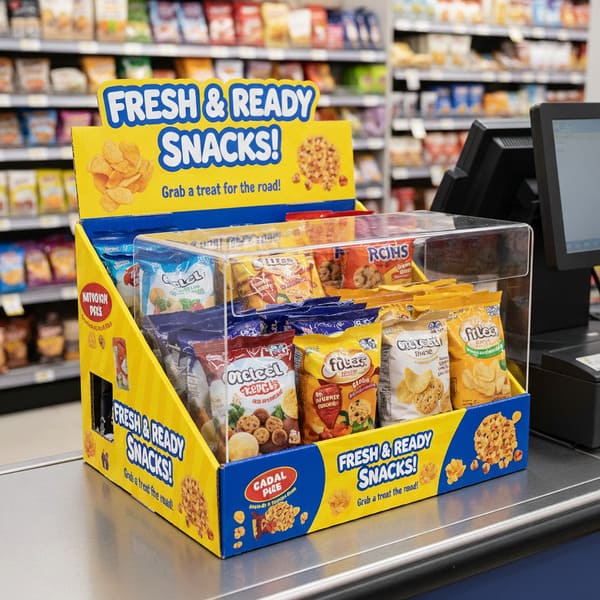
A food display counter is a specialized merchandising unit designed to hold consumable goods while complying with strict food safety regulations. These displays utilize non-toxic, soy-based inks and water-resistant coatings to prevent structural failure caused by moisture or frequent floor cleaning in grocery environments.
Hygiene Standards & FDA Compliance
Here is a nightmare scenario I try to prevent every day: A brand ships 5,000 displays for a new organic snack bar, but they arrive at the store covered in microscopic paper dust which gets into the seals of the food packaging. Cutting cardboard creates dust, and it is unavoidable unless you have the right tech. In my factory, we use "Vacuum Extraction9" heads on our die-cutters to literally suck the dust away as we cut. For food clients, I also use "Air Knives"—high-pressure air blasts—to clean the sheets before packing. It costs me more in electricity, but it ensures you pass GMP (Good Manufacturing Practice) audits and avoid a recall.
Then there is the "Mop Guard" issue. Grocery store floors are wet-mopped every single night, and dirty water splashes onto the bottom of floor displays or low counter units. Standard cardboard wicks this water up like a sponge, turning brown, moldy, and gross in about 48 hours. I learned this the hard way years ago when a client in Florida complained their displays looked "rotten" after a week. Now, for any food display, we apply a clear biodegradable coating to the bottom 2 inches that acts as a shield. Also, be aware of the new PFAS laws in the US. Many old water-resistant coatings contained "forever chemicals," so we have switched to verified PFAS-free coatings10 to keep you legal in states like California.
| Safety Feature | Standard Display | Food-Grade Display |
|---|---|---|
| Ink Type | Standard Petroleum Base | Soy-Based / Vegetable Ink |
| Dust Control | None (High dust risk) | Vacuum Extraction + Air Knives |
| Moisture Shield | None | Mop Guard / Poly-Coat Base |
| Regulatory | General Retail | FDA / CPSIA Compliant |
If you are selling food, tell me upfront. I will provide a non-toxic declaration for your inks and varnishes. It is a piece of paper that keeps your legal team happy and ensures your display does not get flagged during a safety audit.
What is counter display in business studies?
Business schools love to talk about the "4 Ps of Marketing," but they rarely explain how a piece of folded paper actually prints money. In the real world, this is about ROI and maximizing the value of limited retail real estate.
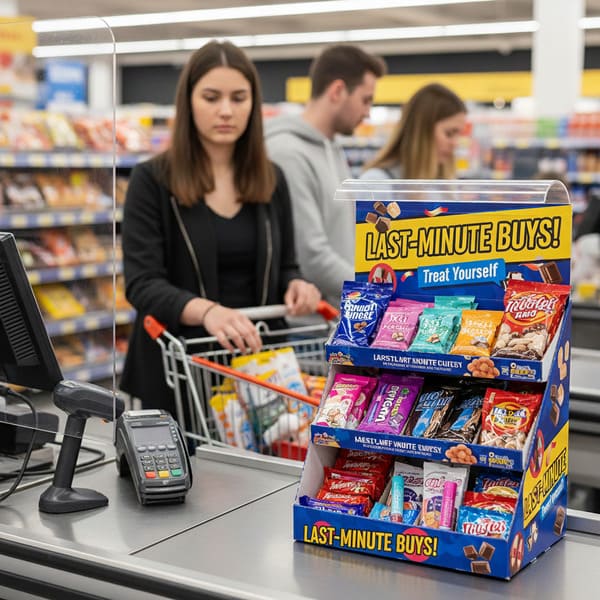
Counter display in business studies refers to the strategic use of POS (Point of Sale) tools to influence consumer behavior at the transaction moment. It is analyzed as a method to increase "average basket size" by triggering latent needs through high-visibility placement in checkout zones.
ROI Calculation & The "3-Second Lift11"
I have clients who argue with me over $0.50 on the unit price, saying that $15 is too expensive for a box, but they are looking at it as a cost rather than an investment. We use the "Sales Lift" calculation to prove the value: a standard product sitting on a home shelf in the regular aisle has low visibility and fights 20 other brands. When you move that product to a counter display, you typically see a 400% increase in sell-through rate, which we call the "3-Second Lift." You have three seconds to grab their attention while they wait for the cashier. But here is the catch: Retailer Funding. Many small business owners don't know that big retailers like Walmart or even local chains often have "MDF" (Market Development Funds12) or Co-Op budgets. If you pitch your display not just as "stock" but as a "Visual Upgrade" for their store, they might subsidize the cost, and I help clients draft the specs to apply for this money.
The biggest killer of ROI is "Decision Fatigue" caused by messy execution. If your display is messy or the header card is curled over—a common failure of single-wall headers—the shopper ignores it. That's why I force the use of "Double-Wall" headers even though it costs a few pennies more. The tension created by the fold keeps the billboard standing straight. A straight header sells; a curled header says "old product." Don't look at the $15 unit price; look at the margin. If you sell just 50 extra units because of this display, the structure pays for itself by Day 2, and the remaining 28 days of the promotion are pure profit.
| Metric | Home Shelf (Aisle) | Counter Display (POS) |
|---|---|---|
| Visibility | Low (Shared space) | 100% (Exclusive space) |
| Sell-Through | 1x (Baseline) | 4x (400% Increase) |
| Customer Mood | Search Mode | Wait Mode (Prone to Impulse) |
| Competition | High (Directly adjacent) | Zero (Solo placement) |
Do not look at the $15 unit price. Look at the margin. If you sell just 50 extra units because of this display, the structure pays for itself by Day 2. The remaining 28 days of the promotion are pure profit. That is the only math that matters.
Conclusion
Getting a sample isn't just possible; it's mandatory if you want to sleep at night. Whether you are dealing with complex food safety laws or just trying to trigger an impulse buy, the prototype is where we catch the mistakes.
Would you like me to send you a [Free Structural 3D Rendering] or cut a physical [White Sample] for your team to test?
Understanding Decision Fatigue can help you design better shopping experiences that reduce overwhelm and boost sales. ↩
Exploring the 'Product First'rule can enhance your display strategies, ensuring maximum visibility and sales effectiveness. ↩
Learning about the Tipping Point can help you create more stable displays, preventing embarrassing product spills in busy environments. ↩
The Empty Front Test is crucial for ensuring display stability; understanding it can lead to better product placement and sales. ↩
Explore the advantages of E-Flute for premium packaging, ensuring a smooth finish and high print quality. ↩
Discover the Washboard Effect and how it can affect the appearance of printed designs on cardboard. ↩
Understanding grain direction is crucial for structural integrity; learn how it impacts load-bearing capabilities. ↩
Learn about the importance of White Samples in testing packaging strength before printing. ↩
Explore this link to understand how Vacuum Extraction improves hygiene and compliance in food packaging. ↩
Learn about PFAS-free coatings to ensure your products meet safety regulations and avoid harmful chemicals. ↩
Understanding the '3-Second Lift'can enhance your marketing strategies by optimizing product placement for maximum visibility. ↩
Exploring Market Development Funds can reveal financial opportunities to subsidize your marketing efforts and improve ROI. ↩