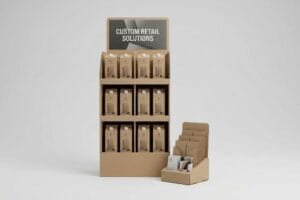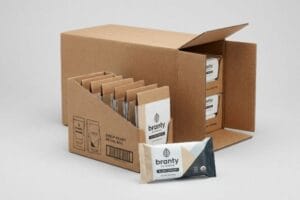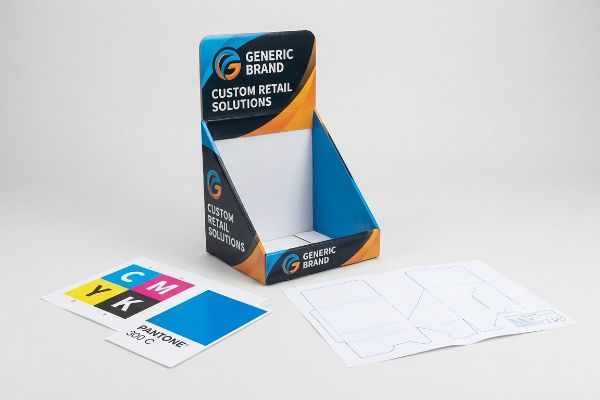
You want your retail display to scream your brand's identity, but standard templates often feel cheap and generic. Sticking your logo on a brown box won't stop cart traffic.
Yes. You can fully customize your display with bespoke branding. Factories utilize CMYK (Cyan, Magenta, Yellow, Key) and Pantone spot colors alongside structural die-cuts to project your exact corporate identity. Customizing structural geometry and high-fidelity graphics ensures maximum retail visibility and compliance with strict merchandising guidelines.
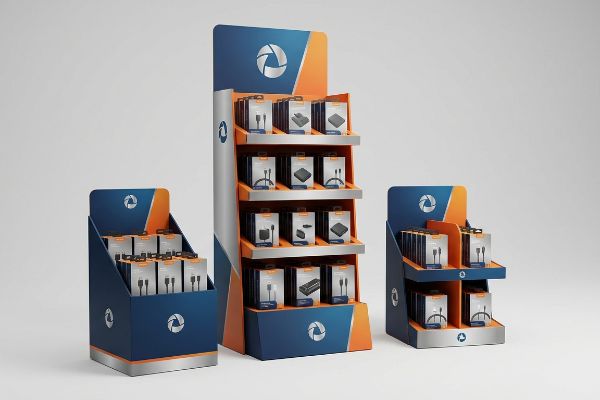
Making your brand look good on a digital screen is easy; making it survive a crowded retail aisle is where the real engineering starts.
What is the 3 7 27 rule of branding?
Retail is a battlefield of distractions. If your display doesn't instantly interrupt a shopper's autopilot, your marketing budget is essentially funding the store's recycling bin.
The 3 7 27 rule dictates that a brand has 3 seconds to catch attention, 7 seconds to establish a connection, and 27 seconds to secure a purchase. In retail display manufacturing, this requires high-contrast graphics and visual disruption to immediately trigger the initial three-second sales lift.
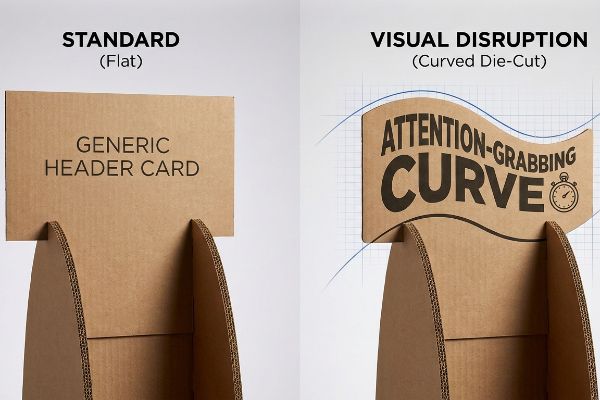
Grabbing that initial three-second glance requires more than just bright colors; it demands physical disruption.
The Psychology of Visual Disruption and Speed
Most beginner marketing teams rely entirely on flat, square header cards to convey their message. They assume standard orthogonal boxes with big text will act as a sufficient billboard in a crowded aisle. However, the human brain quickly filters out uniform geometric shapes1 as background noise, rendering flat headers virtually invisible to fast-walking shoppers.
I routinely see clients submit rigid, rectangular dielines that completely fail the three-second lift test on the floor. When I run these flat concepts past my prepress team, I immediately suggest integrating sweeping, die-cut curves that break the linear aisle structure. I remember a recent campaign rollout where a client's flat header was getting lost; we added a custom CNC (Computer Numerical Control) routed wavy silhouette. Hearing the rapid, high-pitched whir of the Zund digital cutting table slicing that complex curve out of raw 32ECT board told me we had a winner. That simple physical contour grabbed attention faster, drastically increasing impulse engagement without adding a single dollar to the print budget.
| Common Rookie Mistake | The Pro Fix | Retail-Floor Benefit |
|---|---|---|
| Using flat square headers | Die-cut curved silhouettes | Breaks visual aisle monotony |
| Relying only on text | Structural visual disruption | Triggers 3-second sales lift2 |
| Ignoring structural speed | Custom routed board contours | Faster shopper engagement |
I never let a brand settle for a generic square billboard if a custom curve can do the heavy lifting. Engineering your corrugated board to physically reach out and disrupt the aisle guarantees that crucial first glance.
🛠️ Harvey's Desk: Are your header cards getting ignored in a sea of square boxes? 👉 Let Me Review Your Dieline ↗ — Direct access to my desk. Zero automated sales spam, I promise.
What is the rule of 7 in branding?
Consistency is the lifeblood of brand recognition. A consumer needs to see your logo clearly multiple times before they trust it enough to put it in their cart.
The rule of 7 states that consumers must encounter a brand's message at least seven times before making a purchase decision. For physical retail packaging, maintaining absolute color consistency across all merchandising touches ensures immediate recognition, building consumer trust and driving long-term product loyalty.
But achieving that perfectly consistent visual touchpoint is where standard printing methods often collapse under retail lighting.
Preventing Halftone Mud on the Factory Floor
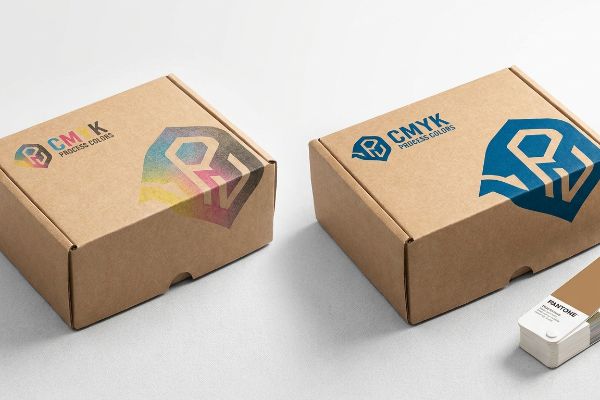
Junior designers often export their digital files directly to standard process colors, assuming the four-ink mix will seamlessly replicate their vivid screen colors on a physical display. They design beautifully layered artwork but ignore the fundamental physical differences between a backlit retina display and porous, unsealed paperboard3 in a physical environment.
I see this trap constantly when brands try to hit their seven touchpoints using standard process printing on raw testliner. A client once approved a beautiful digital proof, but when the four-color halftone dots hit the porous paper, it turned into grainy, washed-out mud. I remember rubbing my thumb across the newly printed sheet, feeling the slightly damp, chalky texture of the ink, and knowing the store's harsh fluorescent lights would destroy their logo's contrast. To fix this, I mandate a spot color flood protocol4, swapping the optical dot blending for a single, dense PMS (Pantone Matching System) pigment. This highly saturated physical flood completely eliminates grain, ensuring every one of those seven brand impressions is razor-sharp from twenty feet away.
| Common Rookie Mistake | The Pro Fix | Retail-Floor Benefit |
|---|---|---|
| Exporting logos as CMYK | PMS spot color ink flood | Razor-sharp logo clarity |
| Trusting backlit screens | Physical Pantone matching | Consistent brand recognition |
| Printing halftones on testliner | Dense solid ink coverage | Eliminates washed-out mud |
I refuse to let an amazing brand design get diluted by lazy process printing. Insisting on dedicated spot colors guarantees your logo commands authority and builds that essential trust on every single visual encounter.
🛠️ Harvey's Desk: Is your brand's signature color looking muddy and washed out under harsh store lights? 👉 Request A Color Audit ↗ — Download safely. My inbox is open if you have questions later.
How do I showcase my brand?
Having beautiful graphics means nothing if they are hidden behind pricing tags or placed below the shopper's knee. Strategic brand showcasing requires mastering physical retail geometry.
Showcasing your brand effectively requires placing core visual elements within the consumer strike zone, typically 50 to 54 inches (1270 to 1371 mm) from the floor. Maximizing product visibility and utilizing angled shelves ensures shoppers engage directly with your primary merchandising message without physical friction.
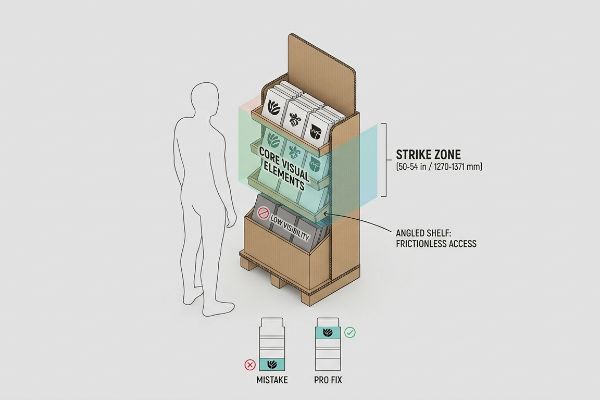
Finding that perfect line of sight involves strict adherence to physical placement limits and clear visibility rules.
The Human Height Heat Map and Visibility Rules
Many brand teams treat a floor display like a massive digital poster, placing critical text and core value propositions all the way down to the base panel. They assume shoppers will take the time to bend down or step back to read every carefully crafted bullet point on the lower tiers. In reality, anything placed below waist level is functionally invisible5 in a narrow, high-traffic aisle.
I have seen countless gorgeous designs wasted because the key branding was buried under a deep tray lip. Think of your display like a real estate billboard—you would not put your phone number behind a tree. I had a client struggling with low sell-through because their front lip hid forty percent of the product face. I watched a store clerk struggling to yank a jammed bottle from the deep pocket, the raw corrugated edge aggressively scraping against the plastic label with a loud tearing sound. We immediately engineered a product-first layout, dropping the lip height to ensure maximum visibility and shifting the primary logo into the 54-inch (1371 mm) strike zone6. This simple structural math lifted the brand into the direct line of sight, entirely removing the physical friction of shopping.
| Common Rookie Mistake | The Pro Fix | Retail-Floor Benefit |
|---|---|---|
| Putting logos on the base | Moving art to the strike zone7 | Maximum shopper eye contact |
| Deep tray lips hiding items | 85% minimum visibility rule8 | Easy product identification |
| Forcing shoppers to bend | Angling lower shelves up | Frictionless buying experience |
I engineer displays to serve the shopper's natural posture, never fighting against it. By meticulously mapping out the exact line of sight, I ensure your brand naturally intercepts their gaze without asking them to work for it.
🛠️ Harvey's Desk: Are your best graphics buried at the bottom of your merchandiser where no one looks? 👉 Get Your Layout Checked ↗ — No forms that trigger endless sales calls. Just pure value.
What are the 7 pillars of personal branding?
Translating your brand's unique identity into physical reality means protecting its reputation on the floor. An unpolished, sloppy execution shatters consumer perception faster than a bad ad.
The 7 pillars of personal branding—authenticity, visibility, consistency, value, differentiation, authority, and reliability—directly parallel product merchandising requirements. In physical display manufacturing, these foundational pillars demand meticulous structural engineering and precise prepress execution to ensure the brand's identity is presented flawlessly across all retail environments.
But knowing the theory isn't enough when the machines start running and paper begins to shift.
Why Standard Print Margins Fail on the Factory Floor
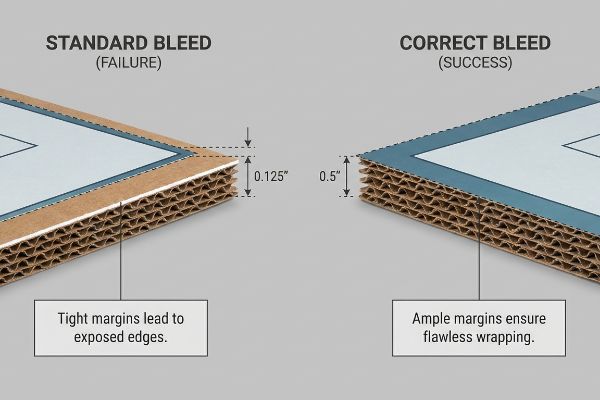
Graphic designers frequently apply standard commercial print bleed, usually 0.125 inches (3.17 mm)9, to their corrugated display files. They treat thick retail displays just like thin business cards, assuming a tiny margin of safety will perfectly cover the automated die-cutting process. They completely underestimate the violent mechanical forces involved when bonding printed paper to rigid flutes10.
In my facility, I routinely see beautifully designed files crash and burn during the litho-lamination phase because of this blind spot. This isn't just theory—I see this happen on the testing floor when we bond wet top-sheets to thick B-flute board. The process inherently involves a mechanical shift, and a standard bleed is woefully insufficient. When I measure the yield off the line, those tight margins result in flashing—ugly, raw brown cardboard edges exposed on the final folded corners, making the entire brand look cheap. I pulled the micrometer readings and proved we needed a ruthless data-driven correction: a strict minimum 0.5-inch (12.7 mm) bleed margin11 past the physical cut line. By enforcing this aggressive structural safety net, I guarantee the artwork completely wraps every exposed edge, eliminating manual rejection sorting and saving the client from a disastrously sloppy store rollout.
| Common Rookie Mistake | The Pro Fix | Retail-Floor Benefit |
|---|---|---|
| Using 0.125-inch print bleed | Enforcing 0.5-inch margin12 | Prevents ugly brown edges |
| Treating displays like paper | Litho-shift prepress math13 | Maintains premium brand image |
| Ignoring mechanical shift | Wrapping art around flutes14 | Zero factory rejection delays |
I refuse to let a millimeter of raw, unprinted board destroy a brand's premium perception. Forcing designers to respect the physics of litho-lamination ensures your physical pillars remain completely uncompromised under the brightest retail lights.
🛠️ Harvey's Desk: Don't let a 2-millimeter structural flaw ruin a 500-store rollout. 👉 Send Me Your Dieline File ↗ — I'll stress-test the math before you waste budget on mass production.
Conclusion
You can spend thousands perfecting your digital logo, but when a tight 0.125-inch (3.17 mm) bleed fails during litho-lamination, those exposed raw brown edges will trigger a massive 30% drop in perceived brand equity on the floor. Over 500 brand managers use my prepress checklist to avoid these exact fatal early-stage mistakes. Stop guessing on factory tolerances and let me personally audit your artwork files through my Free Dieline Pre-Flight Audit ↗ to catch these disastrous mechanical blind spots before they destroy your campaign.
"Visual Habituation and Dishabituation in Preterm Infants – PMC – NIH", https://pmc.ncbi.nlm.nih.gov/articles/PMC3167676/. An authoritative source in cognitive psychology would explain the mechanism of selective attention and how the brain filters repetitive patterns to focus on novel stimuli. Evidence role: technical validation; source type: academic journal. Supports: the psychological basis for visual disruption in retail. Scope note: applies to general visual perception and habituation. ↩
"3 Second Rule of POSM: The Psychology of Visual Impact in Retail", https://www.linkedin.com/pulse/3-second-rule-posm-psychology-visual-impact-retail-spectrum-unitec-oywxc. [A study on retail consumer behavior or a point-of-purchase marketing manual would provide empirical data regarding the timeframe in which visual disruption affects conversion rates]. Evidence role: quantitative validation; source type: industry study. Supports: the efficacy of structural visual disruption. Scope note: applicable to impulse-buy retail environments. ↩
"Additive & Subtractive Color Models > DINFOS Pavilion > Article", https://pavilion.dinfos.edu/Article/Article/2355687/additive-subtractive-color-models/. [A technical guide on color science would detail the contrast between additive RGB color in backlit displays and subtractive CMYK color on absorbent substrates]. Evidence role: technical specification; source type: industry standard. Supports: the scientific basis for color shift from screen to print. Scope note: covers color models and substrate porosity. ↩
"The Printing Press and the Halftone Process – Gallery", https://gallery.lib.umn.edu/exhibits/show/pre-separated-art/press-halftone. [An industry manual on packaging ink would explain how solid spot color floods prevent the dot gain and absorption patterns that cause graininess in process printing on porous substrates]. Evidence role: technical validation; source type: packaging engineering guide. Supports: the claim that spot colors eliminate halftone mud. Scope note: applies specifically to porous, non-coated papers. ↩
"An Eye-Tracking Study Using Tobii 3 Pro and Meta Quest Pro – arXiv", https://arxiv.org/html/2510.16764v1. [Retail eye-tracking research and heat map studies demonstrate a significant drop in consumer engagement for displays located below the waist-to-chest line]. Evidence role: technical validation; source type: market research study. Supports: the assertion that low placement reduces visibility. Scope note: Most applicable to high-traffic retail corridors. ↩
"Retail premises design for effective displays and customer flow", https://www.business.qld.gov.au/industries/manufacturing-retail/retail-wholesale/retail-displays. Industry standards for retail visual merchandising define the 'strike zone'as the optimal vertical height for product visibility, typically aligning with average human eye level. Evidence role: technical specification; source type: retail design guide. Supports: optimal placement of branding for consumer engagement. Scope note: specific height may vary based on the target consumer demographic. ↩
"Why Do Retailers Place Products at Eye Level? – PopDisplay", https://popdisplay.me/why-do-retailers-place-products-at-eye-level/. Authoritative retail design guidelines define the 'strike zone'as the optimal vertical range for product placement to maximize consumer eye contact. Evidence role: factual definition; source type: industry manual. Supports: the strategic placement of branding for maximum visibility. Scope note: Heights may vary by target demographic. ↩
"Gondola Shelving Dimensions Guide", https://rackleaders.com/gondola-shelving-dimensions-guide/. Visual merchandising standards specify a minimum visibility percentage for products to ensure they are easily identified by shoppers without obstruction. Evidence role: technical metric; source type: retail design guideline. Supports: the requirement for shallow tray lips to prevent hidden items. Scope note: This threshold may vary by product size and category. ↩
"How can I determine how much bleed to use?", https://graphicdesign.stackexchange.com/questions/55905/how-can-i-determine-how-much-bleed-to-use. [Professional printing industry standards specify the typical bleed requirement for commercial assets to ensure clean edges after trimming]. Evidence role: technical specification; source type: printing industry guide. Supports: the specific measurement commonly used by graphic designers. Scope note: Standard for most US-based commercial print operations. ↩
"Estimation of the Compressive Strength of Corrugated Board Boxes …", https://pmc.ncbi.nlm.nih.gov/articles/PMC8467740/. [Packaging engineering manuals explain the mechanical stresses and material shifts that occur when laminating printed liners to corrugated fluted board]. Evidence role: technical explanation; source type: manufacturing engineering guide. Supports: the claim that standard margins are insufficient for corrugated displays. Scope note: Specific to rigid fluted materials used in retail displays. ↩
"LithoFlute Litho-Laminated Heavyweight Cartons", https://www.graphicpkg.com/products/lithoflute-litho-laminated-heavyweight-cartons/. Industry technical specifications for corrugated display manufacturing confirm that increased bleed is required to compensate for registration shifts during the lamination process. Evidence role: technical specification; source type: industry manufacturing guide. Supports: the requirement for a specific bleed measurement to prevent exposed board edges. Scope note: applies specifically to litho-lamination on thick corrugated board. ↩
"How to Set Up Document Bleeds for Printing (Video Tutorial)", https://www.youtube.com/watch?v=gnxJYQEY5CA. [An industry printing manual for large-format retail displays specifies the required safety margins to avoid edge clipping and ink drift on corrugated substrates]. Evidence role: technical specification; source type: industry manual. Supports: the preference for 0.5-inch margins over standard bleed. Scope note: Specific to retail floor displays. ↩
"The Offset Printing Process: How it works | Pakfactory Blog", https://pakfactory.com/blog/learn/what-is-offset-printing/?srsltid=AfmBOoqB7bf2k7YNzvUBL-m2qbX6UGR6cQQNsxxucNpagtLbw0zz5zQM. [Technical documentation on litho-lamination explains the mathematical adjustments required to compensate for image distortion when mounting paper to corrugated board]. Evidence role: technical process; source type: printing textbook. Supports: the use of specialized math for display production. Scope note: Applicable to litho-shift in prepress workflows. ↩
"Packaging 101: Guide to Corrugated Packaging – Packola", https://www.packola.com/blogs/boxing-and-packaging-articles/packaging-101-guide-to-corrugated-packaging?srsltid=AfmBOopiVD15HYVxbreUhPT-h4HWRqP0jFpNfWrNHej1Lx-TlNCpKbl-. [Packaging engineering standards describe the practice of extending artwork across the flutes of corrugated board to prevent white gaps caused by mechanical shift during folding]. Evidence role: technical specification; source type: engineering guide. Supports: the method for preventing factory rejection delays. Scope note: Specifically for corrugated substrates. ↩