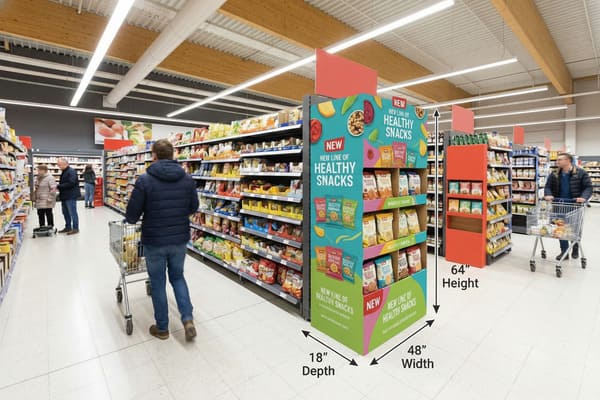
Retail real estate is expensive, and store managers are ruthless. If your display is even half an inch too wide, it gets rejected at the loading dock, costing you thousands in wasted logistics.
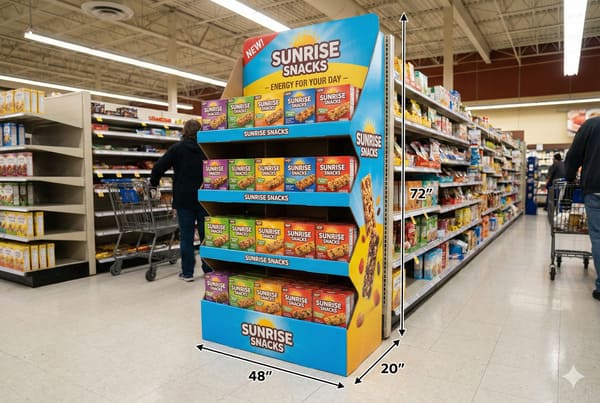
Yes, size limitations for endcap displays are strictly enforced but vary by retail format. While standard grocery gondolas typically cap width at 36 inches (91 cm), warehouse clubs and mass merchandisers often utilize 48-inch (122 cm) pallet-sized endcaps. Height limits generally range from 56 inches (142 cm) in club stores to 72 inches (183 cm) in supermarkets to maintain sightlines.
Getting the size right is just the baseline. You also need to understand the strategic role these displays play in the store ecosystem. If you treat an endcap like a standard shelf, you are throwing money away.
What is the purpose of an endcap display in retail?
Why pay a premium for prime real estate if you aren't going to use it? Shoppers often zombie-walk through aisles; you need a visual disruptor to snap them out of it.
The purpose of an endcap display in retail involves driving impulse purchases and increasing brand visibility by positioning products at high-traffic aisle ends. These POP (Point of Purchase) units disrupt the shopper's journey, leveraging prime placement to highlight promotions, new product launches, or seasonal items that might be overlooked on standard inline shelves.
The Psychology of Visual Disruption1 & Brand Equity2
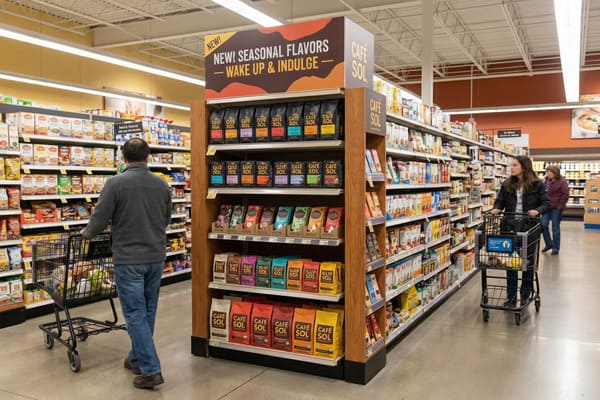
We need to talk about "Decision Fatigue." I see clients make this mistake constantly. They treat the endcap like a library shelf, stuffing it with every SKU they own. But that fails. The real purpose of an endcap isn't inventory storage; it's Visual Disruption. Standard aisles are boring; they are cluttered visual noise. An endcap is a stage. When we isolate a product on a standalone display, we create what I call the "3-Second Lift3." I've seen sales data where a product moved from a crowded inline shelf to a custom endcap saw a sell-through increase of 400%. Why? Because the curvy, die-cut shapes of cardboard—which we can cut into anything—grab attention faster than rigid metal shelving.
But here is the messy reality I deal with on the shop floor: Clients often try to "save money" by using a generic rectangular box structure. It drives me crazy. If you use a square box, you blend in. You must use shape to disrupt. For a recent hunting gear client, we didn't just stack boxes; we cut the header to look like a mountain range. It cost 10 cents more per unit, but it stopped customers in their tracks. The purpose is to break the shopper's autopilot, and you can't do that with a boring box.
Furthermore, we have to discuss "Brand Equity" and durability. A display that looks trashed after five customers engage with it damages the brand. I call this the "50-Touch Rule4." If the purpose is to elevate the brand, the structure must be reinforced—often with double-wall corrugated bases—to withstand at least 50 aggressive customer interactions without losing structural integrity. If the display looks cheap and leaning by Tuesday, the customer assumes the product is cheap too.
| Feature | Standard Inline Shelf | Custom Endcap Display |
|---|---|---|
| Visibility | Low (Lost in clutter) | High (3-Side Visibility) |
| Shopper Interaction | Planned Search | Impulse / Discovery |
| Sales Velocity | Baseline (1x) | Accelerated (3x – 5x) |
| Structure | Rigid Metal/Wood | Custom Die-Cut Cardboard |
| Key Metric | Inventory Capacity | Conversion Rate |
I always tell my clients to stop looking at the unit price and look at the margin. If a custom shape costs you an extra dollar but sells fifty more units in the first week, the structure pays for itself by Day 2.
What is an end cap space?
It is not just an empty wall you can fill with whatever you want. It is a precise geometric slot defined by the retailer's fixture system, and it has zero tolerance for error.
An end cap space is defined as the premium retail area located at the end of a gondola shelving run, facing the main traffic aisle. This zone typically measures 36 to 48 inches (91 to 122 cm) in width and 15 to 20 inches (38 to 51 cm) in depth, serving as the primary location for high-velocity promotional merchandise.

The "Float Tolerance5" Nightmare & ADA Compliance
Let's get into the weeds of compliance. A standard US gondola endcap is theoretically 36 inches (91 cm) wide. So, inexperienced designers send me files that are exactly 36 inches wide. I refuse to print them. Why? Because in the real world, metal shelving gets bent. Store uprights are never perfectly straight. If your display is 36.0 inches and the shelf is 35.8 inches, that display is getting thrown in the trash compactor by the store manager. They will not struggle with it. We use a "Float Tolerance" rule. I design endcap units to be exactly 34.5 inches (87.6 cm) wide for grocery stores, or 47.5 inches (120.6 cm) for club stores. This leaves roughly 0.5 inches (1.3 cm) of clearance. It slides in easily every time.
Another massive constraint is the ADA Reach Range6. In the US, the Americans with Disabilities Act sets strict guidelines. The maximum high forward reach is 48 inches (122 cm) and the minimum is 15 inches (38 cm). I had a client who wanted the "Hero Product" at 60 inches (152 cm) high. I had to tell them no. Not only does it violate ADA compliance for government buildings or pharmacies, but it also puts the product out of the "Eye-Level Buy Level7" for the average 5'4" shopper. We strictly design the primary dispensing zone between 30 and 50 inches (76 to 127 cm) off the floor.
We also have to consider the "Universal Bracket8" issue. Many end cap spaces are "Sidekicks" or "Power Wings" hanging off the side. US retailers use different shelving systems like Lozier, Madix, or Wire Racks. A standard cardboard hook often doesn't fit, causing the display to fall off. I force my clients to spend the extra $0.40 on a Universal Metal Bracket. It ensures the display locks securely onto any fixture type, preventing it from ending up on the floor.
| Retailer / Standard | Max Width Spec | My Recommended Width | Height Limit |
|---|---|---|---|
| Standard US Grocery | 36.0" (91.4 cm) | 34.5" (87.6 cm) | 72" (183 cm) |
| Warehouse Club (Costco) | 48.0" (122 cm) | 47.5" (120.6 cm) | 56" (142 cm) |
| Drugstore (CVS/Walgreens) | 24.0" (61 cm) or 36" | 23.5" (59.7 cm) | 60" (152 cm) |
| ADA Compliance Zone | N/A | N/A | Max Reach 48" (122 cm) |
My team maintains a database of these retailer specs. When you tell me this is for Target, I automatically adjust the width and the header height. It saves us from that dreadful phone call where the display arrives and doesn't fit.
How is an endcap display most commonly used in terms of product types?
You shouldn't put slow-moving inventory here. This space is for speed. Put the wrong product type on an endcap, and you will burn your budget on logistics while the stock collects dust.
An endcap display is most commonly used in terms of product types by prioritizing high-turnover goods like seasonal items, new launches, and bulk impulse buys. Common applications include snack foods, beverages, and cosmetics, where visual disruption triggers immediate conversion rather than planned shopping behavior.
Structural Loading & Product Physics
The product type dictates the engineering. You cannot just use a generic tray for everything. For example, beverages. I've had clients try to put energy drinks on a standard B-flute shelf. It's a disaster waiting to happen. Cans are heavy. A 24-pack of soda weighs a ton. If you put that on a standard shelf, you get "Tier Sag." The middle bows down, products slide together, and the display looks broken. For these heavy items, we engineer a hidden Metal Support Bar9—usually steel tubing—that runs beneath the front lip of each tier. It acts like a steel beam. This allows us to put 50 lbs (22 kg) of liquid on a cardboard shelf without it bending.
On the flip side, we have lightweight impulse items like cosmetics or hunting accessories. The challenge here isn't weight; it's visibility. If you put a small item in a deep shelf, it disappears in the shadows. For these, we use the "Chin-Up" Angled Shelf. We angle the bottom shelves upwards by 15 degrees. The product "looks up" at the customer. This simple change increases label readability by 100% for shoppers standing 3 feet (0.9 meters) away.
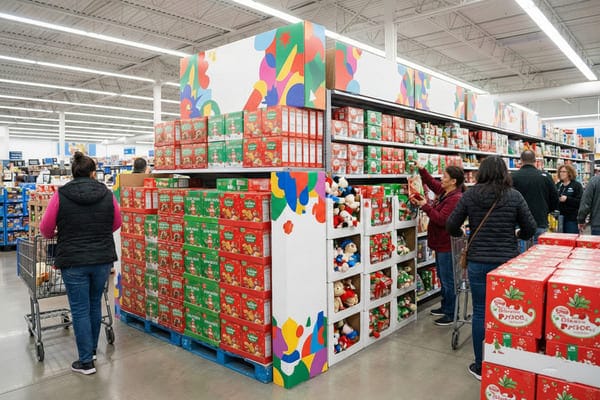
And for bulk items like dog toys or candy? We use Dump Bins. But be careful. The "Dump Bin Bulge10" is real. The internal pressure of 50 lbs (22 kg) of loose product pushes the walls out, turning a square bin into a circle. It looks unprofessional. We solve this by adding an internal "H-Divider" or "Belly Band" to tie the walls together. Plus, for items that roll, like cans, we must calculate the "Friction Coefficient11." A 12-degree angle works for aluminum, but boxed items need 16-18 degrees. I need to test your physical product to guarantee a smooth gravity feed.
| Product Type | Recommended Structure | Key Engineering Feature |
|---|---|---|
| Beverages / Heavy Liquids | Reinforced Floor Display | Metal Support Bars under shelves |
| Cosmetics / Small Tech | Tiered PDQ / Counter Unit | Chin-Up Angle (15°) & Anti-Scuff Matte |
| Seasonal Bulk (Candy/Toys) | Dump Bin | Internal H-Divider (Anti-Bulge) |
| New Launch (Electronics) | Interactive Endcap | LCD Screen & Motion Sensors |
I always ask for a physical sample of the product before we start designing. I need to weigh it, measure it, and calculate the friction coefficient. If I don't touch your product, I can't guarantee the display will work.
What is an endcap unit?
It is more than just a printed box. It is an engineered system that has to survive a brutal supply chain and still look premium when it hits the sales floor.
An endcap unit is a specialized POSM (Point of Sales Material) structure designed to fit onto or replace the end shelving of an aisle. These units are constructed from durable materials like reinforced corrugated board or metal, engineered to support significant weight loads while maximizing graphic surface area for branding.

The Engineering Behind the Cardboard
Let's talk about the "Skeleton" of these units. A lot of people think cardboard is just cardboard. That's wrong. For a proper endcap unit, we don't use standard shipping box material. We use High-Performance Virgin Kraft Liner12. Recycled testliner is cheaper, sure, but the fibers are short. They break. In a humid distribution center—think Florida in July—recycled board absorbs moisture like a sponge. We call it the "Soggy Bottom" effect. The base turns to mush, and the whole unit collapses during floor mopping.
I mandate a biodegradable water-resistant coating on the bottom 2 inches (5 cm) of all our floor displays. Plus, we use a "Safety Factor of 3.513." If your product load is 100 lbs (45 kg), I build the unit to hold 350 lbs (158 kg). Why? Because humidity reduces cardboard strength by 30-40%. By over-engineering the unit, I guarantee that even after three weeks in a damp warehouse, your endcap stands rock solid.
We also have to think about "Grain Direction14." Corrugated flutes are like pillars. If a designer or factory places the grain horizontally on a load-bearing wall to save paper scraps, that wall will buckle immediately. My structural engineers are trained to orient the grain vertically for maximum Stacking Strength (BCT). And finally, we address the "Washboard Effect15." Standard B-flute shows waves through the print. For high-end clients, I switch to E-Flute or Litho-Lam on SBS. This provides a surface as smooth as a magazine cover, ensuring your branding looks premium.
| Component | Standard Material | My "Factory Standard" Upgrade | Benefit |
|---|---|---|---|
| Load-Bearing Walls | 32 ECT Recycled | 44 ECT Virgin Kraft | Resists humidity & crushing |
| Base / Kickplate | Standard Corrugated | Water-Resistant Coated | Prevents "Soggy Bottom" from mopping |
| Header Card | Single Sheet | Folded Double-Wall | Prevents curling/warping |
| Shelf Support | Folded Paper | Metal Bar / Corro-Clip | Zero sagging under heavy load |
I treat every endcap unit like it's going into battle. Because in a busy retail environment, between the stocking clerks, the cleaning crews, and the customers, it basically is.
Conclusion
Size limitations are just the starting point. Whether you are dealing with a tight 36-inch (91 cm) aisle or a massive Costco pallet, the success of your endcap comes down to engineering for the worst-case scenario. Don't let a "Soggy Bottom" or a jamming width kill your campaign.
Would you like me to send you a Free Structural 3D Rendering of your next endcap concept to check for fit and stability before you commit?
Understanding Visual Disruption can enhance your marketing strategies and improve customer engagement. ↩
Exploring Brand Equity helps you grasp its impact on customer loyalty and brand perception. ↩
Learning about the 3-Second Lift can transform your retail display strategies for better sales. ↩
Discovering the 50-Touch Rule can help you design displays that maintain brand integrity and customer interest. ↩
Understanding Float Tolerance is crucial for effective design, ensuring products fit well in real-world applications. ↩
Explore the ADA Reach Range guidelines to ensure your designs comply with accessibility standards for all users. ↩
Discover the importance of the Eye-Level Buy Level in retail design to optimize product visibility and sales. ↩
Learn about Universal Brackets to enhance display stability and compatibility across various retail shelving systems. ↩
Explore this link to understand how Metal Support Bars enhance product stability and prevent sagging. ↩
Learn about Dump Bin Bulge and effective solutions to maintain a professional display for bulk items. ↩
Understand the significance of the Friction Coefficient in ensuring smooth product movement and effective displays. ↩
Discover the advantages of using High-Performance Virgin Kraft Liner for durable packaging solutions. ↩
Learn how a Safety Factor of 3.5 ensures structural integrity in product displays. ↩
Explore the significance of Grain Direction in maximizing the strength of cardboard structures. ↩
Understand the Washboard Effect and how to achieve a smooth finish for premium branding. ↩