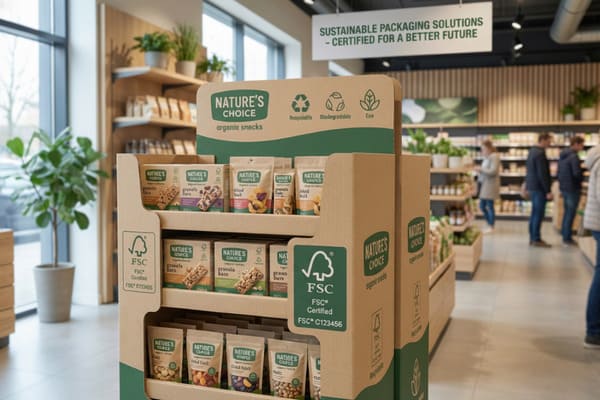
Sustainability is no longer just a trend; it is a strict requirement for major retailers and a priority for modern consumers. Many of our clients ask if our cardboard displays meet these rigorous global standards to ensure compliance and environmental responsibility.
Yes, FSC® and other certifications are available on the majority of our corrugated cardboard products. We work directly with certified paper mills to ensure full supply chain transparency for our clients. This allows brands to display the FSC logo on their packaging, ensuring compliance with retailer mandates while appealing to eco-conscious consumers.
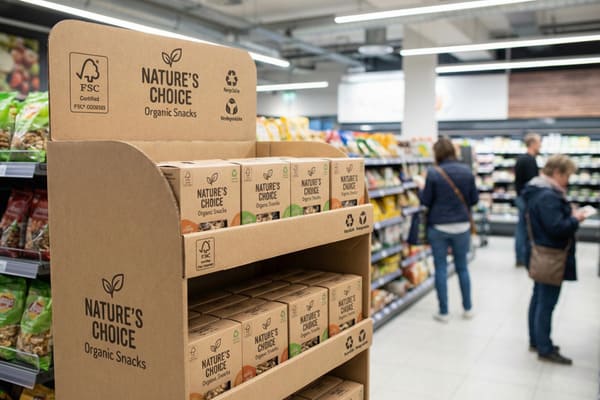
Navigating the complex world of material certifications can be confusing, but understanding them is crucial for securing your supply chain and protecting your brand reputation.
What products might you see FSC on?
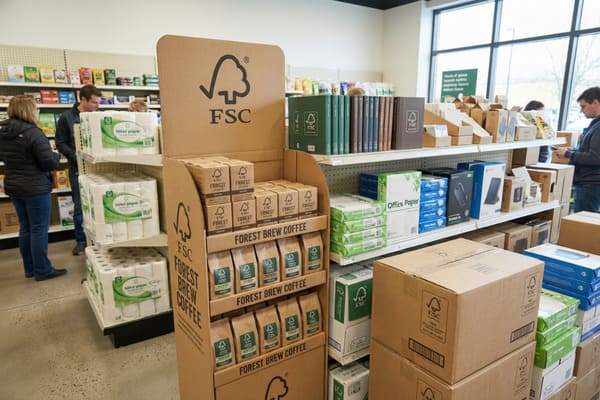
You likely see the tree-and-checkmark logo every day, from your morning coffee cup to the shipping boxes arriving at your door. It signals responsible forestry to consumers instantly and builds trust in the product.
You might see FSC labels on a wide range of paper-based items, including toilet paper, books, office paper, and especially packaging materials. In the retail sector, it is increasingly common on corrugated shipping boxes, folding cartons, and point-of-purchase (POP) cardboard displays used in stores to promote products.
The Scope of Certified Materials in Retail
The application of Forest Stewardship Council (FSC)1 marks in the retail environment has expanded significantly over the last decade. It is no longer limited to simple copy paper or wood furniture. In the Cardboard Display industry, we are seeing a massive shift where the certification applies to the entire structure of the display unit. This includes the main body made of corrugated fiberboard, the internal support structures, and even the high-gloss header cards used for branding.
When we manufacture a display, we deal with various layers of paper. There is the liner (the smooth outer surface), the medium (the wavy fluting inside), and the inner liner. For a product to carry the FSC label, all these components must track back to a certified source. In the North American market, retailers like Walmart and Costco are driving this change through initiatives like Project Gigaton2. They are pressuring suppliers to reduce their environmental footprint. Consequently, you will see these certifications on Floor Displays holding heavy merchandise, Countertop Displays for cosmetics, and Pallet Displays for bulk items.
The visibility of the certification also depends on the specific paper grade used. For example, high-quality clay-coated news back (CCNB) used for high-resolution graphics often carries these certifications to ensure that marketing materials do not come at the cost of ancient forests. Even the brown Kraft paper used for industrial shipping cartons is now frequently certified. It is important to note that the logo does not appear by magic; it must be requested during the design phase so that the printer knows to include it in the artwork die-lines.
| Product Type | Material Composition | Certification Relevance |
|---|---|---|
| Floor Displays | Corrugated (B-flute / EB-flute) | High – Required by major chains |
| Countertop Units | Lightweight Corrugated (E-flute)3 | Medium – Brand preference driven |
| Shipping Cartons | Kraft / Testliner | High – Standard compliance |
| Header Cards | Solid Bleached Sulfate (SBS)4 | High – Visible consumer facing |
I verify the paper source for every order at my factory to ensure that if a client requests a label, the material we source matches that claim 100%.
What products are FSC certified?
Many buyers assume that all recycled or brown cardboard is automatically certified, but that is a dangerous assumption to make in manufacturing. Certification requires a specific chain of custody validation that proves the material's origin.
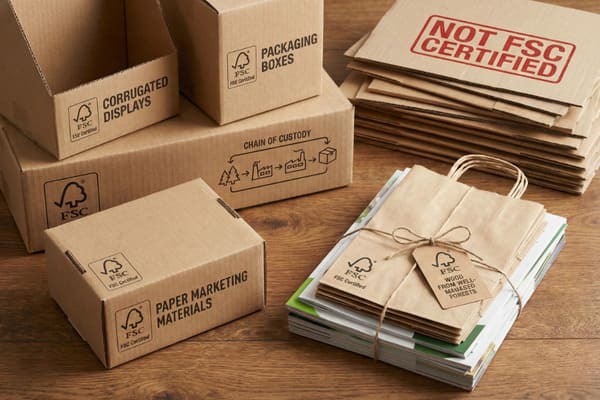
Products are only FSC certified if they use wood fibers from well-managed forests and pass through a certified Chain of Custody (CoC). This includes specific lines of corrugated displays, packaging boxes, and paper marketing materials where the factory has verified the source of every pulp layer involved.
Verification of Chain of Custody5 in Manufacturing
Understanding which specific products are certified requires looking at the manufacturing process, not just the finished look. A product is "FSC Certified6" only when the Chain of Custody (CoC) is unbroken from the forest to the final printer. In my production lines, this means we cannot simply buy paper from any vendor; we must buy from mills that hold their own valid certificates. If we buy certified liner paper but mix it with non-certified fluting medium from an unknown source, we generally cannot label the final display as "FSC 100%".
There are different types of labels you will see on products, and they mean different things. "FSC 100%" means all timber came from FSC-certified forests. This is rare in corrugated displays. More common is "FSC Mix," which means the product is a mixture of materials from FSC-certified forests, recycled materials, and FSC-controlled wood. "FSC Recycled" is also very popular in our industry, meaning the product is made from 100% recycled content.
For a buyer like you, dealing with tight deadlines and high quality standards, the risk lies in "greenwashing." Some suppliers might claim a product is certified because they bought certified paper once, but they are not maintaining the CoC for your specific batch. To ensure a product is truly certified, the invoice you receive must typically reference the certification code. We see this often with high-strength corrugated boards used for heavy hunting equipment. The structural integrity is not compromised by certification; in fact, certified mills often produce more consistent fiber quality, leading to better Edge Crush Test (ECT) results.
| Label Type | Definition | Common Application |
|---|---|---|
| FSC 100% | All material from certified forests | High-end furniture, rare in packaging |
| FSC Mix7 | Certified wood + Recycled + Controlled wood | Most common for Cardboard Displays |
| FSC Recycled8 | 100% Post-consumer reclaimed material | Brown shipping boxes, eco-brands |
| Uncertified | Source unknown or unverified | Low-cost generic packaging |
I ensure my procurement team only sources from mills that provide valid CoC documentation for every batch of "Mix" or "Recycled" board we process.
What are FSC certifications?
Certification sounds like just another piece of paper to file, but it represents a rigorous global standard that impacts trade legality. It protects your brand reputation and ensures market access in strictly regulated regions.
FSC certifications are global standards set by the Forest Stewardship Council to promote responsible management of the world's forests. They confirm that the forest is being managed in a way that preserves biological diversity and benefits the lives of local people and workers, ensuring economic viability.
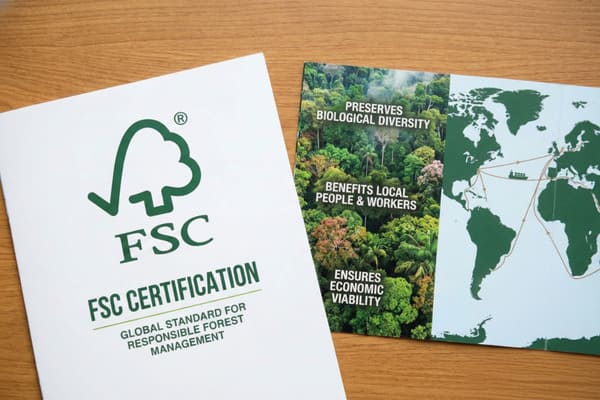
Understanding the Three Pillars of Sustainability
FSC certification9 is not merely about planting trees; it is a comprehensive system based on ten principles and criteria that cover environmental, social, and economic aspects. For a business owner importing goods into the United States or Canada, understanding this is vital for risk mitigation. The "Environmental" pillar ensures that the harvesting of trees maintains the forest's biodiversity, productivity, and ecological processes. This is critical because using wood from illegal logging can lead to severe penalties under laws like the U.S. Lacey Act.
The "Social" pillar is equally important, though often overlooked. It protects the rights of indigenous people and ensures the safety and well-being of forest workers. When you buy a certified display, you are technically validating that the labor used to harvest the raw material was treated fairly. The "Economic" pillar ensures that forest operations are structured and managed to be sufficiently profitable, without generating financial profit at the expense of the forest resource, the ecosystem, or affected communities.
In the context of cardboard displays, these certifications (Standard FSC-STD-40-004) confirm that the material flow is documented. We undergo annual audits by third-party bodies (like SGS or TUV) to retain our ability to sell certified products. It is a rigorous process involving tracking volume in versus volume out. This differs from other certifications like PEFC (Programme for the Endorsement of Forest Certification) or SFI (Sustainable Forestry Initiative10), though FSC is generally considered the "gold standard" by environmental NGOs and major retailers like Target and Home Depot.
| Feature | FSC (Forest Stewardship Council) | PEFC (Programme for Endorsement) | SFI (Sustainable Forestry Initiative) |
|---|---|---|---|
| Focus | Environmental & Social rigor11 | Industry & Supply Chain | North American focus12 |
| Global Reach | Very High (Preferred by NGOs) | Highest volume certified | High in US/Canada |
| Retailer Pref. | Preferred by global brands | Accepted, but less "premium" | Common in construction |
We maintain current audits and keep our certification valid to ensure you never face compliance issues when shipping to strict US or Canadian retailers.
How do I know if something is FSC certified?
You cannot just trust a supplier's word or a generic claim when they tell you their material is green. You need visible, verifiable proof on the final product to ensure you are getting what you paid for.
You can identify if something is FSC certified by looking for the distinct on-product label containing the FSC logo, the label type, and a unique license code. You should also verify this license code on the public FSC database to ensure the certification is valid and currently active.
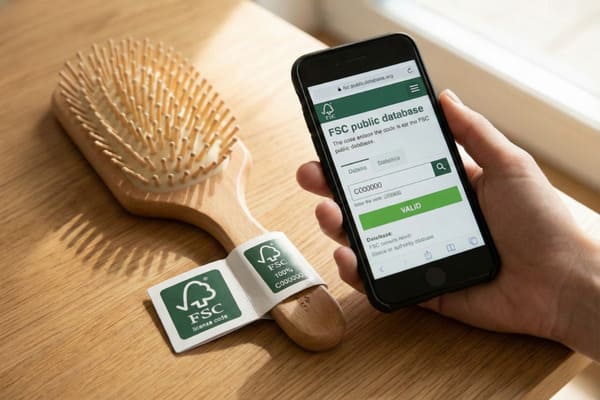
The Protocol for Validating Supplier Claims
Validating a claim is a technical process that every buyer should know. The first step is visual inspection. A valid on-product label must contain three elements: the FSC "tick tree" logo, the label title (e.g., Mix, 100%, or Recycled), and critically, the License Code13. This code usually starts with a 'C'followed by a series of numbers (e.g., FSC® C123456). If a supplier prints the logo but omits the code, it is a red flag. It often means they are using the graphic illegally or without authorization.
The second step is digital verification. You can take that license code and enter it into the FSC Public Search database14. This search will tell you the company name associated with the code, the status of their certificate (Valid, Suspended, or Terminated), and the scope of their certification. If the supplier claims to be the manufacturer but the code belongs to a completely different company, they might be outsourcing without telling you, or simply copying a logo they found online.
From a design perspective, we also have to follow strict graphic standards. There are clear exclusion zones (blank space) required around the logo, and it cannot be distorted or changed in color arbitrarily—usually, it must be black, white, or "FSC Green." When we prepare 3D renderings for your crossbow displays, we position this logo strategically so it is visible to the consumer but does not interfere with your main branding graphics. It serves as a trust signal to your customers.
| Component | Function | What to Check |
|---|---|---|
| The Logo | Visual recognition15 | Is it the correct "tick tree" shape? |
| Label Title | Material source type | Does it say Mix, Recycled, or 100%? |
| License Code | Tracking & Verification | Is it a 'C'followed by 6 digits? |
| Product Type | Scope of certification16 | Does the database list "Packaging"? |
I personally oversee the prepress process to ensure the correct license code is integrated into your artwork before mass production begins.
Conclusion
Certifications like FSC are essential for compliance and brand trust. We offer fully certified options to ensure your displays meet all retail standards.
Explore this link to understand how FSC certification impacts sustainability in retail and why it's crucial for eco-friendly practices. ↩
Learn about Project Gigaton's initiatives and how major retailers are working to reduce their environmental impact. ↩
Discover the advantages of using Lightweight Corrugated (E-flute) for your packaging needs, including cost-effectiveness and sustainability. ↩
Learn about the significance of Solid Bleached Sulfate (SBS) in packaging, especially for consumer-facing products. ↩
Understanding the Chain of Custody is crucial for ensuring product authenticity and compliance with certification standards. ↩
Exploring FSC Certification helps buyers ensure they are sourcing sustainable and responsibly produced materials. ↩
Learn about the differences between FSC Mix and FSC 100% to make informed choices for sustainable sourcing. ↩
Explore the advantages of using FSC Recycled materials for sustainable packaging and eco-friendly products. ↩
Explore this link to understand the significance of FSC certification in promoting sustainable forestry practices. ↩
Learn about the Sustainable Forestry Initiative and its role in sustainable forestry, especially in comparison to FSC. ↩
Understanding this concept is crucial for recognizing sustainable practices in forestry. ↩
Exploring this will provide insights into regional practices and their impact on sustainability. ↩
Learning about the License Code is crucial for ensuring that suppliers are legitimate and compliant with standards. ↩
Exploring this resource will help you understand how to verify supplier claims effectively and ensure compliance. ↩
Understanding visual recognition can enhance your brand's identity and customer recall. ↩
Exploring the scope of certification helps ensure compliance and trust in product claims. ↩