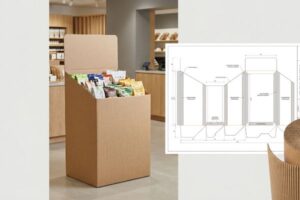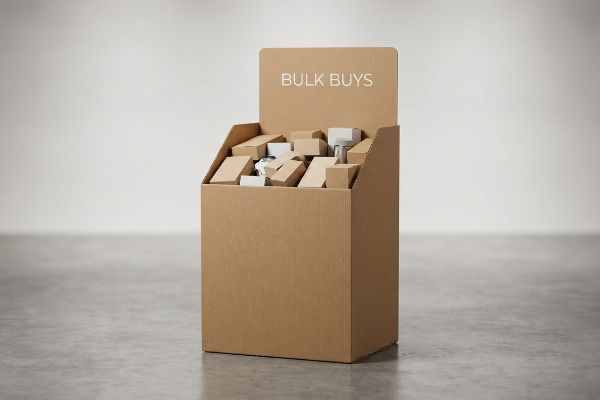
Impulse items need high floor visibility, but choosing the right retail fixture can feel overwhelming. Let's break down the mechanics behind one of the most effective high-volume merchandisers available.
A dump bin display is a freestanding retail fixture engineered to hold loose, unpackaged bulk merchandise. Typically constructed from heavy-duty corrugated board, these open-top structures allow shoppers to easily access products from multiple angles, making them highly effective for rapid inventory clearance.
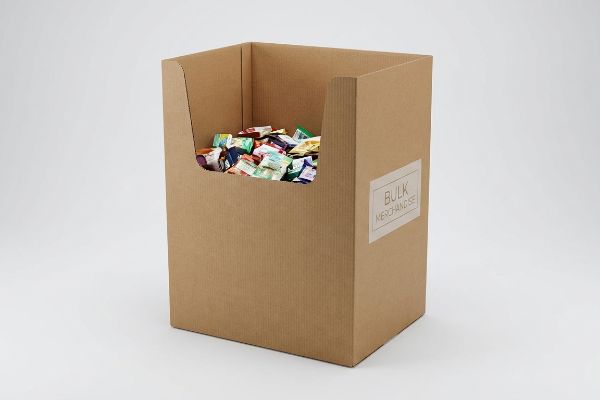
Understanding the basic definition is easy, but optimizing these fixtures for a harsh retail environment requires looking past the surface.
What are the other benefits of using bins?
Beyond holding products, you need fixtures that actively reduce store-level friction.
The other benefits of using bins include high-volume product clearance, seamless floor mobility, and rapid restocking capabilities. By centralizing loose merchandise, these standalone corrugated fixtures allow retailers to cross-sell impulse items efficiently while minimizing permanent shelf footprint, significantly accelerating daily inventory turnover rates.
You know the marketing benefits, but executing them physically introduces a hidden mechanical challenge.
The Hidden Physics of High-Volume Merchandising
A common assumption is that a large corrugated box can effortlessly hold 50 lbs (22.6 kg) of loose, shifting products1 without any specialized internal architecture. Procurement teams often order a basic square bin, assuming the raw material thickness alone will contain the merchandise.
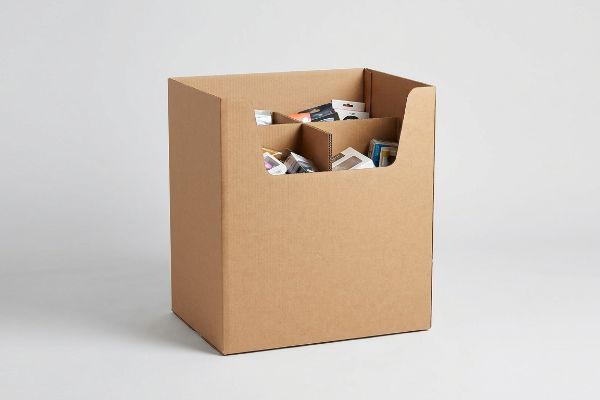
This is a trap I see constantly, leading directly to the "Dump Bin Bulge" phenomenon. When a floor clerk dumps heavy, asymmetrical items into an unreinforced square bin, the outward kinetic pressure causes the flat corrugated walls to visibly bow outward2. I remember watching a store manager aggressively wrapping messy clear packaging tape around the bowing middle of a premium branded bin just to keep it from bursting, completely ruining the visual aesthetic. To fix this, I always engineer an internal "H-Divider" or a hidden corrugated "Belly Band" directly into the structure. You can literally feel the stiff resistance of the virgin kraft board when this internal spine locks into place, creating a rigid tension matrix that completely neutralizes the outward pressure.
| Common Rookie Mistake | The Pro Fix | Retail-Floor Benefit |
|---|---|---|
| Relying on single-wall flat sides | Integrating an internal Belly Band3 | Prevents sidewall bowing |
| Overloading raw corrugated boxes | Engineering H-Divider load distribution4 | Eliminates mid-aisle bursting |
| Taping structural blowouts | Using hidden tension locks | Keeps branding perfectly clean |
By distributing the dynamic load internally, this structural adjustment completely prevents side-wall collapse and saves clients from the massive logistical headache of in-store fixture replacements.
🛠️ Harvey's Desk: Are the side walls of your high-volume merchandisers visibly bowing outward? 👉 Get A Structural Audit ↗ — Direct access to my desk. Zero automated sales spam, I promise.
What is a dump bin display?
Before maximizing impulse sales, you need to understand the exact internal mechanics of this specific fixture.
A dump bin display is a floor-standing open container specifically designed to present bulk promotional goods in high-traffic retail aisles. These fixtures prioritize immediate physical access, featuring a deep central cavity supported by internal load-bearing structures that keep scattered products neatly contained and easily reachable.
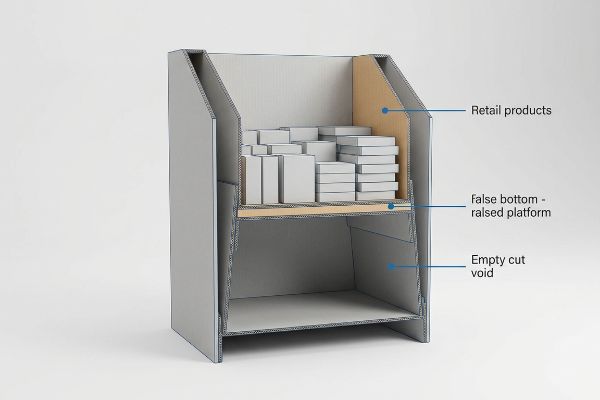
It sounds like a simple open box, but the internal engineering tells a completely different story.
The "False Bottom" Engineering Secret
A standard beginner approach is to design a tall, single-cavity bin that reaches all the way to the floor, assuming maximum internal volume equates to maximum product display. Buyers simply calculate the cubic inches (cm) and fill the entire unit with inventory.
The physical reality is that shoppers do not want to bend over to retrieve products from the floor. I once watched a consumer awkwardly scraping their forearm against the raw corrugated edge trying to fish a small item out of a 36-inch (91.4 cm) deep bin where the bottom half had become completely dead space. The pro fix is to implement a strict "False Bottom" protocol, engineering a raised internal platform that artificially limits the cavity depth5. The loud, hollow thud of a product dropping safely onto this raised platform proves the merchandise is kept perfectly at arm's level.
| Common Rookie Mistake | The Pro Fix | Retail-Floor Benefit |
|---|---|---|
| Creating floor-depth cavities | Engineering a raised False Bottom6 | Keeps products at arm level |
| Wasting inventory at the base | Limiting the functional depth | Reduces necessary stock volume7 |
| Ignoring shopper ergonomics | Elevating the primary grab zone8 | Prevents awkward bending |
By raising the floor of the bin, you drastically reduce the amount of inventory required to make the fixture look fully stocked, cutting your upfront inventory holding costs while improving shopper accessibility.
🛠️ Harvey's Desk: Are shoppers awkwardly scraping their arms just to reach your bottom-tier products? 👉 Check The Ergonomic Math ↗ — Download safely. My inbox is open if you have questions later.
What is the importance of display?
Getting your product into a store is only half the battle; physically stopping the shopper is the real challenge.
The importance of a display lies in its ability to visually disrupt automated shopping patterns and trigger immediate impulse conversions. A well-engineered fixture functions as a standalone salesperson, effectively organizing inventory, communicating brand equity, and actively pulling passive foot traffic toward your specific retail footprint.
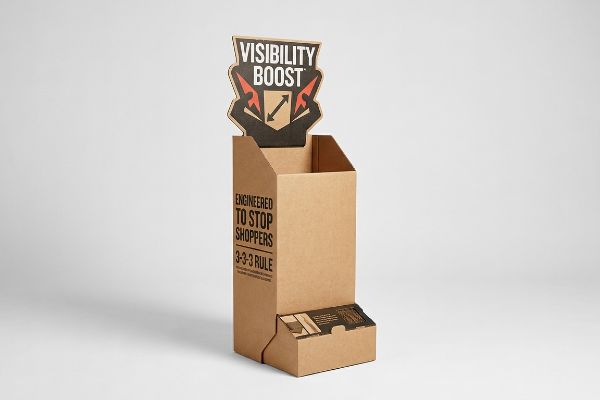
Understanding this importance is great for marketing pitches, but translating it into structural cardboard is where campaigns live or die.
Mastering the 3-3-3 Spatial Engagement Rule
Many designers build structural concepts to look visually perfect up close on a backlit computer monitor. They export flat artwork files, assuming the exact same level of engagement will effortlessly transfer to a busy, brightly lit retail aisle.
The problem is that a big-box store operates more like a crowded highway than an art gallery. I regularly see brands print dense, tiny marketing text on the base of a display, expecting rushing shoppers to stop and read it from 10 feet (304.8 cm) away. When I observe these units on the floor, consumers just walk right past them without breaking stride. You must engineer the layout using the 3-3-3 Rule: capturing attention from 30 feet9 (914.4 cm), engaging interest at 3 feet (91.4 cm), and closing the sale at 3 inches (7.6 cm). The smooth friction of your hand running over a massive, aggressive die-cut header proves you have built a shape capable of achieving that critical 30-foot visual disruption.
| Common Rookie Mistake | The Pro Fix | Retail-Floor Benefit |
|---|---|---|
| Designing for close-up monitors | Designing for 30-foot disruption10 | Pulls traffic from down the aisle |
| Placing small text near the floor | Moving key messages to the header11 | Keeps messaging at eye level |
| Creating flat, rectangular units | Using aggressive die-cut shapes12 | Breaks visual aisle monotony |
Implementing this spatial psychology forces the human eye to engage with your footprint, drastically reducing the chances of your campaign becoming invisible background noise.
🛠️ Harvey's Desk: Are your displays blending into the background of a crowded aisle? 👉 Request A Visibility Check ↗ — No forms that trigger endless sales calls. Just pure value.
Why are visual merchandising displays important?
Visual presentation directly controls the perceived value and quality of your product on the retail floor.
Visual merchandising displays are important because they strategically organize merchandise to maximize aesthetic appeal and highlight key product features. By structuring a cohesive and attractive physical presentation, these layouts actively reduce cognitive friction, allowing shoppers to effortlessly evaluate, engage with, and ultimately purchase the targeted items.
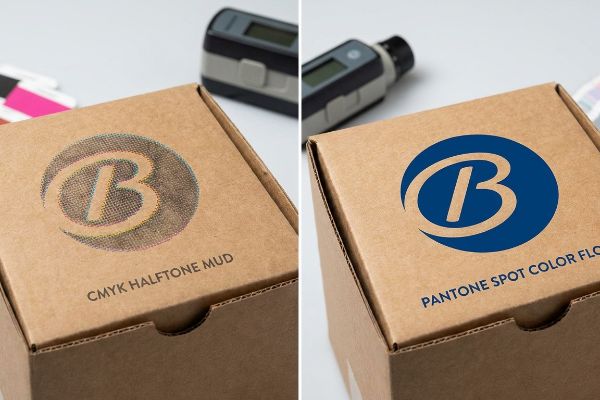
But knowing the theory isn't enough when the factory machines start running and the ink actually hits the board.
Why Standard CMYK Fails on the Factory Floor
A seemingly reasonable assumption is that standard digital artwork will translate flawlessly onto a visual merchandiser. Designers routinely send standard CMYK (Cyan, Magenta, Yellow, Key) files to the factory, fully expecting the complex color blends on their screen to perfectly match the final printed corrugated box13.
In my facility, I routinely see visual campaigns severely compromised by the "CMYK Halftone Mud" trap. When I measure the optical blending on unsealed 32ECT (Edge Crush Test) testliner, the tiny overlapping CMYK dots absorb unevenly into the porous paper fibers14, failing to blend optically. The result is a grainy, washed-out logo that looks incredibly cheap under harsh fluorescent retail lighting. I pulled the densitometer readings and proved to my client that we didn't need to overcomplicate the art file—I just needed to mandate a Spot Color Flood Protocol15. By replacing CMYK dot blending with a single, precisely mixed Pantone spot color ink, we completely eliminated the halftone grain. The pungent, sharp smell of wet Pantone ink curing solidly onto raw kraft paper is the exact sensory proof of a dense, perfectly smooth pigment flood.
| Common Rookie Mistake | The Pro Fix | Retail-Floor Benefit |
|---|---|---|
| Printing CMYK on raw testliner | Using Pantone Spot Color Floods | Prevents washed-out brand logos |
| Relying on optical dot blending | Utilizing pre-mixed solid inks | Eliminates grainy halftone mud |
| Ignoring substrate porosity | Adjusting ink density for kraft board | Maximizes 20-foot visibility |
By enforcing this spot color printing protocol, I ensure your graphics maintain absolute crispness from across the store, saving you from triggering immediate retailer rejections based on poor visual merchandising standards.
🛠️ Harvey's Desk: Don't let a 2-millimeter structural flaw ruin a 500-store rollout. 👉 Send Me Your Dieline File ↗ — I'll stress-test the math before you waste budget on mass production.
Conclusion
You can choose a cheaper printer, but when that unsealed corrugated board causes severe CMYK halftone mud, you trigger an immediate visual rejection from retailers and completely wipe out the campaign's profit margin. Over 500 brand managers use my prepress checklist to avoid these exact fatal early-stage mistakes. Stop guessing on ink absorption rates and let me personally run your artwork through my Free Dieline Pre-Flight Audit ↗ to catch these visual failure points before mass production begins.
"Estimation of the Compressive Strength of Corrugated Board Boxes …", https://pmc.ncbi.nlm.nih.gov/articles/PMC8467740/. [An authoritative source on packaging engineering would provide the load-bearing limits of standard corrugated wall thicknesses versus reinforced architectures for dynamic loads]. Evidence role: Technical validation; source type: Packaging industry engineering standard. Supports: The claim that specialized internal architecture is necessary for heavy loose products. Scope note: Capacity depends on fluting type and Edge Crush Test (ECT) ratings. ↩
"Mechanical Behavior Modeling of Containers and Octabins … – PMC", https://pmc.ncbi.nlm.nih.gov/articles/PMC8124728/. [Materials science sources on corrugated fiberboard would describe how lateral loads lead to wall deflection and bowing in unreinforced structures. Evidence role: technical validation; source type: engineering textbook. Supports: The cause of the 'Dump Bin Bulge'. Scope note: Applicable to standard corrugated board.] ↩
"DISPLAY STRUCTURAL DESIGN FOR INTERACTIVE RETAIL …", https://www.bcipkg.com/display-structural-design-for-interactive-retail-displays/. An authoritative source on structural packaging design would explain how internal reinforcement bands increase lateral rigidity to prevent wall deformation. Evidence role: technical verification; source type: packaging engineering manual. Supports: prevention of sidewall bowing. Scope note: specific to corrugated or thin-walled fixtures. ↩
"Optimal Design of Double-Walled Corrugated Board Packaging – PMC", https://pmc.ncbi.nlm.nih.gov/articles/PMC8950760/. Technical documentation on corrugated inserts would detail how H-shaped dividers redistribute vertical and lateral loads to prevent structural failure. Evidence role: structural validation; source type: industrial design specification. Supports: elimination of box bursting. Scope note: applies to high-volume merchandising loads. ↩
"4 Best Dump Bin Display Ideas For Retail – News – WOW Packaging", https://www.cardboard-display-stand.com/news/4-best-dump-bin-display-ideas-for-retail-85308485.html. [Industry retail fixture guidelines or industrial design manuals would verify that raised internal platforms are used to maintain products within the optimal reaching zone]. Evidence role: technical validation; source type: industry design standard. Supports: the effectiveness of false bottoms in dump bins. Scope note: focused on bulk promotional fixtures. ↩
"Benefits of Dump Bin Retail Displays | CDN", https://www.creativedisplaysnow.com/benefits-of-dump-bin-retail-displays/. [Industry merchandising guides explain how false bottoms are used in dump bins to maintain product visibility by preventing items from sinking]. Evidence role: technical specification; source type: retail design manual. Supports: the use of raised bases to keep products at arm level. Scope note: specific to impulse display fixtures. ↩
"Best Custom Retail Fixtures – Display Craft Manufacturing Co.", https://www.displaycraftmfg.com/services/retail-fixtures/. [Retail inventory management studies demonstrate that limiting the internal depth of a display reduces the quantity of SKUs needed to create a full visual appearance]. Evidence role: efficiency metric; source type: supply chain analysis. Supports: the benefit of limiting functional depth. Scope note: applicable to high-turnover impulse bins. ↩
"[PDF] Guidelines for Retail Grocery Stores – Ergonomics for the … – OSHA", https://www.osha.gov/sites/default/files/publications/OSHA3192.pdf. [Ergonomic research on consumer behavior identifies the optimal 'strike zone'or grab zone height that maximizes product interaction and minimizes shopper fatigue]. Evidence role: ergonomic standard; source type: consumer psychology study. Supports: the prevention of awkward bending through height adjustment. Scope note: focused on upper-body accessibility. ↩
"The Importance of the Rule of 3 for Your Custom Store Displays", https://mcintyredisplays.com/blog/custom-store-displays/. [An authoritative guide on visual merchandising or retail design would verify the specific spatial distances used to attract, engage, and convert consumers]. Evidence role: technical specification; source type: industry manual. Supports: the spatial engagement framework for retail displays. Scope note: focuses on the 3-3-3 distance rule in a big-box retail context. ↩
"Retail premises design for effective displays and customer flow", https://www.business.qld.gov.au/industries/manufacturing-retail/retail-wholesale/retail-displays. [An authoritative retail design guide would validate the specific distance required for a display to disrupt a shopper's path from a distance]. Evidence role: verification; source type: retail design manual. Supports: Effectiveness of long-range visual disruption. Scope note: Distance effectiveness may vary based on aisle width and lighting.] ↩
"Impact of different types of in-store displays on consumer purchase …", https://www.sciencedirect.com/science/article/abs/pii/S0022435921000634. [Eye-tracking studies in retail environments provide evidence that header-level placement aligns with primary shopper sightlines]. Evidence role: verification; source type: consumer behavior study. Supports: Importance of placing key messaging at eye level. Scope note: Effectiveness depends on the physical height of the display unit.] ↩
"How Label Shapes Influence Consumer Behavior", https://ustl.com/how-label-shapes-influence-consumer-behavior/. [Research on visual saliency suggests that non-rectangular shapes act as pattern interrupts to break visual monotony in retail aisles]. Evidence role: verification; source type: marketing psychology journal. Supports: Use of die-cut shapes to increase attention. Scope note: Efficacy may diminish if overused in a single environment.] ↩
"RGB vs CMYK Color Differences Explained | We Custom Boxes", https://www.wecustomboxes.com/blog/rgb-vs-cmyk-color/. [Authoritative sources in color science and packaging print explain how the porosity and base color of corrugated substrates cause ink absorption and color shifts compared to digital screens]. Evidence role: technical verification; source type: printing industry standard. Supports: the claim that screen colors often fail to match corrugated print. Scope note: applies specifically to uncoated corrugated materials. ↩
"What Is Color Matching In Printing, And How Does It Work? – Custom …", https://popdisplay.me/what-is-color-matching-in-printing-and-how-does-it-work/. [Technical documentation on printing on corrugated substrates explains how the porosity of unsealed testliner leads to uneven ink absorption and dot gain in CMYK processes.] Evidence role: technical validation; source type: industry technical manual. Supports: the claim that CMYK fails on porous substrates. Scope note: focuses on unsealed testliner. ↩
"Spot Color vs CMYK for Packaging Design – Which One's Better?", https://stampaprints.com/blog/spot-color-vs-cmyk-for-packaging/?srsltid=AfmBOoocdB22C007T6xBU6h6oH5EBUQF8lpL1ePLkgIJ8-_HTrniZ_Ft. [Printing standards indicate that using solid spot colors eliminates the graininess associated with halftone screens on absorbent materials.] Evidence role: solution validation; source type: graphic arts standard. Supports: the effectiveness of spot colors over CMYK for smoothness. Scope note: specific to high-opacity needs on raw paper. ↩