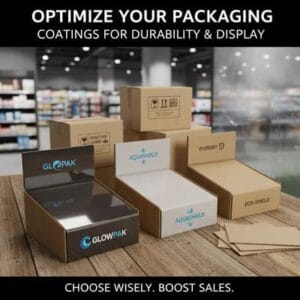
Struggling to get your product noticed in a crowded retail aisle? You need a solution that grabs attention immediately and boosts sales without breaking the bank.
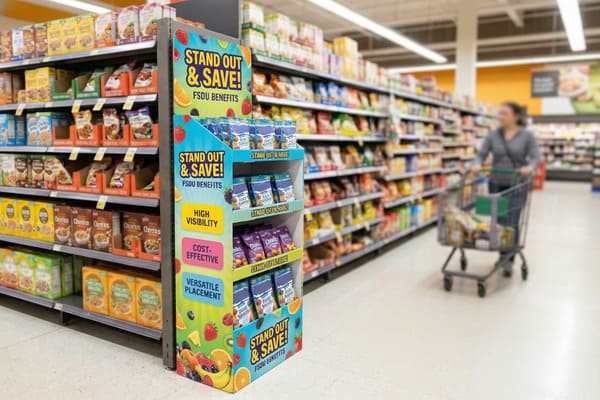
FSDUs (Free Standing Display Units) offer high visibility, cost-effective marketing, and versatile placement options. They operate as standalone salespeople, increasing brand awareness and impulse purchases by disrupting the shopper's journey and highlighting products away from crowded shelves.

Let's explore how these displays can transform your retail strategy and why major brands are investing heavily in them right now.
What are the benefits of Fsdu?
Are your products getting lost on standard shelves? Brands often fail to stand out when placed right next to competitors.
The primary benefits include increased product visibility, flexible placement in high-traffic areas, and significant cost savings compared to permanent fixtures. They allow for custom branding that tells a story, effectively interrupting the shopper's path to drive impulse buys.
Maximizing ROI Through Structural Innovation
To truly understand the value of a Free Standing Display Unit1, we must look beyond just the low cost of cardboard. The real benefit lies in the engineering versatility and the return on investment2. Cardboard displays are manufactured using corrugated board, typically B-flute or EB-flute, which offers a surprising strength-to-weight ratio. While a permanent metal fixture might cost hundreds of dollars and take months to prototype, a cardboard FSDU can be designed, printed, and produced in a fraction of that time. This speed is crucial for brands that need to react to market trends or launch seasonal campaigns quickly.
Furthermore, the customization capabilities of digital and offset printing allow for high-resolution graphics that cover the entire unit. This means 100% of the surface area is marketing space, unlike metal shelving where branding is limited to small strips. However, durability is often a concern. Many retailers like Costco or Walmart have strict compliance guides regarding weight capacity. A poorly made display will buckle under humidity or heavy product load. By utilizing high-strength recycled fibers and water-resistant coatings, we can mitigate these risks. This ensures the display remains pristine for the typical 4 to 6-week promotion cycle, maximizing your sell-through rate without the high capital expenditure of permanent furniture.
| Feature | Cardboard FSDU | Permanent Metal/Wood Display |
|---|---|---|
| Production Cost3 | Low ($15 – $45 avg) | High ($150 – $500+ avg) |
| Lead Time | Fast (10-15 days) | Slow (6-12 weeks) |
| Customization | High (Full print coverage) | Low (Limited branding zones) |
| Sustainability4 | High (Recyclable) | Low (Hard to recycle) |
| Mobility | Lightweight, easy to move | Heavy, fixed location |
I know that structural integrity is your biggest worry when shipping heavy items like outdoor gear. We use reinforced corrugated cores and run distinct load-bearing tests in my factory to ensure your displays survive the journey from Shenzhen to the US retail floors.
What is the key advantage of a straight store layout?
Do customers walk past your aisle without looking? A rigid store layout can make it hard to disrupt shopper behavior.
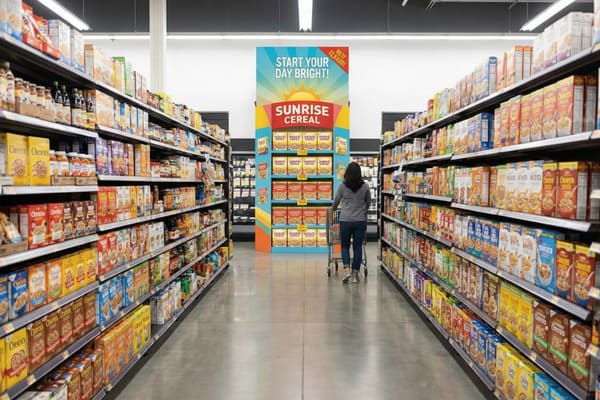
A straight store layout provides a clear, organized path that maximizes shelf space and simplifies inventory control. However, the key advantage for displays is the predictable traffic flow, allowing you to strategically place FSDUs at the end of aisles to capture guaranteed attention.
Strategic Placement in Grid Layouts
The straight store layout, often referred to as the grid layout5, is the standard for most large supermarkets and retailers like grocery chains. The defining characteristic of this layout is efficiency. Shoppers know exactly how to navigate up and down the aisles. For a product manufacturer, this predictability is a massive advantage if used correctly. In a chaotic layout, you might not know where the customer will look. In a straight layout, you know exactly where their eyes are headed: the end of the aisle. This is where the FSDU6 becomes a "power wing" or an "end cap" display.
The technical advantage here relies on the "interruptive" nature of the FSDU. When a shopper is in "autopilot" mode walking down a long straight aisle, their brain filters out most products on the shelf. An FSDU placed at the end of this straight line breaks that visual monotony. It forces a cognitive pause. For this to work, the display must be dimensioned correctly to fit standard retail end-cap specifications (often 36 to 48 inches wide in the US). If the display is too bulky, it blocks the flow; if it is too small, it gets ignored. The goal is to utilize vertical space effectively. Tall, narrow displays work best in straight layouts because they align with the vertical sightlines of a customer walking forward.
| Zone | Traffic Flow Characteristics | Recommended Display Type |
|---|---|---|
| Aisle End (End Cap) | High visibility, predictable stop point7 | Large FSDU or Pallet Display |
| Mid-Aisle | Fast movement, lower attention | Shelf Talker or Clip Strip |
| Checkout Lane | Slow movement, waiting time8 | Countertop Display (PDQ) |
| Store Entrance | High traffic, orientation phase | Stacked Pallet Display |
I understand that placement is useless if the display arrives damaged or is too hard to assemble for store staff. We prioritize flat-pack designs that withstand logistics pressure, ensuring your unit looks perfect when it finally hits that prime end-cap spot.
What are the benefits of in-store experience?
Why do shoppers buy online instead of in your store? Physical retail loses out when it fails to offer an engaging, tangible experience.
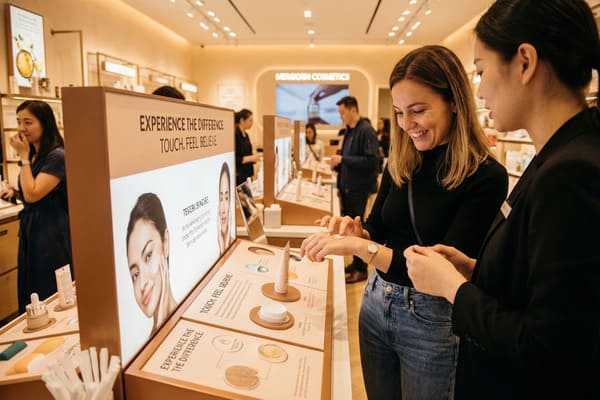
The in-store experience allows customers to touch, feel, and test products before buying, which significantly reduces return rates. Good displays enhance this by educating the shopper, providing tactile engagement, and creating an emotional connection that digital screens cannot replicate.
Enhancing Engagement Through Tactile Design
In an era dominated by e-commerce, the physical store must offer something the screen cannot: reality. The benefit of the in-store experience is sensory validation. Customers, especially in sectors like sporting goods or cosmetics, want to verify the quality of a product before purchasing. A standard shelf does not invite interaction. A well-designed FSDU, however, is an invitation. It can physically present the product out of the box, allowing the customer to grip a handle, feel a texture, or see the actual size. This reduces the "imagination gap" that leads to cart abandonment online.
From a technical design perspective, we can enhance this experience by integrating different textures into the cardboard print, such as soft-touch matte finishes or spot UV coating that makes logos pop. We are also seeing a trend toward "Smart Displays9." By integrating QR codes or NFC tags into the print structure, we bridge the physical and digital worlds. A customer can pick up the product, scan the display, and immediately see a video tutorial or user reviews. This turns a passive shopping trip into an active learning session. For high-value items, the display must also convey trust. Flimsy cardboard suggests a cheap product. Robust, high-quality corrugated board with precise color management suggests premium quality.
| Metric | Online Shopping | In-Store with FSDU |
|---|---|---|
| Sensory Input | Visual & Audio only | Visual, Tactile, Spatial |
| Instant Gratification10 | Low (Wait for shipping) | High (Take home immediately) |
| Brand Trust | Based on reviews | Based on physical inspection |
| Impulse Buy Rate11 | Lower (Search intent driven) | Higher (Discovery driven) |
I believe that color consistency is critical for your brand experience to feel authentic. We use advanced color management systems in my print shop to match your Pantone codes exactly, ensuring your physical presence matches your global brand identity.
What are the advantages of free flow store layout?
Does your product rely on impulse discovery? Rigid aisles might be killing your sales if your product needs browsing to be found.
Free flow layouts encourage exploration and impulse browsing by removing strict walkways. The advantage here is flexibility; you can position FSDUs at various angles to guide shoppers organically, creating dynamic focal points that draw attention to seasonal or promotional items.
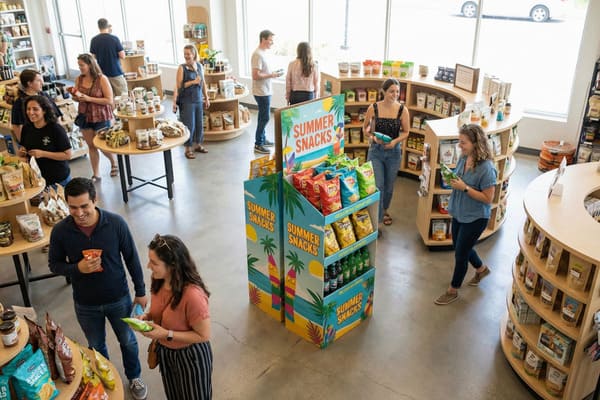
Adapting Displays for Open Retail Environments
A free flow layout12 is typically found in boutiques, apparel stores, or modern concept stores. Unlike the grid, there are no fixed aisles. The advantage for FSDUs13 in this environment is 360-degree visibility. In a grid, a display usually has a "back" that is hidden against a shelf. In a free flow layout, a display is often an island. This means the structural design must be attractive from all angles. It requires a different engineering approach, often using triangular or four-sided pillars that allow shoppers to approach from any direction.
This layout type encourages "wandering." Shoppers are not on a mission; they are exploring. This is the perfect environment for creative, non-standard shapes. We can move away from the boring rectangular box and create displays shaped like the product itself or abstract art. However, the technical challenge here is stability. Without a shelf to lean against, an FSDU in a free flow area is vulnerable to being knocked over. The base must be weighted or designed with a wider footprint to lower the center of gravity. Additionally, because the flow is organic, you can use these displays to physically guide the customer. By placing a series of displays in a curve, you subconsciously direct the shopper toward a specific high-value zone in the store.
| Feature | Grid Layout Display | Free Flow Layout Display |
|---|---|---|
| Visibility | Usually Front/Sides | 360-Degree Visibility14 |
| Shape Constraints | Must fit aisle width | Flexible, can be irregular |
| Stability Requirement | Standard | High (Free-standing) |
| Shopper Mindset | Efficient, focused | Exploratory, relaxed15 |
I see many clients struggle with stability in open layouts where displays stand alone. We engineer custom internal supports and test every prototype for tipping risks, so you never have to worry about a display falling over in a busy store.
Conclusion
Using FSDUs effectively requires understanding your retail environment and product needs. Whether in a grid or free flow layout, these displays provide the visibility and engagement needed to drive sales.
Explore the advantages of Free Standing Display Units to enhance your retail strategy and maximize visibility. ↩
Learn how innovative display solutions can significantly boost your return on investment and drive sales. ↩
Understanding production costs can help you make informed decisions about display options and budgeting. ↩
Exploring sustainability in display manufacturing can guide you towards eco-friendly choices and practices. ↩
Exploring this resource will provide insights into how grid layouts enhance shopping efficiency and product visibility. ↩
Understanding FSDUs will reveal their strategic importance in capturing shopper attention and boosting sales. ↩
Explore how high visibility displays can enhance product awareness and sales in retail environments. ↩
Learn strategies to effectively utilize checkout lane displays to engage customers during waiting times. ↩
Understanding Smart Displays can provide insights into modern retail strategies that blend physical and digital interactions. ↩
Understanding instant gratification can enhance your shopping experience and help you make better purchasing decisions. ↩
Exploring impulse buy rates can reveal valuable insights into consumer behavior and marketing strategies. ↩
Understanding free flow layouts can enhance your retail strategy, making your store more inviting and engaging for customers. ↩
Exploring FSDUs will provide insights into effective display strategies that can boost product visibility and sales. ↩
Explore how 360-Degree Visibility can enhance customer engagement and improve sales in retail environments. ↩
Discover insights on how a relaxed shopping environment can lead to increased customer satisfaction and spending. ↩