Brands demand sustainable packaging, but throwing generic eco-logos onto cardboard often leads to strict retailer rejection. Understanding specific certification tiers is mandatory for big-box compliance.
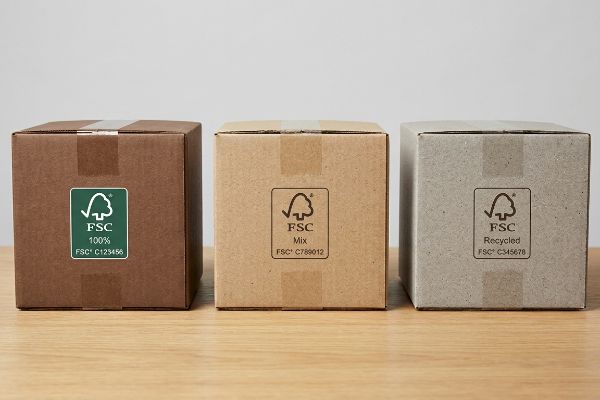
Different types of FSC labels indicate the specific origin of the wood fibers used. The FSC (Forest Stewardship Council) issues three primary certifications: FSC 100%, FSC Mix, and FSC Recycled, ensuring corrugated packaging meets strict environmental and ethical forestry standards for global retail compliance.
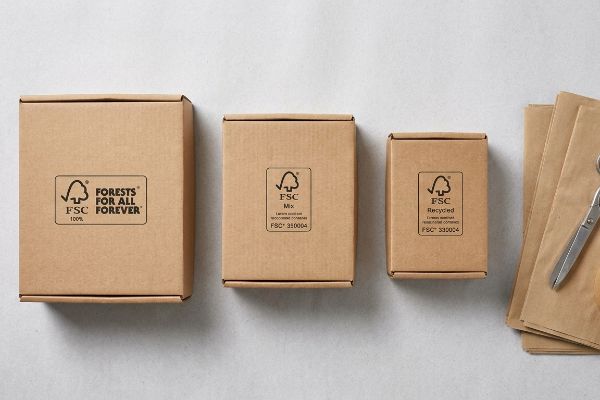
Getting the label right isn't just a marketing exercise; it directly dictates how your supply chain operates and whether strict retailer compliance teams will accept or reject your inbound freight.
What are the two types of FSC labels?
Many procurement teams assume checking a box for "sustainable board" completely covers their legal liability for store rollouts.
The two types of FSC labels most frequently used in retail packaging are FSC 100% and FSC Mix. These specific labels guarantee that the corrugated cardboard originates entirely from responsibly managed forests or a verified blend of sustainable virgin and recycled paper fibers.

However, simply requesting these labels from a vendor doesn't protect your brand from a compliance audit failure if the factory floor lacks strict traceability.
The Chain of Custody Traceability Trap
I constantly see brand managers assume that simply buying certified cardboard automatically guarantees compliance with big-box sustainability mandates. They draft a BOM (Bill of Materials) and trust the factory will handle the rest. What they miss is the mechanical reality of factory operations, where certified boards can easily be mixed with untraceable, low-grade paperboard right on the production floor. Without a verified system, you cannot legally prove your material's origin1.
This isn't just theory—I see this happen on the testing floor when we audit incoming raw materials. A client once transferred a project to my facility after failing a major retailer environmental audit. Their previous supplier had stacked untraceable 32 ECT (Edge Crush Test) testliner2 right next to the certified stock. By enforcing a strict CoC (Chain of Custody) tracking system, I implement absolute raw material segregation and centralized sourcing logs. If we run a batch of 1,500 displays, every single 0.05 inches (1.27 mm) thick E-flute sheet3 is tracked from the paper mill vat to the final die-cut pass. This unbroken paper trail guarantees 100% authentic sustainability, ensuring clients pass rigid procurement audits without friction, avoiding severe chargebacks and keeping the rollout on schedule.
| Compliance Metric | Generic Factory Protocol | Engineered CoC Reality |
|---|---|---|
| Material Segregation | Mixed floor storage | 100% isolated pallet zones4 |
| Origin Tracking | Verbal supplier claims | Verifiable mill paper trail5 |
| Audit Survival Rate | High risk of rejection | Frictionless big-box approval |
I refuse to let sloppy floor management destroy your brand's environmental credibility. True sustainability requires rigorous mechanical segregation, not just a printed logo on a box.
🛠️ Harvey's Desk: Are your current packaging suppliers mixing untraceable materials into your retail shipments and risking massive compliance fines? 👉 Claim Your Free Sustainability Audit ↗ — I review every structural file personally within 24 hours.
What is the difference between FSC 100 and FSC mix?
Navigating material specifications requires understanding how paper fibers actually behave under physical stress.
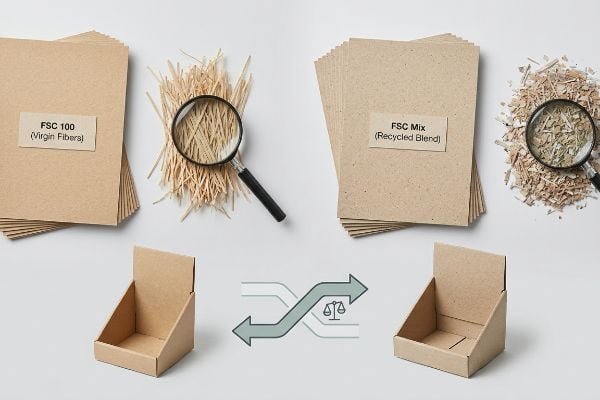
The difference between FSC 100 and FSC Mix lies entirely in the fiber composition. FSC 100 contains wood strictly from FSC-certified forests, while FSC Mix blends certified virgin fibers with verified recycled materials to balance structural performance with strict environmental sustainability goals.
Selecting between these two isn't just about eco-messaging; it fundamentally alters the physics of your retail display.
The Material Science of Virgin vs. Recycled Fibers
When I evaluate structural specifications for heavy-duty displays, I have to look at the microscopic cellular structure of the board. FSC 100 relies exclusively on virgin kraft paper, which features long, unbroken wood fibers. These elongated fibers interlock tightly during the manufacturing process, creating exceptional tensile strength and superior resistance to tearing under heavy top-loads. In contrast, FSC Mix incorporates recycled testliner, where the paper fibers have been previously repulped, sheared, and shortened, inherently altering the board's baseline elasticity and compressive limits.
Understanding this physical distinction is critical when engineering high-capacity floor units. If a display needs to hold 150 lbs (68.03 kg) of dense liquids, specifying a purely recycled mix might require upgrading to a thicker double-wall B/C flute profile to compensate for the shorter fibers6. Conversely, leveraging the longer fibers of a virgin FSC 100 liner7 allows us to maintain a thinner, lightweight E-flute profile while hitting the exact same BCT (Box Compression Test) targets. By calculating this fiber ratio mathematically, we align the material's structural physics with your shipping logistics, optimizing container density and lowering outbound freight costs without compromising retail durability.
| Fiber Characteristic | FSC 100 (Virgin Kraft) | FSC Mix (Recycled Blend) |
|---|---|---|
| Fiber Length | Long and unbroken8 | Shortened and repulped9 |
| Tensile Strength | Maximum tear resistance10 | Moderate baseline elasticity |
| Load Application | Extreme heavy-duty weights | Standard retail merchandise |
I engineer packaging based on the physical reality of the paper fiber, ensuring your material choice actively supports both your environmental goals and structural requirements.
🛠️ Harvey's Desk: Is your current display over-engineered with expensive board grades because the factory misunderstood the physical limits of recycled fibers? 👉 Request a Material Yield Calculation ↗ — 100% confidential. Your unreleased retail designs are safe with me.
What is the difference between FSC and SFI and PEFC?
Global supply chains require standardization, but navigating the alphabet soup of forestry certifications can confuse even veteran procurement teams.
The difference between FSC, SFI, and PEFC revolves around geographic origin and governance. While FSC is the globally recognized gold standard for forestry, SFI (Sustainable Forestry Initiative) focuses primarily on North America, and PEFC serves as an international umbrella organization endorsing various national forest certification systems.
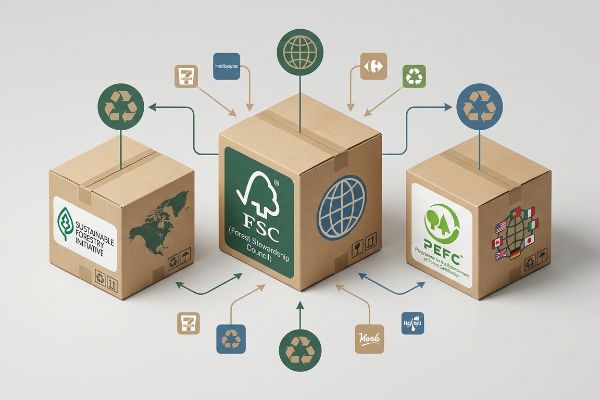
Knowing which standard to specify directly impacts your material sourcing capabilities across different manufacturing regions.
The Sourcing Standard and Curbside Compliance
In structural packaging engineering, material sourcing dictates the baseline variables for our CAD (Computer-Aided Design) software. When specifying 100% recyclable corrugated board, the chosen certification acts as the regulatory blueprint. SFI is deeply integrated into the US and Canadian timber supply chains11, making it highly efficient for domestic paper mills. PEFC provides a broad international framework, validating smaller regional standards. However, FSC remains the most stringent and universally requested standard12 by major global retailers, establishing a strict, unbroken chain of custody that spans across continents and varying manufacturing ecosystems.
As an engineer, I cross-reference these certifications against the specific retailer's vendor guidelines before cutting a single dieline. For instance, if a brand is shipping flat-packed displays to a US club store, aligning the material with SFI or FSC standards ensures seamless integration into their closed-loop OCC (Old Corrugated Containers) recycling streams13. By precisely matching the raw board's certification to the target market's regulatory framework, we eliminate friction at the receiving dock. This strategic alignment guarantees compliance, streamlines customs documentation14, and prevents costly delays in your distribution network.
| Certification Standard | Geographic Focus | Retailer Acceptance |
|---|---|---|
| FSC | Global / Universal | Gold standard compliance |
| SFI | North America | High regional efficiency |
| PEFC | International umbrella | Broad regional validity |
I map every material specification directly to your target retailer's regulatory framework, ensuring your packaging clears customs and receiving docks without hesitation.
🛠️ Harvey's Desk: Are your international shipments getting flagged at receiving docks because your corrugated certifications don't align with local retailer mandates? 👉 Get a Retail Compliance Check ↗ — No account managers in the middle. You talk directly to structural engineers.
What is the FSC label?
A printed eco-logo means nothing if the underlying chemistry of the packaging actively sabotages the recycling stream.
An FSC label is a global certification mark confirming that the wood or paper used in a product originates from responsibly managed forests. It acts as a strict verification tool, assuring consumers and retailers that the packaging materials meet rigorous environmental, social, and economic sustainability standards.
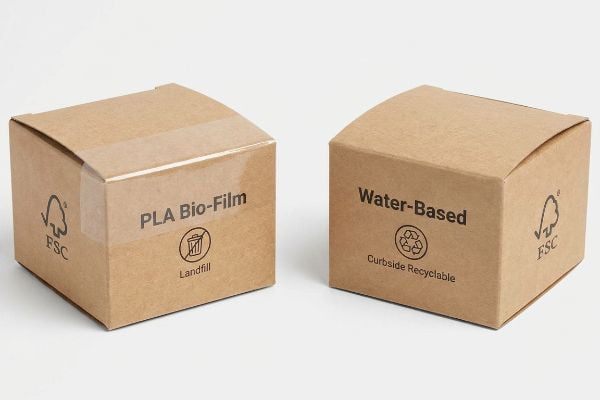
However, adhering a verified label to a box is entirely useless if poor lamination choices render the entire structure unrecyclable.
The PLA Composting Trap vs. True Recyclability
When I engineer a display, I look beyond the raw paper substrate to the final surface coatings. A common assumption is that pairing a certified board with a bio-plastic PLA (Polylactic Acid) film guarantees complete eco-compliance. Unfortunately, from a chemical engineering standpoint, PLA forms a solid physical barrier that repels water15 during standard repulping operations. Standard municipal recycling centers lack the specialized commercial composting facilities16 required to break down these solid films, meaning the otherwise pristine, certified corrugated board is often diverted directly to a landfill.
To preserve the integrity of the certification, I strictly mandate aqueous (water-based) liquid polymer coatings over solid plastic films for sustainable retail campaigns. Because aqueous finishes dissolve seamlessly in paper mill vats17 without leaving heavy residue, the structure remains a true mono-material and 100% curbside recyclable18. By engineering the chemical finish to complement the certified base rather than fight it, we ensure the unit maintains a premium gloss appearance on the shelf while perfectly surviving the post-consumer OCC repulping process, safeguarding your brand's ESG (Environmental, Social, and Governance) investments.
| Finish Chemistry | Repulping Behavior | Curbside Recyclability |
|---|---|---|
| PLA Bio-Film | Repels water in vats19 | Requires commercial composting20 |
| Aqueous Coating | Dissolves seamlessly | 100% standard OCC compliant21 |
| UV Varnish | Can crack under stress | Moderate recycling friction |
I ensure that the chemical coatings we apply mathematically complement your certified board, protecting both your brand's aesthetic and its true end-of-life recyclability.
🛠️ Harvey's Desk: Is a hidden plastic lamination secretly turning your expensive, sustainably-sourced displays into landfill waste? 👉 Claim a Packaging Chemistry Audit ↗ — I review every structural file personally within 24 hours.
Conclusion
Whether we are tracking the exact chain of custody for virgin kraft fibers or engineering aqueous coatings to guarantee true OCC repulpability, true sustainability demands strict factory-level physics, not just printed logos. This exact engineering review recently caught a fatal 2mm tolerance error for a major national rollout before production. To ensure your eco-friendly campaigns actually survive the physical realities of the retail supply chain, let me personally run your structural files through my Free Sustainability and Logistics Audit ↗.
"Chain of Custody Certification – Forest Stewardship Council", https://fsc.org/en/chain-of-custody. [Industry standards for sustainable forestry certification specify that Chain of Custody (CoC) documentation is the only recognized method to legally verify the origin of materials in a supply chain]. Evidence role: validation of legal requirement; source type: certification standard. Supports: the necessity of a verified system for proving material origin. Scope note: specific to FSC/PEFC standards. ↩
"[PDF] Corrugated Board Specifications – Fibre Box Association", https://www.fibrebox.org/assets/2025/09/Walmart_Corrugated-Board_Specifications_Automation_Packaging_Standards.pdf. [Technical packaging standards define the Edge Crush Test (ECT) as a measure of the stacking strength of corrugated board]. Evidence role: technical specification; source type: industry standard. Supports: material strength rating. Scope note: ECT values vary by board grade and manufacturer. ↩
"Cardboard Thickness & Materials Guide: A, B, C, D, E Flutes", https://105packaging.com/blogs/packaging/cardboard-thickness-guide-a-b-c-d-e-flutes?srsltid=AfmBOorc6xLimEgw9w6zw3F5tUmOWqp-QwdR02UIBYhgOU3rHtnKNpEw. [Packaging industry datasheets confirm the typical thickness range for E-flute corrugated cardboard]. Evidence role: technical specification; source type: technical datasheet. Supports: physical dimensions of E-flute materials. Scope note: Exact thickness may vary slightly between mills. ↩
"[PDF] Group Chain of Custody (CoC) FSC Certification Manual", https://cfwc.mgcafe.uky.edu/sites/cfwc.ca.uky.edu/files/cfwc_coc_group_certification_manual_revised_2_16_2018_0.pdf. [Industry standards for FSC Chain of Custody certification specify the necessity of physical segregation of certified materials to prevent mixing with non-certified stock]. Evidence role: technical specification; source type: industry standard. Supports: requirements for material segregation. Scope note: specific implementation may vary by facility size. ↩
"Chain of Custody Certification | Forest Stewardship Council", https://us.fsc.org/chain-of-custody-certification/chain-of-custody-certification. [Certification bodies require a documented audit trail, including mill invoices and shipping documents, to prove the legal and sustainable origin of materials]. Evidence role: procedural requirement; source type: certification guideline. Supports: origin tracking standards. Scope note: applies specifically to CoC certified supply chains. ↩
"[PDF] Strength loss in Recycled Fibers and Methods of Restoration", https://www.fpl.fs.usda.gov/documnts/pdf1992/minor92a.pdf. [An authoritative source on pulp and paper science verifies that recycled fibers undergo shortening during the repulping process, reducing the material's inherent tensile and compressive strength]. Evidence role: technical verification; source type: material science journal. Supports: structural necessity for thicker profiles in recycled paper. Scope note: applies to mechanical recycling processes. ↩
"The Ultimate Guide To Corrugated Boxes – Shorr Packaging", https://www.shorr.com/resources/blog/ultimate-guide-corrugated-boxes/. [Packaging engineering standards confirm that long-fiber virgin pulp provides superior interlocking and structural stability, allowing for higher Box Compression Test (BCT) values at lower thicknesses]. Evidence role: technical verification; source type: packaging industry handbook. Supports: use of thinner flute profiles for virgin liners. Scope note: assumes standard corrugated manufacturing. ↩
"Recycle vs. Virgin Fiber Characteristics: A Comparison … – TAPPI.org", https://imisrise.tappi.org/TAPPI/Products/PM/PM92379.aspx. [An authoritative source on pulp and paper science will describe the intrinsic length of virgin cellulose fibers compared to recycled ones]. Evidence role: factual verification; source type: material science textbook or technical paper. Supports: fiber length characteristics of FSC 100. Scope note: applies to kraft pulping process. ↩
"Impact of shredding degree on papermaking potential of recycled …", https://pmc.ncbi.nlm.nih.gov/articles/PMC8410872/. [Industry standards on recycled paper fiber demonstrate the reduction in fiber length caused by repeated mechanical pulping cycles]. Evidence role: factual verification; source type: technical industry report. Supports: fiber length characteristics of FSC Mix. Scope note: depends on the number of recycling cycles. ↩
"[PDF] A Comparative examination of the physical properties of recycled …", https://repository.rit.edu/cgi/viewcontent.cgi?article=1299&context=theses. [Technical specifications for virgin kraft paper typically show superior tear and tensile strength due to longer fiber integrity]. Evidence role: technical verification; source type: engineering data sheet. Supports: performance of FSC 100. Scope note: relative to recycled blends. ↩
"2024-2025 SFI ANNUAL SURVEY", https://forests.org/wp-content/uploads/SFI-2024-Annual-Survey-FIBER-SOURCING.pdf. [Industry market data or certification reports confirm the prevalence and integration of SFI within North American forestry systems]. Evidence role: Geographic scope validation; source type: Market analysis report. Supports: SFI's regional efficiency. Scope note: Applies specifically to the North American timber market. ↩
"[PDF] The Sustainable Forestry Initiative vs. The Forest Stewardship Council:", https://gps.ucsd.edu/_files/faculty/gourevitch/gourevitch_cs_stryjewski.pdf. [Comparative studies by environmental NGOs or global retail procurement standards verify the rigor of FSC's criteria relative to other certifications]. Evidence role: Verification of technical stringency; source type: Comparative environmental audit. Supports: FSC's status as a global gold standard. Scope note: Stringency may be subjective depending on the specific environmental metric used. ↩
"FSC® Certification – Forest Stewardship Council", https://us.fsc.org/get-certified/certification. [Authoritative sustainable packaging and waste management standards verify if FSC or SFI certifications are necessary for materials to be accepted into closed-loop Old Corrugated Containers recycling systems]. Evidence role: technical validation; source type: industry standard. Supports: The link between forestry certification and recycling infrastructure. Scope note: Specific to corrugated cardboard in US retail environments. ↩
"[PDF] The Impact of Forest Certification on Costs, Revenues, and … – MN.gov", https://www.lcc.mn.gov/lpsfc/meetings/20161206/The%20Impact%20of%20Forest%20Certification%20on%20Costs,%20Revenues,%20and%20Market%20Access.pdf. [International trade and customs regulations provide evidence on whether forestry certifications like FSC or SFI simplify declarations and reduce processing time for wood-based product shipments]. Evidence role: factual verification; source type: trade regulation. Supports: The claim that certification reduces logistics friction. Scope note: Impact may vary by national customs authority. ↩
"Water Repellent Coating in Textile, Paper and Bioplastic Polymers", https://pmc.ncbi.nlm.nih.gov/articles/PMC11479018/. [Technical literature on polymer science and paper recycling confirms that PLA films create hydrophobic barriers that hinder fiber separation during hydraulic repulping]. Evidence role: Technical verification; source type: Peer-reviewed scientific journal. Supports: The claim that PLA inhibits paper recycling. Scope note: Specific to the repulping phase of recycling. ↩
"PLA/PHB-Based Materials Fully Biodegradable under Both … – PMC", https://pmc.ncbi.nlm.nih.gov/articles/PMC9572414/. [Waste management infrastructure reports verify that most municipal recycling streams are not equipped with the high-heat industrial composting required to degrade PLA]. Evidence role: Factual confirmation; source type: Government or industry waste management report. Supports: The claim that PLA films are diverted to landfills. Scope note: Facility availability varies by geographic region. ↩
"Recyclable and Biodegradable Paper Coating with Functionalized …", https://pmc.ncbi.nlm.nih.gov/articles/PMC11948148/. [Technical documentation on paper repulping processes explains how water-based polymers break down during the agitation and screening phases of recycling without leaving significant contaminants]. Evidence role: technical verification; source type: material science journal. Supports: the efficiency of aqueous finishes in recycling. Scope note: specific to aqueous liquid polymers versus plastic films. ↩
"Mono-Material Packaging & EPR Savings – SoGreenPack", https://sogreenpack.com/post/mono-material-packaging-epr/. [Waste management standards and recycling guidelines define mono-materials by their ability to be processed in a single stream without compromising the purity of the recovered fiber]. Evidence role: standard verification; source type: industry guideline. Supports: the claim of 100% recyclability. Scope note: dependent on local municipal facility capabilities. ↩
"A review on bio-based polymer polylactic acid potential on … – PMC", https://pmc.ncbi.nlm.nih.gov/articles/PMC11091039/. [Materials science literature would explain the hydrophobic nature of PLA films and their failure to integrate during the hydropulping stage of paper recycling. Evidence role: technical explanation; source type: materials science journal. Supports: Repulping behavior of PLA. Scope note: Focuses on the aqueous phase of repulping.] ↩
"What Is Industrial Compost Vs Home Compost? – Bioleader", https://www.bioleaderpack.com/what-is-industrial-compost-and-home-compost/. [An authoritative source on biodegradable plastics would verify that PLA requires the specific heat and microbial conditions of industrial facilities to decompose. Evidence role: verification; source type: environmental science study. Supports: PLA disposal constraints. Scope note: Distinguishes between industrial and home composting.] ↩
"[PDF] Voluntary Standard For Repulping and Recycling Coated or Treated …", https://www.fibrebox.org/assets/2025/07/2025_Voluntary_-Standard.pdf. [Technical standards for Old Corrugated Containers (OCC) would specify the threshold for coating contaminants that allow a material to be considered fully recyclable. Evidence role: technical validation; source type: recycling industry standard. Supports: Recyclability of aqueous coatings. Scope note: Compliance may vary by regional facility.] ↩