
Brands often treat packaging as an afterthought, but in today's cutthroat aisles, the corrugated box surrounding your product is your only silent salesman.
Retail packaging is gaining importance because it actively drives impulse conversions, ensures retailer supply chain compliance, and physically protects merchandise during transit. Mastering modern corrugated engineering prevents costly damages while guaranteeing maximum brand visibility in crowded big-box store environments.

But knowing the theory isn't enough when the machines start running; let's break down exactly what happens on the factory floor.
Why Is Packaging Important to a Retailer?
Retailers do not care about your brand story; they care about optimizing their high-value floor space.
Packaging is important to a retailer because it directly dictates aisle space utilization. Big-box stores demand mathematically optimized display footprints that maximize product density per square foot, ensuring rapid inventory turns without creating physical hazards for shopping carts.

You might design a massive, beautiful structure, but if it disrupts store operations, the buyer will reject it instantly.
Optimizing Fractional Pallet Geometries for Store Approval
Marketing teams often pitch full-size 48×40 inches (1219×1016 mm) floor displays1 to major retailers, assuming a campaign must monopolize an entire wood base to stand out. They build these massive structures in CAD (Computer-Aided Design), fully expecting store managers to eagerly clear premium floor space for their launch.
I see this constantly: a brand submits a beautiful but bloated floor merchandiser, and the retailer immediately kicks it back. Retail aisle space is strictly rationed. When you force a store clerk to drag a massive, squeaky wooden pallet into a tight checkout lane, they simply won't do it. Instead of fighting for a full footprint, engineer bulk merchandisers precisely to standard fractional dimensions, like half pallets or quarter pallets. This mathematical subdivision guarantees two or four distinct promotional campaigns can perfectly share a single GMA (Grocery Manufacturers Association) base2. This approach actively secures your premium placement because it seamlessly aligns with the retailer's strict density rules.
| Common Rookie Mistake | The Pro Fix | Retail-Floor Benefit |
|---|---|---|
| Monopolizing a full 48×40 pallet3 | Engineering 24×20 quarter-pallets4 | Doubles promotional floor density5 |
| Ignoring aisle clearance rules | Fractional subdivision sharing | Prevents shopping cart bottlenecks |
| Forcing clerks to move oversized units | Modular structural footprint | Speeds up physical store restocking |
I refuse to let my clients get rejected over spatial ignorance. By strictly anchoring your structural footprint to fractional retail geometries, I ensure your campaign gets approved faster and secures the high-traffic intersections you actually want.
🛠️ Harvey's Desk: Not sure if your new POP structure violates standard aisle clearance zones? 👉 Let Me Measure Your Footprint ↗ — Direct access to my desk. Zero automated sales spam, I promise.
What Are the 4 C's of Packaging?
A successful retail launch requires balancing competing priorities before the ink ever touches the paper.
The 4 C's of packaging are Cost, Concept, Convenience, and Communication. This strategic framework ensures your retail boxes remain financially viable, structurally sound under pallet weight, effortlessly assembled by warehouse workers, and visually clear to rushing shoppers navigating congested store aisles.
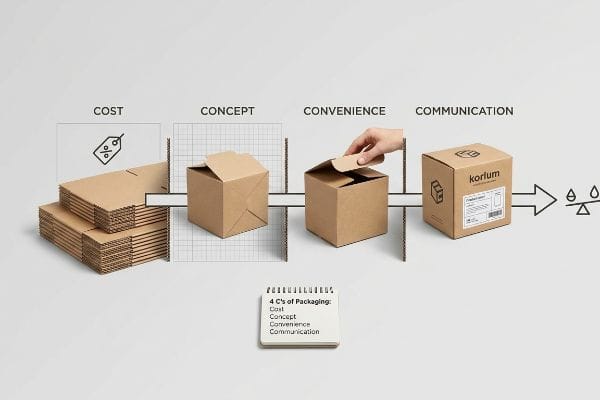
However, knowing these four pillars is entirely different from successfully executing them on a high-speed production line.
The Procurement Imbalance Trap in Retail Rollouts
Brand teams frequently use the four C's framework to guide their retail rollouts6, attempting to hit every metric perfectly in their initial concept phase. However, procurement departments often isolate and obsess strictly over the primary "Cost" metric, aggressively hollowing out structural board grades to save a few pennies per unit upfront.
This single-minded cost-cutting destroys the other three pillars entirely. I have watched co-packers struggle with cheap, downgraded corrugated flutes; you can literally hear the raw paperboard tearing as they force distorted dielines together. To fix this, you must unify your assessment. Mathematically link your structural cost directly to downstream supply chain convenience—like frictionless assembly—and guaranteed physical communication. Spending a fraction more on a stronger board prevents your entire concept from buckling under heavy pallet weight7, effectively eliminating catastrophic chargebacks8 and protecting your true profit margin.
| Common Rookie Mistake | The Pro Fix | Retail-Floor Benefit |
|---|---|---|
| Obsessing strictly over raw unit cost | Unified 4 C's assessment protocol | Protects total ROI margin |
| Downgrading structural board grades | Matching material to dynamic load9 | Prevents transit crushing |
| Ignoring assembly labor times | Engineering frictionless dielines | Saves 30% in co-packing fees10 |
I strictly forbid my clients from treating raw unit cost as an isolated metric. If your cheap board crushes during transit, you have not saved money—you have just financed your own retailer rejection.
🛠️ Harvey's Desk: Are your procurement savings secretly setting up your displays to collapse in transit? 👉 Request a Structural Material Audit ↗ — Download safely. My inbox is open if you have questions later.
What Are the 5 P's of Packaging?
Beyond basic design, your packaging must align with fundamental retail mechanics to survive in the wild.
The 5 P's of packaging are Product, Price, Place, Promotion, and Positioning. Structuring your corrugated retail strategy around these elements guarantees your physical merchandiser seamlessly integrates into the targeted store's operational model, protecting supply chain logistics while maximizing point-of-purchase profitability.
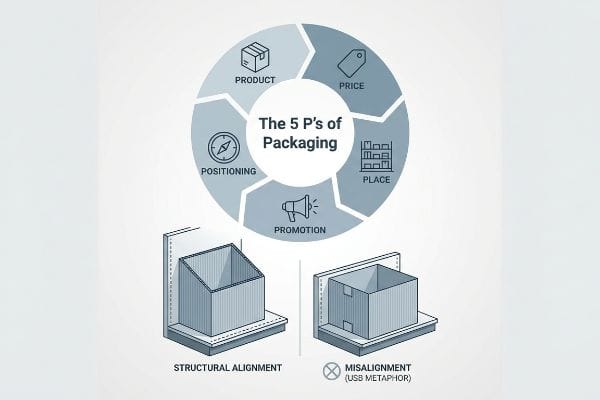
You can memorize these principles all day, but they mean nothing if your physical box doesn't fit the store environment.
Aligning Structural Design with Retailer Mechanics
New brands frequently attempt to launch products without mastering the foundational frameworks of commercial retail, assuming a good item will naturally sell itself. They completely ignore strict business mechanics and fail to adapt their structural strategies across distinct types of retail environments11, from convenience stores to massive warehouse clubs.
Think of it like trying to plug a USB cable in upside down—if your structure does not match the retailer's operational flow, supply chains break. I often see brands design intricate, fragile trays for club stores, only to watch a warehouse worker accidentally crush the display's header because it was not engineered for high-volume handling12. Before you approve a design, systematically map your logistical strategy directly against the targeted store's specific environment. Ensure your physical rollout handles the rough friction of standard warehouse receiving, maximizing your placement success.
| Common Rookie Mistake | The Pro Fix | Retail-Floor Benefit |
|---|---|---|
| Ignoring specific store operations | Mapping design to retail type13 | Ensures seamless floor integration |
| Designing fragile display headers | Engineering reinforced structural zones14 | Survives rough employee handling |
| Applying one format to all stores | Customizing footprint per channel15 | Maximizes point-of-purchase placement |
I always mandate a strict framework alignment before engineering any physical campaign. By adapting your corrugated structures to fit the exact environment of your target retailer, I guarantee your rollout drives actual profitability instead of logistical headaches.
🛠️ Harvey's Desk: Worried your current display format might get rejected by a specific big-box retailer? 👉 Get a Retail Compliance Check ↗ — No forms that trigger endless sales calls. Just pure value.
Why Is Packaging so Important?
We have covered the marketing theory, but true packaging importance is proven under crushing physical pressure.
Packaging is critical because it acts as the primary mechanical shock absorber during turbulent supply chain transit. An engineered master carton strictly distributes heavy vertical loads, completely eliminating transit damages, averting massive retailer chargebacks, and protecting the physical integrity of the merchandise inside.
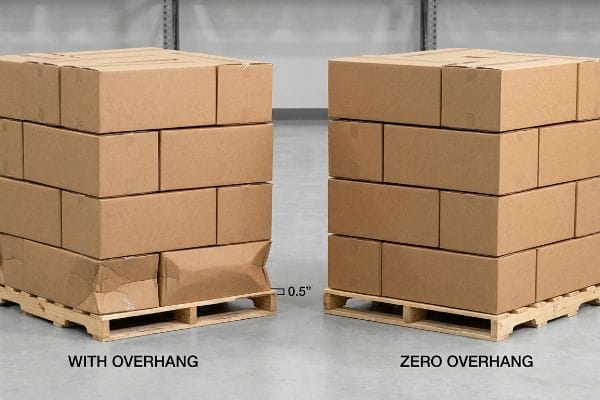
Getting one display to stand up in a climate-controlled lab is easy, but here is the harsh reality when you ship 500 of them across the ocean.
Why Theoretical BCT Fails on the Factory Floor
Procurement teams often expand master carton dimensions to maximize shipping density, assuming a heavy-duty corrugated board's raw compression metrics will automatically protect the goods. They blindly trust the lab-tested ECT (Edge Crush Test) rating of the flat board16, packing their containers tight without considering the actual physics of vertical warehouse stacking.
In my facility, I routinely see this theoretical assumption cause massive logistical nightmares. The blind spot is pallet overhang; when a master carton overhangs a standard pallet by just 0.5 inches17 (12.7 mm), the structural corners carry zero load. When I run the fully loaded boxes through the hydraulic compression press, that slight overhang strips away 60% of the box's dynamic BCT18 (Box Compression Test) strength, causing the unsupported bottom tier to visibly bow outward and catastrophically buckle under a 1,250 lbs (566 kg) top-load. To fix this, I ruthlessly enforce a zero-overhang bounding box protocol. I artificially shrink the maximum allowable carton footprint in our structural software by exactly 12.7 mm inside the pallet perimeter. By enforcing this strict geometric tolerance, I restore the critical corner compression strength, completely eliminating transit damages and saving my clients thousands in LTL (Less-Than-Truckload) freight penalties.
| Common Rookie Mistake | The Pro Fix | Retail-Floor Benefit |
|---|---|---|
| Maximizing box size past pallet edge | Zero-overhang bounding box protocol | Maintains 100% corner strength19 |
| Relying strictly on flat board ECT20 | Dynamic transit load validation | Pre-empts crushing under top-load |
| Ignoring warehouse stacking physics | Artificial 12.7 mm footprint reduction21 | Eliminates massive freight penalties |
I do not let procurement teams dictate structural geometry based on theoretical savings. A minor geometric reduction guarantees your corners bear the real-world compressive force, easily surviving double-stacked ocean transit without a single collapsed box.
🛠️ Harvey's Desk: Don't let a 2-millimeter structural flaw ruin a 500-store rollout. 👉 Send Me Your Dieline File ↗ — I'll stress-test the math before you waste budget on mass production.
Conclusion
You can choose a cheaper vendor to maximize carton sizes, but when that fractional pallet overhang causes the bottom tier to catastrophically crush under heavy warehouse top-loads, you will face massive retailer chargebacks and complete margin wipeouts. This is the exact spec sheet my top 10 retail clients use to guarantee zero print rejections. Stop gambling with theoretical compression limits and let me personally audit your logistics footprint through my Free Structural Tolerances Review ↗ to catch fatal geometric errors before mass production begins.
"Standard Pallet Sizes | With Chart", https://www.kampspallets.com/standard-pallet-sizes-with-chart/. Confirmation of the Grocery Manufacturers Association (GMA) standard pallet dimensions used in retail logistics. Evidence role: technical specification; source type: logistics industry standard. Supports: The physical baseline for retail floor display footprints. Scope note: Primary standard for North American big-box retail. ↩
"Pallet Display Types: Full, Half & Quarter – GreenDot Packaging", https://greendotpackaging.com/understanding-pallet-display-types-full-half-and-quarter-pallet-displays/. An industry standard manual or logistics guide would verify the dimensions of a GMA pallet and how standardized fractional units (half/quarter) are designed to fit within that specific footprint. Evidence role: technical verification; source type: industry standard; Supports: the mathematical feasibility of sharing a single GMA base. Scope note: primarily applies to North American retail logistics. ↩
"GMA American Pallet. Dimensions, types and much more.", https://acrosslogistics.com/blog/en/american-pallet-gma. Verification of the standard Grocery Manufacturers Association (GMA) pallet dimensions used across North American retail logistics. Evidence role: technical standard; source type: industry specification. Supports: the baseline for standard pallet sizing. Scope note: Specific to North American logistics standards. ↩
"Half pallet: Definition, measurements, and main uses", https://www.interlakemecalux.com/blog/half-pallet. Confirmation of the 24×20 inch dimension as a recognized fractional or quarter-pallet size for retail point-of-purchase displays. Evidence role: technical specification; source type: logistics manual. Supports: the viability of fractional subdivision. Scope note: Dimensions may vary slightly by retailer. ↩
"How Custom Pallet Displays Drive Bulk Purchase Opportunities", https://atlaspackaginginc.com/how-custom-pallet-displays-drive-bulk-purchase-opportunities/. Quantitative analysis demonstrating how replacing full pallets with quarter-pallets increases the number of product displays per square foot. Evidence role: quantitative impact; source type: retail operations study. Supports: the benefit of fractional geometries. Scope note: Based on geometric area comparisons. ↩
"How the 4 C's of Packaging Drive Business Growth – LinkedIn", https://www.linkedin.com/posts/gauravchheda-thebaxsaaco_what-are-the-4-cs-of-packaging-the-baxsaa-activity-7307752054314229762-sr8h. Verification of the 4 C's framework as a recognized strategic tool for retail packaging design and launch. Evidence role: conceptual validation; source type: packaging industry whitepaper or marketing textbook. Supports: the application of the framework in brand rollouts. Scope note: specific to packaging logistics and marketing. ↩
"Investigation of the Effect of Pallet Top-Deck Stiffness … – PMC", https://pmc.ncbi.nlm.nih.gov/articles/PMC8585293/. Technical guides on corrugated board grades explain how higher Edge Crush Test (ECT) ratings prevent vertical collapse under static pallet loads. Evidence role: Technical validation; source type: Engineering manual. Supports: The necessity of board strength for structural integrity. Scope note: Applies specifically to corrugated shipping containers. ↩
"What Contract Packaging Mistakes Trigger Retailer …", https://www.industrialpackaging.com/blog/copacker-mistakes-retailer-chargebacks. Retailer compliance manuals detail financial penalties (chargebacks) imposed on vendors for shipping damaged goods due to insufficient packaging. Evidence role: Financial validation; source type: Retail compliance guide. Supports: The link between packaging quality and the avoidance of vendor fines. Scope note: Specifics vary by retailer agreement. ↩
"A Simplified Dynamic Strength Analysis of Cardboard Packaging …", https://pmc.ncbi.nlm.nih.gov/articles/PMC10385285/. Technical guidance on selecting corrugated board grades based on dynamic loading to prevent crushing. Evidence role: technical validation; source type: engineering manual. Supports: the necessity of matching material to load. Scope note: Specific to structural board grades. ↩
"Influence of Analog and Digital Crease Lines on Mechanical …", https://pmc.ncbi.nlm.nih.gov/articles/PMC9268991/. External data on packaging design efficiency and its effect on co-packing labor costs. Evidence role: quantitative verification; source type: industry report. Supports: the cost-saving claim for optimized dielines. Scope note: Percentage may vary by product type. ↩
"Club Stores Require Different Approach to Packaging Design", https://www.packagingstrategies.com/articles/94105-club-stores-require-different-approach-to-packaging-design. Authoritative retail management guides explain why packaging must vary by channel to meet different shelving and shipping constraints. Evidence role: factual verification; source type: industry manual. Supports: the need for channel-specific structural packaging strategies. Scope note: focus on corrugated design. ↩
"Club Store Displays: endcaps, pallets & more for bulk merchandise", https://www.qpack.com/retail-displays/pallet/club-store. Industry standards for retail packaging detail the structural requirements, such as Edge Crush Test (ECT) ratings, necessary to withstand high-volume handling in club store environments. Evidence role: technical verification; source type: industry standard; Supports: the need for specialized engineering in bulk retail settings. Scope note: applies specifically to corrugated cardboard displays. ↩
"Retail Packaging: The Complete Guide", https://bpkc.com/blogs/blog/retail-packaging-the-complete-guide. Brief explanation of how aligning packaging structural design with specific store operational constraints ensures integration. Evidence role: operational guideline; source type: retail management report. Supports: the achievement of seamless floor integration. Scope note: relates to store-level operational mechanics. ↩
"Structural Packaging Design Services", https://www.internationalpaper.com/services/structural-design. Brief explanation of how structural reinforcement in display headers prevents mechanical failure during retail handling. Evidence role: technical specification; source type: packaging engineering manual. Supports: the necessity of reinforced zones for durability. Scope note: specific to point-of-purchase materials. ↩
"Communication within the Packaging Industry", https://digitalcommons.calpoly.edu/cgi/viewcontent.cgi?article=1001&context=grcsp. Brief explanation of how tailoring packaging dimensions to specific retail channels optimizes shelf space and placement. Evidence role: industry best practice; source type: retail logistics study. Supports: the maximization of point-of-purchase placement. Scope note: focuses on multi-channel retail environments. ↩
"BCT & ECT Tests: Assessing Corrugated Box Strength", https://www.metropack.eu/definition/materials/corrugated-cardboard/ect-edge-crush-test-and-bct-box-compression-test-corrugated-box. Authoritative engineering standards distinguish between ECT (material strength) and BCT (structural strength), explaining why board ratings alone do not guarantee stacking integrity. Evidence role: technical validation; source type: industry engineering standard. Supports: the limitation of ECT in predicting real-world vertical load capacity. Scope note: specifically for corrugated fiberboard. ↩
"How to Prevent Pallet Overhang in Animal Feed Operations", https://www.bwpackaging.com/blog/how-to-prevent-pallet-overhang-in-animal-feed-operations. Technical documentation on packaging engineering explains the loss of structural integrity when carton corners do not align with pallet supports. Evidence role: technical verification; source type: industry handbook. Supports: the mechanical failure of corners due to overhang. Scope note: Standard corrugated boxes. ↩
"Effect of Pallet Overhang on Box Compression Strength", https://admin.fibrebox.org/wp-content/uploads/2025/07/Pallet_Overhang_Phase_1.pdf. Empirical data from compression testing provides the specific percentage drop in Box Compression Test (BCT) values when overhang occurs. Evidence role: quantitative validation; source type: technical study. Supports: the 60% strength reduction claim. Scope note: Results depend on carton grade and pallet type. ↩
"Effect of Palletized Box Offset on Compression Strength of …", https://digitalcommons.calpoly.edu/cgi/viewcontent.cgi?article=1067&context=it_fac. Technical analysis demonstrating how pallet overhang leads to loss of vertical compression strength in corrugated packaging. Evidence role: technical validation; source type: engineering study. Supports: The efficacy of zero-overhang protocols. Scope note: Applies to standard corrugated board structures. ↩
"New Edge Crush Test Configuration Enhanced with Full-Field Strain …", https://pmc.ncbi.nlm.nih.gov/articles/PMC8510352/. Comparison between static Edge Crush Test (ECT) values and actual dynamic compression performance during transit. Evidence role: technical critique; source type: packaging science journal. Supports: The claim that ECT alone is insufficient for predicting real-world crushing. Scope note: Focuses on the gap between theoretical and applied BCT. ↩
"[PDF] Intercontinental Pallet Standard – ANSI Webstore", https://webstore.ansi.org/preview-pages/AIAG/preview_AIAG+RC-12-2010.pdf?srsltid=AfmBOop_Kp-wYij0jGnXosZXkYi6schn37MbOUQwv2ef3e5ai2JCf2rm. Industry standards regarding precise footprint tolerances to avoid oversized load penalties in logistics. Evidence role: industry standard; source type: freight shipping guidelines. Supports: The use of a specific measurement to eliminate freight penalties. Scope note: Specifics may vary by logistics carrier. ↩