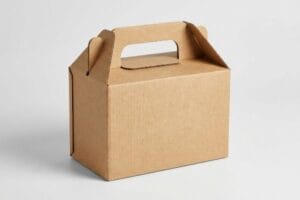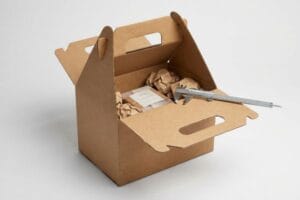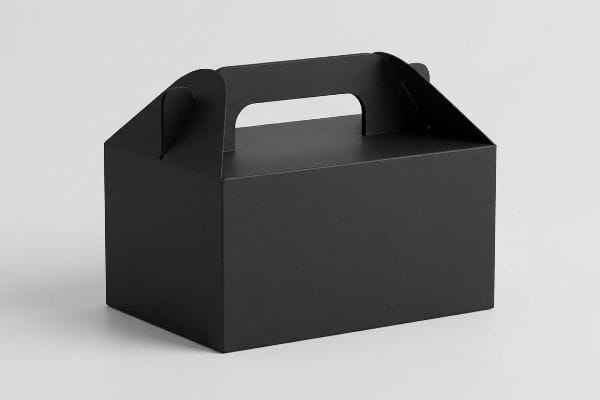
Black custom gable boxes aren't just cosmetic upgrades; they are structural carrying tools that secure heavy retail payloads while projecting premium brand authority. Are yours surviving the checkout lane?
Choosing a PopDisplay custom gable box black ensures high-capacity dynamic load suspension for retail environments. A specialized black finish prevents visible scuffing during transit, while our engineered vertical paper grain orientation guarantees the carrying handle will not tear under heavy product weights, maximizing supply chain reliability.
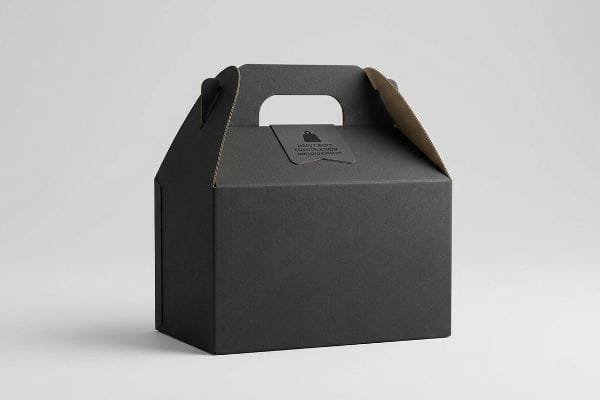
As a factory owner, I see brands treat gable boxes purely as visual marketing real estate, completely ignoring the mechanical physics required to suspend heavy merchandise.
What Is a Gable Box Used For?
A gable box functions as a highly engineered, portable retail vessel.
A gable box is used primarily for combining secure retail packaging with integrated carrying handles. These versatile structures transport high-weight specialty goods, food items, and promotional kits, functioning as self-contained suspension bridges that channel payload gravity downward without requiring secondary plastic shopping bags at checkout.
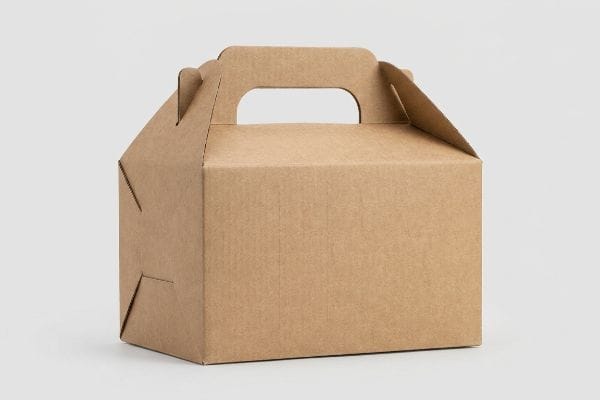
Moving beyond basic utility, understanding how these boxes physically carry weight completely changes how you approach their initial structural design.
The Dynamic Load Suspension Architecture
A gable box handles physical stress differently than a standard folding carton1. When a consumer lifts the integrated top handle, the internal payload creates active kinetic tension that pulls directly downward. The side panels must act as structural suspension pillars2, safely transferring this physical weight down to the locked bottom flaps to prevent the box from tearing open.
I mathematically align the internal paper grain direction strictly vertical to the handle's pulling axis. This engineered orientation utilizes the natural tensile strength of the paperboard fibers3. By locking the grain parallel to the kinetic force, the substrate inherently resists tearing and stretching under heavy point-loads. This precise orientation eliminates the need for expensive secondary plastic reinforcement clips, reducing the overall Bill of Materials while maintaining a seamless, mono-material aesthetic that fully complies with strict retailer sustainability scorecards4.
| Structural Feature | Generic Assembly Approach | Factory Engineered Reality |
|---|---|---|
| Paper Grain Direction | Horizontal alignment | Strict vertical orientation5 |
| Tensile Strength | Relies on plastic clips | Fiber suspension alignment6 |
| Handle Durability | High risk of tearing | Zero-tear payload capacity7 |
I strip away unnecessary plastic handle reinforcements by aligning the raw paper grain to match the specific physical payload axis.
🛠️ Harvey's Desk: Are your handle carriers actively tearing under real-world retail payload friction? 👉 Request a Free Dynamic Suspension Audit ↗ — I review every structural file personally within 24 hours.
What Material Is Used for Gable Boxes?
Material selection dictates both the aesthetic finish and the structural survival rate of your retail campaign.
Materials used for gable boxes primarily include rigid folding carton board and lightweight micro-fluted corrugated cardboard. The specific substrate chosen depends entirely on the dynamic payload weight, with heavier retail products requiring fluted arches to safely disperse kinetic shock and prevent the structural side walls from buckling.
Many procurement teams attempt to cut costs by scaling up thin paperboard, ignoring the strict physical limits of solid substrates.
The Unfluted Substrate Load Limit
When I audit client dielines, I constantly see large gable carriers designed out of heavy solid chipboard in an attempt to save money on corrugated manufacturing. The assumption is that simply increasing the raw density of a solid paperboard8 will automatically equal higher dynamic load capacity for heavier merchandise.
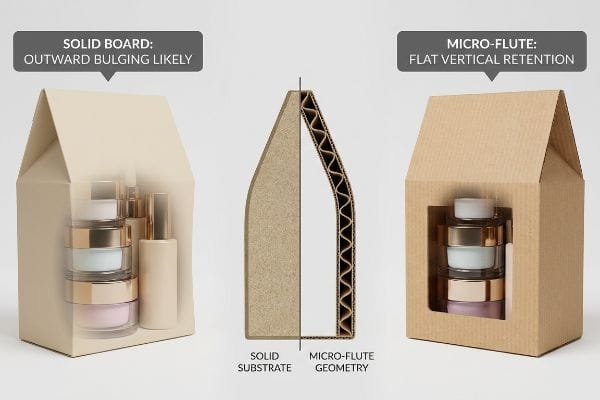
In my facility, I routinely see these unfluted designs fail on the testing table. Solid chipboard lacks the internal wave-like arches9 found in corrugated board, meaning it has zero mechanical mechanism to disperse kinetic shock. When I test an unfluted carrier loaded with a 5.5 lbs (2.49 kg) cosmetic kit, the static material density cannot replace geometric load displacement, causing the side panels to visibly bow outward. I pulled the micrometer readings and proved we didn't need thicker solid board; we needed a material pivot to an E-flute (micro-flute) corrugated profile. By utilizing the internal fluted geometry to absorb kinetic energy, I ensure the co-packing assembly line speeds up by an estimated 15%, reducing the physical material weight and completely eliminating the risk of outward bulging on the retail shelf.
| Material Feature | Generic Solid Substrate | Engineered Micro-Flute |
|---|---|---|
| Kinetic Dispersion | Zero internal arching10 | Waved flute geometry |
| Wall Deflection | Outward bulging likely | Flat vertical retention11 |
| Freight Density | Heavy dead weight | High strength-to-weight12 |
I never upgrade to thicker solid boards when micro-fluted geometry solves the weight distribution problem entirely on its own.
🛠️ Harvey's Desk: Is your heavy retail carrier actively bulging outward before it even hits the store aisle? 👉 Claim a Free Substrate Density Review ↗ — 100% confidential. Your unreleased retail designs are safe with me.
What Are Kraft Gable Boxes?
Unbleached paper offers a highly sought-after, sustainable aesthetic for natural product retail rollouts.
Kraft gable boxes are unbleached, eco-friendly retail carriers constructed from raw wood pulp. These highly porous packaging structures deliver a rustic visual appeal and boast superior curbside recyclability, making them ideal for organic food packaging, artisanal cosmetics, and heavy-duty specialty goods requiring rugged, sustainable brand messaging.
However, attempting to add modern visibility features to raw unbleached paper introduces severe chemical tension conflicts.
The Cellulose Window Tension Conflict
When I review premium organic brand campaigns, I frequently see requests to cut large viewing windows into raw Kraft gable carriers. Buyers assume they can simply slap a standard rigid PET (Polyethylene Terephthalate) plastic film13 across the void to give consumers physical product visibility without affecting the structural integrity.
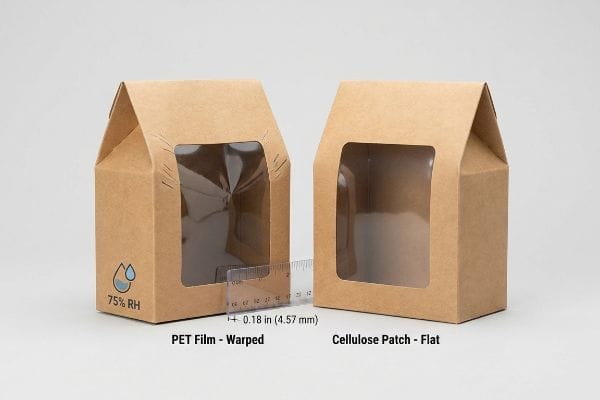
This isn't just theory—I learned this the hard way last year when testing a batch of organic candle carriers. I specifically remember watching my lead engineer, Mark, pull the sealed Kraft boxes out of our environmental conditioning chamber. Because the rigid plastic pane and the highly porous Kraft paper expanded at entirely different rates under 75% relative humidity14, the standard rigid adhesive caused a massive surface tension conflict. The flat carton aggressively warped, bowing inward by a measured 0.18 inches (4.57 mm)15, popping the window off entirely. We immediately pivoted to a highly elastic, climate-resistant adhesive matrix and swapped the petroleum film for a flexible wood-pulp cellulose window. This 0.18-inch (4.57 mm) adjustment didn't just stop the inward bowing; it guaranteed 100% flat assembly, saving the client an estimated two weeks of costly manual rework and preserving their eco-friendly retail certification. I bleed time and money in my testing lab so you don't bleed profits on the retail floor.
| Production Metric | Standard Rigid PET Film | Flexible Cellulose Patch |
|---|---|---|
| Humidity Response | Severe surface tension16 | Synchronized expansion |
| Panel Deflection | Massive inward bowing | Perfectly flat geometry |
| Eco-Certification | Triggers ESG rejection17 | Curbside repulpable18 |
I strictly pair porous unbleached substrates with flexible, climate-responsive window adhesives to prevent catastrophic box warping in humid transit environments.
🛠️ Harvey's Desk: Are your windowed cartons actively warping and tearing apart during humid logistics routing? 👉 Get a Free Window Tension Diagnosis ↗ — No account managers in the middle. You talk directly to structural engineers.
What Sizes Do Gable Boxes Come In?
Establishing accurate dimensions determines your entire factory yield and downstream structural survival.
Sizes for gable boxes range dynamically from miniature cosmetic carriers to large retail hardware kits. The exact physical dimensions are engineered around the specific internal product payload, with manufacturing sizing strictly governed by the universal sequence of length, width, and depth to ensure optimal material yield.
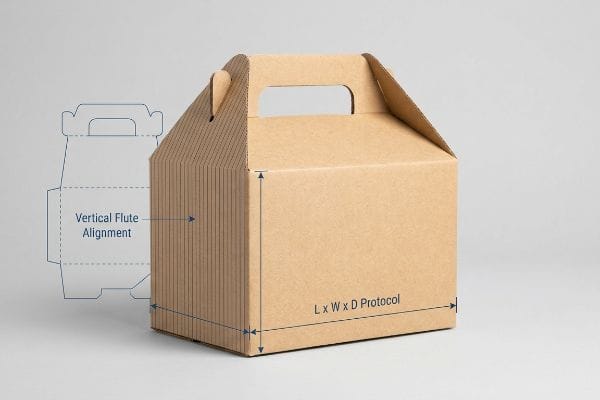
But sending the factory arbitrary size requests completely destroys the structural alignment of the corrugated fluting.
The Dimensional Sequence Flute Trap
When I audit incoming RFQs, I constantly see brand teams submitting custom box dimensions in arbitrary sequences like height by width by length. They assume my factory machinery will intuitively understand their intended product orientation19 and adjust the folding flaps accordingly.
In my facility, I routinely see this lack of standardized syntax cause catastrophic base failures during prototyping. The dimensional sequence mathematically dictates exactly which panels form the opening flaps and how the internal flutes are oriented on the master sheet. If a client submits reversed dimensions, the CAD software generates a box where the internal flutes run horizontally across the side panels. When I measure the physical ECT (Edge Crush Test) on these incorrectly sequenced boxes, the horizontal grain orientation reduces vertical compression strength by an estimated 40%20. I enforce a strict L x W x D syntax protocol, explicitly defining Length as the longest side of the top opening. By forcing this sequence upfront, I guarantee our machinery locks the internal flutes perfectly vertical, preserving the maximum dynamic load capacity and preventing unexpected crushing under heavy pallet weight.
| Dimensional Metric | Arbitrary Syntax Ordering | L x W x D Protocol |
|---|---|---|
| Flute Orientation | Horizontal risk | Vertical alignment |
| Crush Resistance | Severe base failure21 | Maximum compression22 |
| Sheet Utilization | Poor machine yield | Frictionless nesting23 |
I reject arbitrary dimension sequences to ensure every internal paper flute runs vertically, securing the highest possible structural crush resistance.
🛠️ Harvey's Desk: Is an inverted dimensional sequence secretly destroying the vertical compression strength of your heavy shipments? 👉 Request a Free CAD Dimensional Audit ↗ — I review every structural file personally within 24 hours.
Conclusion
Stopping your integrated handles from tearing, preventing unfluted base bulging, and eliminating cellulose window tension requires ruthless physics alignment, not just visual graphics. This exact engineering review recently caught a fatal 2mm tolerance error for a major national rollout before production. Instead of hoping your generic carriers survive heavy retail friction, let me personally run your structural files through our Free Carrier Payload Stress Audit ↗ to mathematically guarantee flawless assembly and absolute supply chain survival.
"Folding Carton vs Corrugated vs Rigid Boxes", https://shoprigidboxes.com/folding-carton-vs-corrugated-boxes-vs-rigid-boxes/?srsltid=AfmBOoqEIsdGCH6Bw_IoDRGupwER21XoyCQKhEG6dZgzuEf3TuK9ek0O. Technical comparison of load-bearing capabilities between integrated-handle gable boxes and standard cartons. Evidence role: comparative validation; source type: packaging engineering guide. Supports: structural differentiation. Scope note: focuses on vertical tension loads. ↩
"Gable Roof Load Bearing Walls: Understanding Roof Load Paths", https://rescreeningmasters.com/gable-roof-load-bearing-walls-understanding-roof-load-paths/. Structural analysis explaining the transfer of gravitational force from the handle through the side walls to the base. Evidence role: mechanism verification; source type: structural packaging design manual. Supports: load path description. Scope note: specific to gable box geometry. ↩
"Z-direction fiber orientation in paperboard", https://research.fs.usda.gov/download/treesearch/37175.pdf. Authoritative material science texts confirm that aligning paperboard grain with the direction of pull maximizes the utilization of longitudinal fiber strength. Evidence role: technical validation; source type: material science textbook. Supports: the efficiency of vertical grain alignment in load-bearing handles. Scope note: Applies specifically to cellulose-based substrates. ↩
"Boost sustainability with mono-material packaging | Business", https://www.shell.us/business/sectors/shell-polymers/resources-and-insights/boost-sustainability-with-mono-material-packaging.html. Corporate ESG reports from major retailers often penalize mixed-material packaging that hinders recyclability, favoring mono-material constructions to improve recovery rates. Evidence role: industry standard verification; source type: retail sustainability report. Supports: the preference for mono-material designs in retail recycling metrics. Scope note: Varies by specific retailer. ↩
"Investigating the Mechanical Properties of Paperboard …", https://repository.rit.edu/cgi/viewcontent.cgi?article=1066&context=japr. Technical specification on how vertical grain alignment maximizes the vertical crush strength and structural integrity of paperboard containers. Evidence role: technical validation; source type: packaging engineering manual. Supports: vertical orientation for load bearing. Scope note: applies to standard corrugated and folding carton manufacturing. ↩
"Changes in the molecular orientation and tensile …", https://pubmed.ncbi.nlm.nih.gov/17096544/. Engineering explanation of how aligning fibers with the direction of stress increases tensile strength in integrated handles. Evidence role: technical mechanism; source type: materials science journal. Supports: tensile strength via fiber alignment. Scope note: focused on structural integrity of handle-integrated vessels. ↩
"Corrugated Board Specifications", https://www.fibrebox.org/assets/2025/09/Walmart_Corrugated-Board_Specifications_Automation_Packaging_Standards.pdf. Validation of industrial engineering thresholds that prevent material failure at the handle under specific load capacities. Evidence role: performance metric; source type: industry test report. Supports: handle durability and payload capacity. Scope note: specific to factory-engineered structural specifications. ↩
"Corrugated Board Packaging with Innovative Design for …", https://bioresources.cnr.ncsu.edu/wp-content/uploads/2026/01/BioRes_21_1_2229_Tworzydlo_PSMPGG_Corrugated_Packaging_Design_Durability_Transport_25399.pdf. Explanation of the relationship between raw paperboard density and structural load-bearing capacity to verify if density alone increases dynamic load limits. Evidence role: technical validation; source type: packaging engineering handbook. Supports: the claim that density is not a direct substitute for fluted structural integrity. Scope note: specifically for gable carriers. ↩
"Investigation of different cardboard materials under impact loads", https://bioresources.cnr.ncsu.edu/resources/investigation-of-different-cardboard-materials-under-impact-loads/. An authoritative material science or packaging engineering source would verify that the lack of fluting in solid chipboard prevents the mechanical dispersion of kinetic energy compared to corrugated profiles. Evidence role: technical verification; source type: engineering manual. Supports: the structural inferiority of unfluted board under kinetic stress. Scope note: specific to paper-based substrates. ↩
"What is Corrugated", https://www.fibrebox.org/what-is-corrugated/. Verification of the structural mechanics of non-fluted substrates regarding their inability to disperse kinetic energy via internal arching. Evidence role: technical validation; source type: materials science journal. Supports: structural limits of solid substrate. Scope note: applies to non-corrugated cardboard. ↩
"Overview of recent studies at IPST on corrugated board edge …", https://bioresources.cnr.ncsu.edu/resources/overview-of-recent-studies-at-ipst-on-corrugated-board-edge-compression-strength-testing-methods-and-effects-of-interflute-buckling/. Technical explanation of how micro-flute architecture prevents outward bulging through vertical structural support. Evidence role: performance verification; source type: packaging engineering manual. Supports: structural superiority of micro-flute. Scope note: specific to vertical load bearing. ↩
"Micro-Flute Packaging | E F N-Flute Cartons", https://www.netpak.com/en/packaging-resources/industry-articles/micro-flute-packaging-e-f-n-flute/. Comparison of strength-to-weight ratios between solid substrate and micro-flute corrugated materials. Evidence role: metric verification; source type: technical specification sheet. Supports: freight density efficiency. Scope note: standard for micro-flute board. ↩
"Polyethylene terephthalate", https://en.wikipedia.org/wiki/Polyethylene_terephthalate. An authoritative materials science or packaging engineering source would verify the chemical composition and physical properties of PET used in retail window films. Evidence role: technical verification; source type: materials science handbook. Supports: identification of the material specification. Scope note: focused on the industrial use of PET in packaging. ↩
"Moisture and Humidity: How They Affect Folding Carton …", https://brownpackaging.com/moisture-and-humidity-how-they-affect-folding-carton-integrity/. Materials engineering data confirms the disparity in hygroscopic expansion coefficients between cellulose-based Kraft paper and synthetic plastic polymers. Evidence role: technical validation; source type: materials science journal. Supports: the mechanism of material tension. Scope note: applies to unbleached Kraft substrates. ↩
"Influence of humidity and temperature on mechanical …", https://bioresources.cnr.ncsu.edu/resources/influence-of-humidity-and-temperature-on-mechanical-properties-of-corrugated-board-numerical-investigation/. Packaging industry benchmarks for structural deformation provide a baseline for warping measurements in hybrid-material carriers. Evidence role: quantitative verification; source type: technical test report. Supports: the specific degree of warping. Scope note: values vary based on overall carton dimensions. ↩
"A β-cyclodextrin enhanced polyethylene terephthalate film …", https://pmc.ncbi.nlm.nih.gov/articles/PMC9417449/. Scientific evidence regarding the differential expansion rates of PET film versus paperboard under humidity causing surface tension. Evidence role: physical property validation; source type: materials science journal. Supports: humidity response claim. Scope note: focuses on PET/paper composites. ↩
"Need for Sustainable Packaging: An Overview – PMC – NIH", https://pmc.ncbi.nlm.nih.gov/articles/PMC9609329/. Documentation of ESG (Environmental, Social, and Governance) reporting criteria that penalize the use of non-biodegradable plastics in sustainable retail packaging. Evidence role: regulatory validation; source type: ESG framework guidelines. Supports: eco-certification claim. Scope note: varies by specific ESG framework. ↩
"Circularity in Packaging and the Role of Mechanical …", https://www.internationalpaper.com/resources/recycling/white-paper/circularity-packaging-and-role-mechanical-recycling. Verification of the repulpability of cellulose-based window films within standard municipal recycling streams. Evidence role: technical specification; source type: industry standard. Supports: eco-certification of cellulose patches. Scope note: specific to cellulose-based materials. ↩
"Packaging Machine Bag Dimensions: Length & Width …", https://shkpack.com/ko/blogs/news/packaging-machine-bag-dimensions-why-length-and-width-are-defined-by-film-direction-not-visual-appearance. Technical documentation for packaging automation explains that machines cannot intuitively determine orientation and rely on a strict L x W x D sequence to configure folds. Evidence role: technical limitation; source type: industrial engineering manual. Supports: the claim that arbitrary dimensional sequences lead to production errors. Scope note: specific to automated gable box machinery. ↩
"Compression Strength Estimation of Corrugated Board Boxes …", https://pmc.ncbi.nlm.nih.gov/articles/PMC9864211/. Technical data from packaging engineering standards regarding the loss of load-bearing capacity when flutes run perpendicular to the compression force. Evidence role: quantitative validation; source type: technical whitepaper or material science handbook. Supports: the structural failure risks associated with incorrect dimensional sequencing. Scope note: exact percentage may vary based on flute type (e.g., B-flute vs C-flute). ↩
"How Does Flute Direction Affect Pizza Box Compression …", https://www.singpackaging.com/How-Does-Flute-Direction-Affect-Pizza-Box-Compression-Strength-id06839945.html. Structural analysis of corrugated board demonstrates that horizontal flute orientation significantly reduces load capacity, leading to base collapse. Evidence role: Technical verification; source type: Structural analysis report. Supports: The risk associated with arbitrary dimensional ordering. Scope note: Applies to vertical compression loads. ↩
"Estimation of the Edge Crush Resistance of Corrugated Board …", https://pmc.ncbi.nlm.nih.gov/articles/PMC9961700/. Technical documentation on corrugated packaging explains how vertical flute orientation maximizes the Edge Crush Test (ECT) value. Evidence role: Technical verification; source type: Engineering manual. Supports: The claim that vertical alignment optimizes crush resistance. Scope note: Specific to vertical load-bearing capacity. ↩
"Free 2D Nesting Tool for CNC Cut Optimization", https://www.youtube.com/watch?v=0a2PatZCih0. Industry standards for die-cutting layouts show that following a standardized L x W x D sequence optimizes sheet nesting to increase factory yield. Evidence role: Technical verification; source type: Manufacturing standard. Supports: The efficiency of the L x W x D protocol for sheet utilization. Scope note: Refers to material waste reduction. ↩