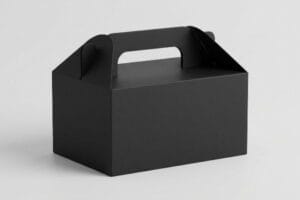
Are your apparel sales falling flat because of uninspired packaging? Presenting garments in premium packaging instantly elevates perceived value, turning a simple purchase into a memorable unboxing event.
The benefits of using gift boxes for shirts include enhanced brand perception, superior product protection during transit, and a memorable consumer unboxing experience. Upgrading to structured apparel packaging increases perceived retail value, directly driving higher impulse purchases and fostering long-term brand loyalty across global markets.

Moving from a flimsy polybag to a rigid carton feels like an easy win, but structural packaging introduces new logistical challenges. Let's break down exactly how this transition works in the real world.
What Is the Main Purpose of a Gift Box?
The primary goal isn't just shipping air; it is about communicating value while protecting the garment. Mastering this balance dictates whether your apparel succeeds or fails in stores.
The main purpose of a gift box is to protect merchandise from physical damage while maximizing brand equity. Functionally, it balances structural integrity with visual appeal, ensuring the enclosed apparel arrives in pristine condition while simultaneously generating strong retail engagement and enhancing the consumer unboxing experience.
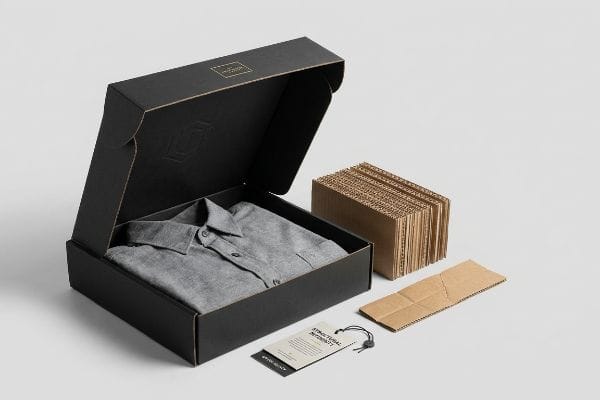
Understanding the theoretical purpose is one thing, but executing it without blowing your procurement budget is where things get complicated.
Balancing Cost and Communication in Gift Boxes
Many procurement teams rely on the four pillars of packaging strategy—Cost, Concept, Convenience, and Communication1—to guide their retail rollouts. However, buyers often isolate the cost metric, assuming they can simply hollow out the structural board grades to save a few pennies upfront. They expect the package to still communicate premium value, completely ignoring that a weakened substrate compromises the entire physical presentation.
I constantly see veteran procurement teams strip the structural density out of their apparel packaging to fund expensive cosmetic foil stamping. When those boxes hit a humid 3PL (Third-Party Logistics) warehouse, I can literally hear the dull crinkle as the thin sidewalls buckle under the weight of stacked pallets2. That tiny material saving causes massive friction, slowing down the assembly line by an estimated 30%3 and triggering expensive manual repacking fees.
| Common Rookie Mistake | The Pro Fix | Retail-Floor Benefit |
|---|---|---|
| Downgrading board thickness for cost | Unified structural assessment | Eliminates crushed inventory |
| Funding cosmetic foil via cheap cores | Maintain strict ECT standards4 | Ensures perfectly square stacking |
| Ignoring transit weight limits | Mathematical load displacement testing | Saves 30% on repacking labor5 |
I refuse to let brands hollow out their structural integrity just to save a fraction of a cent. Engineering a balanced package ensures you deliver pristine shelf communication without catastrophic transit failures.
🛠️ Harvey's Desk: Not sure if your current packaging balances cost with actual structural survival? 👉 Get a Free Structural Audit ↗ — Direct access to my desk. Zero automated sales spam, I promise.
What Size Gift Box for a Shirt?
Sizing your apparel packaging correctly is a mathematical necessity. Getting the dimensions wrong completely ruins your pallet efficiency and frustrates retail clerks during unboxing.
Standard gift box sizes for apparel generally measure 15 inches (38.1 cm) in length by 9.5 inches (24.1 cm) in width. However, exact retail dimensions depend heavily on the specific garment's folding style, fabric thickness, and the necessary spatial void required to prevent compression during transit.
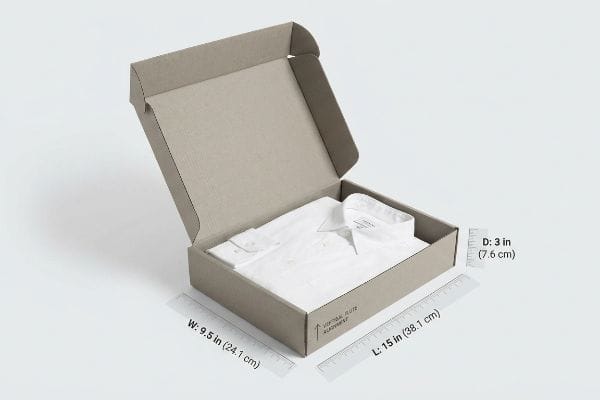
Knowing the standard measurements is helpful, but communicating those dimensions to your manufacturing partner is where critical errors happen.
The Dangers of Incorrect Gift Box Dimensions
Brand teams frequently submit custom box dimensions based on the physical garment size, assuming any sequence of numbers will intuitively make sense to the factory. They simply list height, width, and length arbitrarily without following industrial standards6. This lack of clear syntax forces the manufacturer to guess the intended product orientation, leading to disastrous production runs.
Even experienced designers often send me specs labeled as width by length by depth, which completely flips the orientation of the internal corrugated flutes. When I fold the physical white sample, I immediately feel the spongy, weak resistance because the paper fibers are running horizontally instead of vertically. This syntax error mathematically destroys the dynamic load capacity, resulting in base buckling7 that triggers an immediate retailer rejection.
| Common Rookie Mistake | The Pro Fix | Retail-Floor Benefit |
|---|---|---|
| Sending arbitrary number sequences | Mandate exact syntax standards | Guarantees correct flap opening |
| Ignoring flute grain direction | Vertical alignment of structural flutes8 | Maximizes dynamic load survival |
| Guessing internal clearance | Use physical fully-filled garments | Prevents primary product crushing9 |
I always mandate the universal Length by Width by Depth syntax before a single test board is cut. Locking down this dimensional sequence guarantees the mechanical strength required for brutal logistics.
🛠️ Harvey's Desk: Worried your dimension sequence might be causing hidden flute compression failures? 👉 Request a Blueprint Review ↗ — Download safely. My inbox is open if you have questions later.
Is It Good to Give a Shirt as a Gift?
Presenting apparel thoughtfully drastically increases its emotional and financial impact. The physical presentation transforms an ordinary piece of clothing into a highly anticipated premium experience.
Yes. Giving a shirt as a gift is excellent when presented in premium packaging, as it significantly elevates the recipient's unboxing experience. Upgraded structural cartons transform standard garments into luxury items, increasing overall brand loyalty and generating positive emotional connections that generic polybags simply cannot achieve.
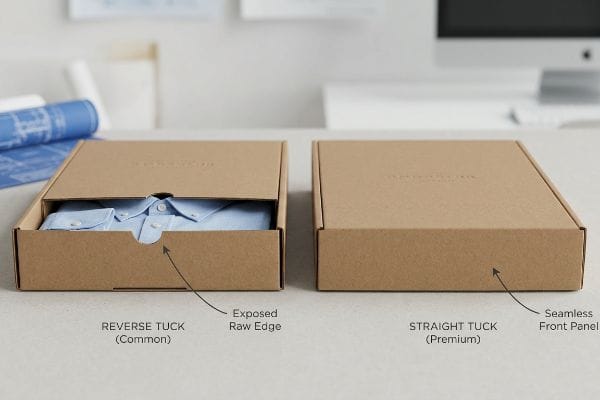
But crafting that luxury feel requires more than just picking a nice color; the structural folding mechanism itself dictates the final cosmetic presentation.
Elevating the Unboxing Experience with Proper Gift Boxes
When upgrading to retail folding cartons for premium apparel, designers often arbitrarily choose between reverse tuck and straight tuck folding styles10. They assume that as long as the box closes properly, the internal folding mechanism has no impact on the final consumer presentation. This lack of strategic alignment between the die-cut pattern and the brand's premium positioning creates subtle but jarring visual flaws.
I regularly see luxury apparel brands default to a reverse tuck design because their procurement team wants to tightly nest the dielines on the master printing sheet11 to save paper waste. But when I assemble that box, my thumb constantly catches on the raw, exposed paperboard edge directly on the front display face. I always pivot premium clients to a straight tuck architecture; while it consumes slightly more material, it guarantees a completely seamless, flawless front panel12 that justifies a high-ticket price.
| Common Rookie Mistake | The Pro Fix | Retail-Floor Benefit |
|---|---|---|
| Defaulting to reverse tuck designs | Mandate straight tuck for luxury | Eliminates visible raw edges13 |
| Chasing maximum sheet yield | Prioritize uninterrupted front panels14 | Justifies premium product pricing |
| Ignoring the closure friction | Smooth friction-lock tab engineering15 | Prevents tearing during unboxing |
I never let minor material yield percentages ruin a brand's premium visual equity. A flawless front presentation is non-negotiable when you are asking consumers to pay top dollar for gifted apparel.
🛠️ Harvey's Desk: Are exposed raw paper edges secretly cheapening your luxury apparel presentation? 👉 Claim Your Free Layout Check ↗ — No forms that trigger endless sales calls. Just pure value.
What Are the Latest Gift Box Trends?
Eco-conscious designs and sustainable materials are dominating the retail packaging sector. Brands are aggressively pivoting away from permanent plastics to satisfy strict environmental scorecards.
The latest gift box trends heavily prioritize zero-waste sustainability, utilizing mono-material structures, water-based inks, and fully curbside repulpable substrates. Retailers and consumers alike demand packaging that eliminates toxic plastics while maintaining structural integrity, pushing brands toward innovative finishes that do not compromise the premium unboxing experience.

But knowing the sustainable theory isn't enough when the factory machines start running and rigid retailer audits begin.
Why Standard Eco-Friendly Gift Boxes Fail on the Factory Floor
Brands frequently mandate PLA (Polylactic Acid) bio-plastic laminations16 for their new apparel packaging, assuming this corn-based film ensures complete environmental compliance. Procurement teams love to slap an eco-friendly badge on the box, believing that any plant-based plastic will naturally degrade and seamlessly pass through municipal recycling streams17 without a second thought.
In my facility, I routinely see clients demand these solid bio-plastic films, ignoring how they behave during standard OCC (Old Corrugated Containers) repulping processes. When I test these supposedly green boxes in the pulper, the rigid bio-plastic forms a solid waterproof skin18 that aggressively repels the vat liquids, leaving a sticky, unusable residue. I immediately strip out the bio-plastics and substitute a 0.02-inch (0.5 mm) liquid aqueous coating19, which dissolves completely in standard paper mills, preserving 100% curbside recyclability and saving the brand from massive retailer ESG (Environmental, Social, and Governance) compliance chargebacks.
| Common Rookie Mistake | The Pro Fix | Retail-Floor Benefit |
|---|---|---|
| Using solid plastic films | Upgrade to liquid aqueous coatings20 | Guarantees curbside repulpability |
| Assuming all bio-plastics recycle | Validate local vat chemistry21 | Passes strict retailer audits |
| Creating mixed-material waste | Enforce mono-material paper structures22 | Eliminates downstream sorting fees |
I engineer sustainability into the chemical reality of the paper mill, not just the marketing copy on the box. Switching to an aqueous polymer matrix ensures your eco-claims actually survive physical recycling operations.
🛠️ Harvey's Desk: Does your current eco-friendly lamination secretly trigger hazardous waste sorting fees? 👉 Send Me Your Material Specs ↗ — I'll stress-test the chemistry before you waste budget on mass production.
Conclusion
You can try to save money by blindly specifying arbitrary dimensional sequences, but when that horizontal flute orientation collapses in a humid logistics hub, you risk massive internal friction, slowing down fulfillment by an estimated 20% and completely wiping out your profit margin. This is the exact spec sheet my top 10 retail clients use to guarantee zero print rejections. Stop guessing on structural syntax and let me personally run your specs through my Free Dimensional CAD Audit ↗ to catch fatal load-bearing errors before mass manufacturing begins.
"How the 4 C's of Packaging Drive Business Growth", https://www.linkedin.com/posts/gauravchheda-thebaxsaaco_what-are-the-4-cs-of-packaging-the-baxsaa-activity-7307752054314229762-sr8h. Verification that these four pillars are a recognized industry framework for retail packaging procurement. Evidence role: verification; source type: supply chain or packaging industry manual. Supports: the standard methodology used by procurement teams. Scope note: limited to retail packaging strategies. ↩
""Relative Humidity Effects on the Compression Strength of …", https://open.clemson.edu/all_theses/3225/. Technical data from packaging engineering sources explaining how humidity degrades the Edge Crush Test (ECT) value of corrugated board, leading to structural collapse under vertical loads. Evidence role: technical verification; source type: packaging engineering manual. Supports: The causal link between humidity and structural failure. Scope note: Specific to corrugated fiberboard materials. ↩
"How Packaging Materials Impact Machine Performance & …", https://www.douglas-machine.com/the-overlooked-link-between-packaging-materials-machine-specs-and-line-performance/. Logistics industry benchmarks or case studies quantifying the productivity loss associated with packaging failures and the subsequent need for manual intervention. Evidence role: quantitative validation; source type: supply chain efficiency report. Supports: The claim that packaging defects cause significant operational delays. Scope note: Efficiency losses vary based on automation level. ↩
"ECT Ratings Explained: What They Mean for Your …", https://epackagesupply.com/blogs/packaging-guide/ect-ratings-explained-what-they-mean-for-your-corrugated-packaging?srsltid=AfmBOopqM2maBQ_sLivS796J8HQkU_WXQI5pHJvMKwZF0KuZcDdcIdtN. Technical standards for Edge Crush Test (ECT) provide the primary metric for determining the stacking strength of corrugated boxes. Evidence role: technical validation; source type: industrial engineering standard. Supports: the use of ECT standards to prevent structural failure. Scope note: specific to corrugated fiberboard packaging. ↩
"How Structural Packaging Design Reduces Waste and Costs", https://www.bcipkg.com/how-structural-packaging-design-reduces-waste-and-costs/. Quantitative data demonstrating the reduction in labor costs when structural packaging prevents inventory damage and subsequent repacking. Evidence role: quantitative verification; source type: logistics case study. Supports: the specific 30% efficiency gain in labor. Scope note: percentage may vary based on warehouse scale. ↩
"LxWxH Box Dimensions Order Guide", https://custompackagingpro.com/blog/decoding-dimensions-understanding-length-width-and-height. Technical manuals for packaging and logistics specify the conventional sequence of dimensions (typically Length x Width x Height) to prevent orientation errors. Evidence role: technical specification; source type: industrial manual; Supports: the claim that specific syntax standards exist for box dimensions. Scope note: applies to global logistics and manufacturing. ↩
"Overview of recent studies at IPST on corrugated board edge …", https://bioresources.cnr.ncsu.edu/resources/overview-of-recent-studies-at-ipst-on-corrugated-board-edge-compression-strength-testing-methods-and-effects-of-interflute-buckling/. Technical engineering data explaining how vertical flute alignment maximizes compression strength and how incorrect orientation reduces load capacity. Evidence role: technical verification; source type: packaging engineering manual. Supports: the link between flute orientation and structural failure. Scope note: applies specifically to corrugated fiberboard. ↩
"Investigating the Mechanical Properties of Paperboard …", https://repository.rit.edu/cgi/viewcontent.cgi?article=1066&context=japr. Authoritative packaging engineering standards explain how vertical flute orientation optimizes compression strength and stacking capacity. Evidence role: technical verification; source type: industry standard; Supports: claim that vertical alignment maximizes dynamic load survival. Scope note: Applies specifically to corrugated fiberboard materials. ↩
"Effect of Internal Clearance on Load Distribution and Life …", https://ntrs.nasa.gov/citations/20120008398. Packaging science literature describes the correlation between precise internal clearance and the reduction of product deformation during transit. Evidence role: causal link; source type: technical textbook; Supports: the claim that physical garment testing prevents crushing. Scope note: Specifically pertains to tight-fit packaging for soft goods. ↩
"Difference between straight & reverse tuck boxes", https://oxopackaging.com/blog/difference-between-straight-tuck-and-reverse-tuck-boxes.html?srsltid=AfmBOoqcp5G9AHbOD8dxYZXIQBf7FVucHmaoMmKHpzl4NgwlJD_zrhkI. Technical analysis of folding carton closures demonstrating how specific tuck styles influence the structural integrity and visual quality of premium packaging. Evidence role: technical validation; source type: packaging engineering handbook. Supports: the existence and distinction of these folding mechanisms. Scope note: limited to folding carton standards. ↩
"Straight Tuck vs Reverse Tuck Boxes: Key Differences", https://gentlever.com/straight-tuck-vs-reverse-tuck-boxes/. Technical explanation of how reverse tuck layouts maximize sheet yield by nesting dielines more efficiently to reduce material waste. Evidence role: technical verification; source type: packaging manufacturing handbook. Supports: the claim that reverse tucks reduce paper waste. Scope note: applies to high-volume printing. ↩
"Difference between straight & reverse tuck boxes", https://oxopackaging.com/blog/difference-between-straight-tuck-and-reverse-tuck-boxes.html?srsltid=AfmBOop_gZMOJc6kTpSZakE6ZbQtIMiJ73iBIpqqLLUfLmNGH8-WXsja. Comparison of box closure types demonstrating that straight tuck closures hide the flap on the rear, leaving the front face unobstructed. Evidence role: design specification; source type: structural packaging guide. Supports: the aesthetic advantage of straight tuck architecture. Scope note: relates to visual perception of luxury. ↩
"Difference between straight & reverse tuck boxes", https://oxopackaging.com/blog/difference-between-straight-tuck-and-reverse-tuck-boxes.html?srsltid=AfmBOor1Kx9tVg7hRppYhBzj_IY2sFtcytzwxAtahcCcAfP_RC6h80zm. Technical explanation of how straight tuck closures hide raw cardboard edges more effectively than reverse tuck designs. Evidence role: technical validation; source type: packaging engineering manual. Supports: structural benefit of straight tuck. Scope note: specific to folding carton construction. ↩
"Effects of Design Aesthetics on the Perceived Value of a Product", https://pmc.ncbi.nlm.nih.gov/articles/PMC8359925/. Research on the correlation between minimal packaging seams and the consumer's perception of luxury and price justification. Evidence role: market research; source type: consumer psychology study. Supports: link between design and premium pricing. Scope note: applicable to luxury retail apparel. ↩
"Custom Box Closures: Types, Uses, and Selection Guide", https://gentlever.com/custom-box-closures-guide/. Engineering specifications on how friction-lock tabs optimize tension to prevent material failure during the opening process. Evidence role: technical validation; source type: industrial design guide. Supports: prevention of unboxing tears. Scope note: varies based on paperboard weight. ↩
"A review on bio-based polymer polylactic acid potential … – PMC", https://pmc.ncbi.nlm.nih.gov/articles/PMC11091039/. Verification of the chemical composition and origin of Polylactic Acid as a corn-based bio-plastic. Evidence role: factual verification; source type: materials science journal. Supports: technical identification of the material. Scope note: focus on bio-plastic synthesis. ↩
"Eunomia finds bioplastic shortcomings", https://www.recyclingtoday.com/news/pla-plastic-bioresin-eunomia-pcc-report-recycling-composting-sustainability/. Technical analysis of whether PLA bio-plastics are compatible with standard curbside recycling infrastructure or cause contamination. Evidence role: technical verification; source type: waste management regulatory body. Supports: claim regarding recyclability feasibility. Scope note: regional differences in facility capabilities. ↩
"Biodegradable Packaging Materials from Animal Processing …", https://pmc.ncbi.nlm.nih.gov/articles/PMC8348897/. Technical reports on the failure of non-repulpable bio-plastics to break down in OCC pulping vats. Evidence role: technical verification; source type: recycling industry technical paper. Supports: the claim that bio-plastics impede the repulping process. Scope note: applies to non-biodegradable bio-polymers. ↩
"Fully circular shapable transparent paperboard with closed-loop …", https://pmc.ncbi.nlm.nih.gov/articles/PMC11980830/. Guidelines on aqueous coating thickness and its impact on paper mill recyclability and repulping efficiency. Evidence role: technical specification; source type: packaging industry standard. Supports: the efficacy of 0.5 mm aqueous coatings for curbside recycling. Scope note: dependent on the specific polymer base of the coating. ↩
"Repulpability of coated corrugated paperboard", https://imisrise.tappi.org/download.aspx?key=91OCT079. Technical explanation of how aqueous-based coatings facilitate fiber recovery during the pulping process compared to plastic films. Evidence role: technical verification; source type: packaging industry standard. Supports: the claim that aqueous coatings ensure repulpability. Scope note: effectiveness may depend on coating weight. ↩
"Carbon Recycling of High Value Bioplastics: A Route to a Zero …", https://pmc.ncbi.nlm.nih.gov/articles/PMC11207349/. Scientific evidence regarding the specific temperature and pH requirements in recycling vats for different bio-plastic polymers to be processed. Evidence role: chemical specification; source type: polymer science journal. Supports: the need to verify local facility capabilities for bio-plastic recycling. Scope note: refers to industrial composting or chemical recycling. ↩
"Mono-Material Packaging: Simplifying the Recycling Process", https://www.berlinpackaging.com/insights/sustainability/mono-material-packaging-simplifies-the-recycling-process?srsltid=AfmBOooICpS_FzDtUo00VrUDOH8QdDFXoiFtPNF-JGEsASIFxLWea4uK. Analysis of how single-material designs reduce the complexity of automated sorting in Material Recovery Facilities (MRFs), lowering operational costs. Evidence role: economic impact analysis; source type: waste management report. Supports: the claim that mono-materials eliminate downstream sorting fees. Scope note: applies primarily to large-scale industrial recycling. ↩