
Sourcing retail displays overseas brings massive margins, but suddenly an unexpected customs bill wipes out your profit. Unplanned import taxes can turn a lucrative rollout into a financial disaster.
A tariff is a government-imposed tax on imported goods and services. It directly regulates international trade by increasing the final landed cost of foreign products, which ultimately impacts domestic pricing, supply chain logistics, and global manufacturing strategies for cross-border businesses.

Understanding these trade levies requires proactively re-engineering your supply chain. You must legally protect your margins before the cargo ship even leaves the manufacturing port.
What is a tariff in simple terms?
Think of it as a toll booth for global trade. If you don't declare your goods correctly, that toll quickly becomes a massive roadblock for your retail timeline.
A tariff is a specific border tax applied to international shipments. Customs agencies assign these fees based on structural material categories, meaning the exact classification of your corrugated displays directly determines how much extra you pay upon arrival.

But knowing the basic definition won't save you money unless you understand how these international codes physically map to your packaging structures.
The Hidden Costs Behind Tariff HS (Harmonized System) Codes
When emerging brands import point-of-purchase merchandisers, they often leave the shipping paperwork entirely up to their freight forwarder. Junior marketing teams assume that all basic cardboard boxes are treated equally under international trade laws, trusting third-party logistics to handle the finer details. This hands-off approach usually results in generic customs classifications that inadvertently trigger the highest default tax brackets1 at the border, drastically reducing the overall profitability of the seasonal retail campaign before the product even hits the floor.
The reality is that vague packing lists labeled simply as "retail fixtures" invite maximum duty penalties2 and intense scrutiny from customs agencies. Smart procurement professionals proactively audit their bill of materials before shipment, assigning exact Harmonized System codes based on precise paperboard composition3. By taking control of this administrative step and ensuring accurate material declarations, brands can easily bypass mixed-material penalty taxes, accelerate their port clearance timelines, and legally qualify for significantly lower duty exposure.
| Common Rookie Mistake | The Pro Fix | Retail-Floor Benefit |
|---|---|---|
| Using generic "retail fixture" labels | Assigning exact material-specific codes | Prevents sudden 25% duty hikes |
| Mixing plastic clips with paperboard | Designing mono-material displays | Bypasses mixed-material penalty taxes |
| Letting forwarders guess classifications | Auditing bill of materials pre-shipment | Accelerates port clearance by 3 days |
Strategic oversight of your shipping documentation transforms a potential financial burden into a manageable supply chain step. Proper material classification ensures your marketing budget goes toward retail execution rather than unnecessary government levies.
🛠️ Harvey's Desk: Are your current displays being heavily taxed because of an outdated plastic hook? 👉 Get a Free Material Audit ↗ — Direct access to my desk. Zero automated sales spam, I promise.
Are tariffs good or bad?
Import taxes inherently squeeze margins, but they also force brands to build leaner, more efficient supply chains. The real threat isn't the tax itself—it's the compliance paperwork.
It depends. Tariffs are good when they protect domestic industries, but bad when sudden tax hikes destroy your margin. For importers, these fees force structural packaging innovations and strict customs filing protocols to offset increased costs and prevent devastating port delays.
Whether you view these fees as a burden or a barrier to entry for your competitors, surviving them requires flawless logistical execution.
Why Tariffs Expose Bad Logistics (And ISF 10+2)
Many brands operate under the assumption that paying the standard import fee is the only hurdle when moving retail displays across borders. They focus heavily on negotiating the lowest possible product costs with overseas suppliers while completely ignoring the rigid administrative timelines dictated by international maritime law4. This strategic blind spot leads marketing teams to believe their promotional rollouts are safe as long as the manufacturing is finished on time and the vessel is booked.
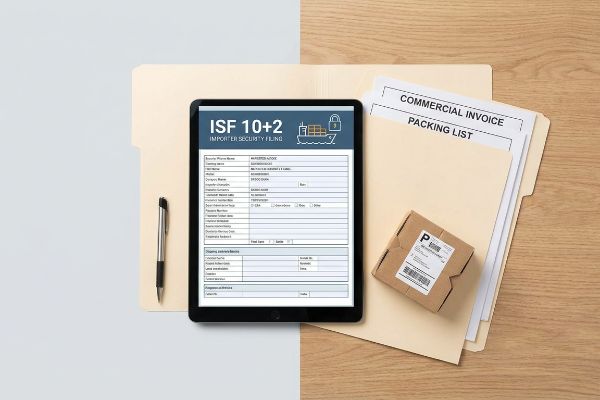
In reality, ignoring strict documentation protocols like the Importer Security Filing (ISF) 10+2 will instantly halt a product launch. If critical supply chain data is not filed correctly 72 hours before the vessel departs5, customs authorities will apply crushing penalty fees6 that quickly eclipse the actual duty cost while impounding the cargo. Successful retail importers centralize their manufacturing data early, ensuring flawless administrative execution to pre-clear commercial invoices and keep their promotional timelines fully intact.
| Common Rookie Mistake | The Pro Fix | Retail-Floor Benefit |
|---|---|---|
| Filing customs paperwork after sailing | Executing strict ISF 10+2 protocols | Eliminates $5,000+ customs penalties |
| Relying on slow overseas communication | Centralizing manufacturing data early | Keeps promotional rollouts on schedule |
| Ignoring port congestion risks | Pre-clearing commercial invoices | Speeds up distribution center intake |
Flawless compliance protocols are just as critical as the product manufacturing itself. Proactive document management ensures your seasonal rollout clears customs smoothly and arrives at distribution centers right on schedule.
🛠️ Harvey's Desk: Are you confident your current factory is filing the ISF 10+2 data 72 hours before departure? 👉 Check Your Compliance Risk ↗ — Download safely. My inbox is open if you have questions later.
Who benefits from a tariff?
While domestic governments collect the revenue, savvy importers can actually weaponize these taxes. Brands that engineer their way out of high freight costs gain a massive competitive advantage.
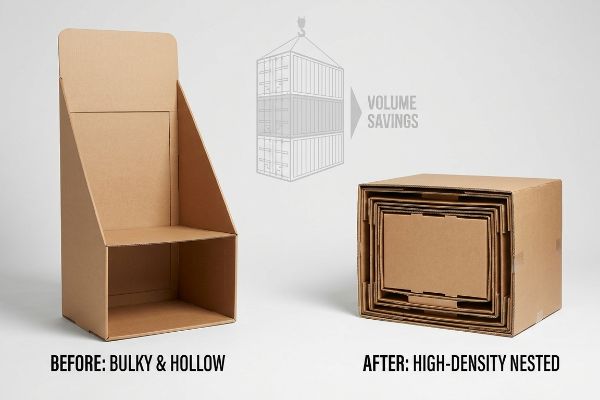
The entities benefiting from tariffs include domestic manufacturers and government treasuries. However, smart retail brands also benefit by using these taxes as a catalyst to aggressively engineer high-density, nested packaging that drastically lowers their per-unit shipping volume compared to slower competitors.
If you cannot control the government's tax rate, you must ruthlessly control the physical volume of your cargo.
How Nested Packaging Beats Tariff Volumes
Junior buyers often complain about high import duties while simultaneously paying to ship massive amounts of empty air across the ocean. They approve beautiful, bulky floor displays based solely on aesthetics, failing to consider how efficiently those structures will pack down for international transit. Shipping hollow, pre-assembled bases means brands are literally handing over valuable profit margin to pay unnecessary import taxes on entirely unused container space7.
Treating a shipping container like an endlessly flexible storage unit is a fast track to ruined margins. To genuinely offset the financial burden of tariffs, brands must mandate a high-density nested packing strategy from the very beginning of the structural design phase. By ensuring every internal shelf and header fits perfectly inside the hollow base structure, retail teams dramatically dilute the per-unit tariff cost8 and fiercely protect their final retail bottom line.
| Common Rookie Mistake | The Pro Fix | Retail-Floor Benefit |
|---|---|---|
| Shipping hollow, pre-glued bases | Engineering nested internal components | Slashes volumetric shipping costs9 |
| Using oversized master cartons | Designing exact-fit negative space packing | Fits 40% more units per pallet10 |
| Absorbing tariff hits directly | Diluting tax per unit via high density11 | Protects the final retail profit margin |
Maximizing cargo density is the ultimate defense against aggressive import taxes. Efficient volumetric planning guarantees that your logistics savings absorb the impact of any unexpected international trade fees.
🛠️ Harvey's Desk: How much empty air are you currently paying import duties on? 👉 Request a Density Audit ↗ — No forms that trigger endless sales calls. Just pure value.
How to explain tariffs to kids?
You tell a child that if they want a toy from another neighborhood, they must pay a toll to the gatekeeper. In retail manufacturing, that toll has heavy physical consequences.
Explaining tariffs to kids involves comparing it to an extra ticket needed to bring a toy home. In global manufacturing, this extra cost acts as a heavy financial burden, forcing engineers to optimize structural load-bearing tolerances to survive long transit without costly damages.
But knowing the theory isn't enough when the machines start running and those heavily taxed containers actually hit the rough ocean swell.
Why Theoretical Tariff Mitigation Fails on the Factory Floor
Procurement teams consistently try to offset heavy import tariffs by aggressively expanding master carton dimensions to cram just one more unit into every box. They operate under the dangerous assumption that as long as the heavy-duty corrugated board possesses a high theoretical burst strength12 in a testing environment, the goods will safely survive a multi-week ocean voyage. This theoretical approach prioritizes immediate shipping density on paper while completely ignoring the brutal physical geometry of the actual wooden pallet13 underneath.
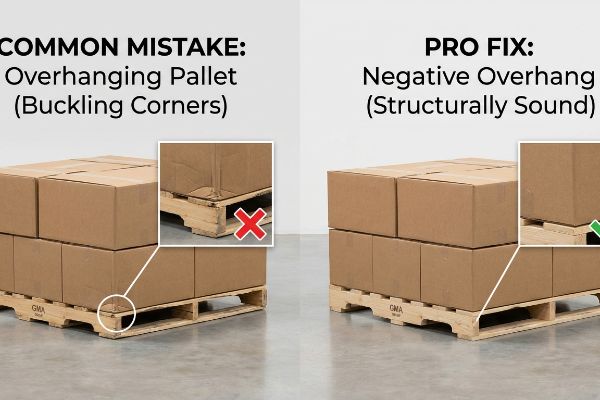
Theoretical load-bearing math instantly disintegrates when a heavily taxed container hits rough ocean swells. In real-world manufacturing, dielines that overhang a standard 48×40 inch (1219×1016 mm) GMA pallet by merely 0.4 inches (10.1 mm) force the vertical corners off the wood. Because corrugated boxes derive up to 60% of their BCT14 (Box Compression Test) strength directly from these corners, that tiny overhang guarantees the flutes will buckle and snap under a 2,000 lbs (907 kg) top-load. Enforcing a strict 0.5-inch (12.7 mm) negative overhang15 mathematically restores the structural corners, preventing catastrophic crush damage that obliterates retail inventory.
| Common Rookie Mistake | The Pro Fix | Retail-Floor Benefit |
|---|---|---|
| Expanding boxes past the wood pallet | Enforcing a 0.5-inch negative overhang | Restores 60% of corner BCT strength16 |
| Relying only on raw board ECT ratings | Aligning structural corners perfectly vertical17 | Prevents bottom-tier crushing in transit |
| Risking damaged goods to save on freight | Mathematically locking the GMA footprint18 | Eliminates retailer chargebacks for damage |
I engineer shipping footprints down to the millimeter to guarantee structural survival. Perfecting your pallet geometry ensures your heavily taxed cargo actually withstands the brutal container journey to generate real revenue.
🛠️ Harvey's Desk: Does your master carton overhang its pallet by even half an inch? 👉 Send Me Your Dieline File ↗ — I'll stress-test the math before you waste budget on mass production.
Conclusion
Ignoring global trade realities is dangerous; a fractional pallet overhang crushing your bottom tier during transit causes an estimated 30% inventory loss that drastically eclipses any tariff fee.
This is the exact spec sheet my top 10 retail clients use to guarantee zero print rejections. Stop gambling with expensive freight and secure your structural integrity before mass production begins.
🛠️ Harvey's Desk: Stop gambling with expensive freight and let me personally run your files. 👉 Get a Free Dieline Audit ↗ — Direct access to my desk. Zero automated sales spam, I promise.
"Frequently Asked Questions (FAQS) about Tariff Classification, the …", https://www.usitc.gov/harmonized_tariff_information/frequently_asked_questions. [An authoritative source on international trade or customs regulations would explain how the Harmonized System (HS) often applies higher default duty rates to 'basket'or non-specific classifications compared to precise headings]. Evidence role: factual support; source type: government customs agency or trade law guide. Supports: the claim that imprecise classification increases costs. Scope note: applies to most HS-compliant jurisdictions. ↩
"What value should be on the commercial invoice submitted to U.S. …", https://www.help.cbp.gov/s/article/Article-1162?language=en_US. [Customs and Border Protection guidelines specify that imprecise descriptions of goods can lead to incorrect classification, resulting in duty underpayments and subsequent penalties]. Evidence role: verification; source type: regulatory guide. Supports: The risk of vague documentation. Scope note: Application varies by jurisdiction. ↩
"4819.10.00.20 – Harmonized Tariff Schedule", https://hts.usitc.gov/search?query=4819100020. [The World Customs Organization's Harmonized System ensures that specific material compositions determine the precise tariff code and corresponding duty rate]. Evidence role: technical specification; source type: international standard. Supports: The necessity of material precision for classification. Scope note: Global standard applied across most trading nations. ↩
"Basic Importing and Exporting | U.S. Customs and Border Protection", https://www.cbp.gov/trade/basic-import-export. [An authoritative source on maritime law and customs regulations would detail the mandatory deadlines for filing manifests and security documentation]. Evidence role: technical verification; source type: legal/regulatory documentation. Supports: the existence of strict legal timelines for importing goods. Scope note: specific to international shipping and customs filings. ↩
"Importer Security Filing (ISF) – 10+2 | What You Need to Know", https://www.shapiro.com/resources/what-you-need-to-know-about-importer-security-filing-isf-102/. [Official U.S. Customs and Border Protection (CBP) regulations specify the mandatory timeframe for filing Importer Security Filings prior to cargo loading]. Evidence role: technical verification; source type: government regulation. Supports: ISF filing deadlines. Scope note: Applies specifically to ocean freight entering the United States. ↩
"Import Security Filing (ISF) – When to submit to CBP", https://www.help.cbp.gov/s/article/Article-1868. [Regulatory documentation from CBP outlines the specific monetary penalties levied for inaccurate or late ISF submissions]. Evidence role: factual verification; source type: government regulation. Supports: Financial impact of compliance failure. Scope note: Penalty amounts are standardized but can vary by violation type. ↩
"Import Tariffs & Fees Overview and Resources", https://www.trade.gov/import-tariffs-fees-overview-and-resources. [An authoritative source on international trade laws will verify if specific duties are applied to the volume or weight of imported goods rather than just their value]. Evidence role: technical verification; source type: customs regulatory body. Supports: the claim that bulky packaging increases tax costs. Scope note: depends on the Harmonized System (HS) code of the product. ↩
"Tariff-Adjusted Landed Cost as the New Sourcing Metric", https://www.supplychainbrain.com/blogs/1-think-tank/post/44045-tariff-adjusted-landed-cost-as-the-new-sourcing-metric. [Supply chain management literature demonstrates that maximizing container density reduces the per-unit shipping cost, which offsets the added expense of import tariffs on the total landed cost]. Evidence role: Economic validation; source type: Logistics trade publication. Supports: The ability to mitigate tariff burdens through volume optimization. Scope note: Applies to goods where shipping cost is a significant portion of landed cost. ↩
"Volumetric Weight and Shipping to Europe: What to Know | ILG", https://www.international-logistics-group.com/us-en/insights/volumetric-weight-explained-161836/. [A technical shipping guide explaining how nesting components reduces the total cubic volume, thereby lowering the dimensional weight charges applied by carriers]. Evidence role: technical mechanism; source type: logistics manual. Supports: cost reduction via nesting. Scope note: Specific to items capable of nesting. ↩
"[DOC] Submitted version (672.09 KB) – VTechWorks", https://vtechworks.lib.vt.edu/bitstreams/359cd5e6-7099-48a8-9a3b-60aeee6db278/download. [A logistics case study or packaging engineering report demonstrating the percentage increase in unit density when transitioning from oversized to exact-fit packing]. Evidence role: quantitative verification; source type: industry case study. Supports: the efficiency gain of negative space packing. Scope note: Actual percentage may vary based on product geometry. ↩
"Understanding How Landed Cost &Tariffs Impact Profit Margins", https://dclcorp.com/blog/supply-chain/total-landed-cost-affect-profit-margins/. [An economic analysis of landed costs showing how maximizing container density reduces the proportional distribution of fixed shipping fees and associated import taxes per unit]. Evidence role: economic rationale; source type: trade analysis. Supports: tariff mitigation via density. Scope note: Effect varies between ad valorem and specific tariffs. ↩
"The Importance of Determining the Burst Strength of Corrugated Boxes", https://compackusa.com/importance-determining-burst-strength-corrugated-boxes. [Engineering standards distinguish between burst strength, measured by the Mullen test, and box compression strength, noting that burst strength alone does not guarantee stability under vertical loads during transit]. Evidence role: technical verification; source type: industrial packaging standard. Supports: the inadequacy of relying on burst strength for shipping safety. Scope note: specific to corrugated fiberboard. ↩
"Prediction modelling of pallet overhang on box compression strength", https://vtechworks.lib.vt.edu/items/d6fb70fe-bf11-40d2-a44c-3ba7918d06e3. [Logistics guidelines demonstrate that carton dimensions creating overhang or underhang relative to the pallet's physical geometry significantly reduce the load's overall stacking strength]. Evidence role: technical verification; source type: shipping and logistics manual. Supports: the claim that pallet alignment is critical for structural survival. Scope note: refers to standard pallet sizes like GMA or ISO. ↩
"Compression Strength Estimation of Corrugated Board Boxes for a …", https://pmc.ncbi.nlm.nih.gov/articles/PMC9864211/. [A packaging engineering manual or academic study would quantify the contribution of vertical flutes to the overall Box Compression Test strength]. Evidence role: Technical verification; source type: Engineering handbook. Supports: The claim that corner misalignment causes catastrophic strength loss. Scope note: Percentage varies by board grade and flute type. ↩
"Predicting the effect of pallet overhang on the box compression …", https://www.researchgate.net/publication/372349298_Predicting_the_effect_of_pallet_overhang_on_the_box_compression_strength. [Industry logistics standards for palletization specify the negative overhang required to ensure load-bearing corners remain supported]. Evidence role: Standard verification; source type: Logistics industry manual. Supports: The technical solution for preventing retail inventory crush damage. Scope note: Specific to GMA pallet dimensions. ↩
"Determining Box Compression Strength – Akers Packaging", https://www.akers-pkg.com/determining-box-compression-strength/. An authoritative source on packaging engineering would quantify the loss of vertical compression strength caused by pallet overhang and the recovery percentage achieved by implementing a negative overhang. Evidence role: quantitative verification; source type: engineering manual. Supports: the structural benefit of eliminating overhang. Scope note: specific percentages may vary based on cardboard grade and flute type. ↩
"Estimation of the Compressive Strength of Corrugated Board Boxes …", https://pmc.ncbi.nlm.nih.gov/articles/PMC8467740/. Packaging science literature confirms that the vertical alignment of corrugated corners is critical for maximizing load-bearing capacity and preventing premature buckling. Evidence role: technical validation; source type: academic paper. Supports: the method for preventing bottom-tier crushing. Scope note: effectiveness depends on the quality of the palletization process. ↩
"Packaging Guide Glossary – SupplierWiki – SPS Commerce", https://www.spscommerce.com/community/articles/packaging-guide-glossary. Logistics manuals and retailer shipping guidelines specify GMA pallet dimensions and the financial penalties associated with non-compliance or damaged goods caused by poor footprint management. Evidence role: industry standard verification; source type: trade regulation. Supports: the link between pallet footprint and cost reduction. Scope note: chargeback policies are specific to individual retailers. ↩