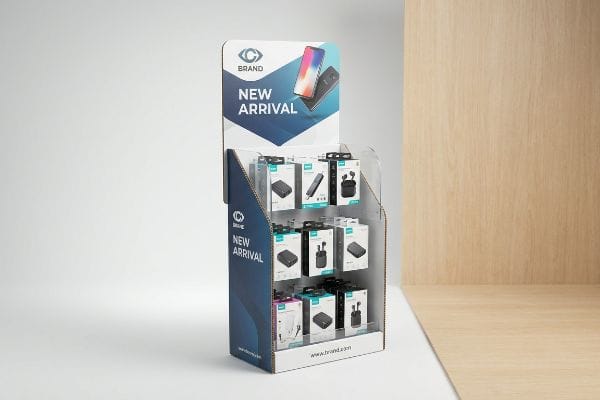
Are your retail campaigns failing to convert foot traffic into actual sales? You spend thousands on marketing, only to see your physical displays ignored in crowded big-box aisles.
A POP (Point of Purchase) display is a highly strategic retail merchandising structure designed to hold physical products and drive impulse purchases outside standard store aisles. Effective structures utilize engineering, brand graphics, and spatial placement to capture shopper attention and significantly accelerate retail sell-through rates.

But designing a beautiful unit on a screen is completely different from surviving the brutal reality of the retail floor.
What Should Effective Point of Purchase POP Displays Do?
Understanding what a display should actually achieve dictates its entire structural DNA. It is not just a box; it is a silent salesman actively hunting for customer attention.
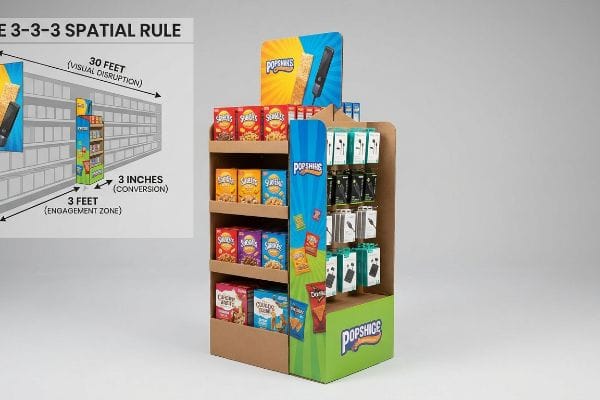
Effective POP displays must capture visual attention from thirty feet away, engage shopper interest at three feet, and drive the final physical conversion at three inches. They optimize retail shelf ergonomics, maximize product visibility, and physically disrupt standard consumer traffic patterns to trigger immediate impulse buying.
Hitting these exact spatial metrics requires more than just bright colors; it requires rigid physical execution.
The 3-3-3 Spatial Rule of POP Displays
Junior marketing teams frequently design retail structures strictly for up-close viewing on backlit computer monitors. They assume that if a graphic looks clean and perfectly symmetrical on their screen, it will naturally command attention in a massive retail environment.
That approach completely ignores how humans navigate store aisles. I constantly see brands rely on tiny text that turns into visual static from just a few steps away. When I walk the floor, I watch rushing shoppers completely ignore flat, uninspired structures. To fix this, I utilize the 3-3-3 rule: aggressive die-cut shapes and Pantone spot color floods for thirty-foot visual disruption, optimizing shelf ergonomics to the 50-inch (1270 mm) strike zone1 for three-foot engagement, and cutting the front retaining lip to guarantee 85% product visibility for the final three-inch tactile conversion. The physical friction of a shopper trying to pull an obstructed product from a tight shelf—hearing that awful scrape against the raw paperboard—instantly kills the impulse purchase. Engineering proper clearance eliminates this friction, accelerating sell-through rates by up to an estimated 25%2 and maximizing your return on investment.
| Common Rookie Mistake | The Pro Fix | Retail-Floor Benefit |
|---|---|---|
| Designing for screen distance | 3-3-3 spatial engineering rule3 | Captures distant foot traffic |
| Tiny text-heavy messaging | Massive die-cut structural focus | Eliminates cognitive overload |
| High retaining lips | 85% visible product clearance4 | Frictionless product retrieval |
I never let a client waste budget on graphics that blend into the background. By mathematically engineering the structure to capture distant visual attention and ensure frictionless physical retrieval, I transform a simple box into an active conversion engine.
🛠️ Harvey's Desk: Are your current displays failing to stop traffic in the aisle? Let me review your artwork for spatial engagement. 👉 Request a Spatial Blueprint ↗ — Direct access to my desk. Zero automated sales spam, I promise.
What Are the 5 P's in Retail?
Launching a physical product without mastering the foundational frameworks of commercial retail guarantees a swift supply chain failure.
The 5 P's in retail are Product, Price, Place, Promotion, and People. These core principles dictate how a brand positions its merchandise, aligns with specific retailer operational models, sets competitive pricing, executes targeted marketing campaigns, and ultimately connects with the end consumer to maximize profitability.
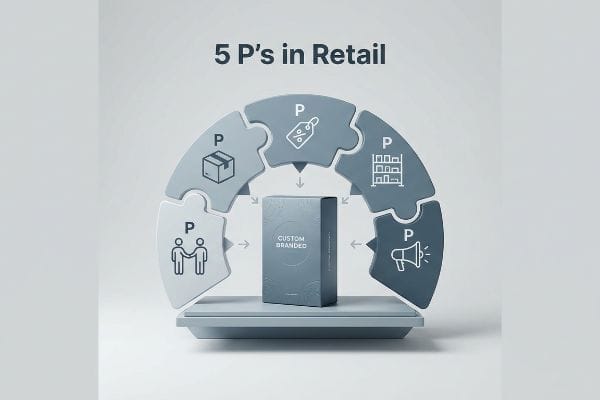
Applying these frameworks means engineering your structural campaigns to seamlessly match the specific environment of your targeted store.
Aligning the 5 P's with Retail Frameworks
New brands frequently attempt to launch items without mastering these basic frameworks, assuming a good item will simply sell itself. They believe the same generic merchandiser can be deployed universally across convenience stores, grocery chains, and massive warehouse clubs.
That lack of fundamental business alignment causes products to end up physically incompatible with the targeted store's operational model5. I remember watching a store manager reject an entire shipment because a client's overly wide structure violated the specific Place and Promotion rules of that retail category. The heavy thud of the rejected master cartons hitting the loading dock was a painful sound. We must map the brand's logistical strategy directly against the specific retailer's compliance guidelines. By adapting the physical rollout to fit the exact commercial ecosystem—down to the precise footprint and visual merchandising height6—we prevent costly store-level rejections and ensure the campaign generates profitable volume.
| Common Rookie Mistake | The Pro Fix | Retail-Floor Benefit |
|---|---|---|
| Universal one-size-fits-all pitch | Retail Framework Matrix alignment | Fits store operational model |
| Ignoring specific aisle rules | Custom footprint engineering | Secures premium aisle placement |
| Focus only on product features | Merging promotion with physical place | Drives higher unit velocity |
I refuse to engineer a unit until we strictly align with the specific commercial requirements of the target retailer. Integrating your supply chain logistics into these strategic frameworks guarantees the physical rollout maximizes retail compliance and overall profitability.
🛠️ Harvey's Desk: Is your upcoming retail pitch aligned perfectly with strict big-box requirements, or are you hoping they make an exception? 👉 Get a Strategy Review ↗ — Download safely. My inbox is open if you have questions later.
What Is a Point of Purchase POP Display?
Differentiating between various retail zones is critical before you cut a single piece of cardboard.
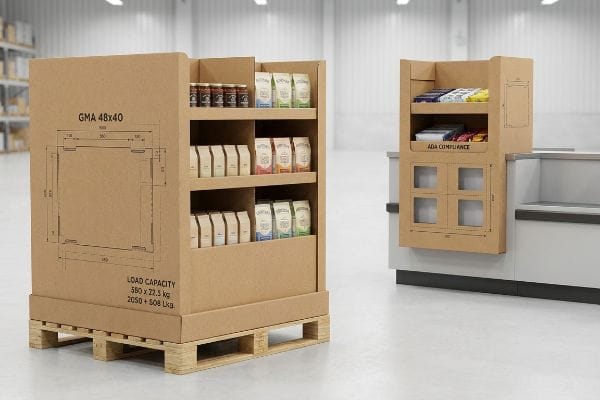
A POP display is a freestanding retail structure anchored within the main store aisles to merchandise bulk products, whereas a point-of-sale display strictly resides at the checkout counter. These heavy-duty corrugated board units are strictly designed around standard pallet dimensions for surviving massive warehouse logistics.
While the definition seems straightforward, the physical engineering required to separate these zones is heavily regulated.
The ADA vs. GMA Spatial Constraint
Trading companies frequently pitch a scalable design where a massive floor display can simply be mathematically reduced by 50% to serve as a checkout counter unit. They view these zones as interchangeable, ignoring the strict legal and logistical rules dictating US retail spaces7.
Shrinking a file does not magically change its physics or legal compliance. I have seen clients try to force a scaled-down floor unit onto a checkout lane, only for the store manager to throw it in the trash because it violated ADA (Americans with Disabilities Act) forward reach limits. You cannot just guess these dimensions. I permanently separate the engineering pipelines: floor units are strictly anchored to the GMA (Grocery Manufacturers Association) 48×40 inch (1219×1016 mm) pallet limit8 for dynamic load capacity, while checkout units are strictly anchored to the 15-48 inch (381-1219 mm) ADA compliance window9. Feeling the rigid stability of a properly anchored pallet display proves why these limits exist. By isolating these structural rules, we prevent massive retailer chargebacks and secure long-term floor placement.
| Common Rookie Mistake | The Pro Fix | Retail-Floor Benefit |
|---|---|---|
| Shrink-to-fit scaling | Separating engineering pipelines | Avoids legal reach violations10 |
| Ignoring pallet dimensions | GMA pallet strict anchoring11 | Survives heavy logistics |
| Guessing checkout limits | ADA compliance mathematical modeling12 | Eliminates store manager rejections |
I completely rebuild the structural math if a client asks for a dangerous crossover design. Locking down specific regulatory dimensions for each display type is the only way to protect your brand from sudden store-level rejections.
🛠️ Harvey's Desk: Are you worried your current floor structure violates specific retail reach ranges? 👉 Claim Your Compliance Check ↗ — No forms that trigger endless sales calls. Just pure value.
What Are the Advantages of POP Displays?
The biggest advantage of these units is generating a massive spike in product visibility.
The primary advantages of POP displays include dominating retail aisle visibility, driving high-volume impulse purchases, highlighting brand promotions outside standard shelving, and enabling rapid product rollouts. When structurally optimized, these displays physically disrupt shopper traffic and dramatically lower the overall cost of retail customer acquisition.
But knowing the theory isn't enough when the machines start running and heavy merchandise gets loaded.
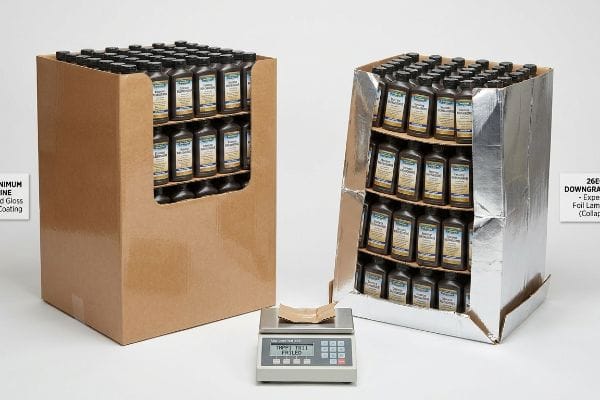
The Cosmetic ECT Downgrade Trap
Procurement teams frequently treat expensive cosmetic finishes, like full-coverage foil laminations, as non-negotiable marketing mandates to maximize their display's visual advantage. To offset these bloated upfront printing costs, they assume they can simply downgrade the internal structural board grades to save pennies13 per unit.
In my facility, I routinely see the devastating physical consequences of this budget trick. When a client secretly downgrades from a robust 32ECT to a flimsy 26ECT board to pay for shiny foil, they strip critical fiber density directly from the core fluting. I test this using a TAPPI T811 ECT (Edge Crush Test)14, and the results are brutal. When you stack 187.5 lbs (85 kg) of actual merchandise onto that weakened structure, the internal flutes aggressively buckle and snap. I pulled the micrometer readings and proved that instead of relying on heavy metallic films on weak paper, I just needed to restore the virgin 32ECT standard and apply a high-solid gloss aqueous coating. By enforcing this strict material baseline, I ensure the structural integrity remains perfectly square, saving clients from catastrophic transit crushing and preventing an estimated 15% loss in damaged retail inventory15.
| Common Rookie Mistake | The Pro Fix | Retail-Floor Benefit |
|---|---|---|
| Downgrading ECT for cosmetics | Virgin 32ECT minimum baseline16 | Prevents vertical top-load collapse |
| Expensive foil lamination | High-solid gloss aqueous coating17 | Reduces per-unit manufacturing cost |
| Ignoring BCT testing | TAPPI T811 Edge Crush Test validation18 | Survives double-stacked ocean freight |
I never allow procurement teams to hollow out the physical engineering just to fund a cosmetic marketing gimmick. Maintaining absolute material density is what actually guarantees your display survives the harsh transit journey to the retail floor.
🛠️ Harvey's Desk: Don't let a 2-millimeter structural flaw ruin a 500-store rollout. 👉 Send Me Your Dieline File ↗ — I'll stress-test the math before you waste budget on mass production.
Conclusion
You can choose a cheaper vendor to fund expensive foil finishes, but when that secretly downgraded 26ECT board catastrophically collapses under heavy warehouse top-loads, it triggers immediate retailer rejections and completely wipes out your campaign's profit margin. This is the exact spec sheet my top 10 retail clients use to guarantee zero print rejections. Stop gambling on weakened paper flutes and let me personally evaluate your structural integrity through my Free Dieline Pre-Flight Audit ↗ to catch fatal load-bearing errors before mass production begins.
"[PDF] Guidelines for Retail Grocery Stores – Ergonomics for the … – OSHA", https://www.osha.gov/sites/default/files/publications/OSHA3192.pdf. Verification of retail anthropometric standards regarding the optimal eye-level or reach zone for shopper engagement. Evidence role: technical specification; source type: ergonomic study or retail design manual. Supports: the specific height for maximum engagement. Scope note: may vary by target demographic. ↩
"Sell Through Rate: Definition, Formula, and Importance – Lightspeed", https://www.lightspeedhq.com/blog/sell-through-rate/. Empirical data demonstrating the correlation between reduced physical friction in product retrieval and increased sales velocity. Evidence role: performance metric; source type: market research or case study. Supports: the claim that proper clearance boosts ROI. Scope note: result is presented as an estimate. ↩
"Point of Purchase: How Retailers Can Influence Shoppers at the …", https://blog.intouch.com/posts/points-of-purchase-displays. Verification of the specific distances and timing metrics defined by the 3-3-3 rule for visual attention in retail. Evidence role: technical specification; source type: retail design guide. Supports: the use of spatial engineering to capture distant foot traffic. Scope note: specific to point-of-purchase architecture. ↩
"Getting the Most Out of Your Retail Display – Frank Mayer", https://www.frankmayer.com/blog/getting-the-most-out-of-your-retail-display/. Technical data confirming the industry benchmark for product exposure to minimize shopper friction. Evidence role: industry benchmark; source type: merchandising manual. Supports: the claim that 85% clearance enables frictionless retrieval. Scope note: applies to open-front POP displays. ↩
"Retail Vendor Selection Criteria – LinkedIn", https://www.linkedin.com/top-content/retail-merchandising/vendor-management-in-retail/retail-vendor-selection-criteria/. Retail industry standards for vendor compliance detail how failure to meet physical specifications leads to shipment rejections. Evidence role: validation; source type: retail operations manual. Supports: The consequence of misalignment between product design and store operations. Scope note: Applicable primarily to big-box and specialty retail. ↩
"[PDF] Retailing Strands and Standards – Utah.gov", https://www.utah.gov/pmn/files/1359861.pdf. Commercial retail guidelines specify exact dimensional requirements for product footprints and display heights to ensure shelving efficiency and safety. Evidence role: technical specification; source type: retail compliance handbook. Supports: The necessity of adhering to specific physical dimensions to avoid store-level rejections. Scope note: Specifications vary by retail category. ↩
"ADA Accessibility Standards – Access-Board.gov", https://www.access-board.gov/ada/. Brief explanation of how ADA accessibility laws and GMA pallet standards dictate retail floor layouts. Evidence role: legal and industry verification; source type: government regulation and industry association. Supports: The claim that retail spatial zones are not interchangeable due to regulations. Scope note: Applies to US retail environments. ↩
"48×40" GMA Pallets | Largest Pallet Manufacturer & Supplier", https://www.palletone.com/products/gma-pallets/. Verification of the official Grocery Manufacturers Association standard pallet dimensions for logistics and load capacity. Evidence role: technical specification; source type: industry standard. Supports: the dimensional basis for floor unit engineering. Scope note: specifically applies to North American logistics. ↩
"Chapter 3: Operable Parts – Access-Board.gov", https://www.access-board.gov/ada/guides/chapter-3-operable-parts/. Official ADA guidelines regarding the height and reach ranges for accessible elements to ensure usability for persons with disabilities. Evidence role: legal requirement; source type: government regulation. Supports: the height constraints for checkout units. Scope note: refers to the 'reachable range'specifications. ↩
"ADA Standards for Accessible Design Title III Regulation 28 CFR …", https://www.ada.gov/law-and-regs/design-standards/1991-design-standards/. Authoritative guidelines from the ADA (Americans with Disabilities Act) define specific maximum reach ranges for accessibility in retail environments. Evidence role: legal standard; source type: government regulation. Supports: the necessity of adhering to reach limits to avoid legal violations. Scope note: applicable to US retail jurisdictions. ↩
"A Complete Guide to GMA Pallets: Everything a Buyer Should Know", https://www.meridianpkg.com/feeds/blog/gma-pallets. Industry standards set by the Grocery Manufacturers Association (GMA) specify pallet dimensions and stability requirements for logistics and retail floor placement. Evidence role: industry technical standard; source type: trade organization. Supports: the claim that GMA standards ensure displays survive heavy logistics. Scope note: primary standard for North American logistics. ↩
"Chapter 9: Built-In Elements – Access-Board.gov", https://www.access-board.gov/ada/chapter/ch09/. Technical documentation on spatial planning and clearance widths for ADA compliance ensures accessibility in high-traffic retail zones. Evidence role: technical methodology; source type: architectural compliance manual. Supports: the use of modeling to eliminate store manager rejections based on spatial violations. Scope note: focused on checkout zone clearance. ↩
"How Much Does a Custom Cardboard Display Cost? (Real Buyer …", https://popdisplay.me/how-much-does-a-custom-cardboard-display-cost-real-buyer-pricing-guide/. Industry technical guides on corrugated packaging explain the cost-benefit trade-offs when reducing Edge Crush Test (ECT) ratings to offset additive cosmetic costs. Evidence role: factual corroboration; source type: industry technical guide. Supports: the common practice of material downgrading for cost reduction. Scope note: applies specifically to corrugated cardboard POP units. ↩
"Full-Field Measurements in the Edge Crush Test of a Corrugated …", https://pmc.ncbi.nlm.nih.gov/articles/PMC8199211/. Verification that TAPPI T811 is the recognized industry standard for measuring the Edge Crush Test (ECT) value of corrugated board. Evidence role: technical validation; source type: industry standard. Supports: the validity of the testing methodology mentioned. Scope note: specific to corrugated materials. ↩
"Why Cheap POP Displays Often Lose Money – Brown Packaging", https://brownpackaging.com/why-cheap-pop-displays-often-lose-money/. Industry data or logistics studies quantifying the percentage of inventory loss attributed to structural failure in retail displays. Evidence role: statistical verification; source type: logistics research. Supports: the claim regarding the economic impact of material downgrades. Scope note: rates may vary by sector. ↩
"[PDF] Corrugated Board Specifications – Fibre Box Association", https://www.fibrebox.org/assets/2025/09/Walmart_Corrugated-Board_Specifications_Automation_Packaging_Standards.pdf. Industry packaging standards provide technical specifications for Edge Crush Test (ECT) ratings to determine minimum structural integrity for retail displays. Evidence role: technical specification; source type: industry standard. Supports: minimum strength requirements to prevent collapse. Scope note: applicable to corrugated cardboard. ↩
"Aqueous Coating (AQ) In Packaging Printing – PopDisplay", https://popdisplay.me/aqueous-coating-aq-in-packaging-printing/. Comparative manufacturing data validates the cost reduction of using aqueous coatings over foil laminations for high-gloss finishes in retail packaging. Evidence role: cost-benefit analysis; source type: manufacturing guide. Supports: reduction in per-unit manufacturing cost. Scope note: focused on finishing processes. ↩
"Edge crush testing methods and box compression modeling, TAPPI …", https://www.tappi.org/publications-standards/tappi-journal/home/2022/aug/edge-crush-testing-methods-and-box-compression-modeling-tappi-journal-august-2022/. TAPPI (Technical Association of the Pulp and Paper Industry) standards document T811 as the formal procedure for measuring the edge crush strength of corrugated board. Evidence role: standard validation; source type: technical standard. Supports: shipping durability for double-stacked freight. Scope note: focused on structural testing. ↩