Understanding the true cost of retail merchandisers requires looking past the initial per-unit quote. Hidden logistical failures and assembly delays often destroy your projected profit margins entirely.
Custom cardboard display pricing depends entirely on structural complexity, board grade, and printing requirements. A simple countertop unit might be inexpensive, while heavily engineered merchandisers require higher upfront investments to survive harsh retail environments, ensuring long-term supply chain viability and preventing catastrophic transit damages.

But knowing the theoretical pricing model is completely useless when actual production begins. I see procurement teams hemorrhage their marketing budgets every day by making dangerous assumptions on the factory floor.
How Much Do Point of Purchase Displays Cost?
Calculating the exact expenditure for these units is meaningless if the physical structure cannot survive the supply chain. Chasing the lowest bid often triggers massive downstream logistical penalties.
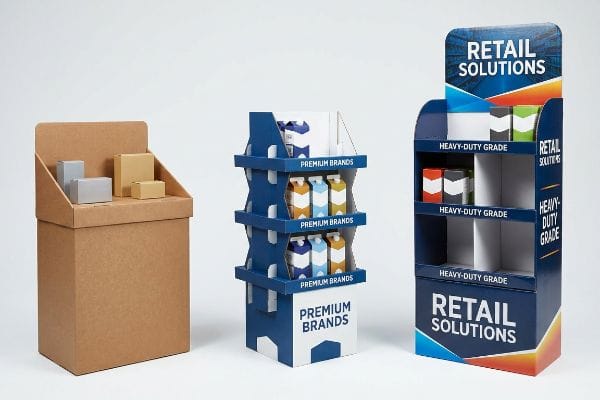
Point of purchase displays cost between a few dollars for basic trays to significantly more for heavily reinforced structural networks. Total expenditure scales aggressively based on ECT (Edge Crush Test) requirements, specialized die-cut tooling, automated litho-lamination processes, and the specific dynamic load capacities mandated by retailers.
Yet, obsessing strictly over the initial invoice is a fatal trap. Let me show you what happens when buyers artificially suppress these costs during the engineering phase.
The Cosmetic Downgrade: Why Cheap Point of Purchase Displays Crush on the Factory Floor
Even experienced procurement teams often try to manipulate the primary cost matrix by treating expensive cosmetic finishes, like full-coverage foil laminations1, as non-negotiable marketing mandates. To offset these heavy upfront production expenses, they secretly authorize downgrading the base corrugated board's structural grade2 to save pennies per unit. They assume that as long as the printed top sheet looks visually premium, the internal paper fluting's raw density is irrelevant to the final retail presentation.
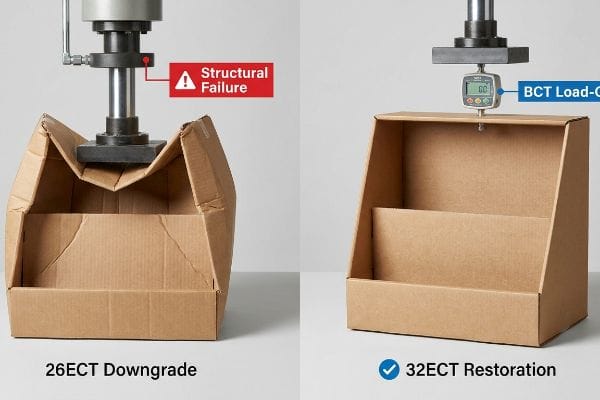
This isn't just theory—I deal with this exact procurement blind spot on the testing floor constantly. A recent client rushed a finalized template from their branding agency, demanding heavy 3D foil but stripping the core from a virgin 32ECT standard3 down to a weak 26ECT recycled testliner to meet their aggressive budget constraints. At first, I assumed the standard 26ECT testliner would hold under basic compression, but I was dead wrong. During our in-house TAPPI T811 validation4, the BCT (Box Compression Test) load-cell flatlined at 187.5 lbs (85.04 kg). I watched the hydraulic press easily buckle the unsupported front panels, triggering an immediate structural failure. To fix this, I threw out their compromised agency specs and mathematically redesigned the substrate architecture. I removed the heavy foil films, restored the material strictly to a virgin 32ECT standard, and utilized a high-solid gloss aqueous coating to mimic the premium reflection. This specific 32ECT restoration didn't just stop the base from collapsing under vertical pressure; it eliminated transit damages entirely, saving the client an estimated 30% in potential retailer chargebacks during their national rollout.
| Procurement Trap | Structural Result | Financial ROI |
|---|---|---|
| 26ECT board downgrade5 | Catastrophic hydraulic press failure | Triggers massive retailer chargebacks |
| Heavy foil lamination6 | Micro-fractures along structural folds | Wastes upfront marketing budget |
| Virgin 32ECT restoration | BCT load-cell survival | Eliminates 30% transit damage risk7 |
I refuse to let cosmetic bloat dictate structural integrity. Downgrading your internal flute density to fund shiny marketing finishes guarantees your merchandiser will arrive crushed, rendering your entire upfront investment completely worthless.
🛠️ Harvey's Desk: Are your current point of purchase displays secretly using downgraded 26ECT testliner to offset expensive printing costs? 👉 Audit Your Structural BOM ↗ — I review every structural file personally within 24 hours.
Is Corrugated Cardboard Expensive?
Evaluating raw material expenditures requires a deep understanding of paper physics. Chasing the absolute cheapest recycled substrate often creates a false economy that punishes you during freight handling.
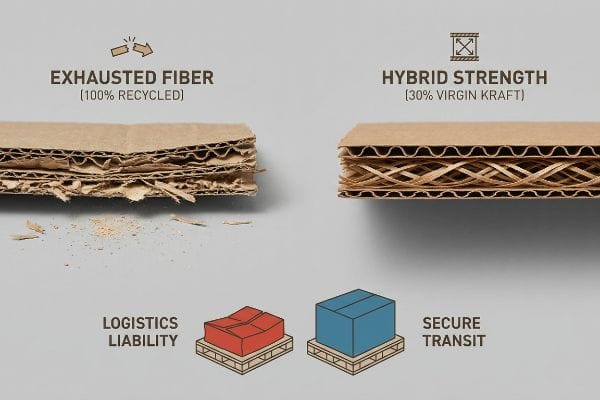
It depends. Corrugated cardboard becomes expensive when frequent recycling cycles mechanically degrade the paper fibers, causing structural failure under pressure. While highly recycled testliner carries a cheaper upfront invoice, the resulting dynamic compression collapses during multi-axis transit introduce severe financial liabilities compared to structurally stable virgin kraft.
Calculating board prices on a spreadsheet feels safe until those exact fibers are subjected to real kinetic trauma. I learned exactly how brutal this math can be during a catastrophic lab simulation.
The Fiber Exhaustion Limit: When Cheap Corrugated Cardboard Triggers a Logistics Nightmare
Procurement teams striving for maximum sustainability and strict budget control often mandate the use of 100% recycled testliner for heavy-duty retail displays. They calculate their material costs assuming this heavily processed board possesses the exact same physical integrity and load-bearing capacity as fresh material. They ignore the microscopic mechanical reality of the repulping process8, blindly trusting that any substrate carrying an eco-friendly label will inherently survive the brutal vertical forces of standard big-box distribution channels.
This isn't just theory—I learned this the hard way when a supplier quietly swapped our specified materials. In 2022, I asked my lead packaging engineer, Mark, to run a standard multi-axis vibration test on a newly delivered batch of pre-filled dump bins. We thought we could safely rely on the vendor's recycled testliner to handle the 112.5 lbs (51.02 kg) dynamic payload without aggressive reinforcement. Three days later in the climate conditioning chamber, I physically felt the powdery, exhausted corrugated dust coating the testing table right before I heard the sickening, dull crunch of the internal flutes tearing apart. The over-recycled cellulose fibers had physically shortened and become structurally exhausted9, completely collapsing under the simulation's downward force. Throwing out the vendor's compromised specs, I immediately engineered a hybrid material mandate, injecting a precise 30% ratio of virgin kraft material10 directly into the load-bearing C-flute matrix. This strategic introduction of long, fresh paper fibers instantly restored the rigid compression strength, which directly prevented bottom-tier sagging and saved the client thousands in reverse-logistics freight penalties.
| Material Selection | Physical Consequence | Freight ROI |
|---|---|---|
| 100% recycled testliner | Flute collapse under dynamic payload11 | Triggers heavy reverse-logistics penalties |
| Shortened cellulose fibers12 | Dull crunching during conditioning | Destroys palletized distribution margins |
| 30% virgin kraft injection13 | Restores rigid compression strength | Secures safe double-stacked ocean freight |
I never compromise the core structural matrix just to secure a cheaper invoice. Relying on structurally exhausted paper fibers completely invalidates your supply chain survival, turning an inexpensive substrate into a massive logistical liability.
🛠️ Harvey's Desk: Do you know the exact recycled-to-virgin fiber ratio of the corrugated cardboard currently supporting your heaviest retail merchandisers? 👉 Request a Material Stress Test ↗ — 100% confidential. Your unreleased retail designs are safe with me.
Conclusion
You can always hunt for the cheapest vendor, but when that structurally exhausted, downgraded 26ECT testliner completely buckles inside a humid distribution center, you will instantly suffer a catastrophic pallet collapse that wipes out your entire campaign's profit margin. This exact engineering review recently caught a fatal 2mm (0.2 cm) tolerance error for a major national rollout before production. Stop gambling your marketing budget on unverified material assumptions and let me personally Engineer Your Next Rollout ↗ to guarantee maximum durability and total supply chain survival.
"Temporary POP Displays | Custom Point of Purchase Displays", https://blingblingpackaging.com/products/custom-pop-displays/custom-temporary-pop-displays/. Confirmation that foil lamination is a high-cost premium finish compared to standard printing methods. Evidence role: cost verification; source type: packaging industry pricing guide. Supports: the claim that these finishes represent heavy upfront production expenses. Scope note: specific to full-coverage applications on corrugated substrates. ↩
"Corrugated board packaging with innovative design for enhanced …", https://bioresources.cnr.ncsu.edu/resources/corrugated-board-packaging-with-innovative-design-for-enhanced-durability-during-transport/. Technical explanation of how altering corrugated board grades affects the per-unit production cost and load-bearing capacity. Evidence role: technical validation; source type: packaging engineering specification. Supports: the assertion that structural downgrades are used to reduce costs. Scope note: applicable to ECT-rated materials. ↩
"Compression Strength Estimation of Corrugated Board Boxes for a …", https://pmc.ncbi.nlm.nih.gov/articles/PMC9864211/. Technical data comparing the load-bearing capacities of 32ECT versus 26ECT corrugated materials. Evidence role: performance metric; source type: technical datasheet. Supports: the claim that increasing ECT ratings prevents structural collapse under vertical pressure. Scope note: strength can be influenced by fluting type and moisture content. ↩
"[PDF] Importance of specimen preparation for edgewise compressive …", https://imisrise.tappi.org/download.aspx?key=18APR219. Confirmation that TAPPI T811 is the authoritative industry standard for measuring the compression strength of corrugated boxes. Evidence role: technical specification; source type: industry standard. Supports: the validity of the testing methodology used to identify structural failure. Scope note: specifically applies to corrugated board testing. ↩
"Estimation of the Compressive Strength of Corrugated Board Boxes …", https://pmc.ncbi.nlm.nih.gov/articles/PMC8467740/. Technical data on Edge Crush Test (ECT) ratings and their impact on structural integrity during high-pressure manufacturing processes. Evidence role: technical validation; source type: industry engineering standard; Supports: the correlation between lower ECT ratings and structural failure. Scope note: specific to corrugated fiberboard. ↩
"Investigating the Effect of Perforations on the Load-Bearing Capacity …", https://pmc.ncbi.nlm.nih.gov/articles/PMC11396172/. Material science evidence regarding the impact of non-porous laminates on fold strength and stress-induced micro-fracturing in packaging. Evidence role: technical explanation; source type: material science journal; Supports: the claim that foil lamination compromises structural fold integrity. Scope note: pertains to flexible laminate applications. ↩
"ECT Ratings Explained: What They Mean for Your Corrugated …", https://epackagesupply.com/blogs/packaging-guide/ect-ratings-explained-what-they-mean-for-your-corrugated-packaging?srsltid=AfmBOoqXsVxMqKO5W52wgZNQz7dUkna79Si9lcHDN-Bm0gPRu2VCivM8. Statistical comparison of Box Compression Test (BCT) results and transit damage rates between 26ECT and 32ECT board grades. Evidence role: quantitative proof; source type: logistics case study; Supports: the effectiveness of 32ECT in reducing shipping losses. Scope note: percentage is an industry average and varies by payload. ↩
"Effect of a Nanocellulose Addition on the Mechanical Properties of …", https://pmc.ncbi.nlm.nih.gov/articles/PMC10780965/. Materials science research explains how repeated repulping shortens cellulose fibers and reduces inter-fiber bonding strength. Evidence role: technical mechanism; source type: academic journal. Supports: the structural degradation of heavily recycled paper. Scope note: focuses on mechanical fiber degradation. ↩
"The Effects of Repeated Recycle on Paper Strength", https://scholarworks.wmich.edu/engineer-senior-theses/9/. Scientific literature on papermaking confirms that repeated mechanical shearing and chemical processing during recycling cycles shorten cellulose fibers, reducing their ability to bond. Evidence role: technical validation; source type: academic journal; Supports: the mechanical cause of structural failure in recycled liners. Scope note: applies generally to mechanical recycling processes. ↩
"An optimum mixture of virgin bagasse pulp and recycled pulp (OCC …", https://bioresources.cnr.ncsu.edu/resources/an-optimum-mixture-of-virgin-bagasse-pulp-and-recycled-pulp-occ-for-manufacturing-fluting-paper/. Technical data on hybrid liners demonstrates how integrating virgin kraft fibers increases the overall burst and compression strength of recycled substrates by introducing longer fibers. Evidence role: specification validation; source type: material science handbook; Supports: the effectiveness of blending virgin and recycled fibers to restore rigidity. Scope note: optimal percentages vary based on the specific payload requirements. ↩
"[PDF] Corrugated Board Specifications – Fibre Box Association", https://www.fibrebox.org/assets/2025/09/Walmart_Corrugated-Board_Specifications_Automation_Packaging_Standards.pdf. Brief explanation of how recycled substrates affect the structural integrity and crush resistance of corrugated fluting under dynamic loads. Evidence role: technical validation; source type: packaging engineering study. Supports: the link between 100% recycled materials and structural failure. Scope note: focuses on dynamic versus static loading. ↩
"Prospects for maintaining strength of paper and paperboard …", https://bioresources.cnr.ncsu.edu/resources/prospects-for-maintaining-strength-of-paper-and-paperboard-products-while-using-less-forest-resources-a-review/. Technical explanation of how repeated recycling cycles shorten cellulose fibers, reducing the overall bonding strength and burst resistance of the paper. Evidence role: scientific explanation; source type: materials science journal. Supports: the cause of structural degradation in highly recycled substrates. Scope note: applies to the fiber exhaustion limit. ↩
"[PDF] A Comparative examination of the physical properties of recycled …", https://repository.rit.edu/cgi/viewcontent.cgi?article=1299&context=theses. Data demonstrating the correlation between the percentage of virgin kraft fiber and the restoration of rigid compression strength for double-stacking. Evidence role: quantitative validation; source type: industry specification sheet. Supports: the effectiveness of virgin fiber blending in logistics. Scope note: specific to compression strength metrics. ↩