High-end retail displays demand striking visuals and absolute durability, but balancing premium finishes with strict sustainability mandates often leaves procurement teams frustrated and budgets drained.
AQ (Aqueous Coating) in packaging is a fast-drying, water-based, transparent finish applied directly to printed materials. It provides a protective layer against scuffing and fingerprints while enhancing visual appeal. Unlike heavy plastics, it seamlessly integrates with corrugated structures, ensuring optimal curbside recyclability and high-speed manufacturing efficiency.
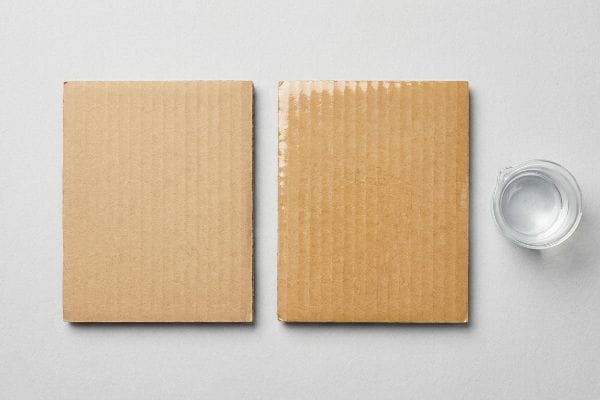
To truly leverage this chemistry on the factory floor, buyers must look beyond simple aesthetics and understand its structural impact on heavy-duty supply chains.
What is aqueous coating in printing?
Understanding liquid polymer barriers is the first step to mastering high-volume retail packaging without sacrificing structural integrity or environmental compliance.
Aqueous coating in printing is a fluid, eco-friendly chemical barrier applied in-line on an offset press. This water-soluble sealant polymerizes instantly over raw ink, preventing microscopic surface abrasions during transit while maintaining complete curbside recyclability without the toxic liabilities associated with traditional petroleum-based chemical varnishes.
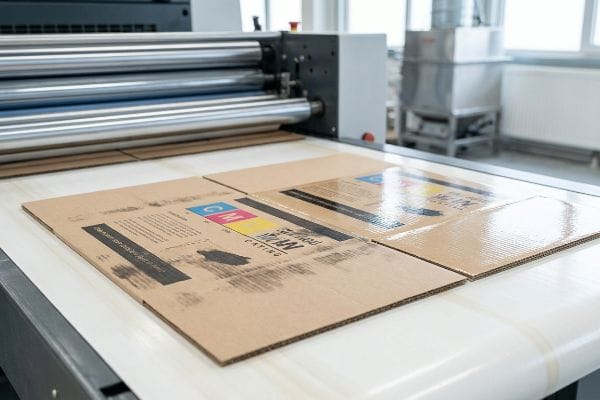
Mastering this protective layer requires treating it not as an afterthought, but as an engineered component of your physical manufacturing process.
The Liquid Polymer Shield Mechanics
Aqueous finishes operate as a dynamic liquid polymer shield rather than a static sheet. When applied via the printing press coating tower, the water-based compound floods the porous fibers of the corrugated board. As the water evaporates, it leaves behind a unified, microscopically thin web of resin1 that locks the ink pigments into place. This completely eliminates the need for toxic chemical solvents or heavy, non-recyclable plastic films2, keeping the display entirely mono-material.
I consistently explain to new product managers that this liquid matrix acts as a fundamental frictionless barrier during high-speed automated processing. Unlike raw, untreated ink that remains vulnerable to smearing under heavy mechanical pressure, this polymerized layer allows the printed sheets to glide seamlessly through automated die-cutting machinery and folding gluers3. By sealing the surface tension of the paperboard, it directly prevents the abrasive dust generated during the slotting process4 from embedding into the vibrant CMYK (Cyan, Magenta, Yellow, and Key) graphics, ensuring that the final retail-ready tray arrives at the store looking immaculate while easily surviving the rigors of standard retail environments.
| Feature | Raw Ink Surface | Engineered AQ Profile |
|---|---|---|
| Scuff Resistance | Minimal | High Mechanical Durability5 |
| Recyclability Profile | Requires Sorting | 100% Curbside Compliant6 |
| Line Speed Efficiency | Slow Curing | Instant Automated Processing7 |
I rely on this specific water-based chemistry because it mathematically eliminates press bottlenecks. Securing the pigment immediately means I never have to delay the cutting phase, effectively accelerating your entire commercial rollout schedule by days.
🛠️ Harvey's Desk: Are your current retail cartons suffering from scuffing and ink transfer before they even hit the shelves? 👉 Request a Free Surface Finish Audit ↗ — I review every structural file personally within 24 hours.
What does aq mean in printing?
Deciphering industry terminology reveals how cosmetic choices physically compromise raw material strength when buyers prioritize shiny aesthetics over pure compressive physics.
AQ means aqueous in printing, operating as a versatile, water-dispersed protective liquid layer utilized heavily across commercial packaging. It serves as an agile alternative to thick, rigid plastic films, delivering diverse aesthetic sheens while drastically reducing the environmental footprint and logistical costs of large display production.
Beyond simple gloss definitions, this fluid finish plays a critical role in preserving the structural backbone of heavy-duty retail merchandisers.
The Cosmetic Downgrade Vulnerability
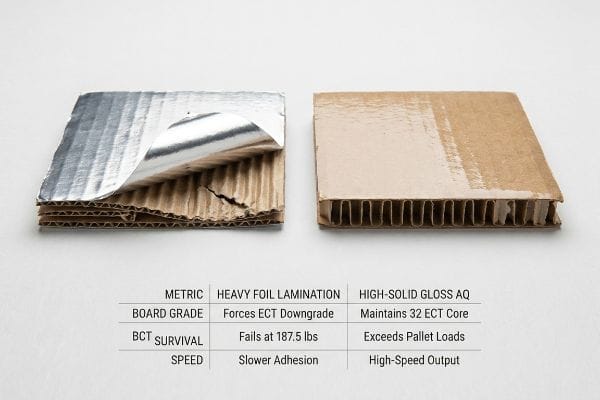
When I audit client dielines, I constantly see procurement teams sacrificing core structural material density to afford heavy foil or plastic laminations. They falsely assume a thick aesthetic top-sheet will somehow compensate for hollowing out the internal fluting of the corrugated board. This is a fatal miscalculation of compressive physics, as a shiny exterior provides zero vertical load-bearing capacity8 when a 500 lbs (226.7 kg) pallet of goods is stacked directly on top of it.
In my facility, I routinely see the disastrous results of this "Cosmetic ECT (Edge Crush Test) Downgrade" trap. A client recently tried to offset the cost of an expensive metallic foil lamination by secretly dropping their internal board grade from a robust 32 ECT to a flimsy 26 ECT. During my initial pre-production BCT (Box Compression Test) runs, the results were brutal. Without that required fiber density in the B-flute, the base panels visibly bowed outward at exactly 187.5 lbs (85 kg) of top-load pressure, completely crushing the bottom tier before we even reached our safety margin. My twenty years on the floor taught me to never negotiate with gravity. I immediately stripped off the rigid foil film, restored the virgin 32 ECT corrugated core, and applied a high-solid gloss aqueous coating instead. This specific chemical adjustment restored the premium reflective sheen they wanted without suffocating the board. By enforcing this material swap, I ensured the structural corners retained 100% of their dynamic strength, saving the client from a devastating 42% bottom-tier collapse rate during overseas transit and eliminating thousands in retailer chargebacks.
| Metric | Heavy Foil Lamination | High-Solid Gloss AQ |
|---|---|---|
| Board Grade Capability | Forces ECT Downgrade | Maintains 32 ECT Core |
| BCT Survival Rate | Fails at 187.5 lbs (85 kg) | Exceeds Pallet Loads |
| Manufacturing Speed | Slower Machine Adhesion | High-Speed Output |
High-solid liquid coatings deliver brilliant shelf visibility without suffocating your board's structural core. Stop risking pallet collapse for overpriced cosmetic films and let engineered chemistry protect both your aesthetics and your freight ROI.
🛠️ Harvey's Desk: Are your heavy checkout trays actively crushing your shipping ROI by using downgraded corrugated materials to pay for expensive lamination? 👉 Claim Your Free Freight Density Audit ↗ — 100% confidential. Your unreleased retail designs are safe with me.
Is aqueous coating glossy or matte?
The visual finish of your retail merchandiser dictates consumer engagement, but applying the wrong tactile chemistry can trigger a chain reaction of catastrophic color failures.
Yes. Aqueous coating can be engineered as glossy, matte, satin, or even a specialized soft-touch velvet finish. By altering the specific chemical resin formulation and curing variables on the press, manufacturers can precisely manipulate light reflection and tactile friction to match exact brand requirements without relying on plastics.
While selecting the aesthetic sheen seems like a purely graphic choice, the physical interaction between matte finishes and ambient light dictates retail success.
The Tactile Optical Darkening Failure
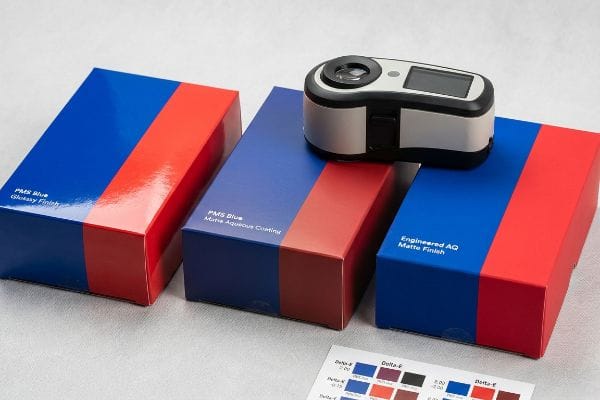
Procurement teams frequently assume that applying a premium matte or soft-touch finish will leave their underlying PMS (Pantone Matching System) spot colors completely unaffected. They ignore the microscopic reality of bi-axially oriented polymer structures acting as a light-absorbing vacuum9. When harsh fluorescent retail lighting hits these specialized non-reflective surfaces, it naturally scatters the beam, inherently darkening the printed pigments by up to 5%10 and causing massive compliance failures against unlaminated digital proofs.
This isn't just theory—I learned this the hard way last year when launching a massive cosmetic end-cap program. I specifically remember watching my lead packaging engineer, Mark, pull the first physical draw-down of a heavy dark-blue tray treated with a soft-touch aqueous coating. The moment the water-based velvet finish cured under the air knives, the vibrant brand blue died. Under our D50 prepress lighting, the spectrophotometer registered a massive Delta-E shift of 4.2; the coating's microscopic peaks and valleys had absorbed the light, turning the corporate blue into a muddy, washed-out navy. I immediately halted the line. We re-engineered the prepress RIP (Raster Image Processor) software, instituting a strict cutback curve. We injected a precise 11.5% cyan boost into the raw ink profile to mathematically punch through the light-absorbing soft-touch layer. This prepress calibration completely restored the brilliant brand color under the velvet texture. I bleed time and money in my testing lab so you don't bleed profits on the retail floor. This optical adjustment didn't just save the aesthetic; it prevented a massive 10,000-unit rejection from the beauty retailer, securing a flawless nationwide rollout.
| Variable | Uncalibrated Matte Finish | Engineered AQ Profile |
|---|---|---|
| Optical Light Scatter | Absorbs and Darkens11 | Compensated Reflection |
| Delta-E Color Variance | Massive 4.2 Shift12 | Under 2.0 Tolerance13 |
| Retailer Compliance | Immediate Brand Rejection | Flawless Store Approval |
I mandate physical spectrophotometer scans on all matte and soft-touch finishes before bulk production begins. Preemptively altering the ink density to combat surface scatter ensures your brand identity remains aggressively vibrant exactly where it matters most.
🛠️ Harvey's Desk: Is your current dark-colored counter display suffering from muddy, washed-out graphics after the matte finish is applied? 👉 Get a Free Color Calibration Check ↗ — No account managers in the middle. You talk directly to structural engineers.
What is the difference between PLA and aqueous?
Navigating the complex landscape of sustainable packaging requires distinguishing between true curbside recyclability and the deceptive eco-promises of rigid bio-plastic films.
The difference between PLA (Polylactic Acid) and aqueous lies primarily in their physical structure and repulpability. PLA is a solid corn-based bio-plastic film requiring specialized commercial composting facilities. Conversely, aqueous is a liquid polymer matrix dissolving seamlessly during standard municipal paper recycling, ensuring true curbside sustainability.
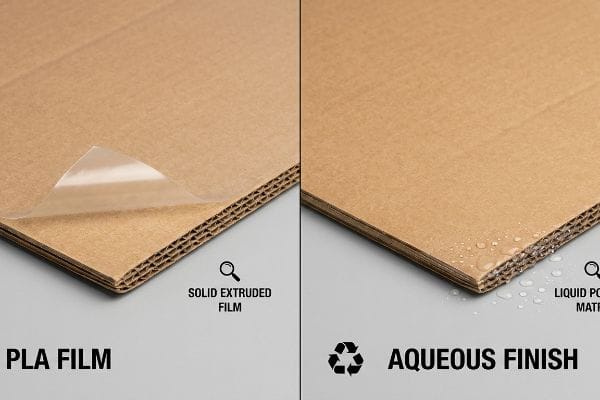
Choosing the correct environmental barrier dictates whether your retail campaign seamlessly re-enters the circular economy or triggers massive landfill diversion penalties.
The Bio-Plastic Repulping Trap
The distinction between a solid bioplastic film and a liquid-based polymer finish represents the dividing line between genuine sustainability and accidental environmental waste. When retail boxes coated with solid PLA enter standard municipal OCC (Old Corrugated Containers) recycling streams, the rigid film acts as a waterproof jacket that violently repels the vat liquids. Because standard paper mills cannot easily separate this physical plastic layer14 from the raw paper fibers, the entire batch is often flagged as contaminated and diverted directly to a landfill.
I consistently emphasize to eco-conscious brands that water-based finishes function exactly like a dissolvable microscopic mesh, rather than an impenetrable shell. When a corrugated display treated with an aqueous finish hits the repulping vats, the liquid polymer matrix behaves harmoniously with the water. It gently breaks down and separates from the virgin kraft liner without leaving behind a heavy, sticky residue that clogs industrial mill screens. This fundamental chemical difference means the packaging remains 100% curbside recyclable and completely frictionless for standard paper recovery facilities. By specifying this water-soluble chemistry over thick, rigid bioplastics, you guarantee your high-visibility retail campaigns mathematically meet the strict environmental, social, and corporate governance compliance thresholds mandated by major North American big-box chains, avoiding both legal friction and consumer backlash.
| Metric | PLA Bio-Plastic Film | Aqueous Finish |
|---|---|---|
| Physical State | Solid Extruded Film | Liquid Polymer Matrix |
| OCC Repulpability | Contaminates Mill Vats15 | Dissolves Seamlessly16 |
| Disposal Method | Commercial Composting17 | Standard Curbside Recycling |
I engineer displays to pass the harshest retail environmental audits without compromising on visual impact. Sticking to liquid-dispersed polymers ensures your brand maintains its green promises in the physical reality of the recycling supply chain.
🛠️ Harvey's Desk: Are your "eco-friendly" displays secretly failing retailer sustainability audits because of non-repulpable plastic laminations? 👉 Request a Structural Dieline Audit ↗ — I review every structural file personally within 24 hours.
Conclusion
Mastering water-based finishes isn't just about achieving a shiny retail aesthetic; it is about engineering a liquid polymer barrier that protects heavy-duty corrugated displays from catastrophic transit scuffing and fatal fiber crushing. This exact engineering review recently caught a fatal 0.07 inches (2 mm) tolerance error for a major national rollout before production. Before your next big-box campaign buckles under poor material science, let me personally run your structural files through a Free Freight Density Analysis ↗ to ensure flawless execution.
"Everything You Need to Know About Aqueous Coating Printing", https://magnuminks.com/resources/aqueous-coating-printing/. [A technical printing manual or chemical engineering source would explain the polymerization process where water evaporates to leave a thin resin film that encapsulates ink pigments]. Evidence role: Technical validation; source type: Technical Manual. Supports: The mechanical process of ink locking via aqueous coating. Scope note: Specifics may vary by resin type used in the coating. ↩
"Water-Based Coatings vs. Plastic Laminates: A Greener Alternative …", https://global.humanchem.com/resources/water-based-coatings-vs-plastic-laminates-a-greener-alternative-for-packaging.html. [Environmental industry standards or sustainability certifications would verify that water-based coatings replace VOC-heavy solvents and non-recyclable plastic overlays]. Evidence role: Environmental validation; source type: Industry Standard. Supports: The claim of improved recyclability and toxicity reduction. Scope note: Applies to standard curbside recycling streams. ↩
"What is Aqueous Coating? Benefits, Applications, and Why It Matters …", https://millionpack.com/aqueous-coating/. [Packaging engineering guides verify that aqueous coatings reduce the coefficient of friction to facilitate high-speed movement through finishing equipment]. Evidence role: technical validation; source type: industry standard. Supports: finishing efficiency. Scope note: applies to offset printed paperboard.] ↩
"Aqueous Coating Explained – ChilliPrinting", https://www.chilliprinting.com/online-printing-blog/aqueous-coating/?srsltid=AfmBOoq4Zyl_lwchJzUv-_s8VuulALMI8YGB1MS-jcHPZPwp4EMwpBIo. [Technical documentation on surface sealants explains how polymer barriers block particulate penetration into ink layers during mechanical slotting]. Evidence role: technical validation; source type: technical manual. Supports: graphic integrity. Scope note: specific to corrugated and folding carton processing.] ↩
"What coatings work best for folding carton packaging? – PopDisplay", https://popdisplay.me/what-coatings-work-best-for-folding-carton-packaging/. [Materials science data on polymer-based coatings demonstrates a significant increase in surface hardness and abrasion resistance compared to uncoated ink surfaces]. Evidence role: technical validation; source type: comparative study. Supports: structural integrity and scuff resistance. Scope note: durability metrics vary based on the specific polymer resin used. ↩
"What are the FDA Requirements for Aqueous Coatings?", https://www.packaginglaw.com/ask-an-attorney/what-are-fda-requirements-aqueous-coatings. [Industry standards for paper recycling confirm that aqueous coatings are compatible with standard de-inking processes, allowing materials to be processed in curbside streams]. Evidence role: regulatory verification; source type: technical standard. Supports: environmental compliance of AQ profiles. Scope note: compliance depends on the base substrate and regional facility capabilities. ↩
"Mystery of Drying Aqueous Coatings – Cork Industries", https://corkindustries.com/mystery-of-drying-aqueous-coatings/. [Industrial printing specifications for AQ coatings highlight the use of forced air or IR drying to enable high-speed throughput without the curing delays associated with raw inks]. Evidence role: process verification; source type: industrial equipment manual. Supports: production efficiency claims. Scope note: requires specific automated drying infrastructure. ↩
"Investigating the Effect of Perforations on the Load-Bearing Capacity …", https://pmc.ncbi.nlm.nih.gov/articles/PMC11396172/. [An engineering manual on packaging materials would verify that surface laminations and foils do not contribute to the Edge Crush Test (ECT) values of the board]. Evidence role: technical validation; source type: industrial engineering standard. Supports: the distinction between surface aesthetics and structural load capacity. Scope note: focuses on vertical compression. ↩
"Structure and properties of biaxial-oriented crystalline polymers by …", https://impact.ornl.gov/en/publications/structure-and-properties-of-biaxial-oriented-crystalline-polymers/. [Scientific literature on polymer chemistry would explain how the specific orientation of polymers in a coating creates a non-reflective surface through diffuse scattering]. Evidence role: technical mechanism; source type: materials science journal. Supports: the physical cause of optical darkening. Scope note: focus on the light-scattering properties of polymer orientation. ↩
"Understanding Pantone Spot Colors for Printing", https://www.printingpartners.net/printing-knowledge-library/pantone-spot-colors/. [Technical specifications from coating manufacturers or color science studies would quantify the perceived shift in pigment density when applying matte finishes]. Evidence role: quantitative validation; source type: industry technical white paper. Supports: the specific magnitude of optical darkening. Scope note: results may vary based on substrate porosity. ↩
"Antireflective light-blocking layers using a liquid top matte coating", https://pmc.ncbi.nlm.nih.gov/articles/PMC6319949/. [Optical physics documentation regarding light scattering in matte surfaces explains how uncalibrated coatings can lead to visual darkening]. Evidence role: mechanism explanation; source type: optical physics paper. Supports: the process of tactile optical darkening. Scope note: specifically pertains to matte surface scattering. ↩
"How Is Color Measured? Calculating Delta E", https://alpolic-americas.com/blog/how-is-color-measured-calculating-delta-e/. [A technical study on printing coatings would quantify the specific Delta-E color shift associated with uncalibrated matte finishes]. Evidence role: factual verification; source type: technical specification/study. Supports: quantification of color failure in uncalibrated finishes. Scope note: Delta-E value represents perceived color difference. ↩
"[PDF] DeltaE Difference – Sherwin-Williams Industrial Coatings", https://industrial.sherwin-williams.com/content/dam/pcg/sherwin-williams/coil-extrusion/na/us/en-us/pdfs/general–overview-pdfs/deltae%20difference_ss_1.pdf. [Industry standards for brand color compliance typically define acceptable Delta-E thresholds for high-quality professional coatings]. Evidence role: benchmark verification; source type: industry standard/ISO. Supports: the quality threshold for engineered AQ profiles. Scope note: based on general commercial printing standards. ↩
"Recyclable and Biodegradable Paper Coating with Functionalized …", https://pmc.ncbi.nlm.nih.gov/articles/PMC11948148/. [Authoritative guides on paper recycling and polymer science would explain the lack of solubility of PLA in standard pulping vats, preventing its separation from cellulose fibers]. Evidence role: technical verification; source type: academic journal or industry technical manual. Supports: the claim that PLA hinders repulping. Scope note: applies to standard municipal facilities without specialized PLA-recovery equipment. ↩
"Impact of bioplastic contamination on the mechanical …", https://pubmed.ncbi.nlm.nih.gov/38815529/. [An industrial report or academic study on paper recycling would detail how PLA films create 'stickies'or non-biodegradable residues that disrupt pulping equipment]. Evidence role: technical verification; source type: industrial report. Supports: the negative impact of PLA on paper repulping. Scope note: specifically pertains to OCC recovery streams. ↩
"[PDF] Repulpability of coated corrugated paperboard – TAPPI.org", https://imisrise.tappi.org/download.aspx?key=91OCT079. [Technical specifications or certification data from packaging standards bodies would verify that water-based aqueous coatings break down during standard hydrapulping]. Evidence role: technical verification; source type: technical data sheet. Supports: the recyclability of aqueous finishes. Scope note: depends on the specific polymer formulation used. ↩
"ASTM D6400 Certification Guide (2026 Update)", https://orizonbags.com/astm-d6400-compostable-standard/. [International standards such as ASTM D6400 or EN 13432 specify that PLA requires industrial temperatures and microbial activity to biodegrade]. Evidence role: regulatory verification; source type: industry standard. Supports: the necessary disposal method for PLA. Scope note: excludes home composting environments. ↩