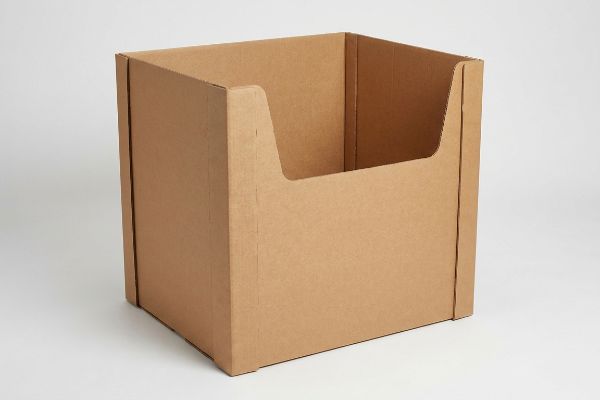
You are losing retail margins because bulk merchandisers collapse under their own weight. If unstructured packaging bows outward in the aisle, buyers immediately reject the entire shipment.
One-piece dump bins are standalone, high-capacity retail fixtures engineered to hold loose bulk merchandise. Manufactured from corrugated paperboard, these promotional vessels maximize aisle visibility, simplify logistics, and trigger immediate impulse purchases in high-traffic commercial shopping zones.

Knowing the basic function is one thing, but translating that concept into a physical structure that survives a trafficked retail environment requires strict discipline.
What is a dump bin display?
Many brands treat bulk displays as an afterthought, simply tossing merchandise into a cheap cardboard box. This fatal oversight guarantees your retail campaign will fail in crowded store aisles.
A dump bin display is a targeted promotional fixture that merges high-volume product storage with aggressive visual marketing. Unlike basic shipping cartons, these specialized units integrate customized graphic headers and strategic product placement zones to disrupt shopper routines and elevate brand equity on the floor.

Turning a basic box into an engaging retail fixture requires strategic shopper marketing, not just pasting a colorful logo on the side of a plain container.
The Hidden Flaw in Open-Top Retail Bins
Procurement teams frequently assume they can create instant retail bins by simply cutting the top flaps off a standard shipping carton. They believe this basic open-top design will seamlessly transition from the delivery truck straight to the retail aisle1, saving time and printing costs while holding large volumes of loose products.
I see this common trap constantly when brands try to bootstrap their marketing campaigns using plain cartons. Without a structured visual presentation, these modified boxes look incredibly sloppy to passing consumers. Shoppers naturally ignore messy, unbranded cartons2 sitting directly on the floor. To fix this, I elevate the structural presentation by integrating tall, custom-printed backer boards that draw the shopper's eye3 from across the store, turning a basic storage box into a premium, highly visible branding opportunity.
| Common Rookie Mistake | The Pro Fix | Retail-Floor Benefit |
|---|---|---|
| Slicing top flaps off plain boxes | Integrated graphic headers4 | Draws shopper attention instantly |
| Ignoring floor-level visibility | Elevated branding panels | Engages buyers across the aisle |
| Using unbranded shipping cartons | Premium visual presentation | Upgrades perceived product value5 |
A cohesive visual strategy transforms passive floor storage into an active marketing tool. Upgrading your graphic presentation ensures the unit captures attention, ultimately accelerating product sell-through and maximizing your promotional footprint.
🛠️ Harvey's Desk: Not sure if your open-top displays are maximizing visual impact? 👉 Request a Free Stress-Test Audit ↗ — Direct access to my desk. Zero automated sales spam, I promise.
What is a dump bin?
If you only focus on the exterior artwork, you are ignoring the core organizational function of bulk packaging. Clean merchandise presentation always wins when holding hundreds of loose products.
A dump bin is the primary containment vessel portion of a larger retail fixture. Designed to hold high volumes of loose merchandise securely, this base component organizes cluttered product assortments to ensure a clean, accessible shopping experience on the busy commercial floor.

A beautiful exterior graphic means very little if the internal cavity fails to present your merchandise cleanly to passing consumers.
Maintaining Clean Presentation in the Retail Aisle
Standard industry practice often involves dumping hundreds6 of irregularly shaped promotional items directly into a large, undivided square cavity. Marketing teams assume a deep bin is sufficient to hold the inventory together and that shoppers will happily dig through massive piles of mixed products during a multi-week campaign.
Buyers frequently ask me why their bulk bins look messy and picked-over after just two days in the store. When loose items are thrown together without organization, the display quickly becomes disorganized and confusing. Shoppers hate rummaging through cluttered bases, which drastically reduces impulse purchases. I solve this by installing simple internal dividers to neatly separate different product variations, creating a highly organized presentation that encourages immediate buyer engagement and keeps the aisle looking immaculate.
| Common Rookie Mistake | The Pro Fix | Retail-Floor Benefit |
|---|---|---|
| Relying on empty square cavities | Corrugated internal dividers7 | Keeps product neatly separated |
| Ignoring shopper rummaging habits | Compartmentalized layouts8 | Makes item selection effortless |
| Mixing multiple product variations | Clear product segregation | Prevents a messy aisle appearance |
You cannot rely on messy piles to drive retail sales. Smart internal organization guarantees the display maintains a premium shopping experience and perfectly aligns with the visual standards of your major retail partners.
🛠️ Harvey's Desk: Are your current floor displays secretly confusing shoppers with messy layouts? 👉 Get Your Setup Reviewed ↗ — Download safely. My inbox is open if you have questions later.
What are the three types of displays?
Navigating retail space means choosing the exact structural format for the real estate secured. Selecting the wrong physical footprint instantly triggers a rigid compliance rejection at the receiving dock.
The three types of displays are floor merchandisers, countertop units, and palletized bulk fixtures. Each format fulfills distinct spatial requirements, strategically engaging consumers across different strike zones while strictly adhering to rigorous global logistical tolerances and physical material compliance standards.

Knowing the theory is worthless when heavy machinery starts running and store managers pull out steel tape measures to verify your exact physical footprint against strict corporate schematics.
Why Shrinking Retail Displays Fails on the Factory Floor
Trading companies frequently pitch a scalable design strategy where a large floor fixture can simply be reduced by fifty percent to serve as a checkout counter unit. They assume structural math scales perfectly in a vacuum, completely ignoring the strict legal codes and severe logistical stress rules9 dictating these two entirely separate operational zones in physical stores.
Getting one reduced display to stand up in a prototyping lab is easy, but here is the catastrophic reality when you mass-produce five hundred units. I routinely see brands hemorrhage cash because they try to shrink a GMA pallet structure down to an ADA-compliant counter space. The physics of paperboard do not scale linearly; flute crush limits drastically change under varying spatial constraints10. When I measure the required 15-inch to 48-inch forward reach compliance window11 on the floor, the shrunk floor-unit proportions always fail. In my manufacturing facility, I permanently separate the engineering pipelines to prevent massive logistical chargebacks from angry store managers.
| Common Rookie Mistake | The Pro Fix | Retail-Floor Benefit |
|---|---|---|
| Scaling floor templates down | Dedicated ADA math pipelines12 | Passes strict store audits |
| Guessing counter dimensions | Precise 15-to-48 inch anchoring13 | Keeps checkout lanes clear |
| Reusing pallet structures | Zone-specific structural engineering | Eliminates retail chargebacks14 |
Attempting to cheat spatial physics with a universal template is a massive commercial liability. I engineer dedicated structural math for each distinct zone, ensuring your massive rollout survives both brutal supply chains and rigid store compliance audits.
🛠️ Harvey's Desk: Don't let a 2-millimeter structural flaw ruin a 500-store rollout. 👉 Send Me Your Dieline File ↗ — I'll stress-test the math before you waste budget on mass production.
Conclusion
You can choose a cheaper unreinforced box, but when parasitic weight distribution causes the side panels to aggressively bulge outward in a busy aisle, it triggers an immediate retailer rejection and completely wipes out your campaign's profit margin. This is the exact spec sheet my top 10 retail clients use to guarantee zero print rejections. Stop guessing on internal tolerances and let me personally run your structural files through my Free Dieline Audit ↗ to map the friction zones before mass production.
"Shelf-ready packaging – Wikipedia", https://en.wikipedia.org/wiki/Shelf-ready_packaging. [Industry guidelines on Retail Ready Packaging (RRP) define the requirements for packaging designed to move directly from delivery to the sales floor without unpacking]. Evidence role: technical specification; source type: industry standard. Supports: the logistical concept of direct shipping-to-shelf transition. Scope note: applies to standardized retail logistics. ↩
"POINT-OF-PURCHASE INSIGHTS: THE IMPACT OF RETAIL POP …", https://www.bcipkg.com/point-of-purchase-insights-the-impact-of-retail-pop-displays-on-consumer-behavior/. [Research on retail consumer behavior validates that poor visual presentation and lack of branding reduce shopper engagement and product discovery]. Evidence role: behavioral validation; source type: consumer psychology study. Supports: the claim that unbranded containers are ignored. Scope note: applies to impulse purchase environments. ↩
"Point-of-Purchase Display Effectiveness: What are the benefits of …", https://www.vanguardpkg.com/point-of-purchase-display-effectiveness-what-are-the-benefits-of-pop-displays/. [Industry data on Point-of-Purchase displays demonstrates that high-visibility headers significantly increase visual disruption and consumer stop rates in retail aisles]. Evidence role: technical efficacy; source type: retail marketing report. Supports: the effectiveness of backer boards for visibility. Scope note: focused on visual merchandising standards. ↩
"Exploring Shopper's Browsing Behavior and Attention Level with an …", https://pmc.ncbi.nlm.nih.gov/articles/PMC6895988/. Visual merchandising research indicates that integrated headers create a focal point that increases the rate at which shoppers stop at a display. Evidence role: causal link; source type: retail marketing study. Supports: effectiveness of graphic headers in attracting attention. Scope note: Varies based on graphic contrast and color. ↩
"[PDF] The Effect of Product Density on Perceived Price and Quality", https://aquila.usm.edu/cgi/viewcontent.cgi?article=1258&context=honors_theses. Consumer psychology research suggests that premium display presentation positively influences the perceived quality and price elasticity of the contained product. Evidence role: correlation; source type: peer-reviewed consumer behavior journal. Supports: link between visual presentation and perceived value. Scope note: Most applicable to impulse-purchase categories. ↩
"When You Should Use Dump Bins To Display Your Products", https://virtualpackaging.com/when-you-should-use-dump-bins-to-display-your-products/. [Retail merchandising manuals and industry trade publications document the prevalence of undivided dump bins for high-volume promotional items]. Evidence role: factual verification; source type: trade publication. Supports: standard industry practice. Scope note: applies primarily to mass-merchandising environments. ↩
"Role of Corrugated Bins in Warehousing as Intermediate Packaging", https://www.packagingcorp.com/resource-hub/industry-insights/role-of-corrugated-bins-in-warehousing-as-intermediate-packaging/. [Industry standards for point-of-purchase displays specify that corrugated dividers prevent product shifting and maintain SKU integrity in bulk bins]. Evidence role: technical specification; source type: packaging industry manual. Supports: The use of dividers to keep products neatly separated. Scope note: Specific to cardboard-based retail displays. ↩
"The Impact of Supermarket Layouts on Female Shopping Behavior", https://fount.aucegypt.edu/etds/2555/. [Retail psychology studies indicate that structured, compartmentalized layouts reduce the 'rummage effect'and lower cognitive load for consumers during item selection]. Evidence role: behavioral evidence; source type: retail management study. Supports: The claim that compartmentalization makes item selection effortless. Scope note: Applies to high-volume loose product bins. ↩
"AG 1091A: Retail Merchandise Displays in the Frontage Zone", https://www.seattle.gov/transportation/permits-and-services/permits/applicant-guides/ag-1091a. [An authoritative source on retail fixture engineering or safety standards would confirm that different load-bearing, stability, and safety requirements apply to floor-standing versus counter-top units]. Evidence role: Technical verification; source type: Regulatory standard or engineering handbook. Supports: The claim that scaling designs doesn't account for differing operational zone rules. Scope note: Standards may vary by jurisdiction. ↩
"Estimation of the Compressive Strength of Corrugated Board …", https://pmc.ncbi.nlm.nih.gov/articles/PMC8467740/. [Technical documentation on corrugated material science explains how load-bearing capacities and crush resistance are dependent on flute geometry and overall dimensions]. Evidence role: technical specification; source type: engineering handbook. Supports: the claim that paperboard physics do not scale linearly. Scope note: focus on corrugated fiberboard. ↩
"ADA Standards for Accessible Design Title III Regulation 28 CFR …", https://www.ada.gov/law-and-regs/design-standards/1991-design-standards/. [The ADA Standards for Accessible Design define specific minimum and maximum reach ranges for accessible elements to ensure usability for individuals in wheelchairs]. Evidence role: regulatory compliance; source type: government standard. Supports: the specific measurement requirements for retail accessibility. Scope note: applicable to forward reach heights. ↩
"ADA Standards for Accessible Design", https://www.ada.gov/law-and-regs/design-standards/. ADA guidelines provide specific clearance and accessibility measurements that retail displays must adhere to avoid compliance failures during store audits. Evidence role: Regulatory requirement; source type: Legal standard. Supports: The necessity of precise ADA-compliant spatial planning. Scope note: Applies specifically to US accessibility laws. ↩
"Chapter 9: Built-In Elements", https://www.access-board.gov/ada/chapter/ch09/. Industry specifications for retail fixtures define optimal width and depth ranges for anchoring to ensure stability without obstructing checkout lane traffic flow. Evidence role: Technical specification; source type: Industry manual. Supports: The use of specific dimension ranges for counter footprints. Scope note: Dimensions may vary based on specific retail chain guidelines. ↩
"How to Prevent Retail Chargebacks: A 3PL Operations Guide", https://getproductiv.com/retail-chargeback-compliance. Major retailers impose financial penalties, or chargebacks, when delivered displays fail to meet strict structural engineering or footprint compliance standards. Evidence role: Financial penalty; source type: Vendor compliance agreement. Supports: The relationship between engineering precision and the avoidance of retail fines. Scope note: Depends on the specific vendor-retailer contract. ↩