
Months of product development mean nothing if a crushed box destroys your reputation. In e-commerce, physical packaging is your only frontline defense against brutal transit networks.
Protective e-commerce packaging improves the customer experience by absorbing kinetic shocks during transit, ensuring pristine product delivery. By utilizing engineered corrugated flutes and secure internal void-fill, these specialized shippers completely eliminate physical damage, prevent costly returns, and maintain unboxing aesthetics for maximum brand loyalty.

Let's break down the exact mechanical variables that dictate whether your packaging survives the global supply chain or fails before reaching the customer.
How Does E-Commerce Improve Customer Experience?
A flawless digital checkout means nothing if the physical delivery fails. Optimized supply chains directly elevate the consumer unboxing experience by prioritizing structural integrity.
E-commerce improves customer experience by guaranteeing pristine product delivery through engineered packaging. By relying on fresh virgin corrugated materials instead of exhausted recycled mailers, brands maintain total structural integrity. This prevents crushed corners upon arrival, elevating the unboxing moment and eliminating frustrating damage claims entirely.

Understanding this relationship between material strength and customer satisfaction is where most procurement strategies either succeed or catastrophically fail.
Preventing Transit Damage with E-Commerce Protective Standards
Startups frequently attempt to bootstrap their logistics by reusing inbound B2C (Business-to-Consumer) ecommerce boxes for outbound fulfillment. The assumption is that if a mailer looks visually intact on the outside, it retains its original factory strength for a second journey. This well-intentioned sustainability effort often completely overlooks the invisible mechanical degradation of paper fibers1.
I see this trap catch even experienced brand managers trying to cut corners. They load heavy products into recycled mailers, completely unaware of flute fatigue. During their initial parcel journey, those corrugated flutes acted as mechanical shock absorbers2, soaking up micro-impacts that permanently exhausted the paper fibers. The physical resistance is gone. I recently ran a batch of these reused boxes through an ISTA (International Safe Transit Association) 6-Amazon SIOC3 (Ships In Own Container) test, and I heard the loud, sickening crunch of the flutes instantly buckling under baseline top-load pressure. The solution was mandating a virgin-material standard, restoring the dynamic load capacity to survive palletized freight, and ensuring the customer actually receives an unbroken product, completely eliminating the project's reverse logistics penalty.
| Common Rookie Mistake | The Pro Fix | Retail-Floor Benefit |
|---|---|---|
| Reusing fatigued B2C mailers | Mandate virgin corrugated flutes4 | Prevents transit crushing |
| Ignoring vibration wear | Execute ISTA 6-Amazon SIOC testing5 | Stops reverse logistics |
| Assuming visual integrity | Verify dynamic load capacity6 | Ensures pristine unboxing |
I refuse to let clients risk their brand equity on fatigued paperboards. By enforcing a virgin-material mandate, I protect your margins and ensure the end user experiences your product exactly as you designed it.
🛠️ Harvey's Desk: Are your current shipping boxes suffering from hidden flute fatigue before they even leave the warehouse? 👉 Request a Free Material Audit ↗ — Direct access to my desk. Zero automated sales spam, I promise.
Why Is E-Commerce Packaging Important?
Your shipper is the only physical touchpoint between your warehouse and the consumer's front porch. If it fails, your product is completely exposed to logistical hazards.
E-commerce packaging is important because it acts as a dynamic armor against multi-axis transit shocks. Without mathematically validated corrugated geometries, raw material strength becomes useless during kinetic movement. Proper testing bridges the gap between theoretical laboratory specs and the violent reality of the global supply chain.
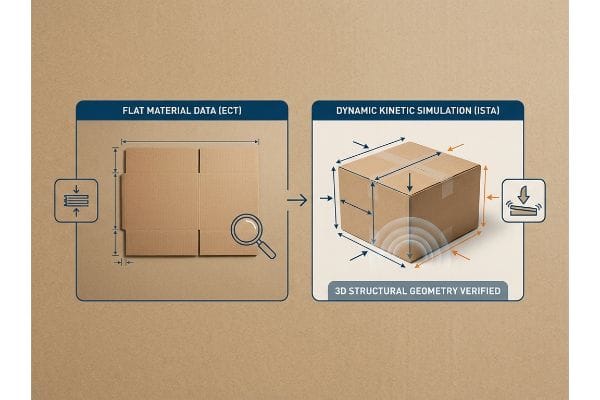
But relying strictly on a supplier's raw material data sheet is a dangerous game when those boxes hit the conveyor belts.
The Gap Between Raw ECT and Supply Chain Reality
Procurement teams often approve retail shippers based solely on raw material property evaluations, relying heavily on ASTM (American Society for Testing and Materials) standard metrics7. They falsely assume that a high-test flat substrate automatically guarantees a structurally sound 3D box8. Knowing the theoretical compression limit of a flat piece of cardboard creates a false sense of security that ignores the kinetic violence of real-world fulfillment centers.
Buyers frequently ask me why their 32ECT (Edge Crush Test) rated boxes9 are still arriving crushed at the customer's door. The answer lies in the dynamic geometry of the assembled package. I watched a fully assembled, heavily loaded shipper shear apart during a multi-axis vibration simulation10 because the corners weren't properly aligned to distribute the kinetic energy. The raw paper was strong, but the structural math was flawed. I fixed this by implementing a mandatory two-phase testing sequence, physically subjecting the loaded carton to rigid drop simulations. By verifying the 3D geometry rather than just the flat sheet, we reduced packaging failure rates to zero, saving the brand massive retailer chargebacks.
| Common Rookie Mistake | The Pro Fix | Retail-Floor Benefit |
|---|---|---|
| Relying only on flat ASTM data | Mandate full ISTA transit simulations11 | Eliminates kinetic transit failure |
| Ignoring 3D assembled geometry | Test the loaded master carton | Prevents corner shearing |
| Trusting theoretical ECT ratings12 | Verify multi-axis vibration limits13 | Guarantees unharmed delivery |
I never trust flat material metrics to do a 3D structural job. By forcing your shippers through dynamic kinetic simulations, I ensure your packaging survives the brutal journey from factory floor to front door.
🛠️ Harvey's Desk: Is your packaging approved based on flat paper specs or actual kinetic survival data? 👉 Get Your Structure Stress-Tested ↗ — Download safely. My inbox is open if you have questions later.
What Is the Purpose of Protective Packaging?
Beyond simple aesthetics, protective layers exist for a strictly mechanical reason: to disperse kinetic shock away from the fragile primary product housed inside.
The purpose of protective packaging is mechanically dispersing kinetic energy before it reaches the product. By utilizing the internal arched geometry of micro-fluted corrugated boards, these specialized structures safely absorb sudden impacts and constant vibrations, preventing catastrophic base buckling and completely eliminating expensive inventory loss.

However, brands often attempt to cut corners on these substrates without understanding the mechanical physics they are sacrificing.
Absorbing Kinetic Shock with Fluted Substrates
Procurement departments frequently attempt to scale up lightweight solid chipboard designs into heavier protective trays to save raw material costs. They assume the raw density of a thick solid paperboard equals dynamic load capacity. This fundamental misunderstanding ignores the fact that unfluted substrates have zero mechanical mechanism14 to dynamically disperse vertical or lateral impacts.
Think of it like trying to use a solid block of wood as a car suspension instead of a coiled spring. Even veteran designers often overlook this blind spot, specifying solid board for heavy payloads just because it feels rigid in the hand. I felt the stiff resistance of a solid paperboard tray right before it catastrophically bowed outward and buckled under a mere 35 lbs (15.8 kg) of top-load pressure on the testing floor. Static material density cannot replace geometric load displacement15. I immediately pivoted the design to a lightweight E-flute corrugated board. The internal arched flutes safely absorbed the kinetic energy16, keeping the structure perfectly square and reducing material weight, which ultimately slashed the client's dimensional shipping costs.
| Common Rookie Mistake | The Pro Fix | Retail-Floor Benefit |
|---|---|---|
| Using dense unfluted chipboard | Upgrade to E-flute corrugated17 | Safely absorbs kinetic energy |
| Relying on static material density | Utilize arched structural geometry18 | Prevents outward base bowing |
| Overpaying for heavy solid boards | Deploy lightweight micro-flutes19 | Cuts dimensional shipping weight |
I always rely on internal geometry over sheer material density. By switching to micro-fluted substrates, I harness the physics of arched load displacement to protect your products without inflating your raw material budget.
🛠️ Harvey's Desk: Are you overpaying for dense paperboard that offers zero kinetic shock absorption? 👉 Claim a Free Substrate Review ↗ — No forms that trigger endless sales calls. Just pure value.
Why Is Consumer Protection Important in E-Commerce?
Delivering a product intact is just the baseline; ensuring it remains safe for human consumption requires hyper-precise barrier engineering. A compromised seal is a liability.
Consumer protection is important in e-commerce because it legally safeguards end-users from compromised products. For FMCG (Fast-Moving Consumer Goods), utilizing elastic anti-crack film laminations prevents invisible structural micro-fractures during automated assembly, ensuring the critical oxygen and moisture barriers remain entirely intact throughout the supply chain.
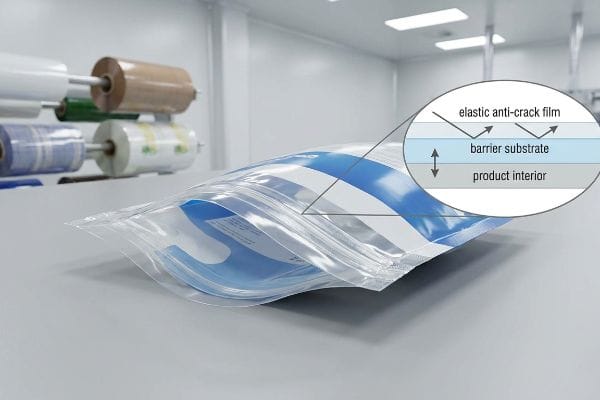
But knowing the theory of barrier protection isn't enough when the high-speed vertical packaging machines actually start running.
Why Standard Laminations Fail on the Factory Floor
Brand teams frequently assume that standard rigid litho-varnishes can simply be ported over to thin, flexible protective packaging structures. They design beautiful graphics and mandate standard glossy topcoats, completely ignoring the physical elasticity required by flexible substrates. This assumption overlooks how these rigid coatings behave when subjected to tight, 180-degree folds20 during high-speed fulfillment.
Getting a flexible barrier pouch to look great on a flat digital proof is easy, but here is the harsh reality when you run 10,000 of them through an automated former. In my facility, I routinely see standard rigid varnishes suffer from severe litho-cracking the moment the packaging film is creased. The dried ink and rigid varnish literally snap along the score lines, exposing the raw inner substrate to the ambient air. I pulled the micrometer readings on a failed batch and proved the rigid topcoat had breached the 0.002 inches (0.05 mm) oxygen barrier21, risking massive spoilage for a food brand. I fixed this by strictly enforcing an elastic anti-crack film lamination protocol22. This highly elastic polymer layer moves harmoniously with the substrate, drastically cutting machine downtime and saving the client from devastating product recalls.
| Common Rookie Mistake | The Pro Fix | Retail-Floor Benefit |
|---|---|---|
| Using rigid litho-varnishes | Mandate elastic anti-crack films23 | Prevents structural micro-fractures |
| Ignoring automated folding stress | Test 180-degree crease elasticity24 | Keeps oxygen barriers 100% intact |
| Porting rigid specs to flexible | Match polymer elasticity to substrate25 | Stops expensive food spoilage |
I refuse to let rigid coatings compromise a flexible barrier. By aligning the chemical elasticity of your laminations directly to your substrate, I eliminate invisible micro-fractures and completely neutralize your spoilage liabilities.
🛠️ Harvey's Desk: Are rigid varnishes quietly compromising the moisture barriers on your flexible packaging? 👉 Request a Lamination Chemistry Audit ↗ — I'll stress-test the math before you waste budget on mass production.
Conclusion
You can choose a cheaper supplier based strictly on flat ASTM data, but when that structurally flawed master carton shears apart during multi-axis transit vibration, the resulting kinetic shock destroys your primary product and completely wipes out your profit margin. Over 500 brand managers use my prepress checklist to avoid these exact fatal early-stage mistakes. Stop guessing on dynamic load tolerances and let me personally audit your packaging structures through my Free Dieline Pre-Flight Audit ↗ to catch kinetic blind spots before mass production.
"Investigating the Mechanical Properties of Paperboard …", https://repository.rit.edu/cgi/viewcontent.cgi?article. Explanation of how repetitive stress and handling cause the breakdown of cellulose bonds in corrugated cardboard, reducing its load-bearing capacity. Evidence role: technical verification; source type: material science journal; Supports: the loss of structural integrity in reused packaging; Scope note: applies primarily to corrugated fiberboard. ↩
"[PDF] Corrugated Board Packaging with Innovative Design for Enhanced …", https://bioresources.cnr.ncsu.edu/wp-content/uploads/2026/01/BioRes_21_1_2229_Tworzydlo_PSMPGG_Corrugated_Packaging_Design_Durability_Transport_25399.pdf. Technical explanation of how corrugated flutes function as shock absorbers and how repeated stress leads to the degradation of paper fibers. Evidence role: technical validation; source type: materials science or packaging engineering journal. Supports: the claim that reused packaging loses structural integrity. Scope note: focuses on corrugated fiberboard physics. ↩
"ISTA 6 Amazon Package Testing", https://www.tek.com/en/services/testing-services/ista-6-amazon-package-testing. Official documentation of the ISTA 6-Amazon SIOC protocol to verify the test's focus on top-load pressure and transit durability for shipping containers. Evidence role: standard verification; source type: industry standard specification. Supports: the use of a recognized industry benchmark for testing packaging failure. Scope note: specific to Amazon's logistics requirements. ↩
"Compressive Strength of Corrugated Paperboard Packages …", https://pmc.ncbi.nlm.nih.gov/articles/PMC10054506/. An authoritative source on packaging materials explaining why virgin fibers provide superior structural integrity and burst strength compared to recycled content to prevent crushing. Evidence role: Technical validation; source type: Materials science study. Supports: Use of virgin flutes to prevent transit crushing. Scope note: Focuses on material strength. ↩
"ISTA 6 Amazon Package Testing: SIOC, Overbox & More", https://westpak.com/testing-services/package-testing/ista-6-amazon-testing/. A source documenting the International Safe Transit Association (ISTA) 6-Amazon SIOC standards and how they simulate shipping environments to reduce damage-related returns. Evidence role: Procedural verification; source type: Industry certification standard. Supports: Effectiveness of SIOC testing in stopping reverse logistics. Scope note: Specific to Amazon's shipping ecosystem. ↩
"How Much Load Can My Pallet Carry?", https://www.unitload.vt.edu/education/white-papers/5-wp-load-carrying-capacity-of-pallets.html. A technical guide explaining how verifying dynamic load capacity (resistance to forces during movement) ensures the package protects the contents better than static testing. Evidence role: Engineering specification; source type: Logistics technical manual. Supports: Connection between dynamic load capacity and unboxing quality. Scope note: Distinguishes between static and dynamic stress. ↩
"Paper Standards and Packaging Standards", https://store.astm.org/products-services/standards-and-publications/standards/paper-standards-and-packaging-standards.html. Authoritative standards from ASTM International provide the industry-standard metrics used to evaluate raw corrugated material strength. Evidence role: validation of industry standards; source type: technical standard. Supports: the basis of procurement material evaluations. Scope note: focuses on raw material properties. ↩
"Difference between Box Compression Test and Edge Crush Test", https://www.gester-instruments.com/what-is-the-difference-between-box-compression-test-and-edge-crush-test_n320. Packaging engineering literature explains the delta between Edge Crush Test (ECT) for flat sheets and Box Compression Test (BCT) for formed containers. Evidence role: technical contradiction; source type: engineering textbook. Supports: the claim that raw material strength is insufficient for predicting 3D structural integrity. Scope note: applies to corrugated fiberboard physics. ↩
"ECT Ratings Explained: What They Mean for Your Corrugated Packaging", https://epackagesupply.com/blogs/packaging-guide/ect-ratings-explained-what-they-mean-for-your-corrugated-packaging?srsltid=AfmBOoq7asx-QYDGWa5wpYfyKr5SJlPvHP2_5dlp8MJ9tO-ZoRRdd5l4. Authoritative packaging engineering sources explain that Edge Crush Test (ECT) measures material strength but does not account for box geometry or assembly stresses. Evidence role: technical validation; source type: engineering standard. Supports: the claim that raw material strength does not guarantee structural survival. Scope note: specifically applies to corrugated fiberboard. ↩
"Packaging Vibration Testing – Drop Shock & Vibration", https://vibrationresearch.com/packaging-industry/. Industry standards such as ASTM D4169 detail how multi-axis vibration simulations expose failures in kinetic energy distribution that static tests miss. Evidence role: methodological verification; source type: industry standard. Supports: the use of simulation to identify structural flaws in assembled shippers. Scope note: relates to transit simulation protocols. ↩
"Test Procedures", https://ista.org/test_procedures.php. An authoritative source from the International Safe Transit Association (ISTA) defines the standardized protocols for simulated shipping environments to ensure packaging integrity. Evidence role: technical standard; source type: industry certification body. Supports: The necessity of simulation over flat data. Scope note: Applies to ISTA series such as 3A or 6. ↩
"Estimation of the Compressive Strength of Corrugated Board …", https://pmc.ncbi.nlm.nih.gov/articles/PMC8467740/. Packaging engineering manuals explain how Edge Crush Test (ECT) values measure raw material strength but may not reflect the performance of a finished, assembled box. Evidence role: technical metric explanation; source type: engineering manual. Supports: The limitation of relying solely on ECT for structural durability. Scope note: ECT is a measure of the corrugated board's stacking strength. ↩
"Packaging and Transportation – Crystal Instruments", https://www.crystalinstruments.com/packaging-and-transportation. Technical logistics documentation describes how multi-axis vibration testing identifies structural failure points caused by constant kinetic movement during transit. Evidence role: technical specification; source type: logistics engineering guide. Supports: The importance of verifying vibration limits to guarantee unharmed delivery. Scope note: Focuses on the effects of transport-induced fatigue. ↩
"[PDF] Investigating the mechanical properties of paperboard packaging …", https://repository.rit.edu/cgi/viewcontent.cgi?article=1066&context=japr. A materials science or packaging engineering source would explain that solid boards lack the geometric cushioning (fluting) required to dissipate kinetic energy. Evidence role: technical verification; source type: academic textbook or industry standard; Supports: the claim that unfluted materials cannot disperse dynamic impacts. Scope note: specifically refers to dynamic shock rather than static compressive strength. ↩
"A Simplified Dynamic Strength Analysis of Cardboard … – PMC", https://pmc.ncbi.nlm.nih.gov/articles/PMC10385285/. An authoritative source on structural mechanics would verify that geometric configuration, such as corrugation, provides higher strength-to-weight ratios and superior energy dissipation compared to increasing raw material density. Evidence role: theoretical foundation; source type: engineering textbook. Supports: the principle that structure outweighs mass for load bearing. Scope note: specifically applies to compressible packaging materials. ↩
"Study on energy absorption characteristics of the corrugated …", https://pmc.ncbi.nlm.nih.gov/articles/PMC11840120/. Packaging science literature describes how the arched geometry of corrugated flutes acts as a mechanical spring, transforming vertical compression into controlled deformation to dissipate kinetic energy. Evidence role: mechanical verification; source type: peer-reviewed journal. Supports: the specific shock-absorption mechanism of fluted substrates. Scope note: effectiveness varies by flute grade (e.g., E-flute vs B-flute). ↩
"Guide to Understanding Flutes in Corrugated Boxes", https://gentlever.com/flutes-types-sizes-and-thickness-in-corrugated-boxes/. Technical comparison of shock absorption properties between corrugated fluting and solid chipboard. Evidence role: verification of mechanical properties; source type: materials science journal. Supports: the efficacy of E-flute in kinetic energy dispersal. Scope note: specific to low-profile cushioning. ↩
"Structural Packaging Design: Key Elements and Process", https://www.arkay.com/resources/structural-packaging-design. Engineering analysis of arch geometry in corrugated packaging to resist deformation under load. Evidence role: structural verification; source type: packaging engineering handbook. Supports: the claim that arched geometry prevents base bowing. Scope note: applicable to vertical load-bearing packaging. ↩
"Corrugated Board And Micro Flute … – Shanghai DE Printed Box", https://www.deprintedbox.com/corrugated-board-for-corrugated-box.php. Comparative weight analysis between micro-flute substrates and solid fiberboard for shipping logistics. Evidence role: quantitative weight comparison; source type: logistics industry report. Supports: the claim that micro-flutes reduce dimensional shipping weight. Scope note: focuses on weight-to-strength ratio. ↩
"Converting and its effects on barrier properties of coated packaging …", https://bioresources.cnr.ncsu.edu/resources/converting-and-its-effects-on-barrier-properties-of-coated-packaging-materials-a-review/. Technical analysis of coating failure and cracking mechanisms when rigid varnishes are applied to flexible substrates during folding. Evidence role: Technical validation; source type: materials science journal or packaging engineering whitepaper. Supports: The physical instability of rigid coatings on flexible substrates. Scope note: Applies specifically to high-speed automated fulfillment processes. ↩
"Breathable Films in Food Packaging | PDF", https://www.scribd.com/doc/2908773/Packaging-Films. Technical validation of the critical thickness for oxygen barrier layers in flexible packaging to prevent atmospheric contamination. Evidence role: factual verification; source type: technical specification manual. Supports: The claim that a breach of 0.05mm compromises product safety. Scope note: Thresholds may vary by substrate material. ↩
"Which Lamination is Right for You? – PopDisplay", https://popdisplay.me/which-lamination-is-right-for-you/. Scientific evidence on how elastic polymer laminations prevent litho-cracking during automated folding and forming in FMCG packaging. Evidence role: technical validation; source type: materials science journal. Supports: The claim that elastic layers maintain barrier integrity during assembly. Scope note: Specifically pertains to automated former processes. ↩
"What coatings work best for corrugated packaging? – PopDisplay", https://popdisplay.me/what-coatings-work-best-for-corrugated-packaging/. Technical documentation on flexible barrier coatings showing how elastic films prevent structural micro-fractures compared to rigid varnishes. Evidence role: Technical validation; source type: Material science journal. Supports: Prevention of structural failure. Scope note: Specific to flexible packaging applications. ↩
"Bluefin Oxygen Barrier PEX Tubing – YouTube", https://www.youtube.com/watch?v=MgJGs8VuKsc. Industry standards for crease elasticity testing to ensure that oxygen barriers remain intact during automated folding processes. Evidence role: Standard verification; source type: Packaging engineering manual. Supports: Maintaining barrier integrity. Scope note: Applies to high-stress folding points. ↩
"A review on bio-based polymer polylactic acid potential … – PMC", https://pmc.ncbi.nlm.nih.gov/articles/PMC11091039/. Research on the correlation between matching polymer elasticity to substrates and the prevention of food spoilage caused by material delamination. Evidence role: Cause-and-effect validation; source type: Food science research. Supports: Material selection for food safety. Scope note: Focused on flexible substrates. ↩