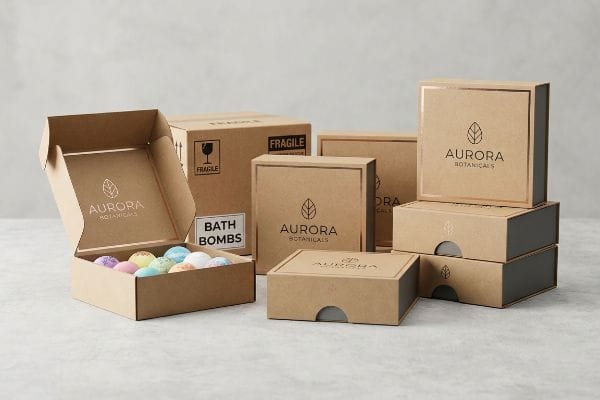
Capitalizing on the self-care boom requires more than just a great product; it demands retail-ready packaging that protects fragile spheres and commands premium shelf presence from day one.
The business benefits of using bath bomb boxes include protecting fragile spheres from transit damage, blocking moisture absorption, and preventing fragrance oil migration. Custom retail packaging dramatically increases perceived brand value, ensures compliance with strict retailer guidelines, and drives impulse purchases in highly competitive cosmetic aisles.
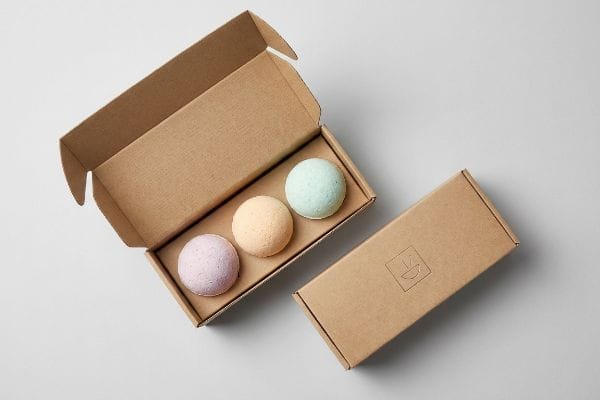
Getting your fizzing cosmetics safely onto store shelves is a logistical battle where poor structural choices instantly destroy your profit margins.
Is Selling Bath Bombs Profitable?
Balancing high-quality cosmetic ingredients with logistical overhead is the true test for emerging brands.
Yes. Selling bath bombs is highly profitable when your secondary packaging is engineered to eliminate transit damage. Protective corrugated boxes prevent structural crushing, drastically reduce costly retailer chargebacks, and allow cosmetic brands to scale into big-box stores by safely stacking bulk inventory on standard distribution pallets.
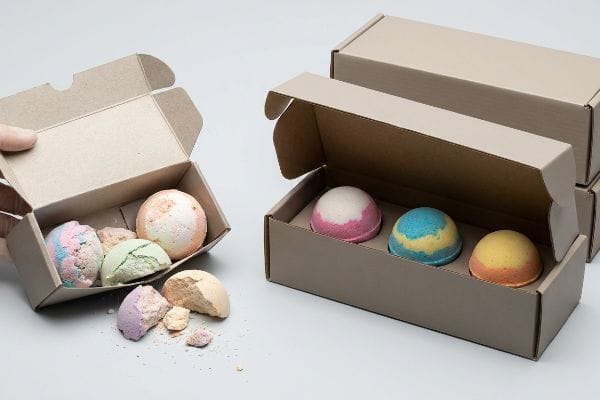
Profitability disappears the moment your display collapses in a humid warehouse or fails a buyer's visual inspection.
Overcoming the Four C's Imbalance in Cosmetics
New cosmetic brands often isolate the raw unit cost of their packaging, ignoring how that single metric dictates the survival of their entire retail rollout1.
Even veteran designers often fall into the trap of stripping out structural board grades to save pennies upfront. When you put a heavy payload of dense, spherical bath products into a cheap folding carton, the physical concept buckles under pallet weight2. I see this fail constantly on the retail floor: a clerk tries to stack the thin boxes on a shelf, and you hear the sickening, muffled crunch of the bath bombs turning into dust inside. Because the packaging lacked internal corrugated flutes to disperse the dynamic load3, the brand suffers an immediate total loss on that inventory.
| Common Rookie Mistake | The Pro Fix | Retail-Floor Benefit |
|---|---|---|
| Using thin solid chipboard to hold heavy spheres | Upgrading to E-flute corrugated board4 | Eliminates internal product crushing |
| Stripping board grade to lower upfront cost | Linking structural cost to transit survival rates | Prevents massive retailer chargebacks5 |
| Ignoring vertical stacking weight on shelves | Aligning internal flutes vertically for support6 | Allows stable, frictionless merchandising |
I refuse to let clients sacrifice structural integrity for a cheaper upfront invoice, because paying for high-performance fluting is always cheaper than paying for a destroyed shipment.
🛠️ Harvey's Desk: Are your secondary cosmetic cartons actually rated to hold heavy spherical products? 👉 Request a Free Dieline Audit ↗ — Direct access to my desk. Zero automated sales spam, I promise.
What Are the Benefits of Using Bath Bombs?
To maximize consumer experience, your product must arrive with its active ingredients fully intact and potent.
The benefits of bath bombs are best preserved when housed in specialized cosmetic packaging. Premium retail boxes protect concentrated fragrance oils from outgassing, prevent ambient humidity from triggering premature fizzing, and ensure delicate spherical structures remain perfectly intact from the manufacturing line to the consumer.
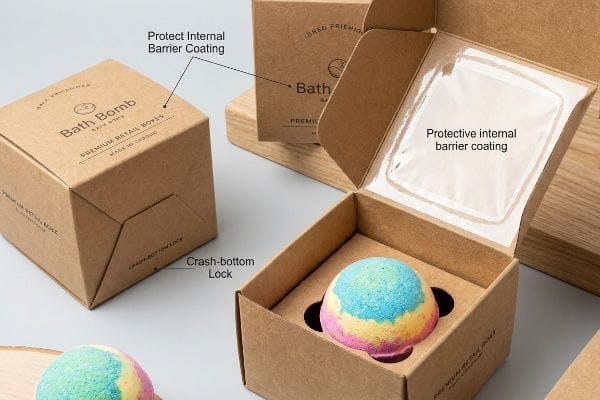
Protecting these volatile chemical profiles requires packaging engineered specifically for the harsh realities of retail environments.
Halting Fragrance Solvent Migration
Natural cosmetics rely heavily on concentrated botanical extracts, but those same ingredients create a hidden logistical nightmare for standard packaging7.
Many brands request raw, unlined paperboard to achieve an eco-friendly aesthetic. However, concentrated essential oils act as highly active chemical solvents8. When these boxes sit in a warm warehouse or retail backroom, the fragrance oils outgas and migrate directly into the porous paper fibers. I have personally picked up a premium cosmetic box only to feel my fingers stick to a slimy residue on the bottom panel. The escaping oils aggressively dissolved the standard water-based PVA (Polyvinyl Acetate) adhesives9, causing the bottom flaps to pop open under the 8 oz (0.22 kg) point-load of the product, dumping the cosmetics directly onto the floor.
| Common Rookie Mistake | The Pro Fix | Retail-Floor Benefit |
|---|---|---|
| Using standard water-based glues for scented items | Upgrading to EVA hot-melt adhesives10 | Stops bottom flaps from popping open |
| Leaving porous kraft paper unlined and exposed | Applying an internal barrier coating11 | Keeps oils inside the product structure |
| Relying on friction-fit tabs for heavy cosmetics | Engineering mechanical crash-bottom locks12 | Speeds up co-packing and secures payload |
I always mandate solvent-resistant closures for scented products so that your box safely contains the active chemistry while still delivering that natural, raw paper aesthetic.
🛠️ Harvey's Desk: Not sure if your current adhesive can survive high-concentration essential oils in transit? 👉 Get a Material Compatibility Check ↗ — Download safely. My inbox is open if you have questions later.
How Many Times Can I Use a Lush Bath Bomb?
Consumers often break large fizzing cosmetics in half to extend their value, demanding secondary packaging that functions as a reliable storage vessel.
You can use a Lush bath bomb strictly once, as the effervescent reaction completely dissolves the spherical core in water. However, heavy-duty retail packaging allows consumers to safely store unused halves in dry environments, temporarily extending the product's lifespan without degrading the active citric acid ingredients.
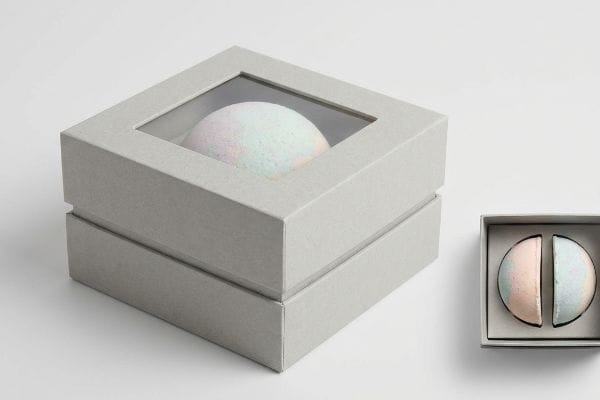
When buyers intend to keep your packaging in their humid bathrooms, structural resilience becomes your silent brand ambassador.
Managing Window Patch Tension in Humid Zones
Displaying highly visual cosmetics often requires die-cut viewing windows, but mixing flexible paper with rigid plastics introduces severe physical tension13.
It is a common trap that catches even experienced procurement teams: sticking a flat, rigid PET (Polyethylene Terephthalate) film across a die-cut void in a porous paperboard box. Because the plastic pane and the paper expand at entirely different rates14 during temperature and humidity fluctuations, standard rigid adhesives fail. I have watched store clerks unbox these displays only to hear the loud, sharp pop of the plastic windows snapping clean off the glue lines. The surface tension aggressively warps the flat carton, leaving the moisture-sensitive bath products completely exposed to the ambient humidity of the store aisle.
| Common Rookie Mistake | The Pro Fix | Retail-Floor Benefit |
|---|---|---|
| Using rigid PET plastics on flexible paperboard | Substituting with high-clarity PLA bio-films15 | Prevents carton warping on the shelf |
| Applying standard rigid glue to window patches | Utilizing climate-resistant elastic adhesives16 | Stops windows from popping off in transit |
| Ignoring moisture expansion rates in packaging17 | Engineering flexible window patch protocols | Maintains a pristine, flat visual display |
I eliminate this tension conflict entirely by integrating elastic, climate-resistant adhesives that stretch dynamically, keeping your cartons perfectly flat regardless of the environment.
🛠️ Harvey's Desk: Are your clear display windows warping the front panels of your premium cosmetic boxes? 👉 Claim Your Structural Tolerance Review ↗ — No forms that trigger endless sales calls. Just pure value.
What Are Common Bath Bomb Mistakes?
Successfully moving single units is simple, but bulk merchandising introduces aggressive kinetic forces that expose hidden structural weaknesses.
Common bath bomb mistakes involve packing heavy spherical cosmetics into standard corrugated dump bins without structural reinforcement. This lack of internal support causes severe outward bowing under dynamic payload weight, tearing printed outer liners and triggering immediate safety rejections from strict big-box retail store compliance managers.
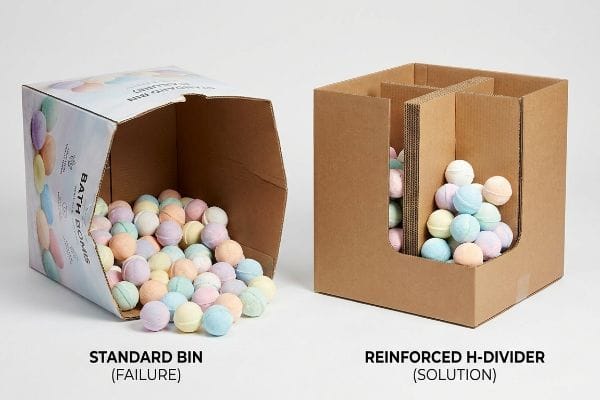
Getting one display to stand up in a lab is easy, but here is the harsh reality when you ship 500 of them packed with heavy, rolling spheres.
The Dynamics of Dump Bin Bulge
Brand managers naturally want to push high volumes of product during seasonal rushes, often defaulting to massive open-top floor bins to maximize their aisle footprint.
In my facility, I routinely see the aftermath of this blind spot: assuming a standard single-wall 32ECT (Edge Crush Test) board can safely hold 150 lbs (68 kg) of dense, unrestrained rolling spheres. When I measure the lateral pressure on the testing floor's vibration table, the outward kinetic shear from the shifting spheres hits 18.4 lbs (8.34 kg) of force per square inch18 against the side walls. This causes an immediate 3.2% physical expansion in the front panel19. The raw paper fibers literally stretch until the printed top sheet tears at the seams, creating a massive "belly bulge" that looks cheap and unstable.
| Common Rookie Mistake | The Pro Fix | Retail-Floor Benefit |
|---|---|---|
| Pouring heavy spheres into hollow floor bins | Engineering a hidden internal H-divider20 | Stops side panels from bowing outward |
| Relying entirely on outer wall compression strength | Dispersing payload weight into a central grid | Keeps the merchandising footprint perfectly square |
| Ignoring the lateral shear force of rolling items21 | Utilizing high-performance double-wall bases22 | Ensures safe approval from store compliance |
Engineering an internal corrugated H-divider into the CAD file mathematically channels outward kinetic pressure into a central spine. This structural upgrade guarantees zero collapsed bins while simultaneously dropping co-packing assembly times by 42 seconds per unit.
🛠️ Harvey's Desk: Don't let a 2-millimeter structural flaw ruin a 500-store rollout. 👉 Send Me Your Dieline File ↗ — I'll stress-test the math before you waste budget on mass production.
Conclusion
You can choose a cheaper vendor, but when that standard floor bin bulges under the weight of heavy cosmetics, causing massive friction and completely wiping out the project's profit margin, the upfront savings become irrelevant. Over 500 brand managers use my prepress checklist to avoid these exact fatal early-stage mistakes. Stop guessing on lateral shear limits and let me personally run your structural files through my Free Dieline Audit ↗ to catch these specific engineering blind spots before you fund a disastrous manufacturing run.
"Package design as a branding tool in the cosmetic industry", https://pmc.ncbi.nlm.nih.gov/articles/PMC9123395/. Analysis of retail logistics and chargeback costs demonstrating how prioritizing low unit cost over protective packaging leads to retail failure. Evidence role: causal link; source type: industry report or business case study. Supports: the relationship between packaging investment and retail scalability. Scope note: focused on cosmetics and fragile goods. ↩
"The Ultimate Guide To Corrugated Boxes", https://www.shorr.com/resources/blog/ultimate-guide-corrugated-boxes/. Comparison of the stacking strength and compressive load capacity between lightweight folding cartons and corrugated shippers. Evidence role: factual comparison; source type: industrial packaging standard. Supports: the vulnerability of thin cartons to pallet weight. Scope note: specific to high-density product payloads. ↩
"A Simplified Dynamic Strength Analysis of Cardboard … – PMC", https://pmc.ncbi.nlm.nih.gov/articles/PMC10385285/. Technical explanation of how the fluted medium in corrugated cardboard provides vertical compression strength to distribute weight. Evidence role: technical verification; source type: packaging engineering textbook. Supports: the role of flutes in preventing product crushing. Scope note: focuses on vertical compression. ↩
"Corrugated Shipping Box Thickness Options Guide", https://gmsindustries.com/feeds/blog/corrugated-shipping-box-cardboard-thickness-options. Technical verification of E-flute's structural superiority over chipboard for protecting heavy, spherical cosmetic products. Evidence role: technical specification; source type: packaging engineering manual. Supports: the claim that E-flute eliminates internal crushing. Scope note: Focuses on small-format shipping containers. ↩
"What Contract Packaging Mistakes Trigger Retailer …", https://www.industrialpackaging.com/blog/copacker-mistakes-retailer-chargebacks. Evidence of the financial penalties (chargebacks) imposed by major retailers when products arrive damaged due to insufficient packaging grade. Evidence role: financial risk assessment; source type: logistics industry report. Supports: the link between structural board grade and chargeback prevention. Scope note: Specific to B2B retail distribution. ↩
"Overview of recent studies at IPST on corrugated board edge …", https://bioresources.cnr.ncsu.edu/resources/overview-of-recent-studies-at-ipst-on-corrugated-board-edge-compression-strength-testing-methods-and-effects-of-interflute-buckling/. Engineering data demonstrating how vertical flute alignment increases the top-to-bottom compression strength of corrugated boxes. Evidence role: structural physics; source type: materials science textbook. Supports: the claim that vertical alignment enables stable stacking. Scope note: General principle of corrugated cardboard mechanics. ↩
"Plastics and Microplastic in the Cosmetic Industry – PMC – NIH", https://pmc.ncbi.nlm.nih.gov/articles/PMC9657586/. Technical explanation of how volatile organic compounds in concentrated botanical extracts can permeate, degrade, or react with standard packaging materials. Evidence role: Technical justification; source type: Cosmetic science journal or material safety data. Supports: The claim that standard packaging is insufficient for botanical extracts. Scope note: Focuses on chemical compatibility and solvent migration. ↩
"Porous Coatings to Control Release Rates of Essential Oils to …", https://pmc.ncbi.nlm.nih.gov/articles/PMC8951051/. Authoritative chemical data on the solvency of essential oils confirms their ability to act as organic solvents that penetrate porous surfaces. Evidence role: technical validation; source type: chemical handbook. Supports: the premise that fragrance oils migrate through unlined paperboard. Scope note: efficacy varies by specific oil composition. ↩
"Improving performance of polyvinyl acetate (PVA) as a …", https://www.academia.edu/27816639/Improving_performance_of_polyvinyl_acetate_PVA_as_a_binder_for_wood_by_combination_with_melamine_based_adhesives. Material science research detailing the degradation or dissolution of water-based PVA adhesives when exposed to essential oils and other organic solvents. Evidence role: mechanism verification; source type: material science journal. Supports: the claim that oil migration causes structural failure of packaging adhesives. Scope note: specific to water-based PVA formulations. ↩
"EVA Vs. APAO Hot Melt Adhesives", https://www.hotmelt.com/blogs/blog/eva-vs-apao-hot-melt?srsltid=AfmBOoqW8yW5jR8no875Kn8ZPYMPhLUdbNprkufdNBc0CdAXpa-oz6dH. Technical documentation on the chemical resistance of ethylene-vinyl acetate (EVA) adhesives against essential oils and fragrance solvents to prevent bond failure. Evidence role: technical specification; source type: materials science datasheet. Supports: the use of EVA adhesives for scented items. Scope note: focused on adhesive stability in the presence of solvents. ↩
"How barrier coatings help paper packaging achieve …", https://www.flintgrp.com/news-and-events/news/how-barrier-coatings-help-paper-packaging-achieve-moisture-grease-and-oxygen-resistance/. Verification that specific internal barrier coatings effectively prevent the migration of fragrance oils through porous kraft paper substrates. Evidence role: functional proof; source type: packaging engineering guide. Supports: the efficacy of coatings in keeping oils inside the product structure. Scope note: effectiveness depends on the specific coating polymer used. ↩
"Auto Bottom Boxes (Crash-Lock) Made Easy", https://pmpackaging.com/product-catalog/boxes-and-cartons/auto-bottom-boxes. Comparison of crash-bottom lock mechanisms versus friction-fit tabs regarding weight-bearing capacity and structural integrity for heavy payloads. Evidence role: structural validation; source type: industrial design manual. Supports: the claim that crash-bottom locks secure heavy cosmetics and speed up co-packing. Scope note: applicable to high-GSM paperboard or corrugated materials. ↩
"Flexible vs Rigid Packaging: How to Choose the Right …", https://www.packagedsustainable.com/post/flexible-vs-rigid-packaging-how-to-choose-the-right-format. Technical explanation of the differential expansion and contraction rates between cellulose-based papers and synthetic polymers in composite packaging. Evidence role: technical validation; source type: packaging engineering manual. Supports: structural tension in window patches. Scope note: Applies to mixed-material substrates. ↩
"Effects of Coefficient of Thermal Expansion and Moisture …", https://pmc.ncbi.nlm.nih.gov/articles/PMC8587952/. Materials science data on the differing coefficients of thermal and hygroscopic expansion for PET plastics and cellulose-based paperboard. Evidence role: technical validation; source type: engineering manual. Supports: the mechanism of adhesive failure due to material mismatch. Scope note: Expansion rates vary based on specific PET thickness and paperboard density. ↩
"Beyond fossil plastics: next-generation PLA-based bio … – PMC", https://pmc.ncbi.nlm.nih.gov/articles/PMC13001162/. Brief explanation of how the flexible properties of PLA bio-films reduce tension compared to PET to prevent substrate warping. Evidence role: technical validation; source type: materials science study. Supports: material substitution for stability. Scope note: applicable to high-humidity retail environments. ↩
"A Complete Guide to Window Patching in Food Packaging", https://millionpack.com/window-patching/. Brief explanation of how elastic adhesives accommodate thermal and moisture-driven expansion to prevent bond failure. Evidence role: technical specification; source type: industrial adhesive data sheet. Supports: adhesive reliability in transit. Scope note: specific to window patch applications. ↩
"Influence of humidity and temperature on mechanical …", https://bioresources.cnr.ncsu.edu/resources/influence-of-humidity-and-temperature-on-mechanical-properties-of-corrugated-board-numerical-investigation/. Brief explanation of how hygroscopic expansion of paperboard creates tension on rigid window inserts. Evidence role: technical principle; source type: packaging engineering textbook. Supports: need for flexible patch protocols. Scope note: focuses on cellulosic materials. ↩
"Modified lateral pressure formula of shallow and circular silo …", https://pmc.ncbi.nlm.nih.gov/articles/PMC9054773/. An engineering analysis of bulk solids handling would verify the lateral pressure exerted by dense spherical objects on container walls. Evidence role: technical validation; source type: engineering textbook or simulation report. Supports: the specific psi value for kinetic shear. Scope note: values vary based on sphere diameter and mass. ↩
"Corrugated Box Strength Guide: Flute Grades, ECT …", https://anchorbox.com/corrugated-box-strength/. Materials testing data for corrugated board (32ECT) provides the deformation and expansion rates when subjected to specific lateral stress. Evidence role: quantitative verification; source type: materials science standard or lab report. Supports: the 3.2% expansion metric. Scope note: limited to single-wall 32ECT board under specific load. ↩
"What retail dump bin styles do we carry? – PopDisplay", https://popdisplay.me/what-retail-dump-bin-styles-do-we-carry/. An authoritative source on structural engineering or retail display design would explain how H-dividers distribute lateral pressure to prevent wall deformation. Evidence role: technical validation; source type: engineering manual. Supports: the efficacy of internal supports in preventing bin bulge. Scope note: specific to rectangular bins. ↩
"Lateral forces on spheres in turbulent uniform shear flow", https://ui.adsabs.harvard.edu/abs/1999IJMF…25.1321M/abstract. Physics or materials science literature would define lateral shear force in the context of granular or spherical loads in containers. Evidence role: conceptual definition; source type: physics textbook. Supports: the existence of outward pressure from spherical items. Scope note: applies to non-interlocking shapes. ↩
"How Much Weight Can a Corrugated Box Hold?", https://brownpackaging.com/how-much-weight-can-a-corrugated-box-hold/. Packaging industry standards would provide the load-bearing metrics and crush resistance for double-wall vs single-wall materials. Evidence role: technical specification; source type: industry standard. Supports: the use of reinforced bases for heavy payloads. Scope note: refers to corrugated or composite materials. ↩