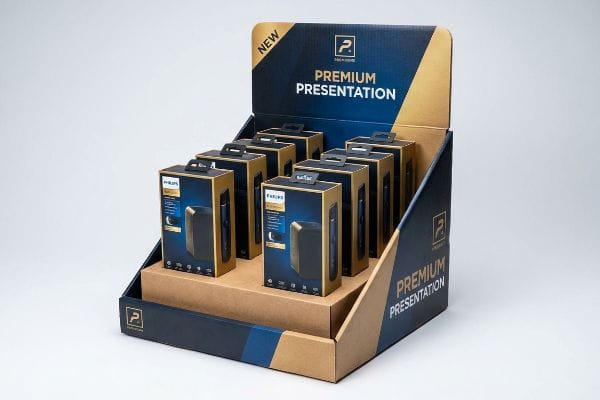
A brilliant product easily becomes invisible in crowded retail aisles. To dominate shelf space, you must engineer physical structures that aggressively disrupt the consumer's visual path.
Display boxes improve product presentation by elevating merchandise off flat shelves, organizing inventory into structured visual blocks, and utilizing high-contrast vertical branding. These engineered units disrupt standard retail sightlines, ensuring consumers instantly recognize core marketing messaging from 30 feet (9.1 meters) away to drive immediate impulse purchasing.
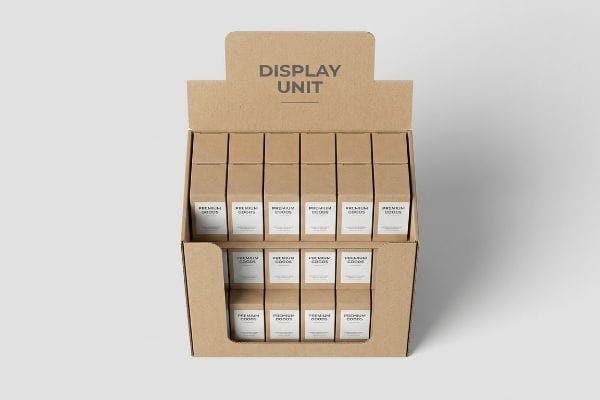
But engineering a corrugated structure that actually forces a rushing shopper to stop and look requires much more than just printing colorful graphics on a piece of standard cardboard.
What Are Display Boxes Used For?
A retail display box isn't just a basic container for holding your inventory; it's an active structural sales tool.
Display boxes are primarily used for organizing retail merchandise, highlighting specific product promotions, and securing premium off-shelf placements. They function as temporary or permanent secondary packaging that strategically guides consumer traffic, driving higher visibility and faster sell-through rates across high-traffic grocery, pharmacy, and big-box store aisles.
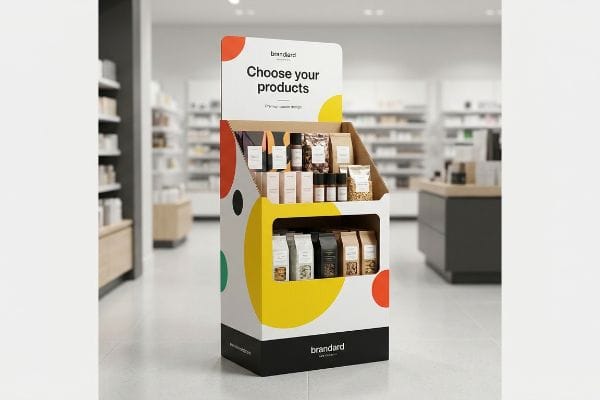
If you just treat them as basic holding bins, you are leaving massive retail revenue on the table by failing to engage the consumer.
The 3-3-3 Rule of Product Presentation
Junior marketing teams often design retail displays specifically for up-close viewing on their backlit computer monitors. They assume that dense, paragraph-long text and intricate product details printed on a cardboard base will naturally draw shoppers in and explain the product's value.
I know you're staring at this cardboard structure feeling lost, because I constantly see brands cram a novel's worth of text onto their side panels. Here is the retail reality: a rushing shopper in a busy aisle is completely blind to small print. When I stand on the store floor watching traffic patterns, I see consumers walk right past these text-heavy displays because it triggers instant cognitive overload. I always tell my clients to follow the 3-3-3 engagement rule1. Your display must capture visual attention from 30 feet (9.1 meters) away, engage their specific interest at 3 feet (0.9 meters), and secure the final physical conversion at 3 inches (76.2 mm). The physical, satisfying snap of a shopper grabbing the product out of the tray only happens if you ruthlessly strip away secondary text and use massive, high-contrast spot colors for that initial 30-foot disruption.
| Common Rookie Mistake | The Pro Fix | Retail-Floor Benefit |
|---|---|---|
| Printing long text paragraphs | 30-foot spot color disruption2 | Captures distant aisle traffic |
| Symmetrical tight product grids | Ergonomic 50-inch strike zone3 | Drives 3-foot engagement |
| High retaining lips | Cutting lips for 85% visibility4 | Secures 3-inch physical conversion |
I never let a client approve a design that requires heavy reading. By engineering aggressive die-cut shapes and prioritizing immediate visual disruption, I guarantee your display actually stops shopping carts instead of blending into the background.
🛠️ Harvey's Desk: Not sure if your artwork creates the right 30-foot visual disruption? 👉 Get My Free Artwork Audit ↗ — Direct access to my desk. Zero automated sales spam, I promise.
What Are the Benefits of Using Custom Boxes?
Generic packaging simply holds your inventory, but custom architecture actively steers consumer psychology and defends your merchandise.
The benefits of using custom boxes include optimized product grouping, reinforced brand equity, and mathematically precise structural protection. Custom packaging eliminates internal friction during transit and utilizes engineered modular dividers to create visual tension on the shelf, naturally drawing the human eye while drastically reducing in-store restocking damages.

The true advantage of deep customization lies in how you mathematically space your products, not just how brightly you print your logos.
Controlling Cognitive Overload with Custom Dividers
Junior designers frequently attempt to flat-pack a dense, perfectly symmetrical grid of products into a single display tray, assuming maximum density yields higher sales. They believe that cramming 50 identical items into a generic box is the most cost-effective way to utilize retail shelf space.
This is a common trap that catches even experienced procurement teams. I often get calls from clients whose perfectly symmetrical displays fail to create any visual tension, causing shoppers to just glance past them. Worse, when store clerks try to forcefully jam items back into these tight, symmetrical grids, you hear the awful tearing sound of raw paperboard as the generic retaining lip rips wide open. My rule of thumb is the 3-5-7 asymmetry rule5. Instead of a tight grid, I use custom modular dividers to separate merchandise into odd-numbered clusters with a strict 0.25-inch (6.35 mm) physical clearance buffer6. This custom spacing creates psychological tension that forces the human eye to stop and look, while that precise clearance completely eliminates paperboard tearing during aggressive in-store restocking.
| Common Rookie Mistake | The Pro Fix | Retail-Floor Benefit |
|---|---|---|
| Symmetrical dense packing | 3-5-7 asymmetrical clusters7 | Creates psychological visual tension |
| Zero physical clearance | 0.25-inch structural buffer8 | Prevents raw paperboard tearing |
| Generic tight fit trays | Custom die-cut modular dividers | Speeds up daily restocking |
Customizing your internal structure isn't an unnecessary luxury; it is a mechanical necessity. By engineering strategic voids between your individual items, I ensure your presentation looks premium while surviving the brutal hands of rushed retail clerks.
🛠️ Harvey's Desk: Are your products packed so tightly that store clerks are tearing your display trays? 👉 Claim Your Custom Dieline Template ↗ — Download safely. My inbox is open if you have questions later.
What Is a Product Presentation?
Effective product presentation is the flawless execution of visibility, ensuring your primary item is the absolute hero of the aisle.
A product presentation is the strategic physical arrangement of merchandise designed to maximize consumer visibility and sensory engagement. It encompasses structural housing, angled shelving, and precise retaining lip heights that guarantee core brand logos, compliance labeling, and product textures remain completely unobstructed and highly accessible to target shoppers.
However, even the most beautiful primary bottle or jar becomes entirely invisible if the secondary housing is engineered poorly.
Engineering Flawless Visibility Clearances
Brands invest heavily in their primary item aesthetics, meticulously designing the labels on their bottles, jars, or cosmetic tubes. They assume that simply placing these premium items into a standard retail-ready corrugated tray will automatically translate into an excellent, high-converting shelf presentation.
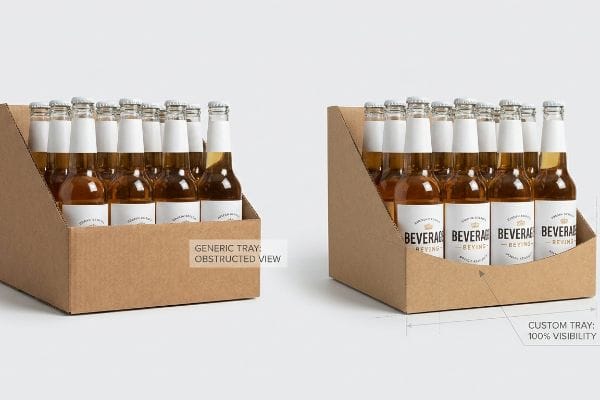
I constantly see brands ruin their own marketing equity by hiding it behind generic cardboard. Think of your display tray like a picture frame; if the frame covers half the painting, the presentation fails. A common headache occurs when generic packaging designers engineer front retaining lips that are entirely too high. For example, in the beverage sector, a high lip physically covers the critical compliance text9 or premium varietal claims on the bottle. I have watched store managers reject entire shipments because shoppers couldn't read what they were buying. My fix is a strict label-clearance mapping protocol. I import the physical product's exact dieline into the 3D CAD10 (Computer-Aided Design) environment and engineer a custom die-cut swoop on the front lip, ensuring 100% unobstructed visibility of the core claim.
| Common Rookie Mistake | The Pro Fix | Retail-Floor Benefit |
|---|---|---|
| High generic retaining lips | Custom die-cut front swoops11 | Guarantees 100% label visibility |
| Guessing lip dimensions | 3D CAD label-clearance mapping12 | Prevents retailer merchandising rejections |
| Hiding core brand claims | Engineering lower strike zones13 | Drives faster impulse conversions |
You cannot sell what the consumer cannot see. By mathematically sweeping the corrugated lip precisely below your primary label, I ensure your product presentation remains fully legally compliant and visually dominant.
🛠️ Harvey's Desk: Is your current display tray physically hiding your most important brand messaging? 👉 Request A Structural Visibility Check ↗ — No forms that trigger endless sales calls. Just pure value.
What Is the Purpose of a Display?
A display's true purpose is to aggressively defend your brand's physical presence against the chaotic variables of a global supply chain.
The purpose of a display is to structurally protect retail merchandise during heavy freight transit while subsequently functioning as an independent, fully branded merchandising fixture. These engineered units isolate kinetic shock, organize complex inventory, and maximize localized point-of-purchase visibility to generate measurable sales velocity without requiring permanent store shelving.
Getting one display to look perfect in a climate-controlled laboratory is easy, but here is the harsh reality when the factory machines actually start running for mass production.
Why Standard Litho-Lamination Fails on the Factory Floor
Procurement teams frequently assume that mounting a high-quality printed top-sheet to a rigid B-flute corrugated board14 naturally results in a perfectly flat display panel. They approve flat artwork on a digital screen and expect the final 60-inch (152.4 cm) tall side panels to stand perfectly plumb on the retail floor without any structural bowing or material distortion15.
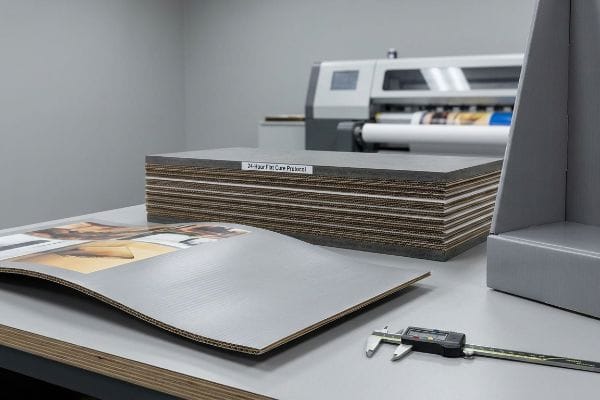
This isn't just theory—I see this happen on the testing floor when buyers ignore the chemical reality of litho-lamination. In my facility, I routinely see large side panels warp like potato chips if they aren't processed correctly. The process uses water-based PVA (Polyvinyl Acetate) adhesive. When this wet glue is applied across large surface areas, the corrugated testliner absorbs the moisture. As the PVA dries in ambient factory air, it shrinks, creating an immense surface tension that violently pulls the board inward. I measure this deflection with digital calipers, and even a 0.14-inch (3.5 mm) warp on a structural load-bearing wall will cause the entire base to wobble, slowing down the assembly line by an estimated 30%16 and completely wiping out the project's profit margin. To fix this, I engineered a strict cure weight protocol. After lamination, I stack the wet boards under exact dead-weight pressure boards for 24 hours to force a flat cure. Furthermore, for extremely large panels, I specify a balanced duplex structure, adding a 0.08-inch (2 mm) back-liner17 to counteract the PVA surface tension. By enforcing this strict flat-cure tolerance, I ensure the co-packing assembly is completely frictionless, saving clients thousands in unnecessary manual rework fees.
| Common Rookie Mistake | The Pro Fix | Retail-Floor Benefit |
|---|---|---|
| Ignoring PVA moisture shrink | 24-hour dead-weight flat curing18 | Ensures perfectly plumb side panels |
| Unbalanced single-sided glue | Balanced duplex back-liner19 | Prevents catastrophic display wobble |
| Rushing the lamination cure | Strict factory moisture extraction20 | Eliminates costly manual assembly rework |
A brilliant graphic design means absolutely nothing if the underlying chemistry pulls the structure apart. By strictly controlling the PVA curing tension, I guarantee your display stands perfectly straight, bears the proper weight, and performs exactly as promised.
🛠️ Harvey's Desk: Do you know the exact moisture content of your current corrugated supplier's B-flute before litho-lamination? 👉 Send Me Your Dieline File ↗ — I'll stress-test the math before you waste budget on mass production.
Conclusion
You can choose a cheaper vendor, but when that water-based PVA adhesive cures and violently warps your 60-inch (152.4 cm) side panels like a potato chip, you will face severe display wobbling that slows down the assembly line by an estimated 30% and triggers immediate retailer rejections. Over 500 brand managers use my prepress checklist to avoid these exact fatal early-stage mistakes. Stop guessing on chemical tolerances and let me personally run your structural files through my Free Dieline Pre-Flight Audit ↗ to catch these invisible friction points before you pay for mass production.
"3-3-3 Rule in Marketing: What You Need to Know – Display Wizard", https://www.displaywizard.co.uk/3-3-3-rule-in-marketing/. Verification of the 3-3-3 rule as a retail marketing framework for managing consumer attention across different distances. Evidence role: industry standard; source type: retail design manual. Supports: the strategic use of visual hierarchy for product conversion. Scope note: Application may vary based on store layout and lighting. ↩
"Proudly presented: the psychology of visual merchandising", https://www.moo.com/blog/business-tips/visual-merchandising-psychology. Verification of sight-line standards in retail environments regarding the distance at which spot colors attract consumer attention. Evidence role: technical validation; source type: retail marketing study. Supports: the use of color disruption to capture distant traffic. Scope note: effectiveness may vary based on ambient lighting. ↩
"Retail premises design for effective displays and customer …", https://www.business.qld.gov.au/industries/manufacturing-retail/retail-wholesale/retail-displays. Analysis of average human eye-level and reach patterns to verify the optimal vertical placement for product engagement. Evidence role: ergonomic verification; source type: consumer behavior study. Supports: the 50-inch height as an optimal engagement zone. Scope note: specific to standing adult demographics. ↩
"Why Do Retailers Place Products at Eye Level? – PopDisplay", https://popdisplay.me/why-do-retailers-place-products-at-eye-level/. Industry benchmarks for point-of-purchase (POP) packaging design regarding how lip height impacts the percentage of product visible to the shopper. Evidence role: factual support; source type: packaging design guideline. Supports: the claim that reduced lips increase visibility to 85%. Scope note: applies to open-front display boxes. ↩
"What is the 3-5-7 Rule in Decorating?", https://montcarta.com/blogs/art-guide-inspiration/3-5-7-rule-interior-decorating-guide?srsltid=AfmBOorfIiiLfoGrkqPDLlI76tmfdi1rDaU9Z1TT4msGOb3ivLkF0tbJ. Brief explanation of how the rule of odd numbers and asymmetry in product grouping increases consumer visual attention. Evidence role: technical validation; source type: visual merchandising guide. Supports: the effectiveness of asymmetrical clusters for visual tension. Scope note: may be a design heuristic. ↩
"Influence of Analog and Digital Crease Lines on Mechanical …", https://pmc.ncbi.nlm.nih.gov/articles/PMC9268991/. Brief explanation of how specific tolerance buffers in modular dividers prevent mechanical stress and tearing of raw paperboard. Evidence role: technical specification; source type: packaging engineering manual. Supports: the claim that 0.25-inch spacing prevents restocking damage. Scope note: depends on paperboard GSM and grade. ↩
"The psychology of visual merchandising", https://depict.ai/resources/blog/the-psychology-of-visual-merchandising-how-product-arrangement-influences-shopper-behavior. Brief explanation of how asymmetrical arrangements and the 'rule of odds'create visual tension and increase consumer engagement. Evidence role: validation; source type: design psychology study. Supports: the psychological benefit of asymmetrical clustering. Scope note: Applies specifically to visual merchandising. ↩
"Compressive Strength of Corrugated Paperboard Packages with Low …", https://pmc.ncbi.nlm.nih.gov/articles/PMC10054506/. Brief explanation of engineering standards for clearance buffers to mitigate mechanical stress and prevent material failure in paperboard. Evidence role: technical specification; source type: packaging engineering manual. Supports: the claim that a 0.25-inch buffer prevents tearing. Scope note: May vary based on paperboard grade and GSM. ↩
"Cosmetics Labeling Guide", https://www.fda.gov/cosmetics/cosmetics-labeling-regulations/cosmetics-labeling-guide. Packaging industry standards and regulatory guidelines define minimum visibility requirements for compliance labeling, which can be obstructed by improper display lip heights. Evidence role: Technical validation; source type: regulatory standard. Supports: The claim that high lips obstruct required text. Scope note: Applicable to regulated consumer products. ↩
"Online Dieline to 3D Mockup Converter", https://packcad.com/mockup. Technical documentation for point-of-purchase engineering demonstrates the use of product dielines in CAD environments to ensure spatial clearances and visibility. Evidence role: Process verification; source type: technical manual. Supports: The efficacy of CAD for precision visibility mapping. Scope note: Standard practice in professional display design. ↩
"Custom Die Cut Labels That Elevate Shelf Appeal and …", https://inovarpackaging.com/custom-die-cut-labels-that-elevate-shelf-appeal-and-brand-identity/. Technical explanation of how specific die-cut geometry improves label visibility in retail displays. Evidence role: technical validation; source type: packaging engineering guide. Supports: efficacy of front swoops for visibility. Scope note: Applicable to shelf-ready packaging. ↩
"Merchandising Best Practices: Compliance – Vanguard Companies", https://www.vanguardpkg.com/merchandising-best-practices-compliance/. Documentation of CAD processes used to ensure product labels meet retailer compliance standards to avoid rejection. Evidence role: process validation; source type: industrial design manual. Supports: role of CAD in merchandising. Scope note: Focuses on clearance tolerances. ↩
"How Point-Of-Sale (POS) Displays Can Increase Impulse Purchases", https://www.iprint360.com/resources/blog/how-point-of-sale-pos-displays-can-increase-impulse-purchases.html. Empirical evidence or industry standard explaining the 'strike zone'concept and its impact on consumer impulse buying behavior. Evidence role: psychological validation; source type: retail marketing study. Supports: correlation between placement and conversion. Scope note: Specific to shelf-level positioning. ↩
"Litho-laminated Microflute", https://mm.group/packaging/technologies/lamination/. Packaging industry standards explain how differential tension between printed liners and fluting during litho-lamination leads to internal stresses and panel curvature. Evidence role: technical verification; source type: manufacturing guide. Supports: the fact that this construction method does not naturally ensure flatness. Scope note: Applies to high-tension adhesive bonding. ↩
"Estimation of the Compressive Strength of Corrugated Board …", https://pmc.ncbi.nlm.nih.gov/articles/PMC8467740/. Mechanical property data for corrugated materials specifies the critical height-to-thickness ratio where B-flute board loses vertical stability. Evidence role: physical property validation; source type: engineering datasheet. Supports: the susceptibility of 60-inch panels to distortion. Scope note: Influence of humidity and load on buckling thresholds. ↩
"[PDF] Corrugated Board Twist Twist watt–causes and remedies", https://imisrise.tappi.org/download.aspx?key=92APR097. Brief explanation of how industrial packaging standards correlate specific warp measurements with production downtime or assembly efficiency loss. Evidence role: quantitative validation; source type: operational efficiency study. Supports: the impact of structural deflection on production speed. Scope note: variance exists based on automation levels. ↩
"Optimal Design of Double-Walled Corrugated Board Packaging", https://pmc.ncbi.nlm.nih.gov/articles/PMC8950760/. Brief explanation of the engineering principle of balanced duplexing to neutralize tension caused by single-sided adhesive application in litho-lamination. Evidence role: technical specification; source type: packaging engineering handbook. Supports: the effectiveness of back-liners in preventing board warp. Scope note: depends on liner weight and adhesive moisture content. ↩
"How Long Does PVA Craft Glue Take To Dry?", https://www.youtube.com/watch?v=UzNtlB8c82Y. Technical specifications regarding PVA adhesive curing cycles and the requirement for dead-weight pressure to mitigate moisture-induced shrinkage. Evidence role: technical validation; source type: industrial adhesive guide. Supports: The claim that a 24-hour flat cure ensures plumb side panels. Scope note: Specific to PVA-based glues. ↩
"Deciphering Double-Walled Corrugated Board Geometry …", https://pmc.ncbi.nlm.nih.gov/articles/PMC10974599/. Engineering standards for material balancing in composite board construction to prevent structural warping and instability. Evidence role: engineering validation; source type: packaging manufacturing manual. Supports: The use of duplex liners to prevent display wobble. Scope note: Focuses on litho-lamination processes. ↩
"Effects of Moisture in the Lamination Process – AICC Now", https://now.aiccbox.org/effects-of-moisture-in-the-lamination-process/. Analysis of how controlled ambient humidity and moisture extraction affect the polymerization rate and stability of lamination adhesives. Evidence role: process optimization; source type: industrial manufacturing study. Supports: The claim that moisture control eliminates assembly rework. Scope note: Applies to industrial factory floor environments. ↩