
Stop letting inefficient contract packaging eat your retail profit margins. If your displays fail on the assembly line, you are burning cash before the product even hits the floor.
Contract packaging solutions offer streamlined, outsourced assembly and fulfillment services for retail brands. By delegating secondary packaging, carton folding, and display packing to specialized third-party logistics providers, companies drastically reduce internal labor costs, improve supply chain agility, and ensure compliance with strict international merchant quality control standards.

The theory of outsourcing sounds great in a boardroom, but true efficiency only happens when your physical structural files are engineered specifically for high-speed manual assembly.
What are the 5 P's of packaging?
Launching a successful physical retail campaign requires mastering the foundational rules of modern commerce.
The 5 P's of packaging encompass product, price, place, promotion, and positioning. These strategic pillars dictate how physical merchandise is engineered, visually branded, and physically protected to survive complex global supply chains while simultaneously driving maximum impulse purchase conversions on crowded retail store shelves.

Knowing these pillars is mandatory, but I constantly see brands fail when they try to cram all that strategy onto a single piece of cardboard.
Translating the 5 P's to the Retail Floor
Even veteran marketers frequently treat corrugated displays like static magazine ads. They try to address every single consumer demographic, pricing advantage, and promotional tagline on the header card, assuming shoppers will stand and read the entire pitch. This textbook approach looks fantastic on a brightly lit computer screen during a corporate presentation.
I see this break down firsthand when those text-heavy POP (Point of Purchase) displays finally hit the aisles. A frantic store manager at a busy Chicago big-box location dragging a pallet jack isn't reading your marketing essay; they are looking for the exact price channel alignment. I remember a specific launch where a brand crammed seven different marketing claims onto a 34.5-inch (87.6 cm) wide end-cap. I could physically feel the slick, over-inked surface of the glossy header card glaring under the harsh fluorescent lights, causing massive visual cognitive overload1 that completely diluted the primary promotional pillar. The display just faded into the background noise, resulting in dismal sell-through rates and triggering an immediate retailer rejection for future orders. Instead of printing a novel, I strip it down to a single high-contrast Pantone flood and one massive die-cut focal point that hooks the shopper from thirty feet away2.
| Common Rookie Mistake | The Pro Fix | Retail-Floor Benefit |
|---|---|---|
| Printing long marketing essays | Single high-contrast focal point | Grabs attention from 30 feet3 |
| Ignoring store lighting realities | Using spot colors for maximum pop4 | Prevents washed-out muddy graphics |
| Overcomplicating the header card | Bold die-cut structural shapes5 | Drives instant impulse conversions |
I never let brands ruin their primary merchandising strategy with visual clutter. By isolating the single most important promotional trigger, my facility ensures your structural investment actually stops foot traffic instead of blending into the aisle.
🛠️ Harvey's Desk: Are your brand's promotional graphics getting lost in retail translation? 👉 Get A Free File Audit ↗ — Direct access to my desk. Zero automated sales spam, I promise.
How to improve packaging efficiency?
Speed to market relies heavily on how fast your secondary structures can be assembled by hand.
To improve packaging efficiency, manufacturers must optimize structural designs for rapid hand assembly, utilize pre-glued components, and eliminate excess material waste. Streamlining the physical folding sequence drastically reduces labor hours during the co-packing stage, ensuring continuous supply chain movement and lowering overall campaign fulfillment costs.
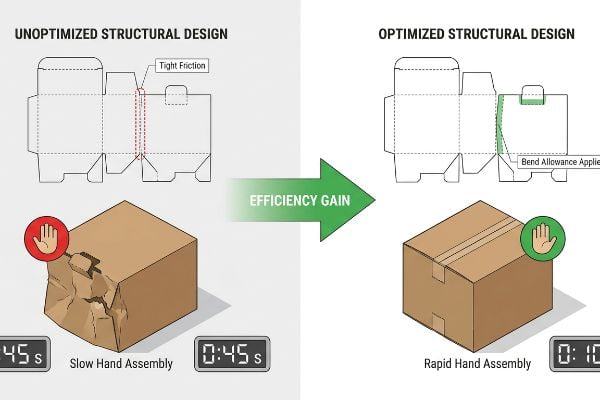
It sounds simple enough to tell a factory to work faster, but true speed is entirely dictated by the invisible math hidden inside your dielines.
The Invisible Friction of Uncompensated Caliper
Graphic design teams frequently build interlocking tabs and slots using 2D software, drawing a one-inch tab to fit perfectly into a one-inch slot6. They assume that because the geometry matches on a flat PDF, the physical box will simply snap together effortlessly on the fulfillment line.
That assumption shatters the moment you introduce the physical thickness of a B-flute board. When a 0.12-inch (3 mm) thick corrugated panel bends 90 degrees, it physically consumes material and expands. I watched a co-packing team sweat through a nightmare shift because the uncompensated slots were too tight. The stiff resistance of the virgin kraft board fought back against their hands, forcing them to crush the flutes just to hammer the locking tabs into place. This severe friction slowed down the assembly line by an estimated 30% and caused costly micro-tears in the printed top sheet. I immediately rebuilt the CAD (Computer-Aided Design) files, writing parametric algorithms to automatically add strict bend allowances to every slot, guaranteeing the structural display clicked together with zero resistance.
| Common Rookie Mistake | The Pro Fix | Retail-Floor Benefit |
|---|---|---|
| 1:1 tab to slot mapping | Parametric bend allowance math7 | Saves 45 seconds per assembly8 |
| Ignoring material thickness | ArtiosCAD 3D folding simulations9 | Eliminates torn top sheets |
| Forcing tight locking tabs | Widening slots by exact caliper | Reduces manual labor fatigue |
I refuse to let poor math cripple your fulfillment timelines. Applying the correct physical bend allowance completely eliminates structural friction, dropping manual labor fees and getting your displays onto outbound trucks significantly faster.
🛠️ Harvey's Desk: Does your current structural file account for the exact thickness of your board? 👉 Request A Dieline Check ↗ — Download safely. My inbox is open if you have questions later.
What does contract packaging mean?
Outsourcing your secondary fulfillment can be a game-saving maneuver, provided your materials are engineered for the journey.
Contract packaging means hiring specialized third-party facilities to physically assemble, pack, and distribute retail merchandise. Also known as co-packing, this service allows brand owners to outsource labor-intensive processes like loading display trays, folding cartons, and shrink-wrapping pallets, converting fixed manufacturing overhead into highly flexible operational expenses.
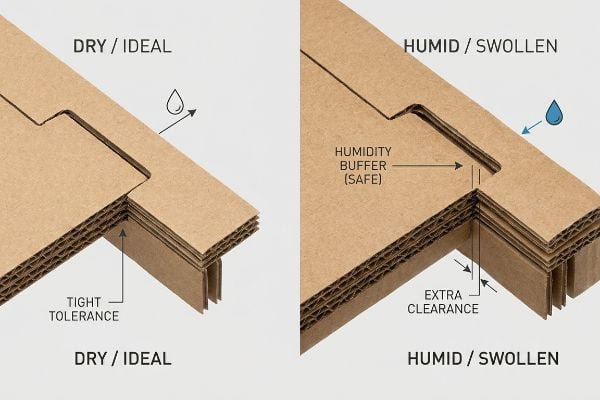
Sending flat cardboard to a third-party facility is an excellent strategy, but you have to protect those raw materials from environmental saboteurs along the way.
Protecting Co-Packers from Moisture Swelling
Brands often approve perfectly engineered structural prototypes in climate-controlled offices and immediately authorize mass production. They assume the 32 ECT (Edge Crush Test) testliner10 will maintain those exact pristine dimensions while sitting flat on a pallet for four weeks.
The reality is that raw paper acts like a sponge. When flat-packs are shipped via ocean freight or stored in a humid environment before reaching the contract packaging facility, the porous fibers absorb ambient moisture and visibly swell. I had a client nearly miss a massive club store rollout because a sudden spike in warehouse humidity caused their locking tabs to expand beyond their tolerances. I could hear the loud ripping sound of the raw paperboard as the frustrated co-packers tried to force the swollen pieces together, resorting to messy clear tape to hold the broken shelves up. To fix this, I engineered a specific humidity buffer into the dieline, adding exactly 0.04 inches (1 mm) of extra clearance to the receiving slots, ensuring a frictionless assembly regardless of the facility's ambient climate.
| Common Rookie Mistake | The Pro Fix | Retail-Floor Benefit |
|---|---|---|
| Designing for dry lab conditions | Adding structural humidity buffers11 | Prevents assembly line halts |
| Using tight interlocking slots | 1mm extra slot clearance12 | Eliminates torn structural tabs |
| Ignoring transit climate | Accounting for paper swelling13 | Keeps fulfillment costs low |
I build fail-safes directly into the math so your third-party logistics partners never have to struggle. Predicting environmental material shifts guarantees that your flat-packs arrive ready to fold, protecting your bottom line from unexpected hourly labor overruns.
🛠️ Harvey's Desk: Are your corrugated displays sitting in a humid warehouse right now? 👉 Claim Your Structural Review ↗ — No forms that trigger endless sales calls. Just pure value.
What are the four types of packaging?
A product's journey from the factory to the consumer's hands relies on multiple protective layers working together seamlessly.
The four types of packaging are primary, secondary, tertiary, and ancillary. Primary holds the actual product, secondary groups items for retail display, tertiary protects bulk shipments during logistics, and ancillary includes structural additions like custom inserts, protective void fill, and automated pallet skirts for enhanced transit security.

But knowing the theory isn't enough when the machines start running and massive weight is stacked onto those tertiary master cartons.
The Tertiary Overhang Collapse Hazard
Procurement teams routinely attempt to maximize shipping density by tweaking the dimensions of their tertiary master cartons14, assuming that high-grade corrugated board will naturally protect the secondary displays15 inside. They push the box sizes right to the absolute limit, believing that a minor dimensional bump is harmless if the box technically still fits in the truck.
In my facility, I routinely see the disastrous consequences of this overzealous optimization during BCT (Box Compression Test) testing. A master carton derives up to 60% of its vertical load capacity16 strictly from the precise alignment of its four structural corners. If a buyer pushes the dimensions so far that the bottom box overhangs the standard 48×40 inch (121.9×101.6 cm) GMA17 (Grocery Manufacturers Association) wood pallet by even 0.25 inches (6.3 mm), those vital corners carry zero load. I watched an entire bottom tier of unsupported boxes physically bow outward and catastrophically crush under the top-heavy warehouse weight, snapping the flutes and destroying the expensive merchandise inside. I pulled the micrometer readings and immediately enforced a strict zero-overhang bounding box protocol, artificially shrinking the maximum allowable footprint by 0.5 inches (12.7 mm). By enforcing this precise tolerance, I ensure the structural corners remain fully supported, completely eliminating container transit damages and saving the client thousands in retailer chargebacks.
| Common Rookie Mistake | The Pro Fix | Retail-Floor Benefit |
|---|---|---|
| Pushing box sizes to the edge | Strict zero-overhang protocol18 | Prevents total pallet collapse |
| Overhanging the wood pallet | Shrinking footprint by 0.5 inches | Restores 60% corner strength19 |
| Relying entirely on raw ECT20 | Precise vertical load distribution | Eliminates transit damage fines |
I never let theoretical shipping volume ruin physical freight survival. Enforcing ruthless dimensional boundaries on your master cartons guarantees that every unit survives the crushing pressure of double-stacked transit and arrives perfectly intact.
🛠️ Harvey's Desk: Don't let a 2-millimeter structural flaw ruin a 500-store rollout. 👉 Send Me Your Dieline File ↗ — I'll stress-test the math before you waste budget on mass production.
Conclusion
You can choose a cheaper vendor, but when an oversized master carton overhangs the pallet and catastrophically crushes under top-heavy warehouse weight, triggering an immediate retailer rejection, your perceived savings instantly vanish. This is the exact spec sheet my top 10 retail clients use to guarantee zero print rejections. Stop guessing on complex dimensional tolerances and let me personally run your structural files through my Free Dieline Pre-Flight Audit ↗ to catch these fatal logistic errors before mass production begins.
"Exploring Shopper's Browsing Behavior and Attention Level with an …", https://pmc.ncbi.nlm.nih.gov/articles/PMC6895988/. [A scholarly source on visual merchandising or cognitive psychology would explain how excessive information density on point-of-purchase displays impairs information processing and decreases conversion rates]. Evidence role: technical validation; source type: academic journal. Supports: The negative impact of information density on shopper attention. Scope note: General principle of cognitive psychology applied to retail. ↩
"The Importance of the Focal Point in Visual Merchandising – Yu Retail", https://www.yuretail.com/en/2025/02/13/focal-point-in-visual-merchandising/. [Industry standards for retail design specify the necessary size, contrast, and simplicity required for visual elements to capture consumer attention from specific distances]. Evidence role: industry benchmark; source type: professional design manual. Supports: The efficacy of simplified, high-contrast focal points for long-distance visibility. Scope note: Applies to big-box retail environments. ↩
"Guide to Successful Corrugated Packaging Design and Branding", https://www.yorkcontainer.com/york-container-blog/perform-promote-protect-your-companys-guide-to-successful-corrugated-packaging-design-and-branding. [Studies on consumer visual perception and retail shelf visibility provide data on the distance at which a high-contrast focal point becomes effective]. Evidence role: factual verification; source type: retail psychology research. Supports: distance for attention grabbing. Scope note: visibility varies by ambient lighting and store layout. ↩
"CMYK vs. Spot Colors in Packaging Printing", https://meyers.com/meyers-blog/cmyk-vs-spot-colors-in-packaging-printing-what-cpg-brands-need-to-know/. [Technical printing guides detail how spot colors offer higher color saturation and consistency than CMYK under harsh retail lighting]. Evidence role: technical specification; source type: printing industry manual. Supports: use of spot colors for visual pop. Scope note: specifically applies to professional offset or flexographic printing. ↩
"The Impact of Visual Elements of Packaging Design on Purchase …", https://pmc.ncbi.nlm.nih.gov/articles/PMC11851823/. [Consumer behavior research indicates that unique structural packaging shapes increase tactile engagement and impulse conversion rates]. Evidence role: causal claim; source type: marketing academic journal. Supports: link between structural shape and impulse conversions. Scope note: efficacy varies by product category. ↩
"Designing Sheet Metal Parts with Tab and Slots – SendCutSend", https://sendcutsend.com/blog/designing-sheet-metal-parts-with-tab-and-slots/?srsltid=AfmBOopr0nEbUKBu3huoMT-NZx9Hq1NNyUtk4LHh2Drs9wp9CXyTq_NZ. [Authoritative packaging engineering manuals specify that slots must be oversized relative to tabs to account for material caliper and fold radii]. Evidence role: technical standard; source type: industry manual. Supports: the failure of 1:1 dimensional matching. Scope note: specifically for foldable secondary packaging. ↩
"Cardboard Constructions: Calculating Bend Allowance 1 – YouTube", https://www.youtube.com/watch?v=j1n5ojAbAic. [Engineering manuals explaining the mathematical application of bend allowance to account for material thickness in corrugated folding]. Evidence role: technical standard; source type: engineering textbook. Supports: correction of mapping errors. Scope note: Applies primarily to corrugated and heavy-stock materials. ↩
"Retail-Ready Packaging Helps Get Products On Store Shelves", https://popdisplay.me/retail-ready-packaging-helps-get-products-on-store-shelves/. [An industry benchmark or time-motion study demonstrating the reduction in assembly time when utilizing parametric design over manual mapping]. Evidence role: empirical metric; source type: industry report. Supports: efficiency gains from parametric math. Scope note: Time savings vary based on structural complexity. ↩
"package design software (structure) – Core77 Discussion Boards", https://boards.core77.com/t/package-design-software-structure/17140. [Technical documentation detailing how ArtiosCAD simulates the folding of materials to identify potential stress points and material failure]. Evidence role: technical specification; source type: software documentation. Supports: prevention of torn top sheets. Scope note: Specific to ArtiosCAD software capabilities. ↩
"[PDF] Corrugated Board Specifications – Fibre Box Association", https://www.fibrebox.org/assets/2025/09/Walmart_Corrugated-Board_Specifications_Automation_Packaging_Standards.pdf. [A technical packaging standard or industrial guide would define the 32 ECT rating and its physical properties regarding compression strength]. Evidence role: technical definition; source type: industry standard. Supports: the specific strength rating of the corrugated material. Scope note: Applies to corrugated fiberboard standards. ↩
"Effect of relative humidity, storage days, and packaging on pecan …", https://pmc.ncbi.nlm.nih.gov/articles/PMC10092868/. [Industrial engineering reports demonstrate how humidity-compensating design elements reduce mechanical failure and downtime on assembly lines]. Evidence role: Process optimization; source type: Industrial engineering report. Supports: Prevention of assembly line halts. Scope note: Focused on high-volume co-packing environments. ↩
"RSC Tolerances for Case Erectors and Packers – AICC Now", https://now.aiccbox.org/rsc-tolerances-for-case-erectors-and-packers/. [Technical packaging guidelines or engineering standards specify the necessary clearance tolerances to prevent material failure during assembly]. Evidence role: Technical specification; source type: Engineering handbook. Supports: Optimal slot clearance to prevent tearing. Scope note: Specific to paperboard and corrugated materials. ↩
"Influence of Moisture and Tool Temperature on the Maximum …", https://pmc.ncbi.nlm.nih.gov/articles/PMC12194946/. [Material science research on the hygroscopic nature of cellulose explains how moisture absorption leads to dimensional expansion]. Evidence role: Scientific principle; source type: Material science journal. Supports: The necessity of adjusting designs for transit climate. Scope note: Dependent on paper grade and relative humidity. ↩
"Primary, Secondary & Tertiary Packaging: A Guide for Logistics", https://pallitegroup.com/us/news/primary-secondary-tertiary-packaging/. [Logistics and procurement industry reports document the standard practice of optimizing carton dimensions to increase pallet density and reduce freight costs]. Evidence role: industry practice validation; source type: logistics white paper. Supports: the common behavior of procurement teams regarding shipping density. Scope note: applies to high-volume B2B shipping. ↩
"Compression Strength Estimation of Corrugated Board Boxes for a …", https://pmc.ncbi.nlm.nih.gov/articles/PMC9864211/. [Packaging engineering standards specify that material grade cannot fully compensate for structural instability caused by improper dimensional fit or overhang]. Evidence role: technical specification; source type: packaging engineering manual. Supports: the technical fallacy of relying solely on board grade for protection. Scope note: specifically concerns vertical compression and load-bearing capacity. ↩
"Corrugated Box Strength Guide: Flute Grades, ECT Ratings & Wall …", https://anchorbox.com/corrugated-box-strength/. [Packaging engineering standards quantify the proportion of vertical compression strength provided by the corner posts of corrugated shipping containers]. Evidence role: technical specification; source type: engineering textbook. Supports: load-bearing mechanics of cartons. Scope note: percentage may vary by board grade and flute type. ↩
"GMA Pallet: 48 × 40 Dimensions, Grades & Prices (2026 …", https://www.repackify.com/blog/what-is-a-gma-pallet-48×40-standard-grades-pricing?srsltid=AfmBOoppcoJR6CTAwEUhobuRuxHvxBrJ33263T1IEqQ1KzoreZH3c5uP. [The Grocery Manufacturers Association defines the standard dimensions for the North American pallet to ensure logistics interoperability]. Evidence role: factual standard; source type: industry specification. Supports: pallet sizing. Scope note: specifically applies to the standard wood pallet used in North American logistics. ↩
"Logistics & Warehousing: Engineering Zero-Shift Pallet Stability", https://www.jsjhpackaging.com/logistics-warehousing-engineering-zero-shift-pallet-stability.html. [Logistics and warehousing guidelines confirm that maintaining zero overhang on a pallet is critical to preventing structural collapse during transit]. Evidence role: best practice verification; source type: logistics handbook. Supports: the prevention of pallet collapse. Scope note: focuses on tertiary packaging stability. ↩
"Predicting the Effect of Pallet Overhang on the Box Compression …", https://vtechworks.lib.vt.edu/items/a44b58f5-f8a2-4e60-b709-23a013411d58. [An engineering study or packaging industry whitepaper supports the specific metric that reducing overhang restores a significant percentage of vertical compression strength]. Evidence role: quantitative proof; source type: technical specification. Supports: the benefit of shrinking the packaging footprint. Scope note: applicable to corrugated cardboard boxes. ↩
"ECT Ratings Explained: What They Mean for Your Corrugated …", https://epackagesupply.com/blogs/packaging-guide/ect-ratings-explained-what-they-mean-for-your-corrugated-packaging?srsltid=AfmBOoppW0fHHUZHjZ4DFOWrT5nOZ8md73B-3ZyYv3aOT6QOSW84MPF4. [Industry standards for the Edge Crush Test (ECT) explain why raw material strength is an insufficient metric without calculating vertical load distribution]. Evidence role: conceptual definition; source type: packaging industry manual. Supports: the need for precise load distribution. Scope note: refers to corrugated fiberboard testing. ↩