
Brands pour thousands into marketing, but if the retail structure collapses in the aisle, sales die instantly. The physical intersection of product and buyer requires heavy-duty engineering.
A point of purchase display is a specialized retail merchandising structure strategically positioned to drive immediate sales. Made from corrugated cardboard, these freestanding or shelf-mounted fixtures maximize brand visibility, disrupt shopper traffic patterns, and hold heavy product inventory directly in commercial store aisles.

Understanding the theoretical definition is easy, but translating that concept into a physical structure that survives a demanding ocean transit changes the conversation entirely.
What is an example of a point of purchase display?
A theoretical mockup on a screen means nothing if it doesn't physically fit the store aisle. Real examples must obey strict retail spatial geometry.
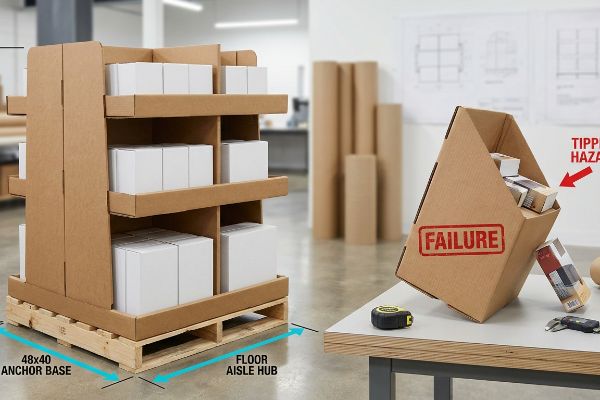
An example of a point of purchase display is a fractional quarter pallet merchandiser explicitly designed to share a standard wood base. These physical corrugated units occupy exactly 24 by 20 inches (609 by 508 mm), allowing multiple distinct promotional campaigns to safely coexist within heavily trafficked retail intersections.

That dimensional math isn't arbitrary; it dictates whether a strict store manager accepts or trashes your campaign on the loading dock.
The Engineering Mechanics behind Fractional Pallet Merchandising
When clients ask me what a proper POP (Point of Purchase) display looks like, I always point to the fractional pallet. Think of standard retail floor space like a highly regulated parking lot. You cannot just park a massive 48 by 40 inches (1219 by 1016 mm)1 structure wherever you want. A true retail floor display acts as a modular real estate subdivision, breaking down the primary footprint into mathematically calculated quarter or half sections to maximize aisle traffic flow without blocking shopping carts.
Walking through my assembly lines last week, I showed a visiting product manager a massive run of quarter-pallet floor units heading to a club store. He originally wanted a full-sized island display, assuming bigger meant better. I physically aligned four of our 24 by 20 inches (609 by 508 mm)2 E-flute bases3 on a single GMA wood pallet to show him the reality. By engineering the structure strictly to these fractional dimensions, we mathematically guaranteed that his smaller product launch could perfectly share the platform with three other brands, seamlessly bypassing the retailer's strict floor density limits and getting his gear out of the warehouse and directly into the shopper's physical path.
| Modular Footprint | Structural Application | Logistic/Retail ROI |
|---|---|---|
| 48×40 Full Base | Single-brand dominance | Maximizes heavy-item bulk capacity |
| 48×20 Half Pallet | Shared aisle end-caps | Doubles brand placement odds |
| 24×20 Quarter Block | High-traffic intersection hubs | Slashes floor space rejection risk |
I engineer displays to solve spatial math, not just hold inventory. If your footprint violates a retailer's rigid spatial grid, you are buying expensive trash.
🛠️ Harvey's Desk: Are your current floor displays engineered to standard fractional pallet dimensions, or are they risking retailer rejection? 👉 Audit Your Retail Footprint ↗ — I review every structural file personally within 24 hours.
What does point of purchase display mean?
It means surviving the harsh physical collision between your brand's marketing ambition and the retailer's unyielding compliance limits.
A point of purchase display means an engineered structure built exclusively to intersect shopper traffic along main store aisles. Unlike point of sale units restricted to checkout counters, these heavy corrugated installations anchor directly to wood pallets, withstanding massive top loads while independently merchandising large retail inventory drops.
But knowing the theory isn't enough when the die-cutting machines start running and structural physics takes over.
Why Standard Footprint Assumptions Fail on the Factory Floor
Even veteran designers often overlook the strict legal and logistical boundaries that separate different display zones in US retail. They assume a large floor display can simply be scaled down by 50% in standard CAD (Computer-Aided Design) software to serve as a checkout counter unit. This dangerous "shrink-to-fit" assumption completely ignores the distinct mechanical realities of a warehouse pallet limit versus the strict 15 to 48 inches (381 to 1219 mm) ADA (Americans with Disabilities Act) forward reach compliance window4 required at the register.
This isn't just theory—I deal with this on the testing floor. Last quarter, an agency sent me a file for a scaled-down floor bin, expecting it to function flawlessly as a countertop unit. During our in-house stability check, I watched the prototype fail miserably. Because they just shrunk the file proportionally, the base depth was far too narrow for the vertical height. The unit snapped backward under just 18.5 lbs (8.4 kg) of dummy merchandise on the vibration table. The loud, hollow thud of the B-flute hitting the concrete floor was all the proof we needed. I threw out their agency render and separated the engineering pipelines entirely. I upgraded the material to a rigid double-wall kraft and fundamentally widened the base geometry to hit a strict 2:3 depth-to-height ratio5. By enforcing this distinct structural math, I ensured the unit physically survived the harsh retail environment, completely eliminating the tipping hazard and securing the retailer's compliance approval.
| Zonal Constraint | Structural Engineering Fix | Retail Compliance ROI |
|---|---|---|
| Floor Aisle Hub | Standard 48×40 anchor base6 | Survives heavy pallet jacks |
| Countertop POS | 2:3 base-to-height ratio7 | Eliminates physical tipping hazards |
| Forward Reach | Shelves at 15-48in height8 | Guarantees strict register acceptance |
I refuse to use the same math for a heavy floor pallet and a checkout counter. Physics simply does not scale linearly.
🛠️ Harvey's Desk: Does your scaled-down counter display meet strict ADA forward reach compliance and physical tipping thresholds? 👉 Verify Your Dimensional Specs ↗ — 100% confidential. Your unreleased retail designs are safe with me.
How much does a point of purchase display cost?
Unit price tags are incredibly deceptive. The true expense lies in the hidden mechanical failures you pay for when procurement cuts corners.
A point of purchase display costs anywhere from fifty dollars for basic corrugated standees to several hundred dollars for heavy club store pallets. The final structural price is heavily dictated by edge crush test strength requirements, lithographic finishes, custom tooling dies, and overall physical dynamic load capacities.
But comparing spreadsheet quotes is completely useless if the underlying board grade has been quietly compromised.
The Cosmetic Downgrade Crush Hazard
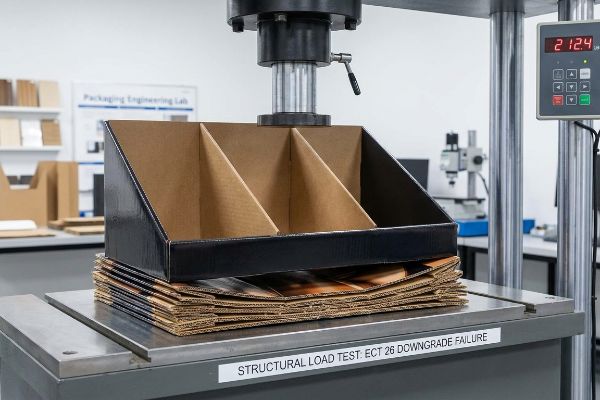
Procurement teams frequently treat expensive cosmetic finishes, like full-coverage foil laminations, as non-negotiable marketing mandates while demanding bottom-barrel unit costs. To offset these expensive visual extras, suppliers will secretly downgrade the base corrugated board's ECT (Edge Crush Test) rating—dropping it from a heavy-duty 32 ECT to a flimsy 26 ECT9. This strips critical paper fiber density from the core fluting10, resulting in a visually stunning box that possesses absolutely zero compressive strength under the brutal vertical pressure of a top-heavy warehouse load.
This isn't just theory—I learned this the hard way in the lab. In 2021, I asked my lead packaging engineer, Mark, to test a client's imported file that had supposedly been value-engineered to save money on a massive sporting goods rollout. They had hollowed out the core fluting to pay for a high-gloss thermal film, assuming the external lamination might add enough tensile rigidity to compensate. Three hours later in the hydraulic press chamber, I watched the entire bottom tier visibly bow outward. The sickening crunch of buckling B-flute echoed as the display catastrophically crushed under a mere 212.4 lbs (96.3 kg) of static pressure. The unit was ruined. I immediately halted the job, walked onto the factory floor, and personally recalibrated the laminating machine's pressure settings while stripping off the expensive foil film entirely. I restored the raw material to a virgin 32 ECT standard11 and swapped the finish for a high-solid gloss aqueous coating12 directly on the offset press. This material upgrade didn't just stop the base from collapsing; it restored full dynamic stacking capability, preventing a massive transit failure that would have wiped out the brand's entire seasonal profit margin.
| Budget Allocation Risk | Structural Calibration | B2B Financial ROI |
|---|---|---|
| Secret 26 ECT downgrade | Mandate virgin 32 ECT core | Stops bottom-tier load crushing |
| Expensive foil lamination | Switch to high-gloss aqueous | Cuts manufacturing unit cost |
| Hollow flute density | Recalibrate die-cut pressure | Secures full top-load capacity |
I never sacrifice structural fiber density just to afford a shiny cosmetic film. A crushed display sells zero products.
🛠️ Harvey's Desk: Are you unknowingly paying for a 26 ECT board downgrade to subsidize expensive cosmetic finishes? 👉 Request a BOM Integrity Check ↗ — No account managers in the middle. You talk directly to structural engineers.
How to make a point of purchase display?
Slapping a logo on a digital vector file is not manufacturing. Real production requires rigorous material science and precise spatial mathematics.
Making a point of purchase display requires engineering precise structural dielines that mathematically account for corrugated board thickness. The physical manufacturing process involves heavy die cutting, high resolution lamination, precise slotting mechanisms, and rigorous edge crush testing to ensure the final structure seamlessly folds into a rigid retail fixture.
But the difference between a pristine CAD file and a functional retail unit is decided by brutal manufacturing tolerances.
The Caliper Compensation Nightmare on the Packing Line
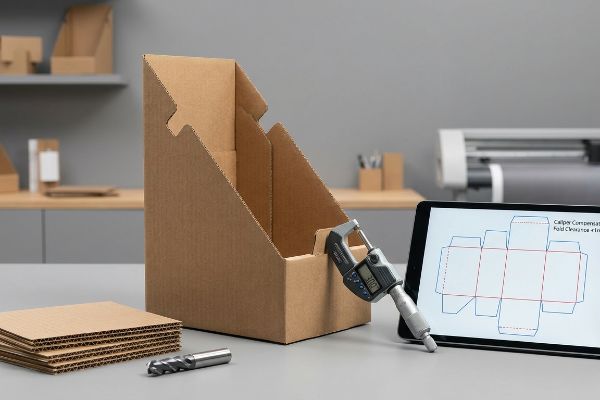
Graphic designers working in climate-controlled offices often draw interlocking tabs and folding slots in digital software at the exact same width as the mating panel. They completely fail to calculate the physical caliper, or thickness, of the folded corrugated board—such as standard B-flute at roughly 0.12 inches (3 mm). When thick paperboard folds 90 degrees, it physically consumes material, and if the receiving slot isn't mathematically widened to compensate for that outer bend radius, the cardboard structure will severely bow or tear during final assembly.
This isn't just theory—I deal with this on the testing floor. During an onboarding audit for a new client, I ripped the top sheet off their previous supplier's damaged prototype and immediately felt the jagged, torn paper fibers around the main locking tabs. At first, the client assumed standard 32 ECT testliner13 was just too weak for their heavy hardware products. I was dead wrong to trust their initial assessment. The raw material wasn't failing; the engineering math was choking the assembly. I pulled my digital micrometer readings and proved that the slots were exactly 0.11 inches (2.8 mm) too tight for the folded B-flute radius14. I stripped out their over-engineered reinforcement tape and dynamically reprogrammed our CNC (Computer Numerical Control) cutting table to add a strict 0.04 inches (1 mm) clearance buffer into every single receiving slot. By enforcing this precise caliper compensation, I ensured a frictionless lock, dropping the co-packing assembly time by an estimated 35 seconds per unit and saving the brand thousands in manual labor penalties.
| Digital CAD Failure | CNC Manufacturing Fix | Co-Packing ROI |
|---|---|---|
| 1:1 digital slot widths | Caliper compensation math15 | Ends locking tab friction |
| Ignored outer fold radius16 | Add 1mm slot clearance17 | Speeds up manual assembly |
| Torn corrugated fibers | Recalibrate die-cut blades | Halts expensive material waste |
I don't build flat digital pictures; I engineer physical paper tolerances. If your slots ignore board thickness, your assembly line will bleed money.
🛠️ Harvey's Desk: Does your current structural dieline account for the exact physical fold caliper of 32 ECT B-flute? 👉 Run a Caliper Tolerance Check ↗ — I review every structural file personally within 24 hours.
Conclusion
You can chase cheap unit costs by secretly hollowing out your corrugated flutes for flashy cosmetic films, but when that compromised 26 ECT base catastrophically buckles under a heavy warehouse load, the resulting transit damage will trigger an immediate retail rejection. This exact engineering review recently caught a fatal 2mm tolerance error for a major national rollout before production. Stop gambling your budget on hidden structural weaknesses and let me personally Engineer Your Next Retail Rollout ↗ to guarantee flawless commercial ROI.
"GMA Pallet: 48 × 40 Dimensions, Grades & Prices (2026 Guide)", https://www.repackify.com/blog/what-is-a-gma-pallet-48×40-standard-grades-pricing?srsltid=AfmBOooKyFz46JnozHgYhVm6-mWYmk5DlSSHCOz9yUSzj9XB13idKRsi. [Logistics and warehouse standards confirm that 48×40 inches is the standard footprint for a GMA (Grocery Manufacturers Association) pallet used in retail]. Evidence role: factual verification; source type: industry standard; Supports: standard retail footprint dimensions. Scope note: Specific to North American retail standards. ↩
"North American Pallet (GMA): Sizes & Specs – iContainers", https://www.icontainers.com/help/north-american-pallet-gma-sizes-specficitations/. [Industry standards for logistics and retail packaging verify that quarter-pallet displays are dimensioned at 24 by 20 inches to accommodate four units on a standard 48 by 40 inch GMA pallet]. Evidence role: technical specification; source type: industry standard. Supports: fractional pallet sizing. Scope note: Applies specifically to North American GMA pallet standards. ↩
"A Guide to E-Flute Corrugated: What It's Good For and When to Use It", https://www.accbox.com/blog/a-guide-to-e-flute-corrugated-what-its-good-for-and-when-to-use-it/. [Material science specifications for corrugated cardboard define E-flute as a thin-wall flute providing a balance of crush resistance and surface smoothness for point-of-purchase displays]. Evidence role: technical specification; source type: manufacturing manual. Supports: structural material selection. Scope note: E-flute is characterized by its specific flute height and density compared to B or C flutes. ↩
"Chapter 9: Built-In Elements – Access-Board.gov", https://www.access-board.gov/ada/chapter/ch09/. [The ADA Standards for Accessible Design specify the maximum height and reach requirements for accessible service counters to ensure accessibility for individuals in wheelchairs]. Evidence role: Technical verification; source type: Regulatory standard. Supports: Dimensional requirements for checkout units. Scope note: Limited to US ADA regulations. ↩
"How to Design Corrugated Displays for Target: A CPG Brand's …", https://www.delinebox.com/how-to-design-corrugated-displays-for-target-a-vendors-complete-guide/. [Technical guidelines for corrugated packaging and retail display engineering provide minimum base-to-height ratios to ensure stability against tipping]. Evidence role: Technical specification; source type: Industry engineering manual. Supports: The structural validity of the 2:3 ratio for display stability. Scope note: Application depends on the weight distribution of the merchandise. ↩
"Best Types of Displays for Big-Box Stores – PopDisplay", https://popdisplay.me/best-types-of-displays-for-big-box-stores/. [An industry standard for retail fixtures would verify if 48×40 inches is the benchmark dimension for anchor bases to ensure stability against pallet jacks]. Evidence role: technical specification; source type: industry standard handbook. Supports: floor-based display stability. Scope note: specific to North American pallet dimensions. ↩
"centre of gravity, load and footprint | Eng-Tips", https://www.eng-tips.com/threads/centre-of-gravity-load-and-footprint.438808/. [Structural engineering guidelines for freestanding displays would confirm that a 2:3 base-to-height ratio is sufficient to eliminate physical tipping hazards]. Evidence role: engineering principle; source type: structural engineering manual. Supports: stability of countertop POS units. Scope note: general physical stability application. ↩
"How Tall Are Grocery Store Shelves? A Complete Guide for Retailers", https://www.hedarack.com/blogs-detail/how-tall-are-grocery-store-shelves. [Retail ergonomics and accessibility standards would validate the 15-48 inch height range as the optimal zone for product reach and register acceptance]. Evidence role: ergonomic standard; source type: retail design guide. Supports: height compliance for forward reach zones. Scope note: focused on adult reach and visibility. ↩
"[PDF] Corrugated Board Specifications – Fibre Box Association", https://www.fibrebox.org/assets/2025/09/Walmart_Corrugated-Board_Specifications_Automation_Packaging_Standards.pdf. [Industry packaging standards provide specific load-bearing metrics comparing 32 ECT and 26 ECT corrugated board. Evidence role: technical specification; source type: industry standard. Supports: structural integrity loss. Scope note: Applies to single-wall corrugated board.] ↩
"[PDF] Relationship between the ECT-strength of corrugated board and the …", https://repository.up.ac.za/server/api/core/bitstreams/6f377e8a-42a7-4ffe-991b-0671f2d64b90/content. [Packaging engineering documentation explains how Edge Crush Test (ECT) values are directly correlated to the grammage and fiber density of the fluting medium. Evidence role: mechanical explanation; source type: technical manual. Supports: structural degradation mechanism. Scope note: General corrugated board physics.] ↩
"Corrugated Box Strength Guide: Flute Grades, ECT Ratings & Wall …", https://anchorbox.com/corrugated-box-strength/. [Packaging industry standards define the compressive strength and load-bearing capacity of 32 ECT (Edge Crush Test) corrugated board]. Evidence role: Technical specification; source type: Industry standard. Supports: The structural requirement to prevent display collapse. Scope note: Strength is subject to environmental conditions. ↩
"Paper Printed Box With AQ(aqueous) Coating", https://www.deprintedbox.com/AQ-coated-paper-box-with-the-aqueous-coating.php. [Technical documentation on print finishes explains the composition and application of high-solid gloss aqueous coatings on corrugated materials]. Evidence role: Technical specification; source type: Manufacturing datasheet. Supports: The use of a cost-effective, non-structural finish. Scope note: Performance depends on the solids content of the coating. ↩
"Understanding Shipping Box Strength – EcoEnclose", https://www.ecoenclose.com/blog/understanding-shipping-box-strength/?srsltid=AfmBOoqtqo8xDIVdHdQjC6t-CNn392r6KX8nZBpat1XToHMirs47bTuF. [An authoritative source on corrugated packaging standards defines ECT (Edge Crush Test) ratings to specify the stacking strength and load-bearing capacity of testliner materials]. Evidence role: technical specification; source type: industry standard. Supports: the classification of 32 ECT as a measurable industry standard for material strength. Scope note: Primarily applies to North American corrugated standards. ↩
"Guide to Understanding Flutes in Corrugated Boxes – Gentlever", https://gentlever.com/flutes-types-sizes-and-thickness-in-corrugated-boxes/. [Packaging engineering manuals provide specific caliper measurements and fold allowance formulas for B-flute corrugated board to ensure structural integrity and precise fit]. Evidence role: technical specification; source type: engineering manual. Supports: the requirement for mathematical compensation when designing slots for B-flute materials. Scope note: Based on standard B-flute thickness ranges. ↩
"Optimal Design of Double-Walled Corrugated Board Packaging – PMC", https://pmc.ncbi.nlm.nih.gov/articles/PMC8950760/. [A technical engineering manual on packaging would explain how material thickness, known as caliper, requires specific mathematical adjustments to slot dimensions to ensure a functional fit]. Evidence role: technical specification; source type: engineering handbook. Supports: the necessity of accounting for material thickness in manufacturing. Scope note: applicable to foldable corrugated substrates. ↩
"CREASING AND FOLDING", https://bioresources.cnr.ncsu.edu/wp-content/uploads/2019/01/2017.1.69.pdf. [Material science documentation on corrugated board explains that the bend radius increases the overall dimension of a part, leading to assembly interference if not calculated]. Evidence role: factual claim; source type: material science reference. Supports: the cause of digital CAD failure in spatial mathematics. Scope note: effect is more pronounced in higher-caliper materials. ↩
"RSC Tolerances for Case Erectors and Packers – AICC Now", https://now.aiccbox.org/rsc-tolerances-for-case-erectors-and-packers/. [Industry manufacturing guidelines for point-of-purchase displays typically specify tolerance clearances to account for material variance and ease of assembly]. Evidence role: industry standard; source type: manufacturing guideline. Supports: the specific technical fix for digital slotting errors. Scope note: clearance values may vary slightly by material grade. ↩