Buying second-hand equipment sounds like a genius way to save a few bucks, but in the retail game, "used" usually means "invisible" or "broken."
Yes, you can buy used fixtures and displays from retail companies, specifically permanent assets like metal gondolas, glass showcases, and wire racks found at liquidation sales. However, temporary POP (Point of Purchase) displays made of corrugated cardboard are engineered for single-use cycles and cannot be purchased used due to material degradation, lack of structural integrity, and brand-specific customization.
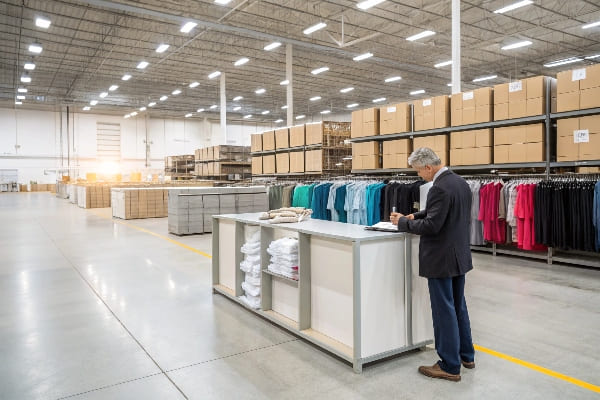
The difference is simple: metal is an asset that lasts for years; cardboard is a "sales machine" designed to burn out in 6 weeks.
What are the types of fixtures used in retail stores?
If you don't know the difference between a "fixture" and a "display," you are going to waste your budget on the wrong gear.
The types of fixtures used in retail stores are primarily classified into three categories based on material lifespan and function:
- Permanent Fixtures: Heavy-duty steel or wood gondola shelving systems designed for 5–10 years of heavy inventory storage.
- Semi-Permanent Displays: Acrylic, wood, or wire units (POSM – Point of Sales Materials) built for 6–12 month promotional cycles.
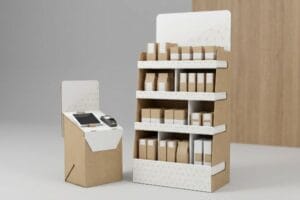
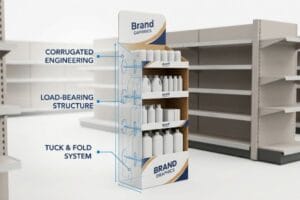
- Temporary POP Displays: Corrugated cardboard structures (FSDUs – Free Standing Display Units) engineered for 4–8 week specific campaigns.
The Structural Anatomy and "Invisible" Engineering
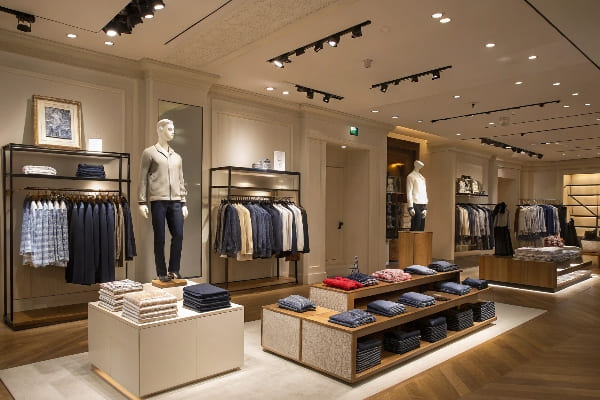
When clients come to me asking to "reuse" a display, I have to give them a reality check on physics. There is a massive engineering gap between a Permanent Fixture and a Temporary Cardboard Display. Permanent fixtures—like the heavy Lozier shelves you see in Walmart—are "Infrastructure." They are made of powder-coated steel, bolted to the floor, and designed to hold thousands of pounds (kilograms) of static weight for a decade. They are necessary, but they are boring. They blend into the background.
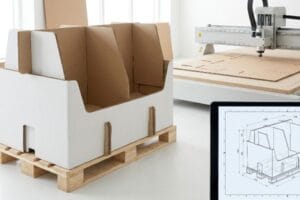
My world is the Temporary POP Display1. These aren't just boxes; they are "Visual Disruptors." But making paper act like a fixture is tricky. We have to manipulate the Grain Direction2 of the corrugated board to trick the paper into having vertical column strength. If a designer places the grain horizontally on a load-bearing wall to save paper scraps, that display will buckle immediately under weight. I learned this the hard way years ago with a wine display. We tried to save 5% on material by rotating the grain. It looked fine in the factory, but once it hit the humidity of a real store, it collapsed. It was a disaster.
Now, I don't mess around. I use high-grade Virgin Kraft Liner3 for structural parts instead of recycled testliner. The long fibers in Virgin Kraft provide tensile strength that allows a lightweight B-flute to hold 50 lbs (23 kg). Recycled fibers are short and snap like dried twigs under pressure. So, while you can buy a used metal shelf, you can't buy the "engineering freshness" of a new cardboard display. Used cardboard is just pre-collapsed fiber. Plus, major retailers like Costco have strict "No-Overhang" rules. A used display from a different chain likely won't fit the specific 48×40 inch (122×102 cm) pallet grid required by your new retail partner, leading to instant rejection at the distribution center.
| Feature | Permanent Fixture (Metal/Steel) | Temporary Display (Cardboard) |
|---|---|---|
| Primary Material | Powder-coated Steel / Glass | Corrugated Board / Virgin Kraft |
| Intended Lifespan | 5 to 10 Years | 4 to 12 Weeks |
| Load Capacity | 500+ lbs (227+ kg) per shelf | 20–50 lbs (9–23 kg) per shelf |
| Recyclability | Low (Scrap Metal) | High (Curbside OCC) |
| Customization | Low (Standard Grid) | High (Full Print/Shape) |
So, don't try to buy used cardboard. You aren't paying for the material; you're paying for the structural integrity that only exists in the first 60 days.
How often should retailers change their displays?
A stale display is worse than an empty floor space because it tells the shopper your brand is tired.
Retailers should change their displays every 4 to 6 weeks. This frequency is dictated by the "Shopper Decision Fatigue" cycle and the physical degradation of corrugated materials, which typically lose structural integrity after 45 days (1.5 months) of exposure to retail floor humidity and cleaning routines.
The "Soggy Bottom" Reality and Material Fatigue
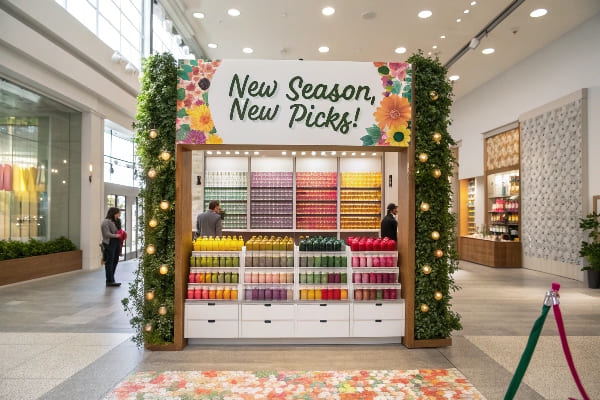
There are two forces fighting against your display: human psychology and industrial cleaning machines. First, let's talk about the messy reality of the "Soggy Bottom" effect. In US supermarkets, floor cleaning crews don't care about your brand. They run massive industrial wet-mops every night, splashing dirty water against the base of every fixture.
Cardboard acts like a sponge. When that water hits the raw edge of a standard display, it wicks up through the capillary action of the flutes. I've seen displays that cost $45 turn into leaning towers of mush within three weeks because the base got wet. It looks terrible. To fight this, I implemented a strict protocol in my factory: we apply a clear, biodegradable Water-Resistant Varnish4 or a "Mop Guard" to the bottom 2 inches (5 cm) of every floor unit. It adds cost, but it prevents the display from collapsing before the product sells out.
Then there is the "Kill Date5". We print a code on the back of displays telling store staff when to trash it. Why? Because of Shopper Decision Fatigue6. If a customer walks past the same red stand for 8 weeks, their brain filters it out as "background noise." You have to change the shape or the header card to reset that visual trigger. I had a client who insisted on keeping a Halloween display up until mid-November because "it wasn't empty yet." Sales flatlined. It looked sad. We also have to watch out for Litho-Cracking7. If you ship a display from my humid factory in China to a dry climate like Las Vegas, the paper dries out and cracks at the folds. We now use special elastic coatings for those regions.
| Time on Floor | Structural Status | Marketing Impact | Recommended Action |
|---|---|---|---|
| Week 1-2 | 100% Rigid | High (Disruptive) | Full Stock Maintenance |
| Week 3-4 | 90% Rigid (Minor Scuffs) | Medium (Familiar) | Rotate Stock / Clean |
| Week 5-6 | 70% Rigid (Base Wicking) | Low (Invisible) | Discount & Plan Removal |
| Week 7+ | <50% Rigid (Leaning) | Negative (Brand Damage) | Immediate Trash/Recycle |
You need to plan your inventory turn to match the lifespan of the paper. If you try to make a cardboard display last 6 months, you are just displaying garbage.
Who sets up store displays?
The best design in the world is worthless if it ends up in the compactor because it was too hard to build.
To set up store displays efficiently, the task is typically assigned to one of three operational groups:
- Store Personnel: Internal staff who assemble flat-packed units during downtime.
- Third-Party Merchandisers: External agencies hired to ensure planogram compliance.
- Co-Packers: Manufacturing teams that assemble and fill the units (pre-loading) at the factory level.

The Instruction Manual Crisis and "Red Bag" Protocol
Here is the truth: nobody reads the manual. I've visited backrooms in Target and Walmart where I saw piles of my beautiful displays in the trash, unbuilt. Why? Because the assembly instructions were a single sheet of dense text, and the busy stock clerk didn't have 20 minutes to decipher it. This is the "Last Mile" problem of our industry.
If the setup relies on an overworked 19-year-old store employee, the design must be intuitive. We moved away from complex "origami" folds. Now, we use IKEA-style "No-Text" Visual Assembly Guides. Even better, we print a giant QR Code on the outside flap of the master shipper. One scan, and it opens a 30-second YouTube video showing exactly how to pop it open. No reading required.
We also introduced the "Red Bag" Strategy8. In a busy store, small plastic clips disappear instantly. If a display needs 4 clips and one is missing, the whole unit is trash. Now, we tape a bright Red Bag to the front of the instructions containing 5% spare hardware. It costs me pennies, but it saved a major launch for a toy client last year. Furthermore, for the biggest retailers like Costco, we don't even trust the store staff. We use Co-packing. We build the display in my factory, load your product, put a shroud around it, and ship it ready-to-sell. This requires passing ISTA 3A Drop Tests—we literally drop the loaded pallet to prove it won't crush during ocean freight. It's expensive shipping "air," but it guarantees execution.
| Assembly Model | Pros | Cons | Ideal For |
|---|---|---|---|
| Flat-Pack | Lowest Shipping Cost | High Risk of User Error | Simple Bins / small PDQs |
| Merchandiser | High Quality Control | Expensive Labor Fees | Complex / Interactive Units |
| Pre-Filled (Co-Pack) | 100% Execution Rate | High Freight Cost | High Volume (Costco/Sam's) |
If you rely on a stressed employee to figure out your complex engineering, you will fail. Make it so simple they can't mess it up.
What is product display in retail?
It is the art of stopping a moving cart. It turns a passive product into an active interruption.
Product display in retail (Visual Merchandising) is the strategic technique of presenting merchandise to maximize sales traction. It involves utilizing specific fixtures like FSDUs (Free Standing Display Units) and PDQ trays (Pretty Darn Quick) to isolate products from the shelf, leveraging color, height, and lighting to disrupt the shopper's visual field.
The Science of "Visual Disruption" and Color Physics
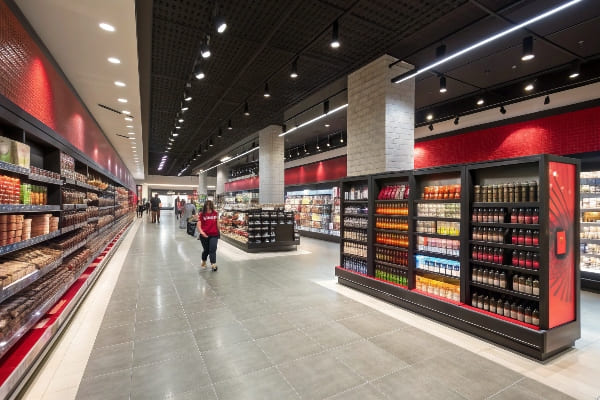
Why do brands pay for a cardboard stand when they have shelf space? Because the shelf is a graveyard of competition. A freestanding display creates a "Strike Zone9"—a dedicated space where your product is the only hero. But getting attention isn't just about being big; it's about color physics and structural ergonomics.
Let's talk about Color Management10. This is where most projects fail. Marketing managers approve designs on bright, backlit MacBook screens (RGB Color Mode). But printing uses ink on paper (CMYK). This leads to the "Muddy Color" disappointment, where a vibrant "Coke Red" comes out looking like a dull brick color. In my factory, we use GMG Color Proofing11 systems. I force my clients to sign off on a physical proof on the actual paper stock, not a digital file. We measure the color accuracy using a Spectrophotometer to ensure the Delta-E (color difference) is less than 2.0. If we don't do this, the display looks cheap, and cheap displays don't disrupt shoppers.
We also engineer the "Strike Zone" based on human height. The average shopper's eye level is around 50–54 inches (127–137 cm). We design the "Hero Product" shelf exactly at this height. For lower shelves, we use a "Chin-Up" Angled Design, tilting the shelf upwards by 15 degrees. This simple geometry trick means a customer standing 3 feet (1 meter) away can read the label without crouching. I once argued with a client who wanted flat shelves all the way down. I convinced them to try the angled bottom shelf, and the sales data showed a 20% lift in units sold from that bottom tier. It wasn't magic; it was ergonomics.
| Zone Name | Height from Floor | Shopper Value | Best Product Type |
|---|---|---|---|
| Eye Level | 48" – 60" (122-152 cm) | Prime Real Estate | New Launch / High Margin |
| Touch Level | 30" – 48" (76-122 cm) | High Interaction | Best Sellers / Kids Items |
| Stoop Level | 0" – 30" (0-76 cm) | Low Visibility | Bulk Packs / Refills |
It is not just a box with a logo. It is a machine designed to manipulate the eye, reflect light, and physically present the product to the hand.
Conclusion
Buying used fixtures is fine for storage, but it fails for marketing. You need fresh engineering to stop the shopper.
If you are worried about your display collapsing or colors looking dull, ask me for a Free Structural 3D Rendering or a Physical White Sample to test the strength yourself.
Explore how Temporary POP Displays can enhance visual marketing and attract customers effectively. ↩
Understanding Grain Direction is crucial for designing strong displays; learn how it impacts structural integrity. ↩
Discover the advantages of Virgin Kraft Liner in creating durable and lightweight packaging solutions. ↩
Explore this link to understand how Water-Resistant Varnish can protect your displays from moisture damage. ↩
Learn about the importance of a Kill Date in retail to optimize product turnover and sales. ↩
Discover strategies to combat Shopper Decision Fatigue and enhance customer engagement in your store. ↩
Find out how Litho-Cracking affects product displays and what can be done to prevent it. ↩
Learn about the "Red Bag" Strategy and its effectiveness in ensuring complete assembly kits for retail displays. ↩
Understanding the 'Strike Zone'can help you optimize product placement for maximum visibility and sales. ↩
Explore how effective Color Management can prevent costly printing errors and enhance brand representation. ↩
Learn about GMG Color Proofing to ensure your printed materials match your digital designs perfectly. ↩