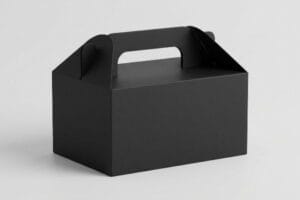
Struggling to get your CBD tinctures noticed in crowded US dispensaries? Generic boxes won't cut it. You need engineered retail displays that command attention and protect fragile glass.
CBD (Cannabidiol) display packaging is specialized retail merchandising designed to securely hold, present, and protect cannabis-derived products. These structures utilize high-strength corrugated cardboard, precise structural inserts, and premium printing techniques to ensure strict legal compliance while maximizing shelf visibility in highly competitive dispensary and pharmacy environments.

But understanding the definition is only the first step; executing it flawlessly on the factory floor is where most campaigns either win or fail.
What Does Cbd Packaging Look Like?
When envisioning premium wellness drops, brands immediately gravitate toward matte, velvety textures to signal natural luxury.
CBD packaging looks like a premium, tactile extension of the wellness product itself. It typically features soft-touch finishes, earthy or deep spot-color floods, and custom die-cut windows, intentionally crafted to project an organic, high-end aesthetic that reassures consumers of the product's safety.

Achieving that dark, velvety look on a computer screen is easy, but the physical chemistry of printing it is a completely different beast.
The "Soft Touch" Darkening Trap
Most graphic designers submit beautiful, vibrant CMYK (Cyan, Magenta, Yellow, Key) artwork for their CBD cartons, strictly mandating a soft-touch thermal lamination1 to give it that expensive, dispensary-ready feel. They casually approve the digital proofs, expecting the final corrugated retail display to match their glowing computer monitors perfectly.
I see this mistake constantly. A buyer will demand premium soft-touch film over a dark green brand color, completely ignoring the microscopic bi-axially oriented polymer structure of the film itself. This film acts like a physical light vacuum. When I run my thumb across the newly laminated sheet, I can feel that satisfying velvet drag—but optically, the film just darkened the printed pigment by up to 5%2. If you don't use a strict Lamination Compensation Curve in the prepress RIP3 (Raster Image Processor) software to preemptively boost the ink densities, your vibrant branding turns into a muddy, unreadable mess, causing a massive Delta-E compliance failure right before launch.
| Common Rookie Mistake | The Pro Fix | Retail-Floor Benefit |
|---|---|---|
| Ignoring lamination color shift | Prepress ink density boost4 | Maintains vibrant brand visibility |
| Approving unlaminated digital proofs | Spectrophotometer scan of laminated drawdown | Eliminates Delta-E compliance failures5 |
| Using generic glossy finishes | Soft-touch tactile films6 | Triggers premium impulse purchases |
I always force a physical color scan under D50 lighting with the actual lamination applied before we mass-produce. It saves my clients from deploying dull, lifeless displays into high-end retail spaces.
🛠️ Harvey's Desk: Not sure if your chosen lamination will muddy your brand colors? 👉 Request A Material Drawdown ↗ — Direct access to my desk. Zero automated sales spam, I promise.
Does Cbd Actually Have Any Benefits?
Shoppers want to know exactly what a wellness product will do for them, leading brands to panic and over-explain every possible health perk.
Yes. CBD actually has benefits, but packaging must communicate them instantly. Rather than listing exhaustive medical claims, effective dispensary displays isolate a single, primary objective—like sleep aid or joint relief—using high-contrast messaging to trigger immediate shopper recognition without causing cognitive overload in the retail aisle.
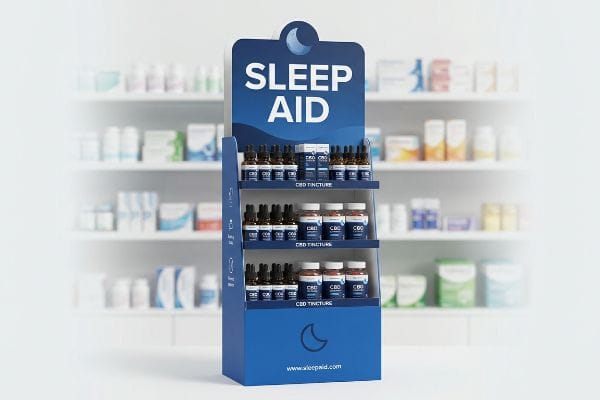
Knowing the benefits of your tincture is great, but trying to print a medical journal on a cardboard header will quickly kill your sales.
The Cognitive Overload Epidemic
It is incredibly common for marketing teams to use comprehensive consumer behavior frameworks, mapping out every possible reason someone might buy their tinctures or gummies. They then attempt to print all of these detailed, multi-layered bullet points directly onto the physical floor display to educate the consumer.
Here is the harsh reality of a busy US pharmacy: a rushing shopper cannot process a wall of text7. I recently watched a store clerk struggling to assemble a heavily-printed endcap, sweating and frustrated as they tried to align three different text-heavy side panels using messy clear tape just to hold the corners together. When the display is finally up, the visual clutter actively hides the core product offer. If you don't ruthlessly distill your research into a single, massive 3D die-cut element targeting one specific purchasing occasion, shoppers will just physically ignore the unit.
| Common Rookie Mistake | The Pro Fix | Retail-Floor Benefit |
|---|---|---|
| Printing paragraphs of health claims | Single objective-isolation messaging | Prevents shopper cognitive overload8 |
| Using small complex fonts | Massive 3D die-cut focal points | Grabs attention from 30 feet away9 |
| Cluttering the base with text | Bold spot-color floods | Forces eye contact to the product10 |
I strip away secondary marketing copy on every floor display I engineer. You have exactly three seconds to trigger a psychological purchasing response before the shopper walks away.
🛠️ Harvey's Desk: Are your current displays acting like chaotic billboards instead of silent salespeople? 👉 Claim A Visual Impact Review ↗ — Download safely. My inbox is open if you have questions later.
What Are the Benefits of Using Custom Packaging?
Off-the-shelf generic boxes might seem cheaper initially, but they offer absolutely zero protection for the delicate containers holding expensive botanical oils.
The primary benefits of using custom packaging include precision structural protection, exact spatial tolerances, and premium unboxing experiences. Custom engineering suspends fragile glass bottles safely within the carton, absorbing kinetic shock during transit while perfectly aligning with the brand's unique visual identity.
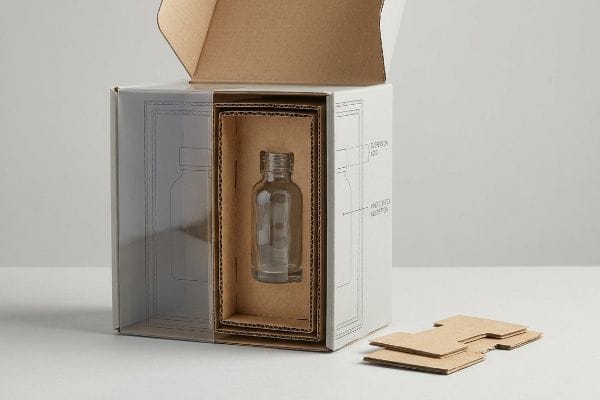
Creating a box that just 'fits'the product is a rookie baseline; creating a box that survives the logistics network requires real physics.
The Kinetic Transfer Catastrophe
Many emerging wellness brands measure the exact exterior of their primary 30ml glass tincture bottles and demand a paperboard carton that wraps it at a perfect 1:1 ratio. They operate under the dangerous assumption that a skin-tight fit provides maximum security against rattling11.
Think of it like wearing a motorcycle helmet with absolutely no foam padding inside. Without an engineered internal spatial buffer, any drop on the rigid outer carton transfers 100% of the kinetic shock directly into your fragile primary container12. I have heard the sickening sound of shattered glass inside a supposedly perfectly sized box after a basic 3 feet (0.91 m) drop test. To fix this, I mathematically expand the interior dimensions to seamlessly integrate a custom die-cut suspension insert. This creates a strict minimum 0.125 inches (3.17 mm) physical clearance from all outer walls13, utilizing the trapped air to absorb the LTL (Less-Than-Truckload) freight shock entirely.
| Common Rookie Mistake | The Pro Fix | Retail-Floor Benefit |
|---|---|---|
| 1:1 skin-tight carton sizing | Suspension void dimensional protocol | Prevents shattered glass bottles |
| Ignoring kinetic drop shock | Minimum 0.125-inch physical clearance14 | Drastically reduces return rates |
| Generic foam peanuts | Custom die-cut paperboard inserts15 | Speeds up co-packing assembly |
I refuse to engineer a tight wrap for fragile liquid containers. Mandating an internal suspension void is the only way I can guarantee your product survives the journey to the shelf.
🛠️ Harvey's Desk: Are your fragile glass bottles absorbing every bump of the LTL freight journey? 👉 Get A Structural Insert Audit ↗ — No forms that trigger endless sales calls. Just pure value.
What Is Cbd Packaging?
This packaging isn't just a transport vessel; it is a highly regulated compliance tool that must simultaneously and aggressively merchandise the product.
CBD packaging is a specialized intersection of legal compliance and structural marketing. It encompasses everything from child-resistant primary containers to secondary corrugated merchandisers. Effective structures are meticulously engineered to showcase mandatory dosage claims and brand equity while physically securing high-value inventory.
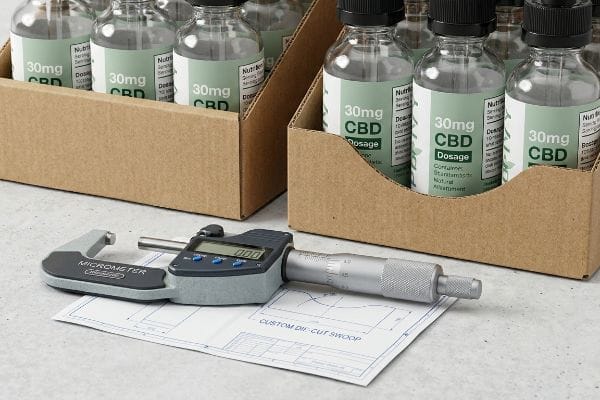
But knowing the theory isn't enough when the machines start running and federal compliance is on the line.
The Dosage Obscuration Trap
A massive blind spot occurs when buyers transition their perfectly compliant tinctures into corrugated RRP (Retail Ready Packaging)16 or floor displays. They often rely on standard, pre-existing structural dielines with generic front retaining lips17 to hold the bottles in place, assuming an off-the-shelf tray will work perfectly.
In my facility, I routinely see brands fail to realize that this standard 2 inches (50.8 mm) retaining lip18 acts as a physical wall, completely hiding the critical milligram dosage printed on the bottom half of their primary bottle. During pre-production testing, I physically place the bottle into the tray and measure the visibility line. If the lip obscures the legal dosage or the core marketing claim, the display is commercially useless. I pull the micrometer readings and map the exact physical bottle dieline directly into my CAD (Computer-Aided Design) software. By engineering a custom die-cut swoop on the front lip with a tight 2.4 mm tolerance, I ensure 100% unobstructed visibility of the dosage claim. This micro-adjustment prevents immediate retailer rejections and saves clients from debilitating compliance chargebacks19.
| Common Rookie Mistake | The Pro Fix | Retail-Floor Benefit |
|---|---|---|
| Using generic retaining lips | Label-clearance mapping in CAD20 | Ensures 100% dosage visibility |
| Hiding compliance text | Custom die-cut front swoops | Prevents retailer chargebacks21 |
| Guessing visibility lines | Physical bottle micrometer testing22 | Increases impulse purchase conversions |
I never approve a structural file without digitally importing the primary bottle's artwork first. Your packaging must seamlessly merge regulatory compliance with rock-solid structural stability.
🛠️ Harvey's Desk: Is your current display lip hiding the most important selling point on your bottle? 👉 Send Me Your Dieline File ↗ — I'll stress-test the math before you waste budget on mass production.
Conclusion
You can choose a cheaper vendor for your custom trays, but when a generic retaining lip actively hides your critical milligram dosage claims, you risk triggering an immediate retailer rejection and completely wiping out the project's profit margin. Over 500 brand managers use my prepress checklist to avoid these exact fatal early-stage mistakes. Stop guessing on structural tolerances and let me personally run your files through my Free Dieline Audit ↗ to catch visibility and kinetic friction errors before mass production begins.
"What Is Color Accuracy in Packaging? Pantone Matching …", https://3dcolor.com/what-is-color-accuracy-in-packaging-pantone-matching-delta-e-and-why-brand-color/. Technical explanation of how soft-touch thermal lamination alters the light refraction and perceived color saturation of CMYK prints. Evidence role: Technical specification; source type: Printing industry manual. Supports: The technical properties of the finish used in premium CBD packaging. Scope note: Specifically applies to thermal-bonded matte films. ↩
"Soft Touch Laminating Film – Velvet Matte Finish, Premium …", https://www.mybinding.com/collections/soft-touch-laminating-film?srsltid=AfmBOorJBd7eujVoFO7XWjRiiERzw4jp8ERMeGbbzH7RXgw-7GhRV_LX. Technical printing guides quantify the optical shift and ink density reduction caused by matte or soft-touch lamination overlays. Evidence role: quantitative verification; source type: printing industry manual. Supports: the specific percentage of pigment darkening. Scope note: Variance may occur based on film micron thickness. ↩
"Mathematical modelling and compensation strategies for printing …", https://pmc.ncbi.nlm.nih.gov/articles/PMC12574880/. Software documentation for Raster Image Processors describes the application of compensation curves to adjust ink levels for finishing effects. Evidence role: procedural verification; source type: software technical documentation. Supports: the necessity of preemptive ink boosting. Scope note: Specific to professional-grade RIP workflows. ↩
""Darker" or "brighter" print (ink density?)", https://printplanet.com/threads/darker-or-brighter-print-ink-density.292745/. Technical documentation on adjusting ink density during the prepress phase to counteract the darkening effect caused by certain lamination films. Evidence role: Procedural proof; source type: Printing industry guide. Supports: Method for maintaining color vibrancy post-lamination. Scope note: Dependent on the specific type of film used. ↩
"What Is Delta E? And Why Is It Important for Color Accuracy?", https://www.viewsonic.com/library/creative-work/what-is-delta-e-and-why-is-it-important-for-color-accuracy/. Technical verification of how spectrophotometer measurements of physical drawdowns prevent Delta-E color variance errors in professional printing. Evidence role: Technical verification; source type: Industry standard/Technical manual. Supports: Use of spectrophotometry for color compliance. Scope note: Specific to printing and lamination workflows. ↩
""Consumer Perception of Tactile Packaging: A Research Study on …", https://repository.rit.edu/japr/vol7/iss1/1/. Research on how haptic packaging elements like soft-touch films influence consumer perceptions of luxury and purchase intent. Evidence role: Behavioral evidence; source type: Marketing study/Academic journal. Supports: Link between tactile finish and premium brand positioning. Scope note: Effects may vary across different product categories. ↩
"The Effect of Product Density on Perceived Price and Quality", https://aquila.usm.edu/cgi/viewcontent.cgi?article=1258&context=honors_theses. Authoritative research in consumer psychology supports the claim that high information density in retail environments causes cognitive overload, leading shoppers to ignore messaging. Evidence role: theoretical framework; source type: academic journal. Supports: the claim that complex text is processed poorly during rapid shopping trips. Scope note: varies by product category. ↩
"The Impact of Information Overload of E-Commerce Platform on … – PMC", https://pmc.ncbi.nlm.nih.gov/articles/PMC9265496/. Research on consumer psychology explains how minimizing information density reduces cognitive load and improves decision-making. Evidence role: theoretical foundation; source type: peer-reviewed journal. Supports: the benefit of single objective-isolation messaging. Scope note: effects vary by product complexity. ↩
"Creating Immersive Retail Displays with 3D Dimensional Design", https://www.cracustom.com/blog/blog-12/visual-merchandising-creating-immersive-retail-displays-with-3d-dimensional-design-350. Visual merchandising guidelines define visibility thresholds for signage and 3D elements to attract customers from a distance. Evidence role: industry standard; source type: design guide. Supports: the effectiveness of massive 3D die-cuts for long-range attraction. Scope note: dependent on ambient lighting and aisle width. ↩
"Eye-Tracking Evidence on How Product Visual Strategy … – PMC", https://pmc.ncbi.nlm.nih.gov/articles/PMC13010595/. Eye-tracking studies demonstrate that high-contrast color floods effectively direct visual attention toward a specific focal point. Evidence role: empirical data; source type: marketing research study. Supports: the claim that spot-color floods guide eye contact. Scope note: varies based on color theory and palette. ↩
"Packaging Glasses: From Containers to Encapsulation Composition …", https://pmc.ncbi.nlm.nih.gov/articles/PMC12897758/. Technical explanation of kinetic energy transfer and shock absorption, demonstrating why rigid, zero-tolerance fits increase the risk of breakage in glass containers compared to engineered cushioning. Evidence role: technical contradiction; source type: packaging science manual. Supports: The claim that skin-tight fits are a dangerous assumption for security. Scope note: Specific to transit-related impact protection. ↩
"Passive Packaging: Science & Role in Supply Chains", https://racklify.com/encyclopedia/the-science-behind-passive-packaging-in-modern-supply-chains/. An authoritative source on packaging physics explains how rigid containers without buffers fail to dissipate kinetic energy, leading to direct shock transfer. Evidence role: technical verification; source type: engineering manual. Supports: the claim that lack of internal buffering causes maximum shock transfer. Scope note: applies specifically to rigid outer shells. ↩
"What are Packaging Inserts? – PopDisplay", https://popdisplay.me/what-are-packaging-inserts/. Industry standards for die-cut suspension inserts specify minimum clearance tolerances to prevent 'bottoming out'during transit impacts. Evidence role: specification validation; source type: packaging industry standard. Supports: the use of a 3.17mm buffer for shock absorption. Scope note: specific to fragile glass shipments. ↩
"Drops and Shock Forces in Packaging – Pkg Solutions", http://pkgsolutions.co.uk/kb/Drops_and_Shock_Forces_in_Packaging.php. Verification of industry standards for minimum physical clearance to mitigate kinetic transfer during impact events. Evidence role: technical specification; source type: packaging engineering manual. Supports: the reduction of bottle breakage via specific clearance gaps. Scope note: applicable to rigid containers. ↩
"Custom Foam Inserts and Die Cut Foam Inserts", https://packagingforindustry.com/custom-foam-inserts-and-die-cut-foam-inserts/. Comparative analysis of assembly line efficiency and co-packing speed when using precision inserts versus loose-fill materials. Evidence role: operational efficiency; source type: logistics study. Supports: the claim that custom inserts accelerate assembly. Scope note: focused on high-volume retail packaging. ↩
"The Complete Guide to Retail Ready Packaging", https://www.jamestowncontainer.com/packaging-resources/blog/the-complete-guide-to-retail-ready-packaging/. Industry standards for Retail Ready Packaging (RRP) define structural requirements for efficiency and compliance in retail environments. Evidence role: definition; source type: industry standard. Supports: the use of RRP in CBD retail. Scope note: general retail packaging standards. ↩
"Collection of Bottle Carrier Packaging Templates, Dielines | cefBox", https://www.cefbox.com/dielines/bottleCarrier. Technical specifications for corrugated trays describe the function of retaining lips in securing cylindrical products during transport and display. Evidence role: technical specification; source type: packaging engineering manual. Supports: the mechanism of off-the-shelf tray design. Scope note: applicable to bottle-shaped containers. ↩
"Understanding PDQ Packaging in Retail", https://www.linkedin.com/pulse/understanding-pdq-packaging-retail-moss-tvthc. Verification of whether a 2-inch retaining lip is a recognized industry standard for retail-ready packaging trays. Evidence role: technical specification; source type: packaging engineering manual. Supports: the physical premise of the dosage obscuration problem. Scope note: measurements may vary by tray style. ↩
"What Contract Packaging Mistakes Trigger Retailer Chargebacks?", https://www.industrialpackaging.com/blog/copacker-mistakes-retailer-chargebacks. Documentation of financial penalties (chargebacks) imposed by major retailers for failing to meet packaging or labeling compliance standards. Evidence role: business practice verification; source type: retail vendor compliance guide. Supports: the financial risk associated with poor packaging design. Scope note: specific penalties differ by retailer. ↩
"Part 128: Packaging & Labeling Guidance", https://cannabis.ny.gov/part-128-guidance. Brief explanation of how computer-aided design (CAD) software is used to map label clearances to ensure critical dosage information remains visible. Evidence role: technical process validation; source type: packaging engineering manual. Supports: effectiveness of CAD in visibility mapping. Scope note: specific to bottle geometry. ↩
"Vendor Compliance: How to Reduce Retail Chargebacks", https://www.quickbox.com/blog/vendor-compliance-retail-chargebacks. Brief explanation of how failing to display mandatory compliance text leads to financial penalties (chargebacks) from retail distributors. Evidence role: financial risk validation; source type: retail partnership agreement. Supports: the business necessity of compliance-focused design. Scope note: varies by retailer contract. ↩
"Measurement Sensors for the Packaging and Logistics …", https://www.keyence.com/products/measure/industries/packaging/. Brief explanation of the use of precision micrometers to verify physical dimensions and visibility lines on packaging prototypes. Evidence role: quality assurance methodology; source type: manufacturing standard. Supports: the precision of physical testing over estimation. Scope note: applicable to rigid packaging. ↩