Stop guessing if your retail displays meet major sustainability mandates. Authentic eco-friendly packaging ensures you pass strict procurement audits and protect tight profit margins.
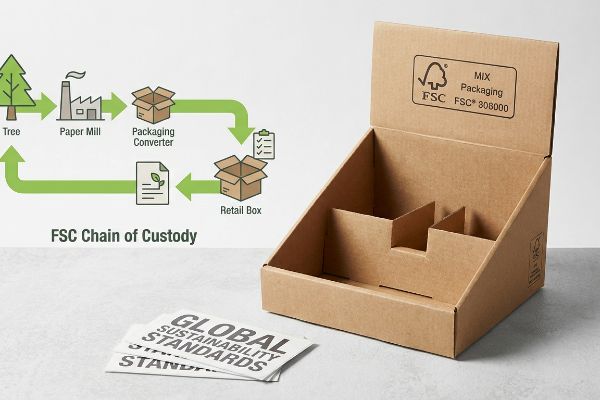
Key FSC (Forest Stewardship Council) certifications guarantee that corrugated paperboard originates from responsibly managed forests. Securing these credentials ensures your retail packaging meets global sustainability standards, preventing retailer chargebacks while appealing to eco-conscious consumers across major international supply chains.
But passing a retailer's sustainability audit requires more than just slapping a green leaf logo on your dieline.
What is the FSC chain of custody certification?
Wondering how to prove your cardboard actually comes from sustainable sources?
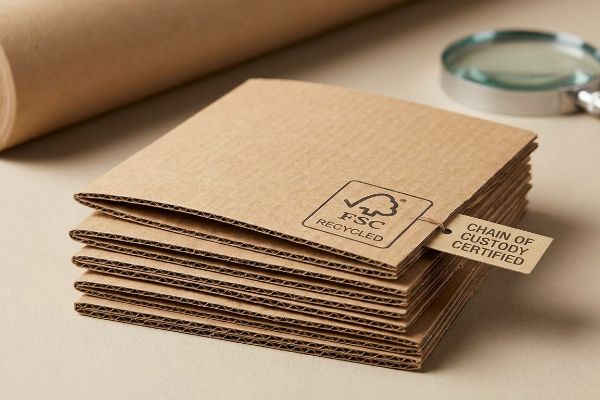
An FSC chain of custody certification tracks sustainable raw materials from the forest to the final product. Maintaining this strict paper trail verifies that your corrugated displays utilize environmentally responsible components, ensuring compliance without falling victim to misleading greenwashing claims.
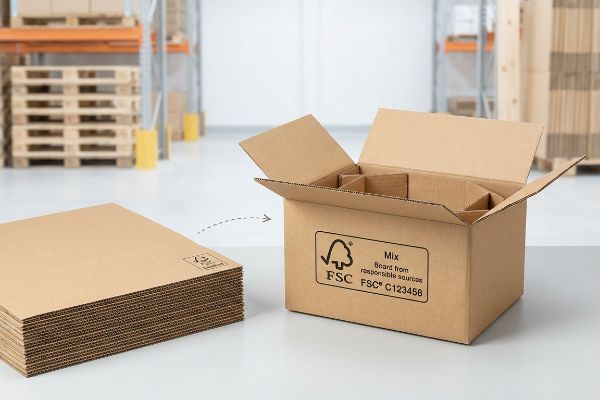
Knowing where your paper comes from is critical, but keeping that traceability intact during manufacturing is where things get messy.
Tracking the Sourcing Standard on the Factory Floor
Many brand managers assume that requesting "eco-friendly" cardboard is enough to satisfy modern retailer mandates. They rely on verbal confirmations from brokers, completely missing the documentation required to pass a strict sustainability audit1.
In my facility, I routinely see clients panic when a big-box buyer demands proof of their SFI (Sustainable Forestry Initiative) compliance. Even veteran procurement teams often overlook this blind spot, assuming the factory will automatically handle the paperwork. I remember a client who shipped a massive run of end-caps, only to realize their broker used untraceable board; the distinct, dry scrape of low-grade paperboard sliding off the pallet was the first sign of trouble. By enforcing our strict sourcing standard for 100% recyclable corrugated board, I ensure the entire supply chain is locked down. This guarantees the material is fully traceable, eliminating the risk of a massive rejection at the retailer's receiving dock.
| Common Rookie Mistake | The Pro Fix | Retail-Floor Benefit |
|---|---|---|
| Trusting verbal green claims | Enforcing documented tracking | Passes retailer compliance audits2 |
| Losing origin paperwork | Utilizing centralized sourcing logs | Prevents costly supply chain delays |
| Mixing certified and unknown boards | Strict raw material segregation3 | Ensures 100% authentic sustainability |
I never leave environmental compliance to chance or verbal promises. By rigorously documenting every inbound pallet of raw corrugated material, I protect your brand equity and ensure your retail rollout proceeds without regulatory friction.
🛠️ Harvey's Desk: Not sure if your current packaging actually meets big-box sustainability mandates? 👉 Request A Material Audit ↗ — Direct access to my desk. Zero automated sales spam, I promise.
What are FSC certifications?
Confused by the different environmental badges your printer offers?
FSC certifications are global environmental credentials that verify paper products originate from sustainable sources. These standard classifications include virgin fibers, recycled mixtures, or fully recycled materials, allowing brands to align their packaging specifications with specific retailer sustainability scorecards.
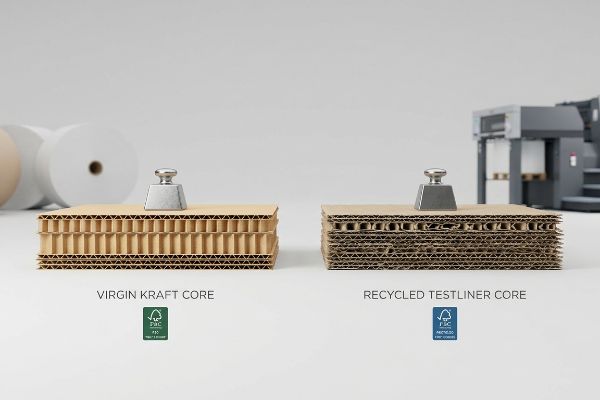
While the classifications look straightforward on a PDF (Portable Document Format), picking the wrong one drastically alters how your display behaves under physical stress.
Virgin Kraft vs. Recycled Testliner Realities
Designers frequently select 100% recycled board to maximize their environmental marketing claims. They assume that recycled paper will perform exactly like virgin material4 when supporting 150 lbs (68 kg) of consumer goods.
When you rely entirely on recycled testliner for load-bearing structures, you are utilizing paper fibers that have been repulped and physically shortened5. I have watched floor displays built from overly recycled board visibly buckle under high humidity; you can actually feel the soft, spongy texture of the exhausted flutes yielding beneath the weight. To fix this, I engineer a strategic blend, utilizing certified Virgin Kraft for the structural core to maintain strict 32 ECT (Edge Crush Test) limits6. This hybrid approach drastically improves compression strength, preventing bottom-tier collapse while keeping the overall display firmly within the retailer's environmental guidelines.
| Common Rookie Mistake | The Pro Fix | Retail-Floor Benefit |
|---|---|---|
| Mandating 100% recycled for heavy loads | Blending virgin kraft with recycled7 | Prevents bottom-tier crushing |
| Ignoring fiber exhaustion8 | Using fresh certified liners | Maximizes long-term display rigidity |
| Sacrificing strength for eco-labels | Engineering hybrid material structures | Survives humid warehouse conditions9 |
I refuse to let sustainability compromise structural physics. Balancing certified virgin fibers with recycled components guarantees your merchandiser holds the weight without sacrificing its required environmental credentials.
🛠️ Harvey's Desk: Are you sacrificing critical load-bearing strength just to hit a recycled material quota? 👉 Get A Structural Review ↗ — Download safely. My inbox is open if you have questions later.
What is a chain of custody certification?
How do you guarantee your packaging stays sustainable after it leaves the forest?
A chain of custody certification is a verified tracking system ensuring sustainable materials are never contaminated by unapproved components. Maintaining this unbroken record guarantees that every manufacturing stage, from raw paper milling to final co-packing, adheres strictly to documented environmental protocols.
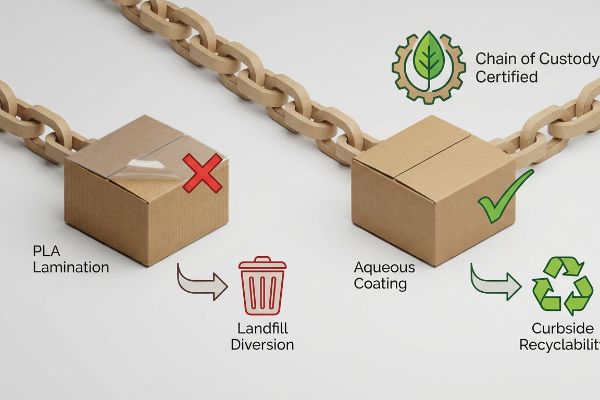
The tracking paperwork might be flawless, but a single poor decision during the finishing process can instantly destroy the entire certification.
The Composting Trap in Sustainable Supply Chains
Marketing teams often mandate PLA (Polylactic Acid) bio-plastic laminations10, assuming this corn-based film guarantees complete eco-compliance for their retail displays. They believe they are perfectly extending the sustainable chain of custody without understanding the chemical reality of end-of-life disposal11.
Think of it like putting diesel fuel into an electric car; you are taking a clean system and instantly corrupting it. I constantly see brands accidentally ruin their fully certified OCC (Old Corrugated Containers) repulpability because that PLA film forms a solid, water-repellent layer12. When standard municipal recycling centers intercept this bio-plastic during sorting, the harsh crinkle of the plastic alerts them, and the entire unit is diverted directly to a landfill13. I strictly enforce a liquid aqueous coating protocol over solid films, ensuring the finish dissolves seamlessly and the underlying certified paper remains 100% curbside recyclable.
| Common Rookie Mistake | The Pro Fix | Retail-Floor Benefit |
|---|---|---|
| Specifying solid PLA laminations | Utilizing liquid aqueous coatings | Ensures 100% curbside repulpability14 |
| Mixing bio-plastics with paper | Enforcing a mono-material mandate15 | Avoids retailer sustainability fines |
| Ruining OCC recyclability16 | Specifying water-based finishes | Simplifies end-of-life disposal |
I always protect the integrity of the underlying paper fiber. By eliminating incompatible plastic films, I ensure your certified material actually makes it through the municipal recycling stream instead of sitting in a landfill.
🛠️ Harvey's Desk: Have you checked if your glossy display finish is secretly ruining your recyclability claims? 👉 Claim Your Coating Analysis ↗ — No forms that trigger endless sales calls. Just pure value.
What is an FSC label?
Ready to print that green logo on your artwork file?
An FSC label is a printed trademark indicating the packaging material meets strict environmental sourcing standards. Displaying this globally recognized symbol provides immediate visual proof of sustainability to consumers, differentiating your product while satisfying corporate ecological compliance requirements.
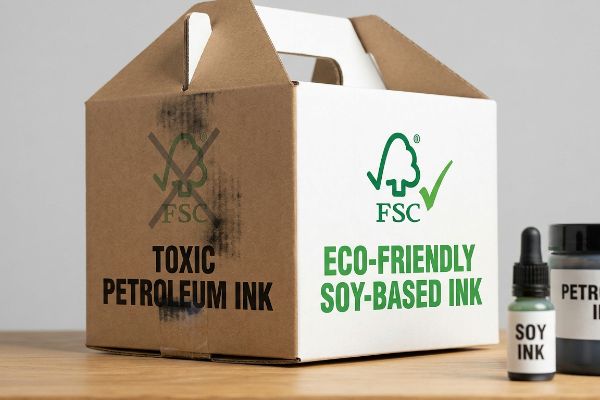
But merely dropping the logo onto your dieline is a dangerous assumption when the commercial printing presses start running.
Why Standard Inks Fail Sustainable Packaging
Graphic designers routinely drop the certification logo onto their artboard and send it to print using standard petroleum-based CMYK (Cyan, Magenta, Yellow, Key/Black) inks17. They assume the eco-friendly journey ends once the certified cardboard is successfully sourced.
In my facility, I routinely see beautifully sourced, fully certified displays ruined at the prepress stage because of chemical ignorance. When you apply heavy, toxic petroleum inks to pure, sustainable paper, you chemically contaminate the very fibers the certification is meant to protect. I smell the sharp, chemical odor of those cheap inks baking under the UV (Ultraviolet) lamps, knowing they will release VOC (Volatile Organic Compounds) and complicate recycling18. To correct this, I mandate a strict transition to Soy-Based Inks and water-based varnishes. By enforcing this 100% chemical shift, I ensure the printed logo perfectly matches the CPSIA (Consumer Product Safety Improvement Act) compliant safety19 of the substrate, preventing massive environmental audit failures while delivering rich visual contrast.
| Common Rookie Mistake | The Pro Fix | Retail-Floor Benefit |
|---|---|---|
| Printing with petroleum inks | Switching to Soy-Based Inks | Maintains full eco-compliance |
| Using high-VOC chemical varnishes | Mandating water-based clear coats | Eliminates toxic retail off-gassing |
| Contaminating certified paper | Enforcing baby-safe ink standards | Protects brand reputation |
I meticulously control the chemistry applied to your certified boards. By utilizing plant-based inks, I guarantee your environmental messaging is authentically supported by the physical reality of the ink on the paper.
🛠️ Harvey's Desk: Don't let toxic petroleum inks ruin the recyclability of your expensive certified cardboard. 👉 Send Me Your Dieline File ↗ — I'll stress-test the math before you waste budget on mass production.
Conclusion
You can spend heavily on certified sustainable materials, but when a hidden bio-plastic lamination chemically ruins your OCC repulpability, it triggers an immediate retailer rejection and completely wipes out the project's profit margin. Over 500 brand managers use my prepress checklist to avoid these exact fatal early-stage mistakes. Stop guessing on chemical compatibilities and let me personally audit your packaging specifications through my Free Dieline Audit ↗ to catch these compliance failures before mass production.
"Packaging Regulations 2026: A Complete Guide", https://creativeretailpackaging.com/packaging-insights/packaging-regulations/. [An authoritative industry standard or certification guide would specify the exact chain-of-custody documentation and certifications necessary to pass corporate sustainability audits]. Evidence role: verification; source type: industry certification standard. Supports: the claim that verbal confirmations are insufficient for sustainability compliance. Scope note: applies to retail and packaging industry audits. ↩
"[PDF] Chain of Custody Certification Report – IN.gov", https://www.in.gov/dnr/forestry/files/fo-FSC_COC_AuditReportPrim_2012.pdf. Industry certification guides explain how documented tracking systems are a primary requirement for passing third-party and retailer sustainability audits. Evidence role: validation; source type: industry standard; Supports: the link between documented tracking and audit success. Scope note: Focuses on retailers requiring verified sustainable sourcing. ↩
"[PDF] Group Chain of Custody (CoC) FSC Certification Manual", https://cfwc.mgcafe.uky.edu/sites/cfwc.ca.uky.edu/files/cfwc_coc_group_certification_manual_revised_2_16_2018_0.pdf. The FSC-STD-40-004 standard mandates the physical or systemic segregation of certified materials from non-certified materials to maintain the integrity of the chain of custody. Evidence role: technical requirement; source type: official certification standard; Supports: the necessity of segregation for authenticity. Scope note: Specific to FSC CoC transfer and processing systems. ↩
"Evaluation of the performance of corrugated shipping containers", https://vuir.vu.edu.au/18233/. [Technical documentation on cellulose fiber length and bonding would demonstrate the difference in tensile and compressive strength between virgin and recycled fibers]. Evidence role: technical verification; source type: material science study. Supports: the comparison of structural integrity between material types. Scope note: performance varies based on fiber grade and board thickness. ↩
"Effect of a Nanocellulose Addition on the Mechanical Properties of …", https://pmc.ncbi.nlm.nih.gov/articles/PMC10780965/. [Scientific literature on paper recycling confirms that mechanical repulping and chemical processing cycles reduce the average length of cellulose fibers, decreasing structural integrity]. Evidence role: technical validation; source type: academic journal. Supports: the claim that recycled fibers are physically shorter. Scope note: applies specifically to recycled testliner]. ↩
"Corrugated Board Specifications", https://www.fibrebox.org/assets/2025/09/Walmart_Corrugated-Board_Specifications_Automation_Packaging_Standards.pdf. [Industry packaging standards demonstrate that virgin kraft fibers possess higher vertical compression strength and higher Edge Crush Test (ECT) values than recycled fibers]. Evidence role: technical specification; source type: industrial engineering manual. Supports: the use of virgin kraft to meet specific ECT ratings. Scope note: 32 ECT is a standard industry benchmark for load-bearing corrugated board]. ↩
"[PDF] Recyclable Zein-Coated Kraft Paper and Linerboard", https://research.fs.usda.gov/download/treesearch/8583.pdf. [An authoritative source on corrugated packaging engineering supports how blending virgin kraft fibers improves compressive strength to prevent box collapse]. Evidence role: technical verification; source type: industry standard/engineering manual. Supports: structural benefit of blending. Scope note: focus on compressive strength. ↩
"Impact of shredding degree on papermaking potential of recycled …", https://pmc.ncbi.nlm.nih.gov/articles/PMC8410872/. [Technical documentation on cellulose fiber degradation explains how repeated recycling cycles lead to fiber exhaustion and loss of structural rigidity]. Evidence role: scientific explanation; source type: materials science journal. Supports: impact of fiber exhaustion. Scope note: specifically for testliner/corrugated board. ↩
"Challenges, Solutions and Future Paperboard Packaging Trends", https://www.pffc-online.com/coat-lam/18426-challenges-solutions-and-future-paperboard-packaging-trends. [Industry studies on hybrid material structures demonstrate higher resistance to hygroscopic deformation and strength loss in high-humidity environments]. Evidence role: performance verification; source type: technical white paper. Supports: environmental durability of hybrid structures. Scope note: specific to warehouse humidity levels. ↩
"A review on bio-based polymer polylactic acid potential on … – PMC", https://pmc.ncbi.nlm.nih.gov/articles/PMC11091039/. [Technical materials science documentation confirms that PLA is a thermoplastic polyester derived from renewable resources such as corn starch]. Evidence role: factual verification; source type: technical reference. Supports: material identity. Scope note: General industrial PLA specifications. ↩
"The Life Cycle Assessment for Polylactic Acid (PLA) to Make It a Low …", https://pmc.ncbi.nlm.nih.gov/articles/PMC8199738/. [Peer-reviewed environmental research demonstrates that PLA requires high-heat industrial composting facilities to degrade and does not break down in landfills or home compost]. Evidence role: technical validation; source type: academic journal. Supports: the 'composting trap'thesis. Scope note: Applies to standard PLA polymers. ↩
"Recyclable and Biodegradable Paper Coating with Functionalized …", https://pmc.ncbi.nlm.nih.gov/articles/PMC11948148/. [Technical documentation on material science explains how Polylactic Acid (PLA) creates a hydrophobic barrier that resists the hydraulic breaking process required for OCC repulping]. Evidence role: Technical validation; source type: Material science journal or recycling industry standard. Supports: The claim that PLA ruins paper repulpability. Scope note: Applies specifically to industrial pulping mills]. ↩
"Blue Bin Recycling – LA Sanitation – City of Los Angeles", https://sanitation.lacity.gov/san/faces/home/portal/s-lsh-wwd/s-lsh-wwd-s/s-lsh-wwd-s-r/s-lsh-wwd-s-r-rybb. [Waste management operational manuals describe the process of identifying and removing non-compatible bio-plastic contaminants from paper streams to prevent batch contamination]. Evidence role: Operational proof; source type: Waste management agency report. Supports: The claim that PLA-coated materials are typically landfilled during municipal sorting. Scope note: Diversion rates may vary by regional facility capabilities]. ↩
"[PDF] Repulpability of coated corrugated paperboard – TAPPI.org", https://imisrise.tappi.org/download.aspx?key=91OCT079. [Technical standards on paper coatings describe the effectiveness of aqueous coatings in achieving full repulpability compared to plastic laminates]. Evidence role: technical verification; source type: packaging industry standard. Supports: The claim that aqueous coatings enable curbside recycling. Scope note: May vary based on municipal recycling facility technology. ↩
"Boost sustainability with mono-material packaging | Business – Shell", https://www.shell.us/business/sectors/shell-polymers/resources-and-insights/boost-sustainability-with-mono-material-packaging.html. [Retailer sustainability charters and supplier codes of conduct often mandate mono-material packaging to reduce contamination and may impose financial penalties for non-compliance]. Evidence role: regulatory verification; source type: corporate sustainability policy. Supports: The link between mono-material mandates and the avoidance of retailer fines. Scope note: Varies by retail organization. ↩
"[PDF] Voluntary Standard For Repulping and Recycling Coated or Treated …", https://www.fibrebox.org/assets/2025/07/2025_Voluntary_-Standard.pdf. [Industry guidelines for Old Corrugated Containers (OCC) define how specific adhesives and finishes interfere with fiber recovery during the pulping process]. Evidence role: technical specification; source type: waste management guidelines. Supports: The risk that improper finishes pose to corrugated cardboard recycling. Scope note: Specific to the OCC waste stream. ↩
"Printing Processes and Printing Inks – NCBI – NIH", https://www.ncbi.nlm.nih.gov/books/NBK424340/. [An authoritative source on print chemistry would confirm that conventional commercial CMYK inks are primarily derived from petroleum-based solvents and pigments. Evidence role: technical specification; source type: industry manual or chemical study. Supports: the claim that standard ink choices conflict with sustainable packaging goals. Scope note: applies to traditional offset and digital printing processes]. ↩
"VOC-Free Inks: 7 Big Reasons Why They're a Game-Changer for …", https://www.jumpdp.com/latest-news/voc-free-advantages-for-eco-friendly-printing. [Authoritative industrial chemistry sources explain how petroleum-based UV-cured inks release volatile organic compounds and can interfere with the de-inking process during paper recycling]. Evidence role: technical validation; source type: environmental science journal. Supports: the negative environmental impact of standard inks on sustainable substrates. Scope note: focuses specifically on the chemical interaction during UV curing. ↩
"The Consumer Product Safety Improvement Act (CPSIA) | CPSC.gov", https://www.cpsc.gov/Regulations-Laws–Standards/Statutes/The-Consumer-Product-Safety-Improvement-Act. [Regulatory documentation from the CPSC defines the specific safety limits for lead and phthalates in consumer product materials to ensure compliance with the Consumer Product Safety Improvement Act]. Evidence role: regulatory verification; source type: government regulation. Supports: the claim that ink and substrate selection affects legal safety compliance. Scope note: applies to products intended for consumer use. ↩