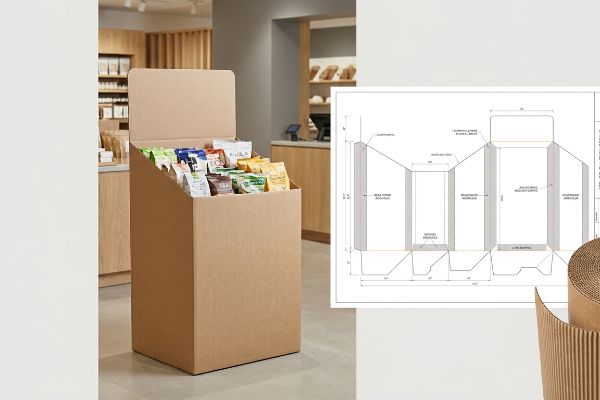
Choosing the right retail fixture feels like gambling with your marketing budget. You need a solution that actually moves product without collapsing halfway through the promotional window.
It depends. A dump bin display is highly effective for fast-moving, impulse-buy products with irregular packaging. These high-capacity, freestanding corrugated structures encourage bulk purchases but require specific structural engineering to prevent catastrophic sidewall blowouts under heavy merchandise loads in high-traffic retail aisles.
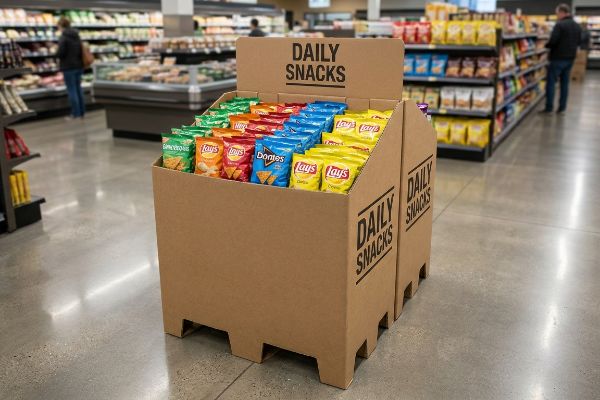
But before you greenlight a massive production run of open-top boxes, we need to look at how these structures actually behave when loaded with merchandise.
What is the rule of three in visual merchandising?
Understanding shopper psychology is the first step before engineering any physical structure. How you group items dictates whether a customer stops or walks right past.
The rule of three in visual merchandising states that products grouped in asymmetrical, odd-numbered clusters immediately capture human visual attention. This psychological principle breaks up monotonous, symmetrical layouts, creating visual tension that forces passing shoppers to pause, engage, and ultimately pull merchandise from the retail display tray.
Knowing this psychological theory is helpful, but translating it into folded cardboard is where most campaigns completely fall apart.
Why Symmetrical Layouts Fail on the Store Floor
Junior marketing teams frequently try to flat-pack a dense, perfectly symmetrical grid of products onto a single display shelf. They assume that maximizing product density automatically yields higher sales conversions1 and lowers shipping volume. This all-or-nothing approach completely ignores the physical reality of how store clerks actually interact with the unit during daily restocking operations.
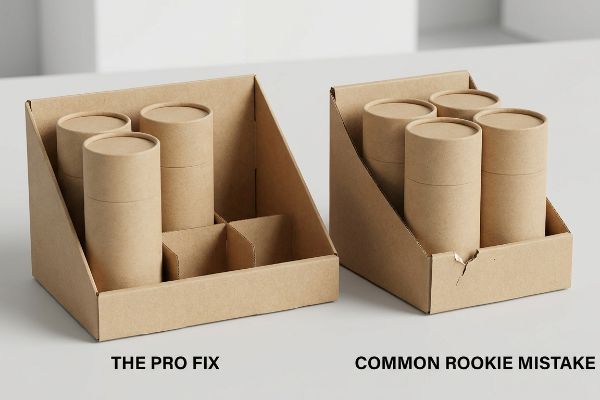
I see this mistake constantly when a brand over-stuffs a tray without built-in spacing. A rushed store clerk tries to force that last bottle into the tight grid, and I can hear the frustrating tearing sound of raw paperboard as the front retaining lip rips open. Even veteran designers often overlook this blind spot, assuming the retail staff will handle the unit delicately. By engineering dedicated modular dividers that naturally separate merchandise into clusters of three, I build in the precise 0.25 inches (6.35 mm) of physical clearance2 needed to eliminate friction. This simple rule of three prevents torn shelves, drastically cuts restocking time, and ensures your brand image stays intact.
| Common Rookie Mistake | The Pro Fix | Retail-Floor Benefit |
|---|---|---|
| Over-packing trays with zero clearance | Modular dividers for odd-numbered clusters | Eliminates paperboard tearing |
| Perfectly symmetrical product rows | Forcing the 3-5-7 asymmetry rule3 | Increases visual shopper engagement |
| Ignoring clerk restocking behavior | 0.25 inches (6.35 mm) finger gaps4 | Speeds up daily store restocking |
I never let a client design a shelf that requires a clerk to struggle. Building the spacing directly into the structural math guarantees the display survives aggressive daily handling while naturally driving higher impulse conversions.
🛠️ Harvey's Desk: Not sure if your layout leaves enough breathing room for the store clerks? 👉 Let Me Check Your Dieline ↗ — Direct access to my desk. Zero automated sales spam, I promise.
What is a dump bin display?
Sometimes you do not need perfectly organized rows. You just need massive volume for fast-moving consumer goods that fly off the shelves.
A dump bin display is an open-top, freestanding corrugated container engineered to hold bulk quantities of loose, irregularly shaped merchandise. These floor fixtures are strategically placed in high-traffic retail intersections to drive impulse purchases, utilizing deep cavities to maximize product volume without requiring neat stacking.
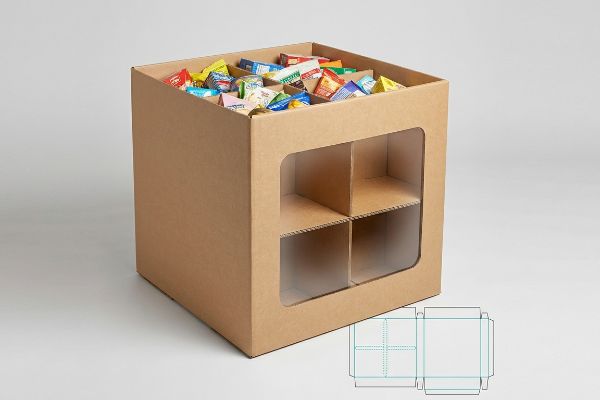
They look incredibly simple on a computer screen, but a giant open box presents severe physical challenges once filled with heavy goods.
The Hidden Physics of Dump Bin Merchandisers
Buyers often assume they can just scale up a standard square box, remove the top flaps, and call it a day. They think the raw material's theoretical strength alone will keep the walls standing tall. This ignores how unorganized, loose items exert chaotic outward pressure against unsupported corrugated panels5, especially in a fast-paced environment.
The most common question I get from emerging brands is why their prototype walls are bowing outward like a balloon. When you dump eighty loose items into an open-top bin, that kinetic energy pushes directly against the center of the walls, causing a massive outward bulge that makes the whole unit look cheap and structurally unstable. I fix this by installing an internal H-Divider or belly band reinforcement6. You will feel the stiff resistance of the virgin kraft board locking into place, instantly squaring up the walls. This unseen structural spine absorbs the chaotic outward weight, keeping the bin perfectly rigid and visually premium while preventing costly retailer chargebacks.
| Common Rookie Mistake | The Pro Fix | Retail-Floor Benefit |
|---|---|---|
| Relying entirely on outer walls | Internal H-Divider reinforcement7 | Prevents outward wall bulging |
| Using standard open-top boxes | Engineered belly band inserts8 | Maintains a premium square shape |
| Ignoring chaotic outward pressure | Structurally isolated load zones9 | Survives high-traffic shopper rummaging |
I refuse to let a brand launch a bin that looks like a sagging potato sack after three days. Engineering an invisible internal skeleton ensures your high-volume promotion looks sharp until the very last item sells.
🛠️ Harvey's Desk: Are your prototype walls already starting to bow outward under the product weight? 👉 Request A Structural Audit ↗ — Download safely. My inbox is open if you have questions later.
What are the four basic types of displays?
Before pitching a retailer, you have to know which physical category your campaign falls into. Every zone in a big-box store has strict operational rules.
The four basic types of displays are floor merchandisers, countertop units, pallet displays, and shelf-ready packaging. Each structural category is mathematically engineered to fit specific retail zones, ranging from massive warehouse aisles to highly restricted cash register checkpoints, maximizing shopper visibility across the store layout.
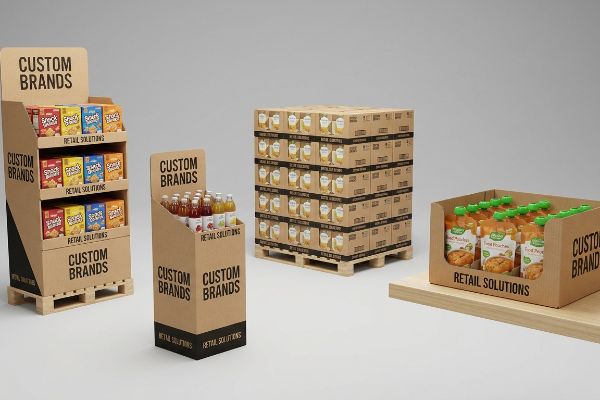
Knowing the categories is easy, but mixing up their specific engineering constraints is the fastest way to get your shipment rejected at the loading dock.
The Danger of "Shrink-to-Fit" Retail Pitches
A common practice among startups10 is trying to design one master POP (Point of Purchase) floor fixture and simply scaling it down by fifty percent to use as a POS (Point of Sale) counter unit. They view this shortcut as a clever way to save on design fees and consolidate tooling costs for their campaign11.
Treating a floor unit and a counter unit like the exact same thing is a massive operational blind spot. Floor units are strictly anchored to massive GMA (Grocery Manufacturers Association) pallet dimensions12, while counter units are legally bound by the ADA (Americans with Disabilities Act) forward reach compliance window of 15 to 48 inches13 (38.1 to 121.9 cm). If you just shrink a floor file, I guarantee the new geometry will violently tip over. I once watched a client try to balance a top-heavy, shrunken floor bin on a desk, only to hear the loud crash of product hitting the ground. I permanently separate these engineering pipelines to guarantee strict retailer compliance, ensuring the POS unit naturally anchors its own center of gravity.
| Common Rookie Mistake | The Pro Fix | Retail-Floor Benefit |
|---|---|---|
| Shrinking floor units for counters | Custom ADA-compliant POS engineering14 | Prevents top-heavy tipping hazards |
| Ignoring checkout counter limits | Strict 2:3 depth-to-height ratio15 | Ensures register stability |
| Mixing POP and POS pipelines | Permanently isolated CAD (Computer-Aided Design) files | Eliminates store manager rejections |
I engineer every category based on its final destination, not a lazy scale-down ratio. Respecting the distinct spatial physics of each retail zone is the only way to protect your brand from dangerous liability claims and logistical failures.
🛠️ Harvey's Desk: Worried your counter unit is too top-heavy to survive the checkout aisle? 👉 Get Your Math Verified ↗ — No forms that trigger endless sales calls. Just pure value.
What does bin mean in UK slang?
The lifecycle of your packaging does not end when the product is sold. You must consider the final destination of the physical materials.
Bin in UK slang means to throw something away or discard it in the trash. In the retail packaging industry, ensuring a corrugated display avoids the landfill bin requires strict adherence to sustainable engineering, utilizing mono-material structures that seamlessly pass through standardized curbside recycling systems.
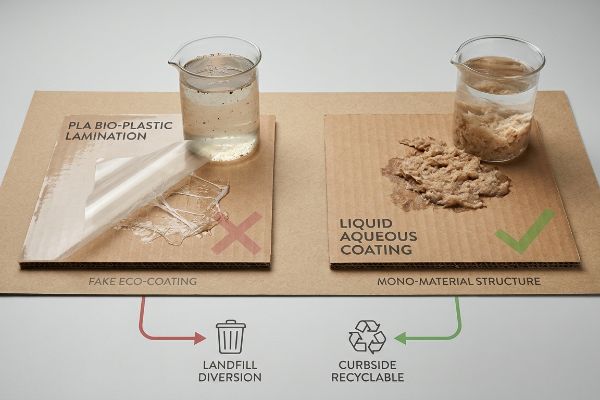
But knowing the theory isn't enough when the machines start running, because fake sustainability can accidentally send your entire campaign straight to the dump.
Why Fake Eco-Coatings Ruin the Supply Chain
In my facility, I routinely see procurement teams mandate PLA (Polylactic Acid) bio-plastic laminations, assuming this "corn-based" film guarantees complete eco-compliance16. They assume that slapping a green sticker on the box means standard municipal recycling centers will gladly process17 the heavy structural boards without a second thought.
This isn't just theory—I see this happen on the testing floor when we evaluate repulpability. That rigid PLA film acts as an impenetrable barrier18 during standard OCC (Old Corrugated Containers) repulping. When I test the breakdown rate, the bio-plastic leaves a nasty, stringy residue that jams the vat. Instead of recycling it, facilities simply divert the entire batch straight to the landfill. I pulled the micrometer readings and proved we did not need that expensive 0.11 inches (2.79 mm) film. I replaced it with a liquid aqueous coating that dissolves perfectly. By stripping out the bloated bio-plastic, I ensure the packaging is 100% curbside recyclable, which saves the client from massive environmental compliance chargebacks during retailer audits19.
| Common Rookie Mistake | The Pro Fix | Retail-Floor Benefit |
|---|---|---|
| Using PLA bio-plastic films | Liquid aqueous coating applications20 | Guarantees curbside recyclability |
| Assuming all green films repulp | Mono-material corrugated structures21 | Avoids landfill diversion |
| Over-engineering the outer gloss | High-solid water-based varnishes22 | Passes strict big-box eco-audits |
I do not rely on trendy buzzwords to achieve sustainability. Engineering a display that actually recycles means stripping away conflicting chemicals and relying purely on the proven physics of paper fibers.
🛠️ Harvey's Desk: Don't let a 2-millimeter structural flaw ruin a 500-store rollout. 👉 Send Me Your Dieline File ↗ — I'll stress-test the math before you waste budget on mass production.
Conclusion
You can choose a cheaper vendor, but when that unsupported corrugated wall bows outward under heavy merchandise, triggering severe base buckling that results in an immediate retailer rejection and weeks of costly manual rework, the upfront savings disappear. Over 500 brand managers use my prepress checklist to avoid these exact fatal early-stage mistakes. Stop guessing on chaotic weight distribution and let me personally run your structural files through my Free Dieline Audit ↗ to catch fatal load-bearing errors before mass production begins.
"What is the relationship between visual merchandising and online …", https://twikit.com/what-is-the-relationship-between-visual-merchandising-and-online-conversion-rates/. [A retail psychology study or industry analysis would evaluate the correlation between product density and consumer conversion rates to validate or debunk this assumption]. Evidence role: factual verification; source type: academic study or industry report. Supports: The argument that high density does not inherently drive sales. Scope note: Effect may vary based on luxury vs. discount retail segments. ↩
"49 CFR Part 173 — Shippers—General Requirements for Shipments …", https://www.ecfr.gov/current/title-49/subtitle-B/chapter-I/subchapter-C/part-173. [A technical manual on packaging engineering or industrial design would specify the ideal clearance tolerances required to prevent material friction and structural failure in retail displays]. Evidence role: technical specification; source type: industry standard. Supports: the specific physical spacing required to prevent tray damage. Scope note: tolerances may vary based on material thickness and product dimensions. ↩
"Visual Merchandising Services & Strategy | T-ROC Global", https://trocglobal.com/visual-merchandising/. [An authoritative source on retail psychology or visual merchandising explains how odd-numbered groupings prevent the brain from processing information too quickly, thereby increasing engagement]. Evidence role: Technical validation; source type: Industry guide. Supports: The effectiveness of asymmetrical layouts. Scope note: Specific to retail floor displays. ↩
"[PDF] Guidelines for Retail Grocery Stores – Ergonomics for the … – OSHA", https://www.osha.gov/sites/default/files/publications/OSHA3192.pdf. [Ergonomic standards or retail operational manuals specify minimum clearance widths to ensure staff can efficiently grip and remove products]. Evidence role: Technical specification; source type: Ergonomic standard. Supports: Restocking efficiency. Scope note: May vary by product size. ↩
"Estimation of the Compressive Strength of Corrugated Board Boxes …", https://pmc.ncbi.nlm.nih.gov/articles/PMC8467740/. [Packaging engineering literature demonstrates how non-uniform bulk loads create lateral stress and outward pressure on vertical corrugated walls]. Evidence role: technical verification; source type: engineering manual; Supports: structural requirements for dump bin displays; Scope note: applies specifically to unsecured bulk merchandise. ↩
"Custom Cardboard Dump Bins", https://boxpackingsolution.com/single-product/custom-cardboard-displays/dump-bins/. [Technical specifications for corrugated retail displays describe how internal H-dividers and belly bands distribute lateral loads to prevent wall bowing in bulk bins]. Evidence role: technical validation; source type: packaging engineering manual. Supports: structural stability solutions. Scope note: specific to fiberboard construction. ↩
"What types of dump bins do you offer? – Custom Cardboard …", https://popdisplay.me/what-types-of-dump-bins-do-you-offer/. [An authoritative source on retail packaging engineering would explain how H-dividers redistribute lateral pressure to prevent outward wall bulging]. Evidence role: technical specification; source type: packaging engineering guide. Supports: structural stability of dump bins. Scope note: applies to corrugated cardboard displays. ↩
"What retail dump bin styles do we carry? – PopDisplay", https://popdisplay.me/what-retail-dump-bin-styles-do-we-carry/. [Industry standards for point-of-purchase displays would detail how belly bands provide circumferential support to prevent deformation and maintain shape]. Evidence role: technical specification; source type: retail merchandising manual. Supports: aesthetic and structural integrity. Scope note: specific to open-top cardboard bins. ↩
"The Shopper Transition Zone Shopping Experience", https://explorerresearch.com/the-shopper-transition-zone/. [Structural analysis of display units would describe how isolating load zones prevents total collapse under chaotic outward pressure from shoppers]. Evidence role: mechanical principle; source type: structural engineering whitepaper. Supports: durability in high-traffic areas. Scope note: applies to heavy-duty dump bins. ↩
"Common Mistakes in Retail Display Designs and How to Avoid Them", https://www.creativedisplaysnow.com/common-mistakes-in-retail-display-designs-and-how-to-avoid-them/. [Retail merchandising guidelines often highlight the error of proportionally scaling large displays for counter-top use]. Evidence role: corroboration; source type: industry guide. Supports: the prevalence of scaling errors in retail. Scope note: focuses on new brand entry strategies. ↩
"Cost of a Point of Purchase Display (POP) – How to Buy Packaging", https://www.howtobuypackaging.com/cost-of-a-point-of-purchase-display/. [Industrial engineering sources explain that reducing unique dies and molds lowers initial setup costs for physical displays]. Evidence role: technical validation; source type: manufacturing manual. Supports: the rationale for reusing a single design across sizes. Scope note: applicable to rigid material production. ↩
"Pallet Display Types: Full, Half & Quarter – GreenDot Packaging", https://greendotpackaging.com/understanding-pallet-display-types-full-half-and-quarter-pallet-displays/. [Industry standards established by the Grocery Manufacturers Association dictate the physical footprint of retail floor displays to ensure logistics and shipping compatibility]. Evidence role: standard; source type: industry guideline. Supports: GMA pallet dimensions. Scope note: Primarily North American markets. ↩
"Chapter 3: Operable Parts – Access-Board.gov", https://www.access-board.gov/ada/guides/chapter-3-operable-parts/. [The ADA Standards for Accessible Design define specific reach ranges to ensure that retail displays and elements are accessible to individuals with disabilities]. Evidence role: legal requirement; source type: government regulation. Supports: ADA reach limits. Scope note: Applies to US public accommodations. ↩
"Chapter 9", https://www.access-board.gov/ada/ada-ibc-comparison/chapter-9/. [Official ADA Standards for Accessible Design specify mandatory height and reach requirements for retail service counters to ensure accessibility]. Evidence role: legal requirement; source type: government regulation. Supports: the necessity of ADA compliance in POS design. Scope note: pertains specifically to US federal accessibility laws. ↩
"14 Types Of Retail Displays | Chicago, IL – Wertheimer Box", https://wertheimerbox.com/types-of-retail-displays/. [Industry engineering guidelines for freestanding retail fixtures establish specific depth-to-height ratios to prevent tipping and ensure structural stability]. Evidence role: technical specification; source type: industry manual. Supports: the use of specific ratios to ensure register stability. Scope note: applies to freestanding retail furniture. ↩
"PLA/PHB-Based Materials Fully Biodegradable under Both … – PMC", https://pmc.ncbi.nlm.nih.gov/articles/PMC9572414/. [Authoritative guides on bioplastics clarify that PLA requires industrial composting facilities to degrade and is not universally eco-compliant in standard waste streams]. Evidence role: factual correction; source type: environmental standards organization. Supports: The validity of eco-compliance claims for PLA films. Scope note: Specific to industrial vs home composting environments]. ↩
"Recycled-Plastic Lumber Standards: From Waste Plastics to …", https://cdn.ymaws.com/www.ses-standards.org/resource/resmgr/imported/wsd%202001%20-%201%20-%20krishnaswamy%20and%20lampo.pdf. [Waste management technical papers explain that PLA laminations often contaminate PET streams and are typically rejected by standard municipal recycling systems]. Evidence role: technical verification; source type: waste management study. Supports: The feasibility of recycling laminated structural boards. Scope note: Varies by municipal facility sorting technology]. ↩
"Effects of pulp preparation and papermaking processes on the …", https://bioresources.cnr.ncsu.edu/resources/effects-of-pulp-preparation-and-papermaking-processes-on-the-properties-of-occ-fibers/. [An authoritative source on pulp and paper chemistry explains why PLA films do not break down during standard OCC repulping, creating contaminants]. Evidence role: Technical validation; source type: Academic journal or industry standard. Supports: The claim that PLA disrupts repulping. Scope note: Focuses on industrial OCC processing. ↩
"Packaging Sustainability Enters the Age of Accountability", https://www.packagingdigest.com/sustainability/packaging-sustainability-enters-the-age-of-accountability. [Industry reports or retail packaging guidelines document the financial penalties imposed on suppliers for non-recyclable packaging]. Evidence role: Business practice verification; source type: Industry white paper or retailer sustainability guidelines. Supports: The existence of financial penalties for non-compliance. Scope note: Penalties vary by retailer and region. ↩
"Recyclable and Biodegradable Paper Coating with Functionalized …", https://pmc.ncbi.nlm.nih.gov/articles/PMC11948148/. [Technical specifications from packaging associations would validate that aqueous coatings do not interfere with the repulping process for curbside recycling]. Evidence role: verification; source type: industry technical standard. Supports: recyclability claims. Scope note: efficiency may vary by coating thickness. ↩
"Containers and Packaging: Product-Specific Data | US EPA", https://www.epa.gov/facts-and-figures-about-materials-waste-and-recycling/containers-and-packaging-product-specific. [Life cycle assessments (LCA) would show that eliminating mixed-material layers in corrugated structures increases material recovery and reduces the percentage diverted to landfills]. Evidence role: verification; source type: environmental impact study. Supports: landfill diversion. Scope note: applies specifically to corrugated paper streams. ↩
"Most Sustainable & Safe Paints, Primers, Varnishes, Stains & Sealers", https://onecommunityglobal.org/most-sustainable-paints-stains-varnish-sealers/. [Environmental compliance manuals for major retailers would certify high-solid water-based varnishes as meeting low-VOC and sustainability criteria for packaging audits]. Evidence role: verification; source type: retail compliance manual. Supports: eco-audit success. Scope note: specific to high-solid formulations. ↩