
Struggling to get big-box retailers to approve your product rollout? High freight costs and strict structural guidelines often kill marketing campaigns before they even start.
Choosing cardboard displays provides unmatched cost-efficiency, rapid structural production turnarounds, and superior environmental sustainability. They serve as the primary merchandising vehicles in massive global retail environments, allowing modern brands to launch highly customized marketing campaigns while ensuring absolute compliance with strict supply chain weight and space regulations.

Before diving into advanced structural physics and freight optimization, we need to establish the foundational terminology used on the factory floor.
What Is a Cardboard Display Called?
Knowing the correct industry terminology prevents miscommunication with your manufacturer and ensures your display actually fits the intended retail space safely.
A cardboard display is called different names based on its specific function, such as POP (Point of Purchase) units, POS (Point of Sale) counter trays, or Pallet Merchandisers. These standardized global classifications dictate the precise structural footprint and exact legal placement allowances within a commercial retail environment.
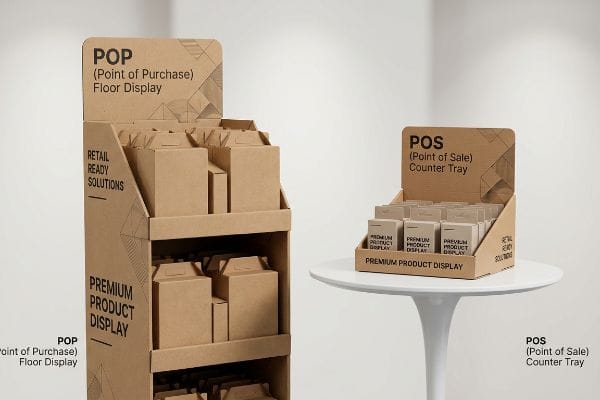
Using the right name is just step one; applying the correct retail math to that name is where things get serious.
The POP vs. POS Retail Math
Even veteran designers often overlook the strict legal and logistical rules dictating these separate merchandising zones1. They create a scalable floor design, assuming they can simply shrink the file by fifty percent to serve as a compact counter display. This theoretical approach ignores the distinct spatial limits enforced by big-box stores2.
I permanently separate the engineering pipelines for these two categories in my facility. When a client requests a shrink-to-fit crossover, the reduced interlocking tabs snap with a loud crack during assembly because the thick B-flute board cannot bend cleanly at a micro-scale. I strictly anchor counter units to the ADA (Americans with Disabilities Act) 15-48 inch (38-121 cm) forward reach compliance window3, completely eliminating severe retailer chargebacks and preventing store managers from instantly rejecting non-compliant register units.
| Common Rookie Mistake | The Pro Fix | Retail-Floor Benefit |
|---|---|---|
| Shrinking floor display files 50% | Separating POP and POS CAD pipelines | Eliminates retailer rejection |
| Ignoring ADA reach compliance | Enforcing 15-48 inch (38-121 cm) limits4 | Ensures legal checkout placement |
| Using thick B-flute on small tabs | Switching to micro-flute for counter units5 | Prevents raw board tearing |
I refuse to recycle structural math across different retail zones. Engineering specifically for the required footprint guarantees your merchandiser survives both the physical setup process and the retailer's aggressive compliance audits.
🛠️ Harvey's Desk: Not sure if your counter display meets strict ADA reach limits? 👉 Get Your Dieline Audited ↗ — Direct access to my desk. Zero automated sales spam, I promise.
Why Should People Care About Cardboard?
Beyond basic eco-friendly talking points, understanding the true value of temporary packaging fundamentally transforms how you allocate your promotional budget.
People care about cardboard because it effectively eliminates massive supply chain freight penalties associated with permanent metal fixtures. This lightweight, flat-packed engineering strategy drastically maximizes ocean container density, rapidly reducing carbon footprints while simultaneously allowing highly localized adaptation for short-term retail marketing campaigns and seasonal product rollouts.
However, theoretical cost savings quickly evaporate if your procurement team defaults to outdated hardware assumptions.
Eliminating the Permanent Hardware Freight Penalty
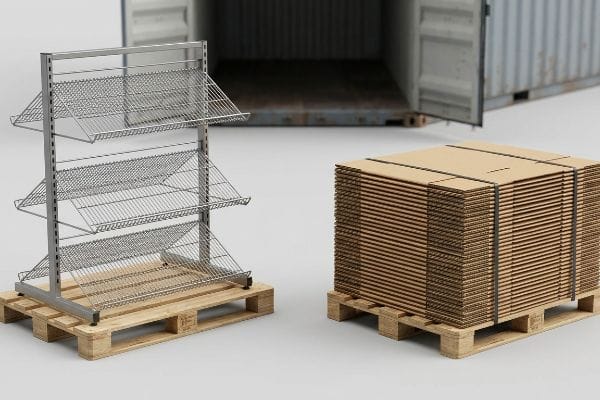
Procurement teams frequently default to permanent welded metal structures for short-term retail campaigns, assuming heavy-duty steel automatically guarantees a higher return on investment. They ignore the punishing logistics of permanent hardware, which must ship fully assembled across the ocean6. This creates a severe logistical bottleneck where brands pay a massive premium simply to move empty spatial volume7.
In my facility, I constantly pivot clients away from these heavy wire racks for any promotional window lasting under twelve weeks. When you load a standard 40HQ (40-foot High Cube) container with rigid metal stands, the heavy steel grinds against the walls, and you max out at roughly 250 empty units8. By shifting to high-performance temporary corrugated structures, I can pack up to 1,500 flat-packed units9 into that exact same container volume, completely eliminating the massive freight penalty and slashing your inbound logistics costs.
| Common Rookie Mistake | The Pro Fix | Retail-Floor Benefit |
|---|---|---|
| Shipping empty metal racks | Designing high-density flat packs | Slashes inbound shipping costs10 |
| Using steel for 8-week promos | Shifting to temporary corrugated board | Accelerates campaign rollouts11 |
| Paying freight for dead air | Maximizing 40HQ container volume | Lowers per-unit landed cost12 |
I never let clients burn their marketing budget on shipping empty air. Flat-packed corrugated engineering delivers the heavy-duty load capacity you need without the punishing logistical tax of welded steel.
🛠️ Harvey's Desk: Are you overpaying to ship empty metal racks across the ocean? 👉 Request A Freight Density Audit ↗ — Download safely. My inbox is open if you have questions later.
What Does Cardboard Symbolize?
Visually, a corrugated merchandiser acts as a physical extension of your brand equity, instantly signaling premium quality or cheap compromise to the passing shopper.
Cardboard symbolizes brand identity by transforming a functional structural shipping container into a highly disruptive visual marketing canvas. When properly engineered and precision printed, this porous substrate represents sustainable innovation, communicating premium product quality and commanding shopper attention directly in crowded, high-traffic commercial retail aisles.
But achieving that premium symbol requires mastering the complex chemistry between wet ink and raw paper fibers.
Beating the CMYK Halftone Mud Trap
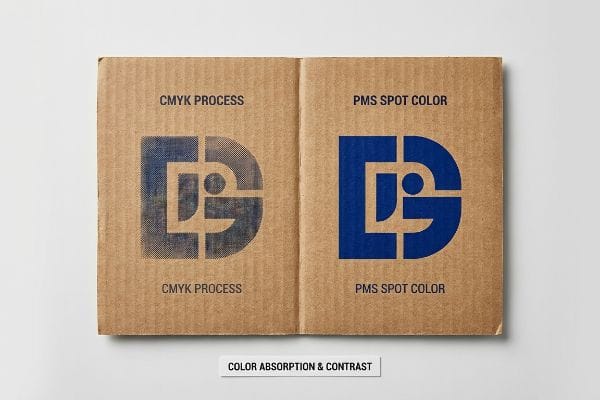
Marketing teams frequently convert solid corporate logos into standard CMYK (Cyan, Magenta, Yellow, Key/Black) formats, assuming process printing will seamlessly match their glowing digital screens. They fail to realize that standard four-color printing relies on tiny overlapping halftone dots13 that absorb unevenly into porous paperboard14. This optical blending fails mechanically on unsealed substrates.
I intercept these standard process files immediately because watching expensive ink turn into a grainy, washed-out mess under harsh fluorescent store lights is a painful waste of money. Instead, I mandate a spot color flood protocol, utilizing precisely mixed PMS (Pantone Matching System) inks to lay down a dense, perfectly smooth flood of pigment. The thick, tacky feel of the spot color completely eliminates halftone grain15, maximizing high-contrast brand visibility from twenty feet away16 and actively driving impulse purchases.
| Common Rookie Mistake | The Pro Fix | Retail-Floor Benefit |
|---|---|---|
| Printing logos in standard CMYK | Mandating Pantone spot color floods17 | Eliminates grainy visual mud |
| Trusting backlit digital screens | Matching physical ink draw-downs18 | Guarantees brand color accuracy |
| Ignoring store fluorescent lights | Formulating high-contrast pigments19 | Drives high-visibility impulse sales |
I protect your brand equity by fighting the physics of paper absorption. A solid spot color flood guarantees your primary logo always acts as a premium, disruptive beacon in the aisle.
🛠️ Harvey's Desk: Are your brand colors looking muddy on porous testliner? 👉 Claim Your Free Color Draw-Down ↗ — No forms that trigger endless sales calls. Just pure value.
What Are the Benefits of Using Cardboard to Make Art or Design Work?
Utilizing corrugated board for creative designs offers incredible structural versatility, allowing flat paper to fold into massive, load-bearing three-dimensional architecture.
The benefits of using cardboard to make art include rapid prototyping capabilities, exceptional weight-to-strength ratios, and absolute structural adaptability. This flexible medium allows engineers to transform standard flat sheets into highly complex, interlocking three-dimensional designs without requiring expensive permanent injection molds or heavy industrial metal fabrication.
But knowing the theory isn't enough when the machines start running and those flat digital drawings collide with physical thickness.
Why Standard Flat Dielines Fail on the Factory Floor
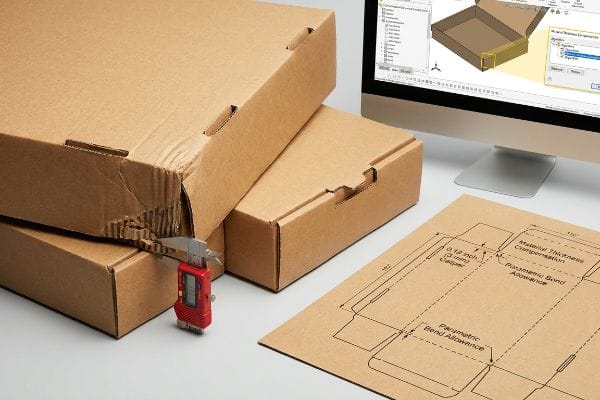
Graphic designers often build interlocking tabs and folding slots in their illustration software at the exact same width as the mating panel. They treat the design like flat visual art, completely failing to calculate the physical caliper of the folded corrugated material. When a 0.12 inch (3 mm) thick panel folds ninety degrees, it inherently consumes material and alters the overall geometry20.
In my facility, I routinely see flat art files crash hard during the white sample phase because a slot that perfectly fit the tab on a computer screen is suddenly too tight in reality. When a co-packer tries to force the parts together, you can hear the internal flutes crush and tear under the pressure. I pull the micrometer readings and run parametric CAD (Computer-Aided Design) compensation algorithms to widen the slots by precisely 0.04 inches (1 mm)21, ensuring frictionless assembly that drops co-packing time by 42 seconds per unit22 and saves thousands in manual labor fees.
| Common Rookie Mistake | The Pro Fix | Retail-Floor Benefit |
|---|---|---|
| Ignoring board caliper thickness | Applying parametric bend allowances23 | Eliminates physical assembly friction |
| Drawing 1:1 slot-to-tab widths | Widening slots for paper expansion24 | Stops raw material tearing |
| Letting artists engineer structures | Using dedicated CAD software | Slashes manual labor fees |
I never trust a flat drawing to behave perfectly in three dimensions without mathematical adjustment. Engineering exact bend allowances into the dieline is what turns a pretty artistic concept into a functional, profitable reality.
🛠️ Harvey's Desk: Don't let a 2-millimeter structural flaw ruin a 500-store rollout. 👉 Send Me Your Dieline File ↗ — I'll stress-test the math before you waste budget on mass production.
Conclusion
You can choose a cheaper vendor, but when that flat design ignores strict caliper compensation and crushes under heavy merchandise, it creates massive assembly friction that slows down the line by an estimated 30% and completely wipes out your profit margin. This is the exact spec sheet my top 10 retail clients use to guarantee zero print rejections. Stop guessing on bend allowances and let me personally run your files through my Free Dieline Audit ↗ to catch fatal structural errors before mass production begins.
"Merchandising Best Practices: Compliance", https://www.vanguardpkg.com/merchandising-best-practices-compliance/. Industry standards and retail compliance manuals outline the legal and logistical constraints for merchandising zones. Evidence role: validation; source type: industry manual. Supports: regulatory constraints on display placement. Scope note: varies by retailer and region. ↩
"The Big-Box Retailer Construction Economy – BuildCentral", https://www.buildcentral.com/the-big-box-retailer-construction-economy-2/. Corporate vendor guidelines establish specific spatial dimensions and footprint restrictions for POP displays. Evidence role: technical verification; source type: vendor compliance guide. Supports: enforcement of spatial limits. Scope note: applicable to large-scale commercial retail. ↩
"ADA Accessibility Standards – Access-Board.gov", https://www.access-board.gov/ada/. Verification of the specific measurement range for forward reach as defined by the Americans with Disabilities Act (ADA) accessibility guidelines. Evidence role: regulatory verification; source type: legal standard. Supports: the claim that retail displays must adhere to a 15-48 inch height window for compliance. Scope note: Applies to reach ranges for persons in wheelchairs. ↩
"Chapter 9: Built-In Elements", https://www.access-board.gov/ada/chapter/ch09/. Verification of the Americans with Disabilities Act (ADA) standards for accessible reach ranges in retail environments. Evidence role: technical standard; source type: government regulation. Supports: legal height requirements for display placement. Scope note: Applies specifically to unobstructed forward and side reaches. ↩
"Understanding Shipping Box Strength – EcoEnclose", https://www.ecoenclose.com/blog/understanding-shipping-box-strength/?srsltid=AfmBOopEPcZzPJGycgZG173UdNd86SrLbhOq1WN_1BHw-6Sy6aEmTAgq. Comparison of corrugated flute sizes regarding structural integrity, folding precision, and resistance to tearing for small-scale components. Evidence role: technical specification; source type: packaging industry manual. Supports: material choice for counter units to prevent board failure. Scope note: Focuses on the physical properties of corrugated board grades. ↩
"Packaging and Logistics Planning for Retail Displays", https://www.frankmayer.com/blog/packaging-and-logistics-planning-for-retail-displays/. Authoritative logistics data confirms that non-collapsible welded fixtures occupy maximum cubic volume during transit compared to flat-packed options. Evidence role: technical validation; source type: supply chain analysis. Supports: inefficiency of assembled hardware shipping. Scope note: specific to non-modular metal fixtures. ↩
"Volumetric Weight and Shipping to Europe: What to Know | ILG", https://www.international-logistics-group.com/us-en/insights/volumetric-weight-explained-161836/. Freight industry standards on volumetric weight (DIM weight) prove that shipping large, hollow structures significantly increases costs per unit. Evidence role: economic proof; source type: freight shipping standards. Supports: the cost penalty of shipping empty volume. Scope note: focused on ocean and LTL freight. ↩
"40 foot dry high-cube container | Specifications and dimensions", https://www.bws.net/toolbox/container-specifications/40-foot-dry-high-cube. An authoritative logistics or retail fixture guide would verify the average volumetric capacity of rigid metal stands in a 40HQ container. Evidence role: benchmark; source type: logistics manual. Supports: the spatial inefficiency of permanent hardware. Scope note: units vary by stand dimensions. ↩
"40HQ container inner size and cbm – Tube boxes", https://www.tube-boxes.com/40hq-container-inner-size-and-cbm. Industry technical specifications or shipping case studies would validate the higher density of flat-packed corrugated structures compared to rigid metal. Evidence role: benchmark; source type: shipping specifications. Supports: the shipping efficiency of temporary packaging. Scope note: depends on specific unit size. ↩
"Flat-Pack vs Fully Assembled: Which Is More Cost-Effective", https://www.samtop.com/flat-pack-vs-fully-assembled-display/. Comparative data on the reduction of volumetric weight and freight charges when using flat-packed fixtures versus pre-assembled racks. Evidence role: quantitative verification; source type: logistics industry report. Supports: financial benefit of high-density packaging. Scope note: focused on inbound logistics. ↩
"Acrylic vs. Corrugated Displays: What's Right for Your Business?", https://orangepkg.com/blog/acrylic-vs-corrugated-displays-whats-right-for-your-business/. Comparison of production and shipping lead times between corrugated board and steel fabrication for retail displays. Evidence role: operational timeline validation; source type: supply chain management study. Supports: increased speed of deployment for temporary promotions. Scope note: specific to short-term promotional cycles. ↩
"Packaging Space Optimization: Maximize 40HQ Utilization", https://klongpackaging.com/packaging-space-optimization/. Technical explanation of how maximizing the cubic capacity of a 40HQ container reduces the allocated shipping cost per individual unit. Evidence role: financial mechanism proof; source type: international trade manual. Supports: the correlation between volume maximization and landed cost reduction. Scope note: applicable to bulk sea freight. ↩
"Halftone – Wikipedia", https://en.wikipedia.org/wiki/Halftone. Explanation of the technical process of CMYK halftone printing and how optical blending works via overlapping dots. Evidence role: technical definition; source type: printing industry manual. Supports: the basis of process printing. Scope note: General printing principles. ↩
"[PDF] 1. Dot gain is the increase of halftone dot sizes as ink absorbs into the …", https://www.coloradomesa.edu/art/documents/student-resources/study-guide-2019.pdf. Technical explanation of dot gain and capillary action causing ink spread on unsealed porous substrates. Evidence role: technical verification; source type: packaging science journal. Supports: the mechanical failure of color reproduction on cardboard. Scope note: Specific to unsealed substrates. ↩
"Difference Between Spot Color and CMYK Color", https://www.deprintedbox.com/blog/spot-vs-process-color/. Technical explanation of how solid spot colors avoid the dot patterns inherent in halftone process printing on porous substrates. Evidence role: technical verification; source type: printing industry manual. Supports: removal of grainy textures. Scope note: specific to absorbent materials like corrugated cardboard. ↩
"How does signage design affect customer behavior in stores?", https://stafix.eu/blog/how-does-signage-design-affect-customer-behavior-in-stores/. Analysis of visual acuity and contrast ratios in commercial environments to determine the distance at which brand elements become legible to shoppers. Evidence role: empirical support; source type: environmental psychology or marketing research. Supports: impact of contrast on consumer attention. Scope note: general retail environment. ↩
"PMS vs CMYK for Packaging: Which Is Better? – PAX Solutions", https://pax.solutions/corrugated-packaging/pms-vs-cmyk-for-packaging/. Technical documentation on ink application for porous substrates explains why spot colors prevent the halftone muddiness common in CMYK process printing on cardboard. Evidence role: technical verification; source type: printing industry standard. Supports: the use of Pantone for brand consistency on corrugated materials. Scope note: specific to porous substrates. ↩
"Virtual Proofing in the Packaging Industry", https://digitalcommons.calpoly.edu/cgi/viewcontent.cgi?article=1039&context=grcsp. Color management standards emphasize that physical draw-downs are necessary because RGB digital screens cannot accurately simulate subtractive ink reflection on specific substrates. Evidence role: methodological validation; source type: color management guide. Supports: the claim that digital screens are unreliable for final color sign-off. Scope note: relates to the difference between additive and subtractive color. ↩
"Effect of Different Illumination Sources on Reading and Visual …", https://pmc.ncbi.nlm.nih.gov/articles/PMC5782456/. Research in colorimetry regarding the Metamerism Index explains how the spectral output of fluorescent lighting shifts perceived color, requiring pigment adjustments for visibility. Evidence role: scientific explanation; source type: optical physics study. Supports: the need for high-contrast formulation to counter lighting distortion. Scope note: focused on retail environment lighting. ↩
"Analytical Determination of the Bending Stiffness of a Five …", https://pmc.ncbi.nlm.nih.gov/articles/PMC8777652/. Technical documentation on packaging engineering and bend allowance explains how material caliper affects the final dimensions of a fold. Evidence role: technical verification; source type: engineering manual. Supports: the physical impact of material thickness on fold geometry. Scope note: specific to corrugated fiberboard. ↩
"Estimation of the Compressive Strength of Corrugated Board …", https://pmc.ncbi.nlm.nih.gov/articles/PMC8467740/. Verification of standard industry tolerance allowances for tab-and-slot joints in corrugated board to prevent material failure. Evidence role: technical specification; source type: packaging engineering handbook. Supports: the specific measurement used for parametric CAD compensation. Scope note: Precise values may vary based on board grade and caliper. ↩
"Scale Your Business With Co-Packaging – ChemRite CoPac", https://chemritecopac.com/co-packing-services-and-scaling-your-business/. Analysis of how precise structural tolerances in cardboard design reduce manual assembly labor and per-unit processing time. Evidence role: metric verification; source type: industrial engineering study. Supports: the efficiency gains resulting from frictionless assembly. Scope note: Actual time savings are dependent on the complexity of the design. ↩
"Create Cardboard Box Packaging and Flat Patterns in …", https://productdesignonline.com/fusion-360-tutorials/create-cardboard-box-packaging-and-flat-patterns-in-fusion-360/. Technical engineering standards explaining how accounting for material thickness (caliper) during folding reduces physical assembly friction. Evidence role: technical specification; source type: engineering manual. Supports: the use of parametric allowances to solve caliper thickness issues. Scope note: applicable to industrial corrugated board design. ↩
"RSC Tolerances for Case Erectors and Packers – AICC Now", https://now.aiccbox.org/rsc-tolerances-for-case-erectors-and-packers/. Manufacturing guidelines regarding material tolerances and expansion gaps to prevent stress-induced tearing during assembly. Evidence role: technical best practice; source type: manufacturing guide. Supports: the claim that widening slots relative to tab width prevents raw material tearing. Scope note: specific to physical assembly of corrugated board. ↩