
You pour your budget into customer acquisition, but when a crushed, generic box arrives on their doorstep, your brand equity instantly evaporates. A premium unboxing experience isn't optional anymore.
Custom ecommerce boxes are important because they physically protect products during transit while serving as a primary brand touchpoint. By utilizing engineered corrugated substrates and targeted dimensions, these tailored shippers reduce dimensional weight costs, eliminate transit micro-fractures, and secure repeat purchases through a superior unboxing experience.

But designing a box that looks great on a screen is completely different from engineering one that survives the brutal realities of modern logistics networks.
What Are the Benefits of Using Custom Boxes?
Stacking your products in cheap, recycled mailers might save pennies upfront, but the hidden cost of transit damage will quickly drain your profit margins.
The benefits of using custom boxes include maximizing structural compression strength and reducing shipping dimensional weight. Tailored corrugated packaging completely absorbs kinetic shock during transit, preventing internal product spalling while drastically lowering fulfillment labor costs through engineered, frictionless assembly features like crash-lock bottoms.
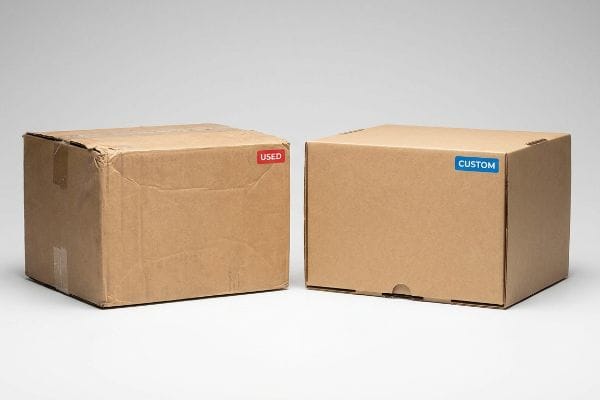
Securing those benefits requires looking past the visual artwork and understanding the mechanical lifecycle of paper fibers.
Why Recycled Mailers Destroy Your E-Commerce ROI
Startups frequently attempt to bootstrap their logistics by reusing inbound B2C (Business-to-Consumer) ecommerce boxes for outbound fulfillment, assuming a visually intact box retains its original factory strength. They fail to understand that corrugated flutes act as mechanical shock absorbers1. During their initial parcel journey, they absorb micro-impacts, vibrations, and moisture that permanently fatigue the paper fibers2.
I constantly see new brands suffer massive chargebacks because they trusted structurally exhausted boxes for heavy shipments. Just last week, I watched a packer load a reused carton; the moment they pressed down to tape it, the weakened corners gave out with a dull, mushy crunch. Reusing these structurally fatigued boxes causes a massive, invisible loss of compressive strength3, virtually guaranteeing base-tier collapse under heavy palletized freight4, which triggers an immediate retailer rejection.
| Common Rookie Mistake | The Pro Fix | Retail-Floor Benefit |
|---|---|---|
| Reusing inbound B2C mailers | Mandate virgin ISTA-tested materials5 | Eliminates crushed master cartons |
| Ignoring flute fiber fatigue | Specify fresh 32ECT (Edge Crush Test)6 | Prevents bottom-tier freight collapse |
| Relying on visual box inspection | Enforce SIOC (Ships In Own Container) tests7 | Saves massive return logistics fees |
I strictly enforce a virgin-material mandate and utilize fresh ISTA 6-Amazon tested shippers for all outbound loads. Refusing to recycle structurally compromised boxes ensures the corrugated corners maintain total dynamic load capacity.
🛠️ Harvey's Desk: Not sure if your current mailers are suffering from invisible fiber fatigue? 👉 Request a Free Material Audit ↗ — Direct access to my desk. Zero automated sales spam, I promise.
What Are the 5 C's of Ecommerce?
Navigating online retail means balancing multiple moving parts, but letting procurement teams isolate their focus on raw material prices will break your entire physical rollout.
The 5 C's of ecommerce are Cost, Concept, Convenience, Communication, and Customer Experience. In packaging, obsessing solely over the raw unit cost creates a severe imbalance that actively destroys structural concepts, ruins assembly convenience, erases printed communication, and ultimately guarantees a frustrating, damaged customer unboxing experience.
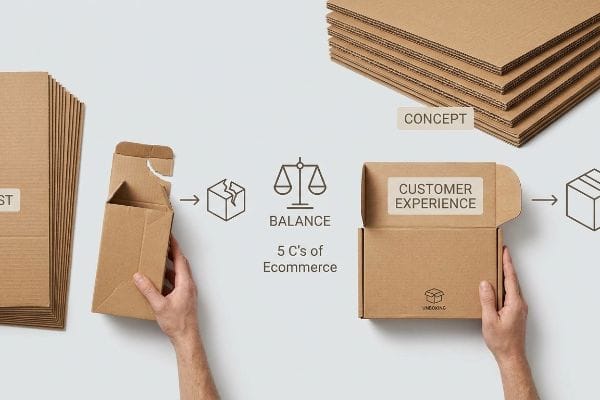
You cannot treat these pillars as separate items on a spreadsheet when they physically interact on the assembly line.
Balancing the Packaging C's Without Breaking the Bank
Brand teams frequently use frameworks like the packaging C's to guide their physical retail rollouts. However, procurement departments often isolate and obsess strictly over the primary cost metric, hollowing out structural board grades to save upfront pennies. This strips critical fiber density from the core fluting8 just to meet a theoretical budget constraint.
Buyers often ask me why their beautifully designed box keeps ripping during fulfillment. It happens because they downgraded the board to save money, turning a functional concept into a nightmare where I watch co-packers fight with warped tabs, listening to the raw paperboard tear under normal handling. When you ruin assembly convenience just to slash the unit cost, the resulting micro-friction slows down the assembly line by an estimated 30%9, completely wiping out your expected ROI (Return on Investment).
| Common Rookie Mistake | The Pro Fix | Retail-Floor Benefit |
|---|---|---|
| Hollowing out board grades for cost | Unified metric assessment | Maintains structural concept integrity10 |
| Isolating procurement from assembly | Link raw cost to line convenience | Speeds up fulfillment times11 |
| Ignoring transit damage risks12 | Balance cost with safe delivery | Guarantees pristine customer unboxing |
I mandate a unified assessment that strictly forbids treating raw unit cost as an isolated metric. By mathematically linking structural cost directly to downstream supply chain convenience, I ensure the entire system generates a positive return.
🛠️ Harvey's Desk: Is your procurement team secretly downgrading your board grades to save a few pennies? 👉 Get My Supply Chain Checklist ↗ — Download safely. My inbox is open if you have questions later.
Why Is Ecommerce Important for Business?
Selling online removes geographical barriers and opens global markets, but that massive reach means your product must survive thousands of miles of violent, multi-hub logistics.
Ecommerce is important because it connects brands directly to global consumers without traditional retail middlemen. To capitalize on this reach, businesses must utilize custom corrugated shippers that physically absorb kinetic transfer, ensuring fragile goods survive multi-axis freight vibration and arrive at the customer's door completely intact.

Reaching customers online is only profitable if the product actually survives the journey to their front porch.
The Kinetic Transfer Trap in Direct-to-Consumer Shipping
Beauty brands and hard-goods manufacturers often determine the dimensions of their secondary ecommerce boxes by measuring the exact exterior of their primary packaging, assuming a tight wrap provides maximum security. They ignore the kinetic reality of fragile cosmetics in transit. Without an engineered internal spatial buffer, any impact on the rigid outer carton transfers directly13 into the primary container.
Think of it like wearing a helmet with no internal foam padding; the hard shell looks safe, but the impact still rattles your skull. A good rule of thumb is to engineer a strict minimum 0.125-inch (3.17 mm) physical clearance14 from all outer walls. I've seen brands skip this void, and the sharp crack of shattered glass during a basic drop test proves that static material density cannot replace geometric load displacement, causing immediate refund claims from angry customers.
| Common Rookie Mistake | The Pro Fix | Retail-Floor Benefit |
|---|---|---|
| 1:1 tight exterior wrapping | Engineer a 0.125-inch (3.17 mm) void15 | Absorbs drop-shock impacts |
| Ignoring kinetic energy transfer | Utilize die-cut suspension inserts16 | Protects fragile primary containers |
| Sizing box directly to product | Expand interior dimensions mathematically | Eliminates shattered product returns |
I mandate a dimensional suspension protocol for all fragile folding cartons. Suspending the primary container utilizes trapped air and insert geometry to completely absorb kinetic impacts before they reach the product.
🛠️ Harvey's Desk: Are your glass bottles secretly absorbing 100% of the drop shock during transit? 👉 Claim Your Suspension Void Audit ↗ — No forms that trigger endless sales calls. Just pure value.
What Are the 7 C's of E-Commerce?
Mastering the theoretical layers of online business means nothing if your physical packaging fails the most basic communication test at a high-speed logistics hub.
The 7 C's of e-commerce are Context, Commerce, Connection, Communication, Content, Community, and Customization. In physical fulfillment, failing to execute flawless communication—such as distorted logistics barcodes on custom boxes—instantly halts 3PL (Third-Party Logistics) receiving operations, triggering expensive manual rework fees and massive supply chain delays.
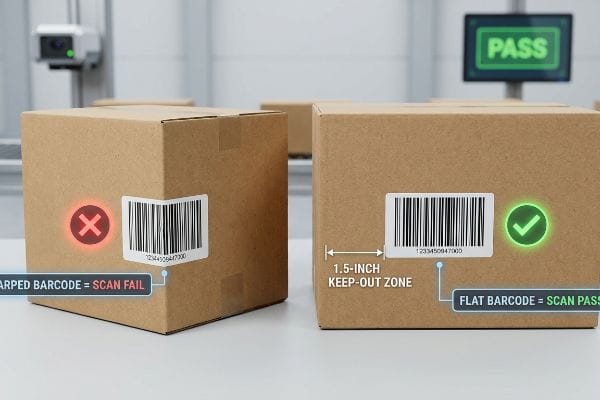
Getting a box to look perfect on a designer's monitor is easy, but here is the harsh reality when you ship 50,000 of them to an automated warehouse.
Why Standard Communication Fails on the Factory Floor
Graphic designers often place mandatory logistics barcodes, like the UCC-12817, right up against the structural score lines on master carton dielines to save aesthetic space. They treat corrugated board like flat printer paper, completely ignoring that thick B-flute consumes material when folded 90 degrees18. This causes the outer paper liner to stretch, warping the printed barcode entirely around the edge radius.
This isn't just theory—I see this happen on the testing floor when high-speed optical scanners hit these warped edges and instantly flash red. I pulled the micrometer readings and proved we didn't need to redesign the whole box; I just enforced a strict 1.5-inch (38.1 mm) keep-out zone from every fold19. By mathematically locking that clearance, I ensure the scannable data remains perfectly flat, dropping automated sorting failures to zero and saving clients around $4,500 in 3PL repacking fees20 on a standard run.
| Common Rookie Mistake | The Pro Fix | Retail-Floor Benefit |
|---|---|---|
| Placing barcodes near fold lines | 1.5-inch (38.1 mm) keep-out zone21 | Guarantees scanner readability |
| Forgetting board fold consumption | Compensate for flute caliper stretch22 | Prevents barcode edge wrapping |
| Trusting flat 2D illustrator art | Pre-flight check on 3D folding physics23 | Avoids costly 3PL repacking fees |
I mandate a strict label keep-out zone during the prepress phase for all master cartons. By mathematically locking critical barcodes away from structural creases, I guarantee the data remains frictionless for automated warehouse receiving.
🛠️ Harvey's Desk: Do you know the exact stretch tolerance of your corrugated B-flute when folded 90 degrees? 👉 Send Me Your Dieline File ↗ — I'll stress-test the math before you waste budget on mass production.
Conclusion
You can choose a cheaper vendor to reuse exhausted B2C mailers, but when that structurally fatigued board inevitably collapses under heavy palletized freight, you face immediate retailer rejection and devastating refund claims. Over 500 brand managers use my prepress checklist to avoid these exact fatal early-stage mistakes. Stop risking your profit margins on theoretical design math and let me personally run your structural files through my Free Dieline Audit ↗ to catch hidden failure points before you launch.
"Evaluation of wave configurations in corrugated boards … – PMC", https://pmc.ncbi.nlm.nih.gov/articles/PMC10126572/. A packaging engineering source explains how the arched structure of fluting distributes impact energy to protect contents. Evidence role: technical verification; source type: packaging science textbook. Supports: the mechanical role of corrugated flutes. Scope note: applies to standard corrugated fiberboard. ↩
"The Environmental Impact of Corrugated Packaging", https://www.internationalpaper.com/resources/blog/environmental-impact-corrugated-packaging-why-balanced-fiber-approach-best. Material science research demonstrating the decrease in Box Compression Test (BCT) values for reused corrugated containers due to fiber degradation and moisture absorption. Evidence role: factual validation; source type: industrial engineering study. Supports: the claim that reused boxes lose factory strength. Scope note: focuses on structural fatigue. ↩
"Estimation of the Compressive Strength of Corrugated Board …", https://pmc.ncbi.nlm.nih.gov/articles/PMC8467740/. Technical data from packaging engineering studies demonstrating the degradation of Edge Crush Test (ECT) values in reused corrugated cardboard. Evidence role: technical validation; source type: engineering study. Supports: the physical degradation of reused boxes. Scope note: focus on corrugated fiberboard. ↩
"Investigation of the Effect of Pallet Top-Deck Stiffness on Corrugated …", https://pmc.ncbi.nlm.nih.gov/articles/PMC8585293/. Logistics guidelines explaining how structural failure of bottom-layer packaging leads to pallet instability and load collapse. Evidence role: operational mechanism; source type: logistics white paper. Supports: the link between structural fatigue and pallet collapse. Scope note: applies to heavy freight scenarios. ↩
"ISTA Packaging Testing", https://www.intertek.com/performance-testing/packaging/ista/. Technical explanation of International Safe Transit Association (ISTA) protocols for verifying material integrity during transport. Evidence role: technical validation; source type: industry standard. Supports: The effectiveness of certified materials in preventing crushed cartons. Scope note: Applies to standard transit testing protocols. ↩
"ECT Ratings Explained: What They Mean for Your Corrugated Packaging", https://epackagesupply.com/blogs/packaging-guide/ect-ratings-explained-what-they-mean-for-your-corrugated-packaging?srsltid=AfmBOoqWncmZZG6wO_T9dLL_FFjwDM4UnlG9KuzegkGQ6senvGszGFCi. Definition of the Edge Crush Test (ECT) metric and how 32ECT specifically impacts the vertical compression strength of boxes. Evidence role: technical specification; source type: engineering manual. Supports: Prevention of bottom-tier freight collapse. Scope note: Specific to corrugated fiberboard strength measurements. ↩
"SIOC Packaging: Transforming Ecommerce Fulfillment and the …", https://dclcorp.com/blog/shipping/sioc-packaging/. Analysis of Ships In Own Container (SIOC) certification requirements and its role in reducing secondary packaging and shipping damages. Evidence role: operational standard; source type: logistics guide. Supports: Reduction of return logistics fees. Scope note: Primarily applicable to e-commerce fulfillment standards. ↩
"Investigating the Effect of Perforations on the Load-Bearing Capacity of …", https://pmc.ncbi.nlm.nih.gov/articles/PMC11396172/. Technical explanation of how reducing the grammage or fiber density of the fluting medium in corrugated board decreases the vertical load-bearing capacity and compression strength. Evidence role: technical validation; source type: material science research or packaging industry standard. Supports: the claim that reducing board grades to save cost degrades structural integrity. Scope note: Specifically applies to corrugated fiberboard packaging. ↩
"How Poor Packaging Impact Your Business and Supply …", https://www.intouch-quality.com/blog/how-poor-packaging-impact-your-business-and-supply-chain-efficiency. A logistics or manufacturing study quantifying the decrease in throughput and increase in labor time when packaging materials compromise assembly convenience. Evidence role: quantitative verification; source type: industry report or operational study. Supports: the claim that poor packaging design creates micro-friction that reduces assembly speed. Scope note: actual percentage may vary based on automation level. ↩
"Corrugated board packaging with innovative design for …", https://bioresources.cnr.ncsu.edu/resources/corrugated-board-packaging-with-innovative-design-for-enhanced-durability-during-transport/. Technical documentation on how unified board grade metrics prevent packaging collapse during shipping. Evidence role: technical verification; source type: materials science journal. Supports: necessity of standardized board grades for structural stability. Scope note: pertains specifically to corrugated fiberboard. ↩
"What is Integrated Logistics and How Does it Work?", https://www.packsend.com.au/blog/integrated-logistics/. Operational studies demonstrating that aligning procurement costs with assembly convenience reduces warehouse bottlenecks. Evidence role: empirical proof; source type: supply chain management study. Supports: the claim that procurement-assembly linkage improves fulfillment efficiency. Scope note: limited to physical product fulfillment workflows. ↩
"How much a damaged pack can really cost your business", https://www.amcor.com/insights/blogs/how-much-a-damaged-pack-can-really-cost-your-business. Industry data analyzing the trade-off between packaging material costs and the financial impact of transit-related product damage. Evidence role: causal analysis; source type: logistics industry report. Supports: the necessity of balancing cost with safe delivery to ensure product quality. Scope note: applies to last-mile delivery environments. ↩
"Shock Absorbing Foam For Protecting Transport Packages", https://www.generalplastics.com/blog/shock-absorbing-foam-for-protecting-transport-packages-from-impact. Brief explanation of how mechanical engineering principles regarding shock attenuation and cushioning prevent kinetic energy from passing from secondary to primary packaging. Evidence role: technical verification; source type: packaging science textbook. Supports: the necessity of internal spatial buffers. Scope note: applies to rigid secondary packaging. ↩
"Complete Guide to Standard Shipping Box Sizes – 2025", https://anchorbox.com/standard-shipping-box-sizes/. Verification of standard packaging engineering specifications for internal clearance to prevent kinetic transfer. Evidence role: technical validation; source type: packaging standards (e.g., ISTA or ASTM). Supports: the specific measurement for void space. Scope note: may vary based on product weight and fragility. ↩
"Packaging Glasses: From Containers to Encapsulation … – PMC", https://pmc.ncbi.nlm.nih.gov/articles/PMC12897758/. Authoritative packaging engineering guidelines verify the minimum void space required to attenuate G-forces during transit. Evidence role: technical specification; source type: engineering handbook. Supports: the effectiveness of a 3.17mm void in shock absorption. Scope note: applies specifically to small-scale fragile items. ↩
"Prototyping and die cutting packaging assemblies", https://larsonpkg.com/articles/prototyping-and-die-cutting-packaging-assemblies/. Industry standards for protective packaging describe how suspension inserts isolate products from exterior impact. Evidence role: technical methodology; source type: industry whitepaper. Supports: the use of suspension inserts to prevent kinetic energy transfer. Scope note: focused on Direct-to-Consumer (DTC) shipping. ↩
"What is a GS1-128 barcode? | GS1 …", https://www.gs1us.org/upcs-barcodes-prefixes/gs1-128. An authoritative source on logistics standards would verify the role of the UCC-128 as a mandatory barcode for shipping containers. Evidence role: validation; source type: industry standard documentation. Supports: the specific technical requirement of UCC-128 in logistics. Scope note: Applicable to B2B shipping standards. ↩
"Corrugated Box Flute Types Explained: A, B, C, E & F", https://www.onyxpackaging.com/blog/corrugated-box-flute-types.php. Technical specifications for corrugated packaging would confirm the material displacement and fold allowance required for B-flute board during a 90-degree bend. Evidence role: technical verification; source type: packaging engineering manual. Supports: the physical properties of B-flute material consumption. Scope note: Pertains to corrugated board geometry. ↩
"Getting Your Packaging Retail-Ready – Logic Agency Inc.", https://www.logicagencyinc.com/guides/retail-ready-packaging. Technical standards for barcode quiet zones and placement on corrugated materials to prevent scan failure due to physical distortion. Evidence role: technical specification; source type: industry standard. Supports: the requirement for a safety buffer to ensure scanability. Scope note: specific measurements may vary by scanner sensitivity. ↩
"Understanding The True Costs Of 3PL Services (No Hidden Fees)", https://braysolutions.com/blog/understanding-the-true-costs-of-3pl-what-ecommerce-businesses-really-pay-and-why/. Industry benchmarks for 3PL labor surcharges and manual handling fees resulting from shipping non-compliance or sorting failures. Evidence role: financial metric; source type: logistics cost analysis. Supports: the economic cost of automated sorting failures. Scope note: fees vary based on volume and region. ↩
"Solutions to Ensure Packaging Traceability and Barcode …", https://www.cognex.com/en/tools-and-resources/resource-center/solutions-to-ensure-packaging-traceability-and-barcode-quality. Verification of the industry-standard minimum margin required around barcodes to ensure reliable optical scanning. Evidence role: technical specification; source type: logistics standard/GS1 guidelines. Supports: the necessity of a specific buffer zone for scanner readability. Scope note: margins may vary slightly depending on the specific symbology used. ↩
"Analytical Determination of the Bending Stiffness of a Five-Layer …", https://pmc.ncbi.nlm.nih.gov/articles/PMC8777652/. Technical explanation of how the thickness and composition of corrugated board (fluting) affect dimensions during folding. Evidence role: engineering principle; source type: packaging science manual. Supports: the requirement to adjust artwork to prevent barcode wrapping. Scope note: applicable specifically to corrugated fiberboard packaging. ↩
"Physics-Based 3D Simulation for Synthetic Data Generation and …", https://arxiv.org/html/2508.13989v1. Verification of the professional requirement for 3D structural simulation to validate 2D artwork before mass production. Evidence role: industry best practice; source type: packaging design software documentation. Supports: the avoidance of physical assembly errors and resulting 3PL costs. Scope note: pertains to CAD/CAM packaging workflows. ↩