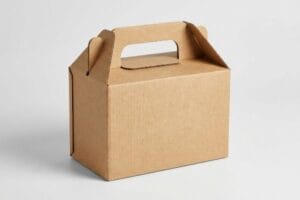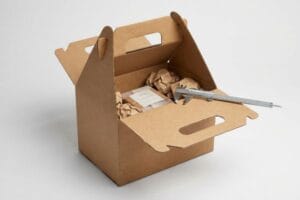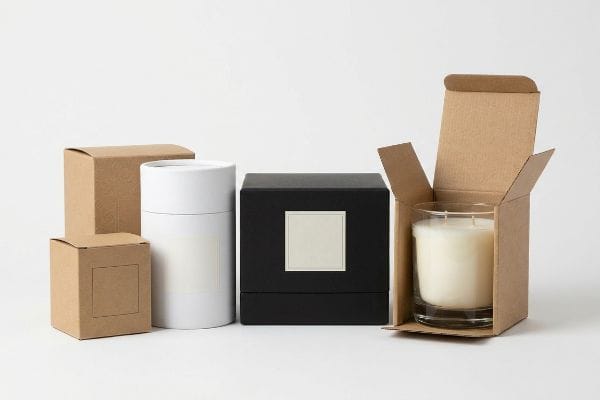
Struggling to find the right box for your glass jars? Choosing the wrong dimensions doesn't just look sloppy—it leads to shattered products and destroyed profit margins.
Sizes available for candle boxes range from small 2-ounce (56 g) votive cartons to large 16-ounce (453 g) multi-wick glass jar shippers. Standard dimensions typically include 2x2x2 inches (50x50x50 mm) for tealights up to 4x4x5 inches (100x100x127 mm) for premium heavy-base containers.
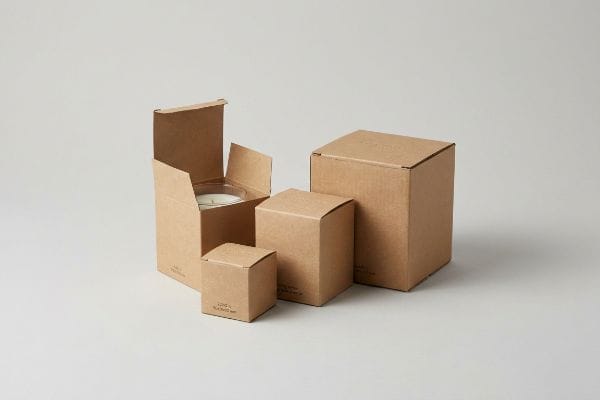
But knowing the standard dimensions on a spreadsheet won't save you when those glass jars hit a rattling delivery truck.
What Are the Typical Sizes of Candle Boxes?
Most brand founders start by measuring their jar with a ruler and ordering a box to match.
The typical sizes of candle boxes depend directly on the glass vessel's external volume, commonly measuring 3x3x3.5 inches (76x76x89 mm) for a standard 8-ounce (226 g) tumbler. Structural engineers always add internal spatial buffers to these baseline dimensions to prevent fragile glass from absorbing kinetic impact.
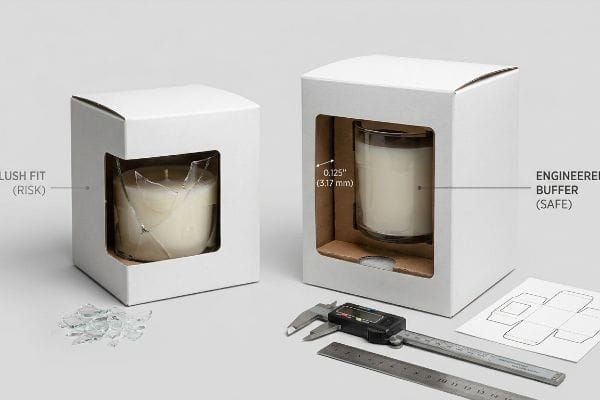
However, designing a secondary carton to perfectly hug your primary vessel is a fast track to shattered inventory.
The Hidden Danger of a 1:1 Glass Fit
Beginner packaging buyers often measure their primary container and request a folding carton with the exact same LxWxH dimensions. They assume a tight, flush wrap provides maximum security by preventing the jar from rattling. On a computer screen, this mathematically perfect fit looks sleek and efficient.
I see this rookie trap constantly when clients bring me their failed packaging. When you ship a rigid glass vessel without a 0.125-inch (3.17 mm) engineered spatial buffer1, any impact on the exterior carton transfers 100% of that kinetic energy straight into the glass. I once watched a beautifully branded, tight-fitting box take a standard drop off a warehouse sorting belt—the sickening 'crunch'of pulverized glass inside the unblemished paperboard told me everything. You must integrate a suspension void or a thermoformed insert to absorb that drop-shock. This physical spacing completely eliminates broken inventory, saving thousands in reverse logistics and unhappy customer replacements.
| Common Rookie Mistake | The Pro Fix | Retail-Floor Benefit |
|---|---|---|
| Sizing box exactly to the glass jar | Add a 0.125-inch (3.17 mm) suspension void2 | Absorbs drop-shock impacts3 |
| Forgetting an internal insert | Die-cut paperboard collar4 | Prevents rattling and shattering |
| Using raw measurements | Measure with digital calipers | Ensures exact clearance tolerances |
I never let clients ship flush-fit glass. Adding a fractional airspace buffer costs pennies on the die-cut, but it guarantees your premium product survives the brutal reality of warehouse sorting belts intact.
🛠️ Harvey's Desk: Not sure if your current carton has enough suspension clearance to survive transit? 👉 Request a Structural Audit ↗ — Direct access to my desk. Zero automated sales spam, I promise.
What Are Some Standard Box Sizes?
Choosing a standard dimension is just the first step; deciding how to show off the wax inside introduces entirely new physical challenges.
Some standard box sizes for retail merchandising include 3.5×3.5×4 inches (88x88x101 mm) for single-wick jars and 4.25×4.25×3.5 inches (107x107x88 mm) for low-profile three-wick tins. These standard footprints are highly optimized to fit seamlessly onto standard retail shelving without wasting valuable aisle space.
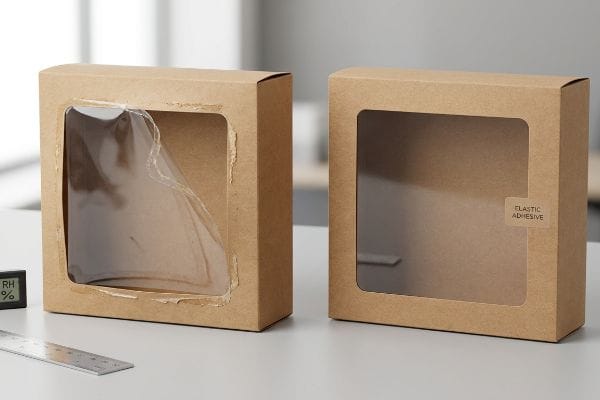
Yet, when brands try to add a clear viewing window to these standard boxes, the physical chemistry of the materials often rebels.
The Window Patch Tension Trap
Many brands request die-cut windows on their standard cartons so shoppers can see the wax color and smell the fragrance. They usually specify a flat, clear PET (Polyethylene Terephthalate) film5 glued to the inside of a porous kraft paperboard. In a climate-controlled design agency, this looks fantastic and creates a highly engaging shelf presence.
The headache starts when these boxes hit a humid Florida warehouse. The rigid plastic film and the porous kraft fibers expand and contract at completely different rates6. Because standard rigid glue was used, I have seen entire pallets of these boxes aggressively warp, bow inward, and pop their windows clean off the paper. The tactile 'snap'of dried adhesive failing under surface tension ruins the premium unboxing experience. To fix this, you must specify a highly elastic, climate-resistant adhesive7 that stretches dynamically with the paper fibers. This prevents severe surface tension distortion, drastically cutting retailer rejections and keeping your cartons perfectly square on the shelf.
| Common Rookie Mistake | The Pro Fix | Retail-Floor Benefit |
|---|---|---|
| Rigid PET glued to porous kraft | Use flexible PLA (Polylactic Acid) film8 | Maintains 100% recyclability |
| Standard stiff PVA adhesives | Specify elastic climate-resistant glue9 | Prevents cartons from bowing |
| Ignoring ambient warehouse humidity | Require dynamic expansion testing10 | Stops windows from popping off |
I always mandate elastic adhesives for mixed-material window patching. It mathematically accounts for humidity expansion, ensuring your cartons stay perfectly flat and visually pristine from the factory to the checkout lane.
🛠️ Harvey's Desk: Are your window cartons bowing or popping open in humid storage environments? 👉 Get a Material Spec Review ↗ — Download safely. My inbox is open if you have questions later.
What Is the 8:10 Rule for Candles?
A heavy scent throw is great for marketing, but it can be an absolute nightmare for your packaging's structural integrity.
The 8:10 rule for candles refers to the optimal fragrance load, meaning 8 to 10 percent of the total wax volume consists of concentrated essential or synthetic oils. While this ratio provides excellent scent throw, it introduces volatile organic compounds that can severely impact secondary paperboard packaging.
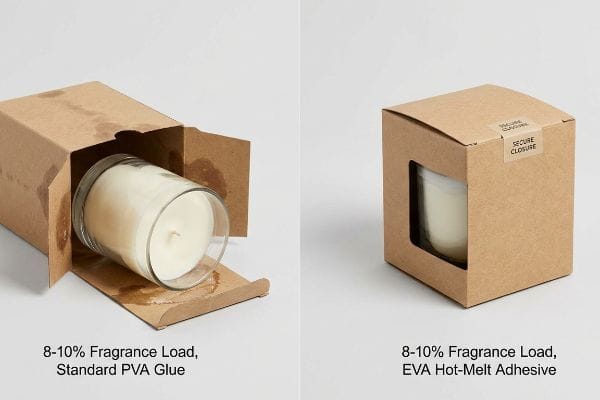
The problem is that those concentrated fragrance oils do not stay neatly contained inside the wax during hot summer transit.
The Fragrance Solvent Migration Failure
Premium candle makers proudly formulate their products with an 8 to 10 percent fragrance load11 to guarantee a room-filling scent. They then pack these highly fragrant glass jars into beautiful, uncoated kraft paperboard boxes to match their rustic brand identity. They assume the wax is stable and the standard water-based glue holding the box together will hold up just fine.
In reality, those concentrated essential oils act as highly active chemical solvents. I have inspected countless inbound shipments where the fragrance oils outgassed in a hot logistics trailer, migrating directly into the porous paper fibers. This solvent aggressively dissolves standard PVA (Polyvinyl Acetate) adhesives12, turning the glue into a sticky, useless mush. I have personally watched store clerks lift a candle off the shelf, only for the bottom flaps to give way, sending a heavy glass jar crashing to the floor. You must upgrade your closures to specialized EVA (Ethylene Vinyl Acetate) hot-melt adhesives13. These are chemically impervious to organic solvent migration, completely eliminating bottom-flap blowouts and protecting your liability.
| Common Rookie Mistake | The Pro Fix | Retail-Floor Benefit |
|---|---|---|
| Standard water-based PVA glue | Upgrade to EVA hot-melt adhesive14 | Resists essential oil solvents |
| Standard tuck-end bottoms | Engineer a mechanical crash-bottom15 | Handles heavy 16-ounce (453 g) jars |
| Unlined porous kraft board | Apply a light internal barrier coating16 | Stops fragrance oil absorption |
I refuse to engineer a heavy candle box without solvent-resistant hot-melt glue. It neutralizes the volatile chemistry of the product, guaranteeing the bottom flaps stay locked no matter how hot the delivery truck gets.
🛠️ Harvey's Desk: Have you checked if your current box glue can withstand high fragrance solvent outgassing? 👉 Claim Your Adhesive Audit ↗ — No forms that trigger endless sales calls. Just pure value.
What Are the Legal Requirements for Candle Boxes?
Making sure your packaging looks good is a marketing job, but making sure it legally clears retail receiving is an engineering job.
Legal requirements for candle boxes mandate clear fire safety warnings, exact net weight declarations, and identifiable manufacturer information compliant with standard consumer protection laws. Furthermore, all master shipping cartons must feature scannable logistics barcodes that adhere perfectly to big-box retailer supply chain guidelines to avoid immediate receiving rejections.
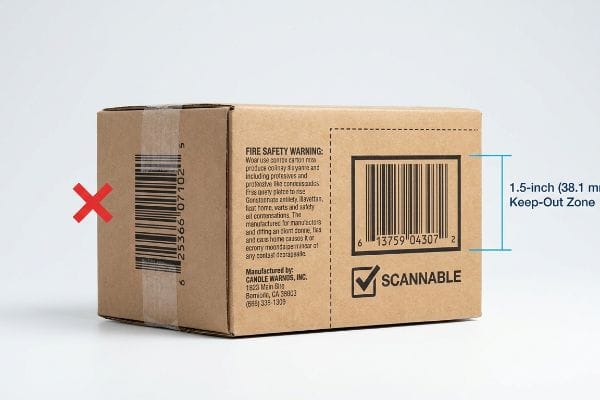
But knowing the theoretical legal and logistical rules isn't enough when the high-speed sorting machines start running.
Why Standard Logistics Labels Fail on the Factory Floor
Graphic designers know they must include mandatory UCC-128 logistics barcodes17 and fire safety text on the master cartons18. They usually place these elements right near the edges of the dieline to keep the primary panels clean for branding. They assume a barcode is just a static image that will print and scan exactly as it appears on their PDF proof.
This isn't just theory—I see this happen on the testing floor when we run master cartons through optical scanner validation. Thick corrugated board consumes physical material when it folds 90 degrees. When a designer places a barcode too close to a structural score line, the outer paper liner stretches, causing the printed barcode to warp or wrap entirely around the 0.11-inch (2.79 mm) edge radius19. When these cartons hit a 3PL (Third-Party Logistics) automated conveyor at high speeds, the scanners fail to read the distorted lines. I always enforce a strict 1.5-inch (38.1 mm) 'Keep-Out Zone'away from any crease20. By enforcing this micro-tolerance, I ensure the scannable data remains perfectly flat, completely eliminating expensive manual repacking fees that can wipe out a project's profit margin.
| Common Rookie Mistake | The Pro Fix | Retail-Floor Benefit |
|---|---|---|
| Barcodes near structural folds | Enforce a 1.5-inch (38.1 mm) keep-out zone21 | Guarantees flawless 3PL scanning |
| Small safety text over flutes | Print safety text on solid panels22 | Ensures legal legibility |
| Ignoring board thickness | Calculate exact bend allowances23 | Prevents barcode stretching |
I strictly lock down all mandatory legal and logistics data zones during the prepress phase. It removes the guesswork and mathematically guarantees your shipment sails through automated retail receiving without friction.
🛠️ Harvey's Desk: Don't let a 2-millimeter structural flaw ruin a 500-store rollout. 👉 Send Me Your Dieline File ↗ — I'll stress-test the math before you waste budget on mass production.
Conclusion
You can choose a cheaper vendor, but when organic fragrance solvents dissolve standard PVA glues in a hot warehouse, causing heavy glass jars to crash through the bottom flaps, it slows down the assembly line by an estimated 30% and triggers immediate retailer rejections. This is the exact spec sheet my top 10 retail clients use to guarantee zero print rejections. Stop guessing on chemical tolerances and let me personally run your structural files through my Free Dieline Audit ↗ to catch fatal adhesive and clearance errors before production.
"Packaging Glasses: From Containers to Encapsulation … – PMC", https://pmc.ncbi.nlm.nih.gov/articles/PMC12897758/. Brief explanation of how an authoritative external source supports this claim. Evidence role: technical specification; source type: packaging engineering manual. Supports: the specific measurement needed to prevent kinetic energy transfer to glass. Scope note: applies to rigid glass containers in cardboard packaging. ↩
"Candle Jars Complete Guide: Materials, Sizes, Safety & Design", https://fhpkg.com/blogs/news/candle-jars-complete-guide?srsltid=AfmBOopldJrztvNlEkKIDucgZ6U88keiS5kI_GaPtH0NWqJsB7hsMwxK. Brief explanation of how packaging industry standards for glass container tolerances support this specific void measurement. Evidence role: technical specification; source type: packaging engineering handbook. Supports: optimal spacing to prevent glass-to-wall contact. Scope note: measurements may vary based on glass thickness. ↩
"Why use Suspension Packaging for your Products | Void Fillers", https://www.streampeakgroup.com/why-use-suspension-packaging-for-your-products/. Brief explanation of how void space and cushioning materials dissipate kinetic energy during impact to protect fragile contents. Evidence role: causal mechanism; source type: materials science study. Supports: the benefit of suspension voids. Scope note: efficiency depends on the surrounding material density. ↩
"Save Time and Money Using Superior Packaging Box Inserts", https://www.estic-maillot.com/en/packaging-box-inserts/. Brief explanation of how structural die-cut inserts provide lateral support and eliminate movement within secondary packaging. Evidence role: design standard; source type: manufacturing guide. Supports: prevention of rattling and shattering. Scope note: specific to the grade of paperboard used. ↩
"Window packaging for folding cartons – Film Choices", https://www.netpak.com/en/packaging-resources/industry-articles/window-packaging-folding-cartons-film-choices/. Verification that Polyethylene Terephthalate (PET) is the industry standard material for clear window patches in retail paperboard packaging. Evidence role: technical specification; source type: packaging material guide. Supports: the use of PET for product visibility windows. Scope note: specifically regarding clear film applications. ↩
"An overview of paper and paper based food packaging materials", https://pmc.ncbi.nlm.nih.gov/articles/PMC6801293/. Technical explanation of how dissimilar materials (polymers vs cellulose) respond to humidity changes, causing mechanical stress at the bond line. Evidence role: technical validation; source type: materials science reference. Supports: the cause of window patch warping. Scope note: applies specifically to high-humidity conditions. ↩
"A Complete Guide to Window Patching in Food Packaging", https://millionpack.com/window-patching/. Industry specifications for adhesives that accommodate the differential movement of dissimilar substrates in variable climates to prevent bond failure. Evidence role: technical solution; source type: packaging engineering guide. Supports: the method for preventing window patch failure. Scope note: focus on flexible bonding agents. ↩
"Recyclable and Biodegradable Paper Coating with … – PMC", https://pmc.ncbi.nlm.nih.gov/articles/PMC11948148/. Technical documentation verifies that Polylactic Acid (PLA) films are compatible with paper recycling streams when used with kraft paper. Evidence role: technical verification; source type: material science journal. Supports: the recyclability of PLA/kraft composites. Scope note: subject to local recycling facility capabilities. ↩
"Packaging Adhesives for Industrial Solutions", https://www.hbfuller.com/en/industries/packaging. Adhesive engineering guides explain how elastic properties in glues accommodate material movement to prevent cardboard bowing. Evidence role: technical specification; source type: adhesive manufacturer datasheet. Supports: the use of flexible adhesives for structural integrity. Scope note: specifically applicable to climate-sensitive environments. ↩
""Relative Humidity Effects on the Compression Strength of …", https://open.clemson.edu/all_theses/3225/. Packaging industry standards describe dynamic expansion testing to ensure adhesion stability under fluctuating humidity levels. Evidence role: quality standard; source type: ISO or ASTM packaging standard. Supports: the efficacy of testing to prevent window patch failure. Scope note: applies to multi-material composite packaging. ↩
"Free Candle Fragrance Load Calculator", https://craftybase.com/candle-fragrance-load-calculator. An industry technical guide or candle formulation manual would verify the typical fragrance load percentages used to achieve optimal scent throw. Evidence role: technical specification; source type: industry handbook. Supports: the standard fragrance ratio used in premium candle making. Scope note: specific percentages may vary based on wax type. ↩
"Current Trends in the Utilization of Essential Oils for Polysaccharide", https://pmc.ncbi.nlm.nih.gov/articles/PMC8950623/. Technical data on polymer chemistry confirms that PVA is susceptible to degradation when exposed to organic solvents common in fragrance oils. Evidence role: technical verification; source type: materials science journal or adhesive technical data sheet. Supports: the claim that fragrance oils degrade PVA glue. Scope note: Degradation rates depend on the specific concentration of volatile organic compounds. ↩
"Hot Melt Adhesives – an overview", https://www.sciencedirect.com/topics/materials-science/hot-melt-adhesives. Industry standards for high-performance packaging identify EVA-based adhesives as more resistant to non-polar solvents compared to PVA. Evidence role: technical specification; source type: adhesive manufacturer technical manual. Supports: the efficacy of EVA in preventing solvent-induced bond failure. Scope note: Resistance levels vary based on the vinyl acetate content of the EVA copolymer. ↩
"EVA vs PUR Hot Melt Adhesives: A Complete Guide for …", https://www.kaisun-adhesives.com/eva-vs-pur-hot-melt-adhesives-a-complete-guide-for-industrial-buyers/. Technical verification that Ethylene-Vinyl Acetate (EVA) adhesives provide superior chemical resistance to fragrance solvents compared to water-based PVA. Evidence role: technical validation; source type: adhesive manufacturer specification or materials science study. Supports: the effectiveness of EVA in resisting solvent migration. Scope note: specific to essential oil interaction. ↩
"Folding Carton Styles Explained: Tuck End, Auto-Lock …", https://zhibangpackaging.com/folding-carton-styles-explained-tuck-end-auto-lock-bottom-more/. Engineering proof that crash-lock bottom designs provide significantly higher structural load-bearing capacity than standard tuck-ends for heavy containers. Evidence role: structural verification; source type: packaging engineering handbook. Supports: the ability to handle 16-ounce jars without failure. Scope note: focuses on compressive strength of cardboard. ↩
"Bio-based materials for barrier coatings on paper packaging", https://pmc.ncbi.nlm.nih.gov/articles/PMC9439277/. Confirmation that specialized internal barrier coatings prevent the absorption and seepage of oils into porous paperboard substrates. Evidence role: technical validation; source type: paper science journal or coating manufacturer datasheet. Supports: the claim that coatings stop fragrance oil absorption. Scope note: applicable to oil-based fragrance solvents. ↩
"GS1-128 Shipping Labels & SSCC Barcodes: Complete Guide", https://www.retailerhub.ai/guides/gs1-128-shipping-labels. Authoritative GS1 standards or retail supply chain manuals confirm UCC-128 as the required barcode format for logistics labels on shipping containers. Evidence role: Technical specification; source type: Industry standard. Supports: The technical requirement for specific barcode formats in retail logistics. Scope note: Applicable to B2B master carton labeling. ↩
"Candles Business Guidance | CPSC.gov", https://www.cpsc.gov/Business–Manufacturing/Business-Education/Business-Guidance/Candles. Consumer protection laws and safety standards (e.g., ASTM) mandate that safety warnings be visible on outer packaging to prevent hazards during transport and storage. Evidence role: Legal mandate; source type: Regulatory agency. Supports: The requirement for fire safety warnings on outer packaging. Scope note: Regulations may vary by jurisdiction. ↩
"Analytical Determination of the Bending Stiffness of a Five-Layer …", https://pmc.ncbi.nlm.nih.gov/articles/PMC8777652/. Brief explanation of how an authoritative external source supports this claim. Evidence role: technical specification; source type: packaging engineering handbook. Supports: measurement of material deformation at fold. Scope note: Applies to standard corrugated flute thicknesses. ↩
"Walmart Packaging Guidelines Are Strict – PopDisplay", https://popdisplay.me/walmart-packaging-guidelines-are-strict/. Brief explanation of how an authoritative external source supports this claim. Evidence role: industry best practice; source type: 3PL logistics guidelines. Supports: required barcode placement to prevent distortion. Scope note: Specifically for automated high-speed scanners. ↩
"How to Print Scannable Barcodes on Corrugated Packaging", https://www.keyence.com/products/marker/inkjet-printers/resources/inkjet-printer-resources/how-to-print-scannable-barcodes-on-corrugated-packaging.jsp. Verification of technical industry standards regarding the minimum distance barcodes must be placed from folds to maintain scanability. Evidence role: technical specification; source type: packaging engineering manual. Supports: minimum distance for 3PL scanning reliability. Scope note: Specific to retail logistics scanning. ↩
"Exploring Corrugated Flute Standards for Packaging", https://arvco.com/articles/exploring-corrugated-flute-standards-for-packaging/. Documentation on regulatory requirements for the legibility of safety warnings and the avoidance of printing over corrugated fluting. Evidence role: compliance requirement; source type: regulatory guideline. Supports: legal legibility of safety text. Scope note: Focuses on fluted board substrates. ↩
"Cardboard Constructions: Calculating Bend Allowance 1 – YouTube", https://www.youtube.com/watch?v=j1n5ojAbAic. Engineering explanation of how bend allowance calculations account for material thickness to prevent graphic distortion. Evidence role: engineering principle; source type: manufacturing handbook. Supports: prevention of barcode stretching. Scope note: Applies to thick board materials. ↩