
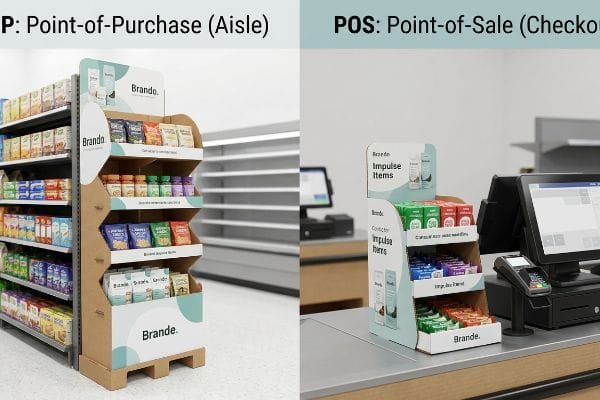
Confusing POP and POS formats actively sabotages your retail strategies. Misaligning these physical merchandising footprints guarantees immediate spatial rejection by strict big-box floor managers.
A POP display differs from a POS display strictly in physical retail location and overall structural footprint. Point-of-Purchase units occupy main aisles to drive brand awareness, while Point-of-Sale merchandisers rest directly at checkout counters to strategically trigger immediate, smaller impulse buys globally from consumers.
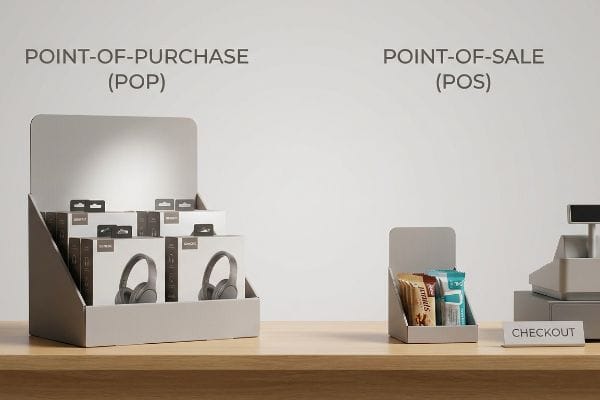
Understanding this strategic division is just the baseline. Translating these marketing definitions into structural reality on the manufacturing floor dictates whether your campaign survives freight and passes retailer compliance.
What Is the Difference Between a POP Display and a POS Display?
Distinguishing these two formats requires looking past mere marketing terminology and focusing directly on the physical spatial logistics governed by strict North American retailer regulations.
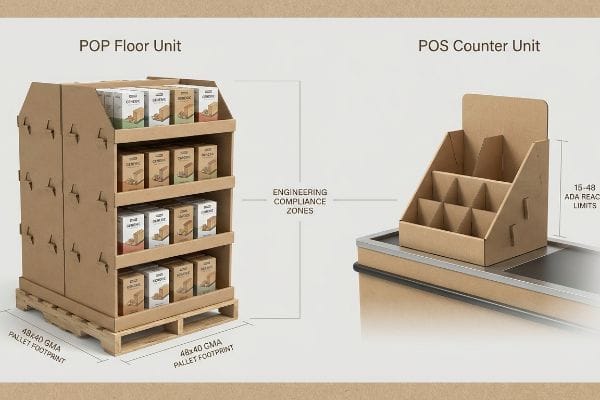
Differentiating a POP display from a POS display requires evaluating strictly enforced structural compliance zones. A Point-of-Purchase unit anchors to standard pallet dimensions for aisle placement, whereas a Point-of-Sale unit conforms to tight forward reach and height limits directly at the checkout register in retail.
These definitions directly dictate how structural engineers build the initial framework for your retail merchandising campaign.
The Engineering Mechanics behind Spatial Constraints
A Point-of-Purchase unit operates as a freestanding structural system engineered to withstand dynamic floor traffic1 and heavy payload distribution. In contrast, a Point-of-Sale merchandiser is a highly constrained, localized unit designed to rest securely on a checkout counter without obstructing sightlines2. The core mechanical difference rests entirely on the foundational footprint and the specific physical stress each unit must endure in its designated retail zone.
When engineering these separate formats, I apply two distinct mathematical pipelines to ensure total retailer compliance. For the larger floor units, the structural math is strictly anchored to the standard 48×40 inches (121.9×101.6 cm) GMA3 (Grocery Manufacturers Association) pallet limit to optimize warehouse logistics and compression strength. Conversely, the smaller checkout units are engineered in absolute obedience to the ADA (Americans with Disabilities Act) 15-48 inches4 (38.1-121.9 cm) forward reach compliance window. Attempting to force a crossover design between these two rigid frameworks simply ignores the spatial reality of retail architecture, causing friction during store-level execution and slowing down placement speed by an estimated 30%.
| Metric/Feature | POP Floor Unit | POS Counter Unit |
|---|---|---|
| Primary Location | Main aisles & end-caps | Checkout & registers |
| Engineering Anchor | 48×40 inch GMA pallet5 | 15-48 inch ADA limit6 |
| Payload Distribution | Heavy dynamic floor load | Localized static top-load |
I engineer these distinct merchandising zones to ensure your structural footprint strictly satisfies North American compliance laws. Separating these CAD (Computer-Aided Design) pipelines completely eliminates spatial friction, ensuring your displays secure their intended placement without store-level pushback.
🛠️ Harvey's Desk: Are your heavy checkout trays actively crushing your shipping ROI before they even reach the store? 👉 Claim Your Freight Density Audit ↗ — I review every structural file personally within 24 hours.
What Is the Difference Between POP and POS?
Beyond spatial placement, the physical geometry and material science required to construct these displays dictate two completely independent manufacturing approaches.
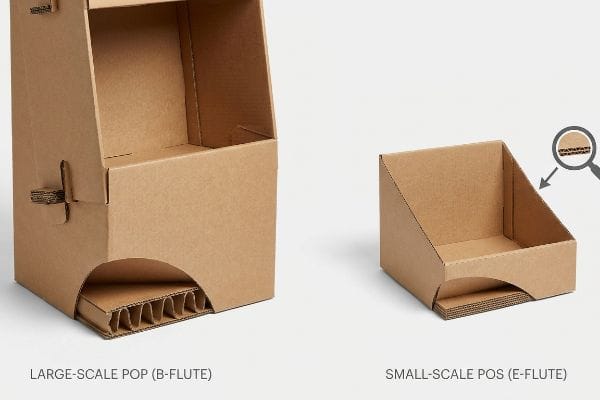
Comparing POP and POS structures requires examining precise material scale and bending physics. Point-of-Purchase formats utilize thick, heavy-duty corrugated fluting to support bulk weight, while Point-of-Sale formats rely on thinner micro-flutes to achieve tight, miniature folds for compact checkout counter spaces globally without board tearing.
Translating an overarching brand campaign across both formats requires precise mathematical adjustments rather than basic visual scaling.
The Engineering Mechanics behind Material Scaling
Designing across different merchandising zones involves recalculating how paperboard behaves when folded at varying dimensions. A massive floor structure utilizes thick, heavy substrates to absorb kinetic shock7, whereas a compact counter tray requires thin, agile substrates to form tight corners8. The fundamental distinction lies in recognizing that bending mechanics change entirely when a structure is reduced in physical volume.
I see many instances where a campaign attempts to mathematically shrink a heavy-duty floor dieline by 50% to serve as a countertop unit. However, the dense B-flute boards used for large structures cannot physically form micro-proportions cleanly. When tight fold radiuses and interlocking tabs are artificially reduced, the thick corrugated flutes cannot bend without snapping the top liner9. To adapt a floor unit for the checkout zone, I mandate a structural step-down to a thin E-flute substrate10 and completely re-engineer the friction locks, ensuring the display maintains perfect dimensional stability and pristine branding at a reduced scale.
| Metric/Feature | Floor Dieline | Counter Dieline |
|---|---|---|
| Material Substrate | Thick B-flute or C-flute11 | Thin E-flute board12 |
| Fold Tolerance | Large macro-radiuses | Tight micro-radiuses13 |
| Tab Mechanics | Heavy friction locks | Scaled precision joints |
I approach scale translation as a complete structural rebuild rather than a simple mathematical reduction. Transitioning substrates ensures the physical bending mechanics align with the unit's final volume, delivering a flawless retail presentation regardless of its physical footprint.
🛠️ Harvey's Desk: Is your current counter display design at risk of tearing its interlocking tabs when scaled down for retail friction? 👉 Request A Structural Dieline Audit ↗ — 100% confidential. Your unreleased retail designs are safe with me.
What Is a POS Display?
Focusing exclusively on the checkout environment reveals a distinct category of merchandising engineered specifically for high-friction, fast-paced transaction zones.
A POS display represents a highly compact retail merchandiser positioned directly at the checkout transaction counter. These specialized units are mathematically engineered to stabilize top-heavy impulse items, maximize restricted spatial footprints, and capture immediate shopper attention during final payment interactions globally across all commercial stores.

Engineering a unit for the checkout counter introduces entirely unique gravitational and spatial variables compared to standard aisle merchandisers.
The Engineering Mechanics behind Countertop Stability
A register-based unit operates in a confined, high-traffic area where physical bumps and rapid product removal are constant. The structure must maintain strict equilibrium while housing densely packed goods in a severely limited horizontal footprint. The primary engineering goal is to anchor the center of mass low enough to prevent tipping14 while keeping the product highly visible to the consumer.
To guarantee equilibrium in these tight transaction zones, I engineer all checkout merchandisers using a strict 2:3 Ratio rule for depth versus height15. Because counter space is heavily rationed by store management, there is a natural tendency to build units vertically to hold more inventory. However, extending height without a proportional base creates a severe gravitational imbalance. By calculating the exact center of gravity and enforcing this spatial ratio, I ensure the unit remains perfectly flush against the counter, eliminating any tipping liability during rapid impulse grabs by rushed shoppers.
| Metric/Feature | Imbalanced Design | Engineered POS Ratio |
|---|---|---|
| Depth-to-Height | Random vertical scaling | Strict 2:3 spatial ratio16 |
| Center of Gravity | Unstable top-heavy load | Low anchored mass17 |
| Tipping Liability | High risk under friction | Zero tilt hazard18 |
I prioritize strict mathematical ratios to secure perfect equilibrium for your register merchandise. Anchoring the center of mass prevents structural instability, ensuring your brand captures immediate conversions without becoming a spatial nuisance to store clerks.
🛠️ Harvey's Desk: Are your vertical checkout trays violating the 2:3 ratio and risking a catastrophic tip-over during rapid impulse grabs? 👉 Get A Free Ratio Calculator ↗ — No account managers in the middle. You talk directly to structural engineers.
What Is the Typical Lifespan of a POP Display?
Establishing the structural parameters of these marketing tools naturally raises questions regarding their physical endurance and operational longevity on the active sales floor.
A POP display lifespan typically ranges between four to twelve weeks for most global promotional campaigns. High-performance corrugated flat-pack structures are explicitly engineered for these short-term retail windows, delivering maximum dynamic load capacity while remaining fully optimized for rapid, cost-effective spatial turnover and immediate disposal.
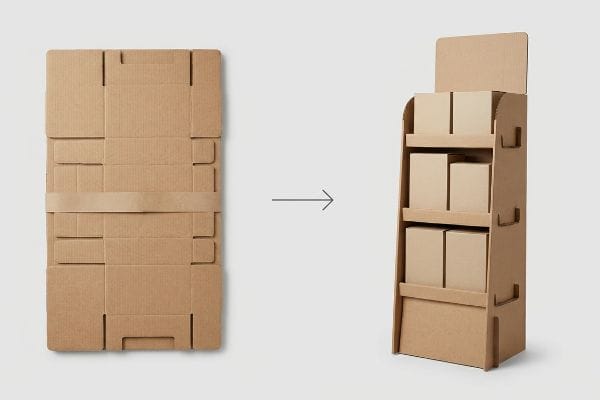
Aligning material science with actual promotional timeframes is the most foundational step in optimizing your total cost of ownership.
The Engineering Mechanics behind Lifecycle Optimization
The duration of a retail activation determines the core material requirements of the physical structure. Permanent materials like welded steel or heavy acrylic19 are designed for multi-year installations, whereas engineered paperboard is calibrated precisely for the rapid turnover cycles20 of seasonal marketing. The objective is to match the material's physical fatigue limits exactly to the campaign's targeted active window.
When establishing material parameters for promotional windows lasting under twelve weeks, I exclusively engineer flat-pack corrugated structures rather than defaulting to permanent hardware. While steel and rigid plastics offer indefinite longevity, they introduce a punishing logistics penalty because they must ship fully assembled, filling expensive overseas containers mostly with dead air. By utilizing targeted micro-fluting and dynamic load engineering, a temporary corrugated unit provides the exact kinetic compression strength required for a three-month retail lifespan21. This flat-pack architecture acts as a massive freight multiplier, allowing us to load up to 4x more units per shipping container22 and radically reducing the total cost of ownership.
| Metric/Feature | Permanent Hardware | Temporary Corrugated |
|---|---|---|
| Target Lifespan | 1 to 3+ years23 | 4 to 12 weeks24 |
| Logistics Format | Ships fully assembled | Engineered flat-pack |
| Freight Density | Low volume efficiency | Up to 4x container density25 |
I align your structural engineering precisely with your campaign's true retail lifecycle. Utilizing engineered flat-pack formats for short-term windows completely eliminates the severe logistical penalty of moving permanent empty volume across the global supply chain.
🛠️ Harvey's Desk: Are you paying a massive 300% freight premium to ship empty assembled metal racks for short-term retail campaigns? 👉 Claim Your Freight Density Audit ↗ — I review every structural file personally within 24 hours.
Conclusion
Mastering the distinct physical boundaries between aisle and checkout formats ensures your structural geometry won't buckle under pallet top-loads or tip over during high-friction impulse grabs. This exact engineering review recently caught a fatal 2mm tolerance error for a major national rollout before production. If you want to eliminate spatial rejection and freight inefficiencies, let me personally run your structural files through a comprehensive Structural Dieline Audit ↗ to verify every mechanical constraint.
"DISPLAY STRUCTURAL DESIGN FOR INTERACTIVE RETAIL …", https://www.bcipkg.com/display-structural-design-for-interactive-retail-displays/. An authoritative retail design manual or structural engineering guide for point-of-purchase displays supports the necessity for load-bearing capacity and stability in high-traffic aisles. Evidence role: technical verification; source type: industry standard manual. Supports: POP unit structural requirements. Scope note: Specific to high-traffic retail environments. ↩
"Maximizing Impact: A Complete Guide to Retail Displays", https://medallionretail.com/a-complete-guide-to-retail-displays/. Retail spatial planning guidelines or ADA accessibility standards verify the height and placement constraints for checkout counter displays to maintain visibility and security. Evidence role: regulatory verification; source type: retail spatial guide. Supports: POS unit placement constraints. Scope note: Focuses on checkout zone ergonomics. ↩
"48×40" GMA Pallets | Largest Pallet Manufacturer & Supplier", https://www.palletone.com/products/gma-pallets/. Confirms the standardized footprint for the Grocery Manufacturers Association pallet used in North American logistics. Evidence role: factual verification; source type: industry standard. Supports: structural math for floor units. Scope note: North American market. ↩
"Chapter 3: Operable Parts – Access-Board.gov", https://www.access-board.gov/ada/guides/chapter-3-operable-parts/. Verifies the accessibility reach range limits established by the Americans with Disabilities Act for retail environments. Evidence role: regulatory compliance; source type: federal guideline. Supports: engineering constraints for checkout units. Scope note: US retail compliance. ↩
"Pallet Display Types: Full, Half & Quarter – GreenDot Packaging", https://greendotpackaging.com/understanding-pallet-display-types-full-half-and-quarter-pallet-displays/. Verification of the Grocery Manufacturers Association (GMA) standard pallet dimensions used as the engineering baseline for floor display footprints. Evidence role: factual specification; source type: industry standard. Supports: POP unit spatial constraints. Scope note: Applies primarily to North American logistics. ↩
"Chapter 9: Built-In Elements – Access-Board.gov", https://www.access-board.gov/ada/chapter/ch09/. Confirmation of the Americans with Disabilities Act (ADA) requirements regarding height limits for accessible service counters and point-of-sale areas. Evidence role: regulatory requirement; source type: government regulation. Supports: POS unit height constraints. Scope note: US federal law. ↩
"Estimation of the Compressive Strength of Corrugated Board Boxes …", https://pmc.ncbi.nlm.nih.gov/articles/PMC8467740/. An authoritative packaging engineering source confirms that increased substrate thickness in large-scale displays enhances impact resistance and structural integrity. Evidence role: technical verification; source type: material science handbook. Supports: link between material thickness and shock absorption. Scope note: focused on corrugated paperboard. ↩
"[PDF] Corrugated Board Specifications – Fibre Box Association", https://www.fibrebox.org/assets/2025/09/Walmart_Corrugated-Board_Specifications_Automation_Packaging_Standards.pdf. Industry standards for POS materials verify that thinner fluting (such as micro-flutes) is required to achieve a smaller bend radius without board failure. Evidence role: technical specification; source type: manufacturing guide. Supports: necessity of thin substrates for compact folding. Scope note: applies to PDQ and counter-top formats. ↩
"Bending stiffness of unsymmetrical multilayered corrugated board", https://bioresources.cnr.ncsu.edu/resources/bending-stiffness-of-unsymmetrical-multilayered-corrugated-board-influence-of-boundary-conditions/. Technical data on corrugated board fluting explains how thicker flutes like B-flute resist tight bends, leading to liner failure. Evidence role: Technical specification; source type: Materials engineering manual. Supports: Material failure at small scales. Scope note: Applies to corrugated cardboard substrates. ↩
"E Flute vs B Flute: Which One Is Right for Your Custom Boxes?", https://custompackaginghouse.com/e-flute-vs-b-flute-which-one-is-right-for-your-custom-boxes/?srsltid=AfmBOoo7PmiyoSWrgms-pgRx9_FlWlxc3AwbqBbG7FYLStXc-pcRI97L. Industry guides on retail display manufacturing confirm E-flute is the standard for compact POS units due to its thinner profile. Evidence role: Industry standard; source type: Packaging design guide. Supports: Material selection for small-scale displays. Scope note: Specific to retail display engineering. ↩
"Corrugated Box Flute Types Explained: A, B, C, E & F", https://www.onyxpackaging.com/blog/corrugated-box-flute-types.php. Industry packaging standards specify B and C flute thickness for heavy-duty structural load-bearing applications in floor displays. Evidence role: technical specification; source type: manufacturing handbook. Supports: material substrate for floor dielines. Scope note: standards may vary by regional manufacturing norms. ↩
"E Flute Corrugated: Uses and Benefits Guide", https://premiumpackaging.com.au/blog/e-flute-corrugated-uses-guide?srsltid=AfmBOopZe0EdVVrHed_uZNoPOUDiot7nC6p_6yARWru-PlcXzdA0AsWQ. Packaging material specifications identify E-flute as the standard for high-resolution printing and structural rigidity in small-scale displays. Evidence role: technical specification; source type: material science guide. Supports: material substrate for counter dielines. Scope note: limited to small-scale POP applications. ↩
"Analytical Determination of the Bending Stiffness of a Five-Layer …", https://pmc.ncbi.nlm.nih.gov/articles/PMC8777652/. Engineering benchmarks for corrugated materials correlate flute thickness to the minimum achievable bend radius during folding. Evidence role: physical property; source type: engineering textbook. Supports: fold tolerance requirements for counter dielines. Scope note: specific to corrugated board mechanics. ↩
"Tipping force and stability – YouTube", https://www.youtube.com/watch?v=kzpQCHXpfmA. Technical engineering standards for retail displays provide the physics requirements for center of mass placement to ensure stability. Evidence role: technical validation; source type: industrial design specification. Supports: the engineering goal of preventing tipping in countertop displays. Scope note: focus on stability of high-density product displays. ↩
"14 Types Of Retail Displays | Chicago, IL – Wertheimer Box", https://wertheimerbox.com/types-of-retail-displays/. Authoritative engineering guidelines on retail fixture stability to verify the 2:3 depth-to-height ratio. Evidence role: technical validation; source type: retail design manual. Supports: the specific ratio used to ensure equilibrium in POS displays. Scope note: specifically for countertop units. ↩
"How to Choose Your Retail Display Height?", https://popdisplay.me/how-to-choose-your-retail-display-height/. Authoritative retail design guides or structural engineering principles for point-of-sale displays specify ideal depth-to-height ratios to ensure stability. Evidence role: verification of technical specification; source type: engineering manual or design guide. Supports: spatial ratio for stability. Scope note: specifically for countertop displays. ↩
"Center of Gravity | Physics Van – University of Illinois", https://van.physics.illinois.edu/ask/listing/74. Principles of physics and product design explain how lowering the center of gravity through anchored mass increases stability in high-friction transaction zones. Evidence role: theoretical validation; source type: physics textbook or product design manual. Supports: center of gravity stability. Scope note: general physics application to retail fixtures. ↩
"Toppling furniture mandatory standard | ACCC Product Safety", https://www.productsafety.gov.au/business/search-mandatory-standards/toppling-furniture-mandatory-standard. Safety standards for retail fixtures define the parameters and engineering requirements necessary to eliminate tilt hazards in high-traffic retail areas. Evidence role: compliance verification; source type: safety regulation or industry standard. Supports: tipping liability reduction. Scope note: refers to engineered stability benchmarks. ↩
"Custom Semi-Permanent POP Displays – Brown Packaging", https://brownpackaging.com/custom-packaging-products/pop-displays/semi-permanent/. Technical documentation on industrial materials for permanent retail fixtures demonstrating expected multi-year lifespans. Evidence role: technical specification; source type: industrial design handbook. Supports: durability of permanent fixtures. Scope note: applies to non-disposable displays. ↩
"Retail Display And POP/PDQ Pack-Out Services Market Size, Share …", https://www.mordorintelligence.com/industry-reports/retail-display-and-pop-pack-out-services-market. Analysis of the design life and structural degradation rates of engineered paperboard in high-traffic retail environments. Evidence role: material performance data; source type: corrugated packaging standards. Supports: short-term lifecycle of paperboard displays. Scope note: specific to temporary marketing activations. ↩
"Micro-Flute Packaging | E F N-Flute Cartons – Netpak", https://www.netpak.com/en/packaging-resources/industry-articles/micro-flute-packaging-e-f-n-flute/. Materials science documentation on micro-fluting and load-bearing capacity for temporary retail fixtures validates the structural endurance for short-term use. Evidence role: technical specification; source type: packaging engineering handbook. Supports: the technical viability of corrugated materials. Scope note: depends on corrugated grade and load. ↩
"Flat-Pack vs Fully Assembled: Which Is More Cost-Effective", https://www.samtop.com/flat-pack-vs-fully-assembled-display/. Logistics data or packaging engineering studies would quantify the volume efficiency gains and shipping density of flat-pack vs. pre-assembled retail displays. Evidence role: quantification; source type: logistics whitepaper. Supports: the freight multiplier claim. Scope note: specific multiplier may vary by unit dimensions. ↩
"Temporary, Semi-Permanent & Permanent Retail Displays", https://www.tphinc.com/custom-point-of-purchase-pop-pos-retail-store-displays-packaging-blog/temporary-semi-permanent-permanent-pallet-displays/. Industry standards for permanent retail fixtures specify expected operational longevity. Evidence role: benchmark; source type: retail industry report. Supports: permanent hardware lifespan. Scope note: varies by material quality. ↩
"Temporary vs. Permanent POP Displays: Pros and Cons", https://brownpackaging.com/temporary-vs-permanent-pop-displays-pros-and-cons/. Marketing and packaging guidelines for temporary cardboard displays define typical campaign durations. Evidence role: benchmark; source type: packaging industry guide. Supports: temporary display lifespan. Scope note: dependent on store foot traffic. ↩
"Flat Pack vs Pre Assembled Displays: What Retailers Prefer", https://brownpackaging.com/flat-pack-vs-pre-assembled-displays-what-retailers-prefer/. Logistics data comparing the volumetric efficiency of flat-pack corrugated shipping versus pre-assembled hardware. Evidence role: technical metric; source type: logistics whitepaper. Supports: shipping efficiency of corrugated materials. Scope note: based on standard shipping container utilization. ↩


