You are losing weeks of production time relying on basic web-drawn packaging lines. If your structure fails at the factory, your entire retail campaign instantly dies before launch.
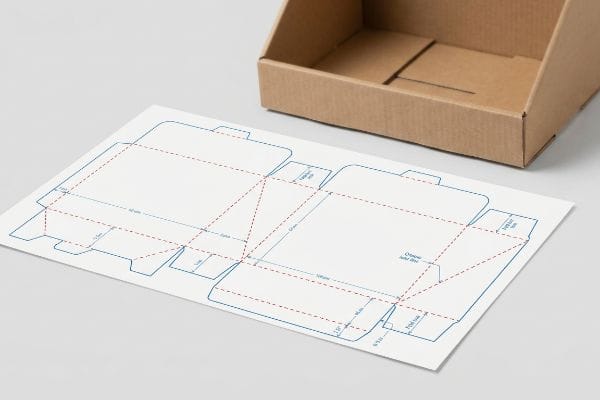
A display box template is a precise 2D vector file, commonly known as a dieline, that dictates the exact cut, crease, and fold lines for assembling a 3D physical merchandiser. It serves as the foundational manufacturing blueprint to guarantee structural integrity and accurate graphic alignment during mass production.
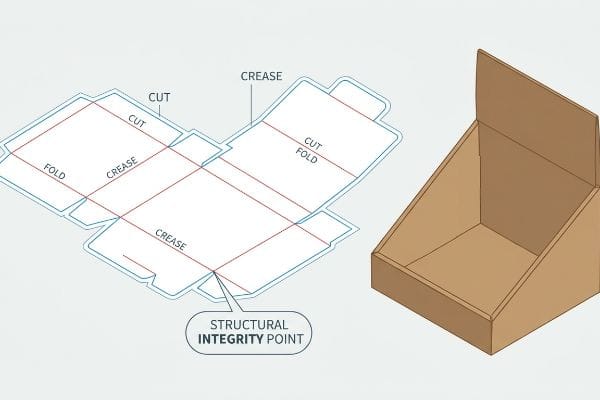
A basic digital outline might look pretty on a monitor, but translating those pixels into heavy-duty corrugated board requires severe mathematical precision and a deep understanding of physical manufacturing constraints.
What Does "Display Box" Mean?
A "display box" isn't just a basic container; it is a vital marketing asset designed to pull immediate foot traffic and boost brand visibility in crowded retail aisles.
In retail strategy, a display box means a custom-printed carton that safely ships commercial goods and physically converts into an open-access shelf or floor unit. It bridges the gap between basic logistics protection and high-visibility point-of-purchase consumer marketing.
Moving from a standard shipping carton to an open retail merchandiser requires careful planning to maximize shelf appeal.
Transitioning to Retail-Ready Merchandising
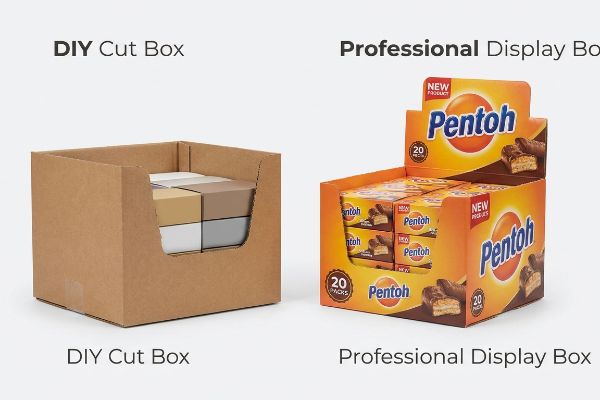
Many new brands assume that creating a retail presence simply involves slicing the top off a standard shipping box and placing it directly onto a store shelf. They believe this DIY approach saves money while still presenting their products effectively to shoppers. In theory, treating a basic corrugated container as a makeshift marketing tool seems like an easy shortcut to capture consumer attention without investing in dedicated retail packaging.
The reality in the retail environment is quite different. A simple cut box lacks the branded artwork and strategic structural design needed to truly engage buyers. Professional display boxes are intentionally crafted with tear-away panels, custom headers, and vibrant graphics1 that instantly communicate product value. Upgrading to a purpose-built merchandiser not only secures better placement from store managers but also transforms a generic product stack into a compelling retail destination that actually drives impulse purchases2.
| Retail Feature | DIY Cut Box | Professional Display Box |
|---|---|---|
| Visual Appeal | Blank or generic | Vibrant custom graphics |
| Shelf Placement | Often rejected3 | Welcomed by retailers |
| Shopper Engagement | Low visibility | High impulse buy rate4 |
Professional retail presentation demands dedicated merchandisers. Relying on hacked shipping cartons will ultimately damage brand perception and stall your sales momentum.
🛠️ Harvey's Desk: Are your open-top display boxes actively crushing your shipping ROI before they even reach the store? 👉 Request a Free Compression Audit ↗ — I review every structural file personally within 24 hours.
What Is a Box Template Called?
Knowing the correct terminology ensures smooth communication with your packaging supplier and prevents costly misunderstandings during the initial design phase of your retail campaign.
A box template is professionally called a dieline. It is a flat, two-dimensional digital outline that shows graphic designers exactly where to place artwork so that the final printed images align perfectly with the cuts and folds of the physical box.
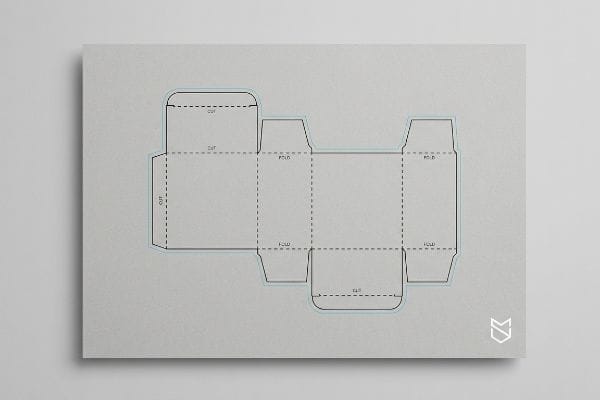
Understanding how to use a dieline properly is the crucial first step in bridging the gap between your creative vision and actual printed packaging.
Navigating Digital Dielines for Artwork
Marketing teams frequently attempt to design retail packaging by guessing the dimensions and submitting standard flat images to their printing partners. They assume the factory will automatically figure out how to wrap their logo around the corners and align the text correctly. In a standard workflow, designers often feel confident that their visual mockups are sufficient to convey the intended structure without needing specialized files.
The actual production process strictly requires a precise dieline5 to function properly. This specialized template acts as a literal map, featuring distinct lines that separate where the box will be cut6 from where it will be folded. When graphic designers overlay their artwork directly onto a verified dieline, they eliminate the guesswork. This standard practice guarantees that important text won't be accidentally sliced off and that your brand logo will sit perfectly centered on the final retail display.
| Template Element | Visual Purpose | Design Action |
|---|---|---|
| Solid Lines | Indicates outer edges7 | Keep artwork inside |
| Dotted Lines | Shows fold locations8 | Avoid placing text here |
| Bleed Area9 | Overhang margin | Extend graphics fully |
Artwork submitted without an accurate dieline is merely a sketch. Securing the official template first is the only way to ensure your graphics translate correctly into physical packaging.
🛠️ Harvey's Desk: Is your current box template relying on unreadable visual lines that will instantly jam a CNC cutting table? 👉 Get a Free Prepress Dieline Review ↗ — 100% confidential. Your unreleased retail designs are safe with me.
What Is an Example of a Template?
Templates come in various styles tailored to specific retail environments, ensuring your products are displayed correctly whether on a vast warehouse floor or a compact store counter.
An example of a packaging template is a countertop PDQ tray dieline. This specific digital layout maps out a compact, space-saving merchandiser optimized for high-traffic retail checkout zones, ensuring products stay organized and highly visible to impulse shoppers.
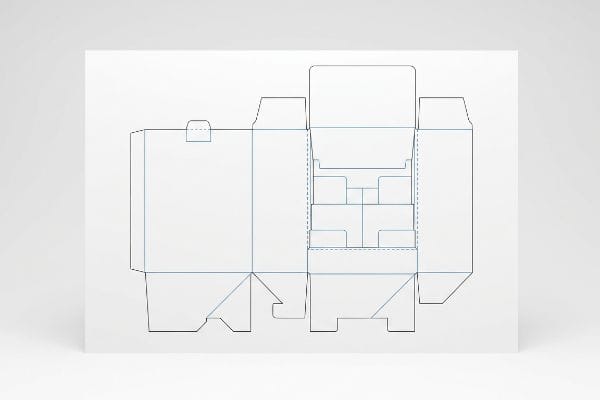
Examining a specific countertop template reveals how smart structural choices maximize product visibility in highly competitive retail spaces.
Maximizing Space with Countertop Displays
Brands looking to capture impulse sales often believe they can just shrink down a standard floor display design and place it near a cash register. They assume all templates function similarly, regardless of their final physical footprint or placement in the store. From a high-level marketing perspective, smaller dimensions seem like a minor adjustment that shouldn't require a completely new approach to the underlying structure.
The retail reality dictates that countertop templates are uniquely engineered to maximize product density within a severely restricted footprint. A standard PDQ (Product Display Quickly) template incorporates specialized display angles and tiered internal structures10 designed to keep small items neatly front-faced for shoppers. Rather than just being a scaled-down floor unit, these specific templates are meticulously crafted to grab customer attention during the brief checkout window, turning unused counter space into highly profitable merchandising real estate.
| Display Type | Retail Placement | Primary Strategy |
|---|---|---|
| Countertop PDQ | Register zones | Maximize impulse buys11 |
| Pallet Display | Warehouse aisles | Bulk volume movement12 |
| Endcap Unit | Aisle ends | Highlight new releases13 |
Choosing the correct template ensures your packaging matches the specific physical demands of the retail environment. Countertop units remain the absolute best tool for capturing last-minute impulse revenue.
🛠️ Harvey's Desk: Are your scaled-down display files lacking the precise micro-tolerances required for a frictionless co-packing assembly? 👉 Claim Your Custom PDQ Dieline Audit ↗ — No account managers in the middle. You talk directly to structural engineers.
What Is the Best Material for Display Boxes?
Selecting the optimal substrate dictates not only visual aesthetics but the fundamental kinetic survival of your goods during brutal freight transits and prolonged warehouse stacking.
The best material for display boxes is lightweight, micro-fluted corrugated paperboard, specifically E-flute or B-flute. Unlike solid unfluted chipboard, corrugated material features engineered internal arches that actively absorb kinetic transit shock and maintain strict vertical compression strength without inflating raw material budgets.
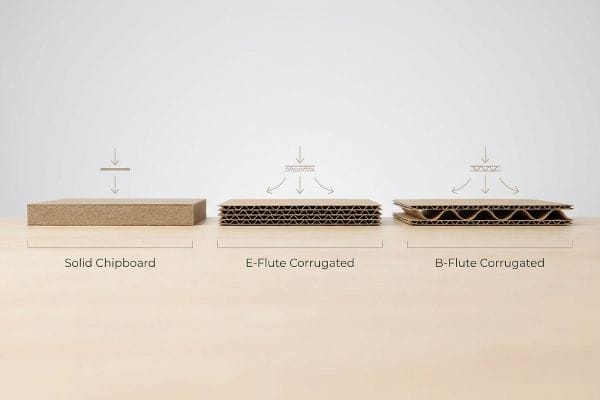
Understanding the mechanical superiority of fluted substrates over solid paperboards is the key to balancing premium retail aesthetics with heavy-duty supply chain performance.
The Kinetic Absorption of Micro-Fluted Corrugated
In the pursuit of cost savings and premium visual aesthetics, brands sometimes try to scale up rigid SBS (Solid Bleached Sulfate) boards for heavily loaded retail trays. Procurement teams look at a dense 24pt solid chipboard and falsely assume that raw material density equates directly to vertical load-bearing strength14. They believe that bypassing corrugated materials will yield a sharper print surface while still surviving the rough journey through cross-country logistics networks.
Factory physics ruthlessly destroy this assumption. Unfluted solid substrates completely lack the internal mechanical arches required to actively disperse shock. When a forklift drops a pallet, the kinetic energy transfers directly into the rigid fibers, causing instantaneous side-wall buckling. By strictly upgrading heavy payloads to an E-flute or B-flute corrugated substrate, you harness the internal wave-like fluting to act as a literal mechanical shock absorber. This internal geometry neutralizes kinetic vibrations15 and maintains rigid vertical compression strength16 during double-stacked warehouse storage, entirely preventing catastrophic structural collapse.
| Material Type | Internal Geometry | Shock Absorption Capacity |
|---|---|---|
| Solid Chipboard (SBS) | Unfluted dense fibers | Zero kinetic displacement17 |
| E-Flute Corrugated | Micro-arched medium | High dynamic vibration dampening18 |
| B-Flute Corrugated | Wide-arched medium | Maximum heavy payload support19 |
Relying on solid unfluted board for heavy structural merchandisers guarantees buckling under transit pressure. Micro-fluted corrugated substrates remain the non-negotiable standard for structural survival.
🛠️ Harvey's Desk: Is your current display material lacking the internal fluted geometry needed to survive double-stacked warehouse storage? 👉 Request a Free Material Strength Analysis ↗ — I review every structural file personally within 24 hours.
Conclusion
Surviving the brutal logistics of modern retail requires more than just drawing basic shapes on a monitor; it demands precision engineering that accounts for strict dieline machine tolerances, micro-flute bend allowances, and dynamic load displacement. Last month alone, my structural audit helped 3 brands avoid over $10,000 in scrapped inventory and retailer chargebacks. If you are launching a high-stakes campaign, let me personally run your structural files through my Free Pre-Production Dieline Audit ↗ to mathematically eliminate kinetic failures before they ever reach the factory floor.
"Shelf Ready Packaging (SRP) – Retail – Smurfit Westrock", https://www.smurfitwestrock.com/products/packaging/retail/retail-ready-packaging. Industry standards for retail-ready packaging (RRP) confirm these specific structural elements are used to facilitate shelf-readiness. Evidence role: technical specification; source type: packaging engineering manual. Supports: the composition of professional display boxes. Scope note: Applies to standard corrugated retail displays. ↩
"The Impact of Point-of-Purchase Displays in Your Store", https://www.ivarsdisplay.com/blogs/industry/the-impact-of-point-of-purchase-displays-in-your-store. Market research indicates that point-of-purchase (POP) displays increase unplanned purchases through visibility and accessibility. Evidence role: performance metric; source type: consumer behavior study. Supports: the claim that merchandisers drive impulse sales. Scope note: Effect varies by product category. ↩
"The Complete Guide to Retail Ready Packaging", https://www.jamestowncontainer.com/packaging-resources/blog/the-complete-guide-to-retail-ready-packaging/. Retail industry standards for Retail-Ready Packaging (RRP) specify that substandard or non-compliant containers are rejected to maintain shelf aesthetics and efficiency. Evidence role: industry standard verification; source type: retail logistics manual. Supports: the claim that DIY cut boxes are unsuitable for professional retail. Scope note: applies primarily to large-scale retail environments. ↩
"(PDF) 10 IMPULSE BUYING AND PRODUCT PACKAGING", https://www.researchgate.net/publication/382001089_10_IMPULSE_BUYING_AND_PRODUCT_PACKAGING_EXAMINE_HOW_PACKAGING_DESIGN_COLOUR_SCHEMES_AND_PRODUCT_DISPLAYS_AFFECT_IMPULSE_PURCHASES. A study on point-of-purchase (POP) marketing would provide data on how custom graphics and visibility increase impulse purchase behavior. Evidence role: quantitative proof; source type: consumer psychology study. Supports: the link between professional display boxes and increased sales. Scope note: effectiveness varies by product category. ↩
"What Is a Dieline in Printing and Packaging?", https://www.globalvision.co/blog/what-is-a-dieline-in-printing-and-packaging. Verification that precision dielines are required for automated cutting and folding in professional packaging manufacturing. Evidence role: Technical requirement; source type: Printing industry standard. Supports: Necessity of dielines for production. Scope note: Focuses on automated production environments. ↩
"How to Build a Packaging Dieline in Adobe Illustrator", https://packaura.com/packaging-dieline-adobe-illustrator-from-scratch/. Confirmation that dielines utilize standardized line styles to distinguish between cutting paths and folding paths. Evidence role: Technical specification; source type: Graphic design manual. Supports: Dieline line differentiation. Scope note: Standard across digital and physical templates. ↩
"What are Dielines – Importance In Printing and Packaging", https://ibexpackaging.com/what-are-dielines/. Authoritative packaging design guides specify that solid lines in a dieline represent cut lines marking the outer edges of the physical box. Evidence role: technical specification; source type: industry standard guide. Supports: the visual purpose of solid lines in dielines. Scope note: Standard across most retail packaging formats. ↩
"Complete Guide to Dielines in Custom Packaging and Printing – Gentlever", https://gentlever.com/dielines-for-custom-packaging-and-printing/. Packaging industry standards define dotted or dashed lines as score lines indicating where the material will be folded. Evidence role: technical specification; source type: industry standard guide. Supports: the visual purpose of dotted lines in dielines. Scope note: Applies to standard foldable retail packaging. ↩
"Understanding the Importance of Bleed in Packaging Design", https://epacflexibles.com/understanding-the-importance-of-bleed-in-packaging-design/?srsltid=AfmBOordkVMu9XK_Y-h3eHdtFl7PkEKuJPb-x5vq1kJLBag0vvl3Fij-. Printing manuals define a bleed area as the region of a graphic that extends beyond the trim edge to prevent white borders after cutting. Evidence role: technical specification; source type: printing manual. Supports: the definition and purpose of the bleed area. Scope note: General print industry standard. ↩
"14 Types Of Retail Displays | Chicago, IL – Wertheimer Box", https://wertheimerbox.com/types-of-retail-displays/. Industry packaging standards and design guides verify the use of specific angles and tiers in PDQ trays to optimize product visibility and organization. Evidence role: technical specification; source type: retail packaging guide. Supports: architectural features of PDQ templates. Scope note: Applies to standard retail point-of-purchase displays. ↩
"Encourage Impulse Buys with Counter Displays: A Smart Strategy for Ret", https://truebrands.com/blogs/the-true-insider/encourage-impulse-buys-with-counter-displays. Authoritative retail merchandising guides explain how point-of-purchase displays at registers drive unplanned purchases. Evidence role: validation; source type: industry guide. Supports: the use of PDQs for impulse buys. Scope note: Specific to point-of-sale locations. ↩
"Pallet Displays for Warehouse Clubs: Best Practices – TPH Global Solutions", https://www.tphinc.com/custom-point-of-purchase-pop-pos-retail-store-displays-packaging-blog/pallet-displays-for-warehouse-clubs-best-practices/. Logistics and supply chain literature details the efficiency of pallet displays in high-volume warehouse environments. Evidence role: validation; source type: logistics manual. Supports: pallet displays for bulk movement. Scope note: Focuses on warehouse-style retail. ↩
"Guide to Using Endcap Displays", https://www.linkedin.com/pulse/guide-using-endcap-displays-gil-biberstein-kxegc. Retail planning documentation describes the high visibility of endcaps for promoting new or seasonal products. Evidence role: validation; source type: retail management textbook. Supports: endcap utility for new releases. Scope note: Applies to standard grocery or department store layouts. ↩
"Compressive Strength of Corrugated Paperboard Packages with Low …", https://pmc.ncbi.nlm.nih.gov/articles/PMC10054506/. Technical analysis demonstrating that structural geometry (fluting) provides superior vertical load-bearing capacity compared to raw material density in solid boards. Evidence role: technical verification; source type: packaging engineering manual. Supports: the claim that density does not equate to strength. Scope note: specific to vertical compression. ↩
"A Simplified Dynamic Strength Analysis of Cardboard … – PMC", https://pmc.ncbi.nlm.nih.gov/articles/PMC10385285/. Technical explanation of how corrugated fluting disrupts energy transfer to dampen vibrations. Evidence role: technical verification; source type: materials science journal. Supports: the vibration-neutralizing properties of fluted geometry. Scope note: applies specifically to transit-induced kinetic energy. ↩
"What is Corrugated", https://www.fibrebox.org/what-is-corrugated/. Comparative data on Edge Crush Test (ECT) values showing superior load-bearing capacity of fluted substrates over solid board. Evidence role: performance metric; source type: packaging engineering standard. Supports: the vertical load-bearing capacity of micro-fluted substrates. Scope note: focused on warehouse stacking scenarios. ↩
"Sandwich Structures for Energy Absorption Applications – PMC", https://pmc.ncbi.nlm.nih.gov/articles/PMC8398022/. Material science properties of dense SBS fiber compared to corrugated substrates. Evidence role: factual contrast; source type: technical data sheet. Supports: Lack of internal cushioning in SBS. Scope note: Specifically regarding shock absorption capacity. ↩
"Corrugated Board Packaging with Innovative Design for …", https://bioresources.cnr.ncsu.edu/wp-content/uploads/2026/01/BioRes_21_1_2229_Tworzydlo_PSMPGG_Corrugated_Packaging_Design_Durability_Transport_25399.pdf. Technical data on micro-flute architecture and its effect on kinetic energy attenuation. Evidence role: performance verification; source type: materials engineering study. Supports: E-flute's ability to dampen vibrations. Scope note: Relative to non-fluted substrates. ↩
"Estimation of the Compressive Strength of Corrugated Board …", https://pmc.ncbi.nlm.nih.gov/articles/PMC8467740/. Comparative analysis of flute height and Edge Crush Test (ECT) values regarding vertical load capacity. Evidence role: specification validation; source type: packaging industry standard. Supports: B-flute's superior weight support. Scope note: Focused on stacking strength. ↩