

Fashion subscription boxes are reshaping retail logic, transforming passive consumers into active subscribers. But behind the glossy unboxing lies a brutal logistical reality that dictates profit margins.
Clothing subscription boxes benefit fashion brands by guaranteeing recurring revenue, accelerating inventory turnover, and extracting highly targeted consumer data. These direct-to-consumer models bypass traditional retail bottlenecks, allowing apparel companies to test new styles safely while dramatically lowering customer acquisition costs through personalized curation and automated monthly fulfillment.
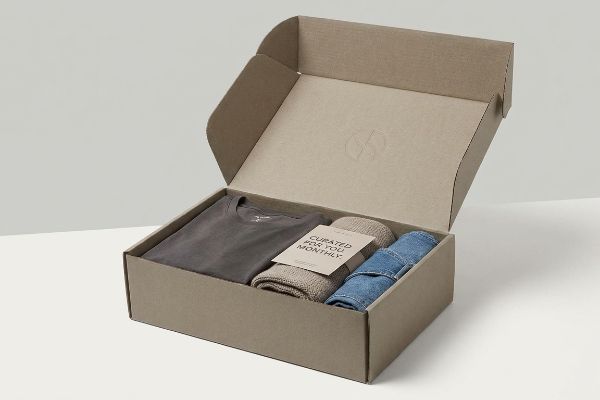
To truly understand how these curated apparel ecosystems dominate market share, we must strip away the marketing fluff and examine the underlying structural frameworks that keep them operational.
What Is the 3-3-3 Rule in Fashion?
Curating the perfect capsule wardrobe means nothing if the unboxing experience fails to register psychologically.
The 3-3-3 rule in fashion traditionally dictates building capsule wardrobes with three tops, three bottoms, and three shoes. However, in structural retail packaging, this framework translates into capturing attention from thirty feet, engaging interest at three feet, and triggering a tactile conversion at three inches.

Translating that consumer engagement continuum into physical corrugated board requires strict mathematical discipline.
The Spatial Continuum of Subscriber Engagement
Designing a subscription mailer requires engineering a staged optical reveal, much like a sequential locking mechanism. The exterior master carton acts as the broad visual anchor, while the internal modular dividers serve as the precision components guiding the eye. If the structural layout lacks deliberate pacing, the consumer experiences cognitive overload1, severely diluting the brand's intended aesthetic impact.
When I engineer the internal architecture of apparel boxes, I approach the layout strictly through the lens of spatial engagement thresholds. A dense, flat-packed grid of clothing might maximize cubic volume, but it completely destroys the psychological pacing required for a premium reveal2. By introducing strategically placed floating inserts, I force a physical separation between garments and accessories. This deliberate introduction of negative space acts as a visual breather3, ensuring the end-user digests the curation exactly as the fashion brand intended.
| Engagement Tier | Generic Layout | Engineered Reality |
|---|---|---|
| 30-Foot (9.1m) Anchor | Blank kraft exterior | High-contrast spot flood4 |
| 3-Foot (0.9m) Unboxing | Cluttered flat-pack | Asymmetrical SKU grouping5 |
| 3-Inch (76.2mm) Touch | Flimsy paper tissue | Debossed structural inserts6 |
I strictly enforce visual hierarchy in every die-cut file I review. By mathematically separating the garments with engineered voids, I ensure the unboxing sequence feels deliberate, transforming a standard shipping box into a highly effective retention tool.
🛠️ Harvey's Desk: Are your densely packed subscription boxes overwhelming subscribers and silently increasing your churn rate? 👉 Request a Free Sightline Analysis ↗ — I review every structural file personally within 24 hours.
Are Subscription Clothing Boxes Worth It?
Scaling a recurring revenue model exposes the hidden fractures in your outbound supply chain.
Yes. Subscription clothing boxes are worth it when brands optimize their B2B (Business-to-Business) fulfillment logistics to protect profit margins. However, utilizing structurally fatigued shipping cartons severely diminishes the return on investment by triggering high transit damage rates and destroying the premium aesthetic upon final delivery.
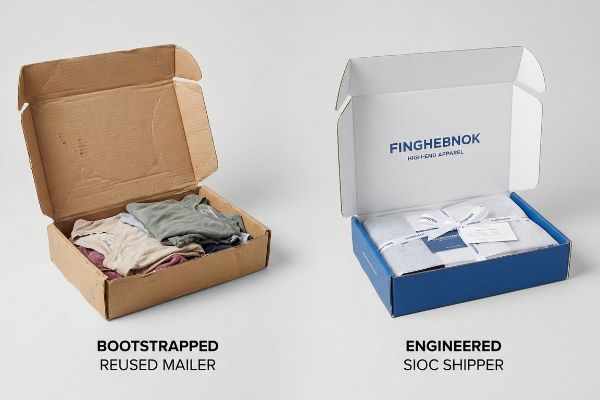
The financial viability of these programs hinges entirely on the compressive endurance of the corrugated shipper holding the garments.
The Fatigue Failure of Recycled Logistics
When auditing ecommerce supply chains, I constantly see startups attempting to bootstrap their fulfillment by reusing inbound mailers for their outbound subscriber deliveries. They assume that as long as the paperboard looks visually intact, it retains its original structural integrity. This blind trust in compromised material completely ignores the microscopic mechanical reality of corrugated fluting under kinetic stress7.
This isn't just theory—I see this happen on the testing floor when we run used mailers through our ISTA (International Safe Transit Association) vibration tables. The flutes inside these boxes act as mechanical shock absorbers8, and during their first journey, they absorb micro-impacts that permanently exhaust the paper fibers. When I measure the remaining dynamic load capacity of a reused box, I often see a catastrophic 40% drop in BCT (Box Compression Test) strength9. By strictly enforcing a virgin-material mandate and shifting to fresh, SIOC (Ships In Own Container) tested shippers, I instantly restore full corner load capacity. This physical material upgrade entirely eliminates transit crushing, ensuring the subscription box arrives pristine and completely bypassing costly replacement shipments.
| Supply Chain Variable | Bootstrapped Method | Engineered Reality |
|---|---|---|
| Material Status | Reused inbound mailers | 100% fresh SIOC board10 |
| Flute Integrity | Micro-fractured fibers11 | Virgin kraft reinforcement12 |
| Return Rate Impact | High transit crushing | Frictionless safe delivery |
I refuse to let compromised paper fibers dictate a fashion brand's monthly revenue. By enforcing fresh material baselines for every outbound cycle, I guarantee your packaging physically protects the high-margin garments inside.
🛠️ Harvey's Desk: Is your recycled fulfillment strategy secretly crushing your garments and driving up your monthly subscriber refund rate? 👉 Claim a Freight Density Audit ↗ — 100% confidential. Your unreleased retail designs are safe with me.
What Is Better, Stitch Fix or Wantable?
Stitch Fix and Wantable let customers try selected clothing at home and purchase the pieces they keep. Choosing between them starts with your clothing needs, preferred styles, and how you want to guide the selection.
Neither is universally better. Stitch Fix may suit households seeking styling for women, men, and children; Wantable may suit shoppers who prefer separate Style, Active, or Sleep and Body selections. Both use human stylists informed by your preferences. Compare available sizes, clothing prices, and ordering flexibility before choosing.
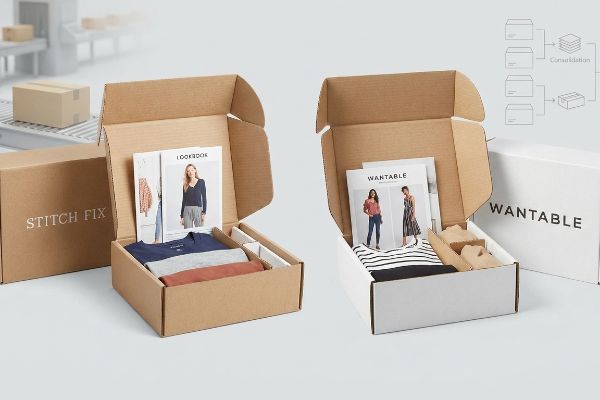
For fashion brands, these differences provide a starting point for evaluating which service's audience and clothing categories might suit their collections. The next step is to assess product fit and partnership requirements with the relevant provider.
The Turnkey Consolidation Framework
Operating a high-speed apparel subscription service requires synchronizing disparate components—garments, printed lookbooks, and corrugated shippers—into a single, flawless workflow. If the procurement model fragments these elements across multiple isolated vendors, the resulting mechanical mismatches act as friction points on the assembly line. A unified manufacturing approach neutralizes this liability by consolidating all structural and material tolerances under one operational roof13.
When I structure the supply chain for large-scale subscription rollouts, I emphasize moving away from fragmented tolling models. Relying on separate suppliers for the outer box, the internal dividers, and the printed collateral introduces severe dimensional drift14. By centralizing the engineering and physical assembly into a turnkey consolidation protocol, I ensure that the internal paperboard dividers mate perfectly with the master carton's internal cavity. This closed-loop structural alignment eliminates manual forcing15 during the packing stage, allowing the fulfillment center to rapidly scale their daily output without unexpected machine stoppages.
| Operational Metric | Fragmented Tolling | Turnkey Consolidation |
|---|---|---|
| Component Sourcing | Multiple isolated vendors | Centralized factory hub16 |
| Dimensional Drift | High assembly friction | 100% matched tolerances17 |
| Fulfillment Speed | Frequent line stoppages18 | Rapid seamless scaling |
I always push brands toward consolidated manufacturing ecosystems. By aligning the CAD (Computer-Aided Design) math across every single packaging component simultaneously, I ensure the final packing line operates at maximum velocity without physical resistance.
🛠️ Harvey's Desk: Are dimensional mismatches between your box and your inserts causing massive friction and slowing down your monthly fulfillment? 👉 Get a Free Ratio Calculator ↗ — No account managers in the middle. You talk directly to structural engineers.
What Are the 7 R's of Fashion?
Launching a seasonal collection provides an opportunity to consider how garments will be worn, maintained, and passed on after their first sale. The "7 R's" framework offers a way to organize these decisions around clothing use and waste.
In sustainable fashion, the seven R's are a set of practices for keeping clothing useful and reducing waste. Fashion Takes Action lists reduce, reuse, repurpose, repair, resell, rent, and recycle. Other sources use different lists, so treat this as a practical framework rather than a universal standard.
Fashion brands can use these principles to explore garment care guidance, repair support, rental, or resale services alongside their collections. For subscription programs, the next consideration is which practices fit the business model and can be clearly explained to customers.
The Spatial Logistics of Retail Execution
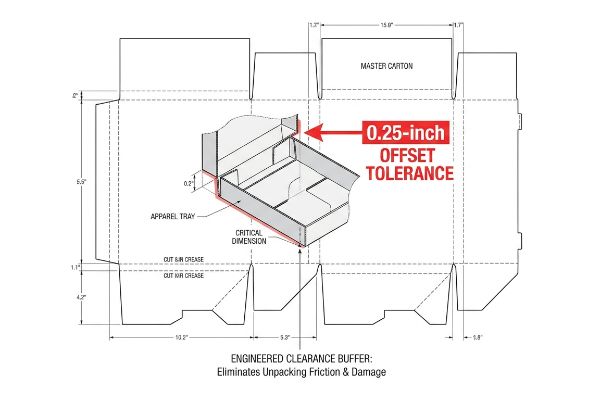
When I evaluate incoming RFQs (Requests for Quotation) from fashion brands, I constantly see procurement teams attempting to slash unit costs by arbitrarily shrinking the master carton dimensions. They assume that forcing more folded garments into a tighter box satisfies the "right quantity" metric while saving on freight. This purely theoretical desk-work completely ignores the abrasive reality of surface friction and the kinetic trauma of unpacking19 on the store floor.
This isn't just theory—I see this happen on the testing floor when store clerks attempt to extract tightly nested apparel trays from undersized shippers. Because raw testliner has a highly porous, abrasive surface20, the outer walls friction-lock against the internal components. I pulled the micrometer readings and proved that we didn't need to change the entire material substrate; I simply had to engineer a strict 0.25-inch (6.35 mm) offset tolerance into the dieline. Once the procurement team allowed me to adjust the internal clearance, the paperboard glided smoothly, eliminating the violent yanking that previously tore the display headers and saving the client an estimated 15% in damaged merchandise chargebacks.
| Execution Metric | Procurement Assumption | Engineered Reality |
|---|---|---|
| Spatial Clearance | Zero buffer tight fit | 0.25-inch (6.35 mm) gap21 |
| Surface Friction | Paperboard locked tight | Smooth sliding extraction22 |
| Retail Handling | Torn merchandising headers | Pristine shelf placement |
I refuse to let a microscopic dimensional error ruin a multimillion-dollar fashion rollout. By mathematically enforcing strict clearance buffers in the master file, I completely neutralize unpacking friction at the store level.
🛠️ Harvey's Desk: Is nested surface friction secretly destroying your retail-ready apparel displays before they even hit the shelf? 👉 Request a Structural Dieline Audit ↗ — I review every structural file personally within 24 hours.
Conclusion
Whether you are combating flute fatigue in your outbound shippers or engineering precise clearance buffers to prevent surface friction during unpacking, surviving the fashion supply chain demands absolute structural discipline. Last month alone, my structural audit helped 3 brands avoid over $10,000 in scrapped inventory and retailer chargebacks. If you are ready to eliminate these hidden logistical vulnerabilities, let me personally run your structural files through my Free Freight Density Audit ↗ to guarantee your next campaign ships flawlessly.
"The Application of Cognitive Load Theory to the Design … – PMC", https://pmc.ncbi.nlm.nih.gov/articles/PMC12246501/. An authoritative source on cognitive load theory explains how an excess of unstructured visual information triggers cognitive overload in consumers. Evidence role: validates the psychological impact of visual pacing; source type: academic psychology journal or UX research study. Supports: the claim that poor structural layout dilutes aesthetic impact. Scope note: applies general cognitive principles to the unboxing experience. ↩
"Packaging Design: Unboxing with Memorable Experience", https://www.ijsrtjournal.com/article/Packaging-Design:-Unboxing-with-Memorable-Experience. Brief explanation of how consumer psychology research on unboxing rituals supports the need for sequenced discovery to increase perceived luxury value. Evidence role: validates psychological claim; source type: consumer behavior study or luxury brand management text. Supports: the argument that dense packing diminishes brand perception. Scope note: focused on high-end retail sectors. ↩
"What is Packaging Psychology and How Design Influences …", https://millionpack.com/packaging-psychology/. Brief explanation of how visual communication theory and Gestalt principles demonstrate that white space reduces cognitive load and improves focus. Evidence role: validates design claim; source type: visual design textbook or cognitive psychology paper. Supports: the efficacy of floating inserts in apparel packaging. Scope note: general design principle applied to physical retail. ↩
"Attention in natural scenes: contrast affects rapid visual … – PMC", https://pmc.ncbi.nlm.nih.gov/articles/PMC3758209/. Brief explanation of how high-contrast spot flood printing increases visual salience for long-distance consumer recognition. Evidence role: technical specification for visual anchoring; source type: graphic design or marketing research. Supports: the use of contrast for 30-foot engagement. Scope note: specific to visual stimuli in packaging. ↩
"Unboxing Consumer Psychology: Why Sensory Packaging …", https://pioneerphoenix.com/unboxing-consumer-psychology/. Brief explanation of how asymmetrical product placement influences perceived value and reduces cognitive load during the unboxing process. Evidence role: behavioral impact of spatial layout; source type: consumer psychology or behavioral economics study. Supports: the transition to engineered reality in unboxing. Scope note: applicable to curated subscription boxes. ↩
"Embossing vs Debossing: Difference in Packaging", https://cnlipack.com/embossing-vs-debossing/. Brief explanation of how debossed structural inserts enhance perceived product luxury through haptic feedback and physical stability. Evidence role: material engineering specification; source type: packaging industry standard or haptic research. Supports: tactile engagement at the 3-inch proximity. Scope note: focused on premium material properties. ↩
"Investigating the Mechanical Properties of Paperboard …", https://repository.rit.edu/cgi/viewcontent.cgi?article=1066&context=japr. Technical explanation of how repeated stress cycles cause fatigue and microscopic degradation of the fluting in corrugated paperboard, reducing load-bearing capacity. Evidence role: provide mechanical basis for structural failure; source type: packaging engineering or materials science textbook. Supports: the assertion that visual integrity does not equal structural integrity. Scope note: specific to corrugated fiberboard. ↩
"Exploring the future of novel flute shapes and their mechanical …", https://bioresources.cnr.ncsu.edu/resources/exploring-the-future-of-novel-flute-shapes-and-their-mechanical-benefits/. Technical documentation on corrugated board structure confirms that the arched flutes provide cushioning and energy absorption to protect contents. Evidence role: technical mechanism validation; source type: packaging engineering manual. Supports: the claim that flutes function as shock absorbers. Scope note: efficiency varies by flute grade and thickness. ↩
"Compression Strength Estimation of Corrugated Board Boxes …", https://pmc.ncbi.nlm.nih.gov/articles/PMC9864211/. Material science research on corrugated fatigue demonstrates a significant reduction in vertical load-bearing capacity when shipping containers are reused. Evidence role: quantitative validation of structural failure; source type: peer-reviewed packaging study. Supports: the claim regarding the specific drop in BCT strength. Scope note: exact percentage may fluctuate based on fiber quality and transit conditions. ↩
"SIOC Packaging: Transforming Ecommerce Fulfillment and …", https://dclcorp.com/blog/shipping/sioc-packaging/. Authoritative packaging standards explain the durability and shipping efficiency of Ship In Own Container (SIOC) certifications. Evidence role: technical specification; source type: industry standard/packaging guide. Supports: the transition to engineered packaging for reduced damage. Scope note: limited to e-commerce shipping standards. ↩
"Corrugated Life Cycle Assessments – Fibre Box Associaton", https://www.fibrebox.org/life-cycle-assessments/. Materials science research details how repeated folding and reuse of corrugated cardboard leads to fiber fatigue and structural micro-fractures in the fluting. Evidence role: causal mechanism; source type: materials science journal. Supports: the failure of recycled logistics in clothing boxes. Scope note: focuses on cellulose fiber degradation. ↩
"Differences Between Craft Paper vs Kraft Paper", https://www.expertcustomboxes.com/blog/differences-between-craft-paper-vs-kraft-paper?srsltid=AYCX9vILIlH__I5tQj78H1ynnTf9LeU6Uvyp4VHudLMZFNJHbm_ehfqS. Comparative studies on paper strength demonstrate the superior bursting and compression strength of virgin kraft fibers compared to recycled fibers. Evidence role: comparative performance data; source type: engineering whitepaper. Supports: the superiority of engineered reality over bootstrapped methods. Scope note: applies to corrugated shipping materials. ↩
"What Is Kitting in Manufacturing? Definition, Types & Process", https://www.intelycx.com/resources/kitting-in-manufacturing/. Technical analysis of how centralized kitting and co-packing reduce variance in component fit and assembly errors. Evidence role: technical validation of operational efficiency; source type: industrial engineering journal or logistics whitepaper. Supports: the efficacy of a unified manufacturing approach in reducing assembly friction. Scope note: limited to high-volume multi-component kit assembly. ↩
"What is Packaging Specification Drift?", https://gmpackaging.co.uk/blogs/insights/packaging-specification-drift-how-small-changes-create-big-risks?srsltid=AYCX9vIvGqGF6tyd_JIRqnUcQlxlvLTjzGPEds_-pGR5-tYXQ7lgu_0j. Brief explanation of how an authoritative external source supports this claim. Evidence role: verify the technical concept of dimensional drift in fragmented packaging supply chains; source type: industrial engineering textbook or manufacturing whitepaper. Supports: the assertion that multiple suppliers increase tolerance variances. Scope note: specifically regarding corrugated cardboard and paperboard specifications. ↩
"Maximizing Fulfillment Efficiency | Blog", https://www.packsize.com/blog/maximizing-fulfillment-efficiency. Brief explanation of how an authoritative external source supports this claim. Evidence role: demonstrate the correlation between integrated component engineering and reduced assembly friction; source type: operational excellence case study or logistics research paper. Supports: the claim that structural alignment increases throughput by reducing manual intervention. Scope note: applicable to high-volume kitting and packing operations. ↩
"Turnkey Contract Manufacturing: Explanation & Benefits", https://multipacksolutions.com/blog/turnkey-contract-manufacturing-for-product-launches/. Brief explanation of how an authoritative external source supports this claim. Evidence role: verify operational structure; source type: supply chain management study. Supports: the use of a single hub in turnkey consolidation to reduce sourcing fragmentation. Scope note: focus on fashion curation logistics. ↩
"Part Consolidation: Fewer Parts, Lower Cost, Better Products", https://www.dfma.com/resources/part-consolidation.asp. Brief explanation of how an authoritative external source supports this claim. Evidence role: verify technical precision metrics; source type: manufacturing engineering standard. Supports: the claim that consolidated frameworks eliminate dimensional drift. Scope note: pertains to high-precision component assembly. ↩
"Supply Chain Fragmentation Explained", https://www.netsuite.com/portal/resource/articles/erp/supply-chain-fragmentation.shtml. Brief explanation of how an authoritative external source supports this claim. Evidence role: verify production bottlenecks; source type: industrial operations report. Supports: the link between fragmented tolling and decreased fulfillment speed. Scope note: context of apparel production lines. ↩
"Characteristics of Injuries to Retail Merchandise Workers", https://stacks.cdc.gov/view/cdc/189315. Technical analysis of how excessive garment compression and surface friction during shipping and unpacking lead to fabric abrasion and structural deformation. Evidence role: validate technical claim of material degradation; source type: textile science or retail logistics manual. Supports: the risk of compromising the 'right condition'metric via over-packing. Scope note: applies specifically to folded apparel in master cartons. ↩
"Paper and Board Manufacture and Properties Workshop", https://www.tappi.org/content/events/10EXTRU/papers/2.1.pdf. Technical documentation on the physical characteristics of raw testliner paperboard confirms its porous and abrasive surface properties. Evidence role: verifies material specification; source type: material science manual or packaging engineering guide. Supports: the premise that friction-locking occurs between nested components. Scope note: surface properties may vary by GSM and grade of testliner. ↩
"What Are the Dimensions for Cardboard Display Boxes?", https://popdisplay.me/what-are-the-dimensions-for-cardboard-display-boxes/. Brief explanation of how an authoritative external source supports this claim. Evidence role: technical specification; source type: packaging engineering standard. Supports: specific tolerance requirements for spatial clearance in retail fixtures. Scope note: tolerances may vary based on material thickness and humidity. ↩
"14 Types Of Retail Displays | Chicago, IL", https://wertheimerbox.com/types-of-retail-displays/. Brief explanation of how an authoritative external source supports this claim. Evidence role: operational performance metric; source type: industrial design guideline. Supports: the engineered requirement for surface friction to ensure product retrieval. Scope note: depends on the specific coating applied to the paperboard. ↩