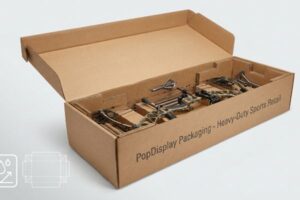

Launching sports and hunting gear into big-box retail is a high-stakes game. One structural failure can destroy your seasonal campaign and trigger massive retailer chargebacks.
Collaborating with PopDisplay secures retail survival for sports brands. We engineer heavy-duty corrugated structures that seamlessly absorb brutal supply chain shocks, eliminate spatial compliance rejections, and drastically reduce global freight volume, guaranteeing your high-value sporting goods dominate big-box aisles without catastrophic EOL (End-of-Life) disposal penalties.

Moving from theoretical brand equity to physical execution requires mastering the brutal logistics of retail floors.
What Contributes to the Growth of Sports and Entertainment Marketing?
Capturing shopper attention in a busy sporting goods aisle requires clear brand messaging and smart placement to stand out effectively.
Strategic visual disruption significantly contributes to the growth of sports and entertainment marketing. By designing clear retail displays that grab attention within a three-second window, brands can successfully engage shoppers, translate foot traffic into reliable sales lift, and improve overall in-store merchandising execution.

Understanding this foundational growth strategy helps brands build better in-store promotional campaigns.
Maximizing Spatial Engagement
Many sports brand marketers assume that putting every technical detail about a product on their display will educate the buyer and drive sales. They often design dense, text-heavy graphics, believing that more information naturally justifies a premium price point in the minds of everyday shoppers.
In the actual retail environment, this over-communication creates cognitive overload, causing rushed shoppers to simply walk past the promotion. To fix this, brands must shift toward bold, visually engaging 3D elements that disrupt the shopper's sightline from thirty feet away1. By focusing strictly on primary branding and ensuring the physical product is clearly visible at the point of purchase, companies can significantly boost their impulse conversion rates2 without confusing the consumer.
| Metric/Feature | Generic Approach | Retail Strategy |
|---|---|---|
| Visual Target | Text-heavy clutter | 30-foot clear visibility3 |
| Shopper Focus | High cognitive load | Rapid impulse conversion |
| Design Priority | Crowded messaging | Striking visual disruption |
Displays must respect human attention spans. Clean, aggressive visual shapes will always pull more foot traffic than walls of tiny text.
🛠️ Harvey's Desk: Are your crowded display graphics actively repelling shoppers and crushing your retail ROI? 👉 Request a Sightline Analysis ↗ — I review every structural file personally within 24 hours.
What Is the Marketing Concept for Sports and Entertainment Events?
Planning a successful promotional event means ensuring your brand's strategy perfectly aligns with the physical layout of the store.
The marketing concept for sports and entertainment events is a strategic framework that aligns product promotions with retailer operations. It carefully maps a campaign's physical execution to specific store environments, ensuring custom displays fit seamlessly into big-box layouts without causing spatial disruptions or extra labor.

Grasping these foundational ideas is essential before launching a nationwide retail campaign.
Aligning with Retail Frameworks
When developing new seasonal campaigns, many marketing teams treat their event concepts purely as creative exercises. They design massive, attention-grabbing structures under the assumption that a beautiful aesthetic will automatically succeed in any warehouse club or local sporting goods store.
However, if a theoretical design fails to account for a specific retailer's aisle metrics or footprint restrictions4, the entire promotion can stall before it even reaches the floor. A successful concept must map the brand's creative goals directly against the store's practical layout limits. By treating the campaign as a natural extension of the store's ecosystem, marketers ensure that their displays meet compliance mandates5 while effectively promoting their featured sporting goods.
| Metric/Feature | Theoretical Concept | Practical Alignment |
|---|---|---|
| Footprint Model | Universal floor size | Retailer-specific dimensions6 |
| Aisle Integration | Disrupts store flow | Seamless ecosystem fit |
| Campaign Focus | Abstract brand goals | Physical compliance mapping7 |
Your promotional vision means nothing if it doesn't fit the store. Strategic alignment guarantees your marketing actually survives the retail floor.
🛠️ Harvey's Desk: Is your upcoming event rollout fundamentally incompatible with your target retailer's operational mechanics? 👉 Claim a Compliance Mapping ↗ — 100% confidential. Your unreleased retail designs are safe with me.
What Is a Marketing POP?
Turning browsing shoppers into active buyers requires dedicated, well-placed merchandising zones right at the final point of sale.
A marketing POP is a specialized merchandising unit placed directly at the point of purchase to drive immediate sales. These displays maximize product visibility and logically subdivide retail floor space, capturing impulse buyers while strictly adhering to the spatial rules of major retail stores.
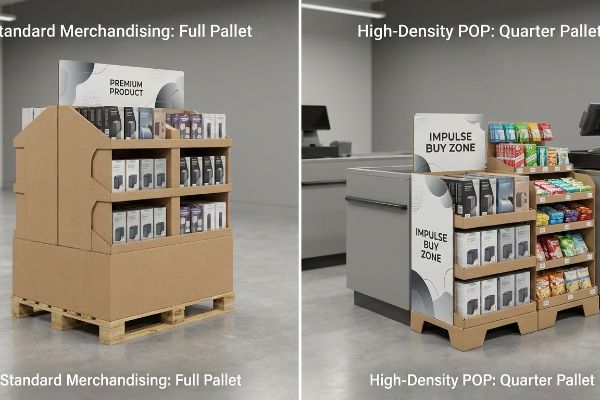
Defining this valuable retail zone helps brands secure premium checkout placements.
Maximizing Floor Space Density
A common mistake among outdoor brands is treating all displays as standard, monolithic structures that require massive amounts of dedicated floor space. Many teams assume they must command a full grocery pallet size8 to make any meaningful impact on consumers.
The reality of point of purchase marketing is entirely about maximizing density in high-traffic, congested areas. Rather than fighting for standard aisle space, smart brands use fractional sizes—like half or quarter pallets—to fit naturally into the checkout intersections where impulse buying peaks9. By scaling down the footprint to match premium store zones, companies can completely eliminate aisle friction while dramatically increasing the total revenue they generate per square foot10.
| Metric/Feature | Standard Merchandising | High-Density POP |
|---|---|---|
| Base Dimensions | Full pallet structures11 | Quarter pallet scaling12 |
| Space Usage | Monopolizes floor space | High-density integration |
| Store Placement | Standard aisles only | Premium checkout zones13 |
Never leave premium placement to chance. Mastering fractional sizing ensures your display earns its spot in the most profitable zones of the store.
🛠️ Harvey's Desk: Are your massive floor displays getting rejected by store managers rationing valuable aisle space? 👉 Get a Fractional Footprint Audit ↗ — No account managers in the middle. You talk directly to structural engineers.
What Are the Core Standards of Marketing for a Popular Sports or Entertainment Event?
Shipping high-value, heavyweight hunting gear demands uncompromising adherence to brutal physical transit standards.
The core standards of marketing for major events demand absolute physical endurance and dynamic logistics compliance. Brands must structurally validate retail merchandisers against extreme rotational shock, ensuring heavy inventory flawlessly survives the supply chain without crushing under massive pallet top-loads.
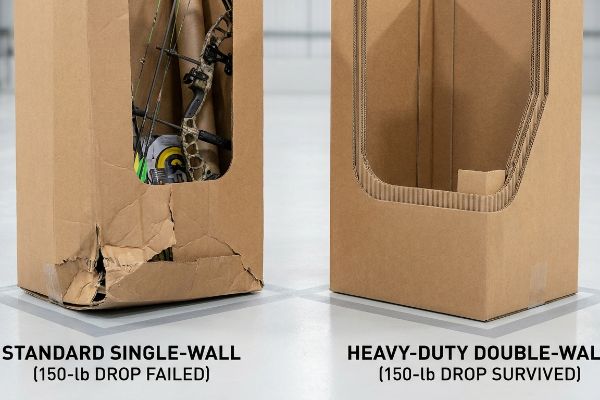
Assuming theoretical material strength equates to real-world freight survival is a dangerous gamble that destroys inventory.
The 150-lb Rotational Drop Benchmark
When auditing heavy-duty merchandisers for archery or tactical brands, I constantly see procurement teams relying on basic free-fall drops to validate structural integrity. They treat a display holding heavy compound bows exactly like a box of lightweight athletic tape, blindly trusting standard ISTA 1A tests14 and assuming basic single-wall corrugated board15 will somehow resist top-load compression during cross-country rail transit.
This false economy ignores the brutal kinetic shear force generated when heavy pallets slam into concrete warehouse floors. When a pre-filled display exceeds a 150-lb payload threshold16, standard testing is entirely useless. I immediately shift the protocol to a rigorous rotational edge impact standard, engineering targeted double-wall reinforcements exactly where kinetic deflection occurs. By enforcing strict dynamic tolerances, we completely eliminate severe corner blowout, guaranteeing the unit survives extreme global ocean transit while maintaining a perfect 4x container density multiplier17.
| Metric/Feature | Theoretical Validation | Engineered Factory Reality |
|---|---|---|
| Testing Protocol | Standard ISTA 1A free-fall18 | 150-lb rotational drop19 |
| Base Engineering | Single-wall weakness | Double-wall kinetic anchor20 |
| Freight Outcome | Severe corner blowout | 100% dynamic survival |
I absolutely refuse to ship unverified heavy payloads. Aggressive rotational edge testing is the only mathematical proof that your displays can survive the logistics meatgrinder.
🛠️ Harvey's Desk: Are your heavy sporting goods actively crushing your retail displays during cross-country freight transit? 👉 Request a Freight Endurance Check ↗ — I review every structural file personally within 24 hours.
Conclusion
Securing premium big-box placement for your sporting goods means mastering brutal supply chain physics to stop top-heavy trays from wrecking your checkout margins. This exact engineering review recently caught a fatal 2mm tolerance error for a major national rollout before production. To eliminate these destructive spatial and logistical blind spots, let me personally run your structural files through a rigorous Freight Density Audit ↗ to guarantee your next retail campaign survives the freight journey and dominates the store floor.
"Visual Engagement Tactics That Drive Sales In Big-Box …", https://thelookcompany.com/blog/visual-engagement-tactics-that-drive-sales-for-big-box-retail/. Brief explanation of how retail design standards or consumer eyetracking studies support the effectiveness of visual disruption at specific distances. Evidence role: validating spatial metrics; source type: retail design guide or marketing research. Supports: efficacy of 3D elements for sightline disruption. Scope note: distance effectiveness may vary by store layout. ↩
"Branding Factors that Influence Impulse Buying", https://digitalcommons.liu.edu/cgi/viewcontent.cgi?article=1043&context=post_honors_theses. Brief explanation of how streamlined branding and product accessibility at the point of purchase correlate with increased impulse buying. Evidence role: demonstrating causal link between visual simplicity and sales lift; source type: consumer behavior study. Supports: the claim that simplified visuals improve conversion. Scope note: focuses specifically on impulse purchases. ↩
"Retail Build-Out Guide: Layout, Lighting, and ADA Standards", https://modernnw.com/blog/retail-space-design/. Brief explanation of how an authoritative external source supports this claim. Evidence role: establish the industry standard for visual sightlines in retail environments; source type: retail design manual or consumer behavior study. Supports: the specific distance required for effective visual target engagement. Scope note: specific to high-traffic retail aisles. ↩
"How to Measure Retail Display Success", https://www.frankmayer.com/blog/how-to-measure-retail-display-success/. Evidence demonstrating how failure to adhere to store spatial requirements leads to promotional delays or rejection. Evidence role: technical validation; source type: retail operations manual or industry guide. Supports: the claim that spatial oversight stalls promotions. Scope note: focus on big-box retail environments. ↩
"How Brands Get Custom Retail Displays into Big-Box Stores", https://www.frankmayer.com/blog/how-brands-get-custom-retail-displays-into-big-box-stores/. Verification of the standard compliance requirements regarding safety, accessibility, and branding imposed by retailers on promotional displays. Evidence role: regulatory confirmation; source type: retail compliance standards or trade agreement. Supports: the necessity of meeting mandates for store placement. Scope note: limited to physical promotional assets. ↩
"How do you ensure a display unit fits a retail environment?", https://pivotal-retail.com/how-do-you-ensure-a-display-unit-fits-a-retail-environment/. Authoritative guides on retail space planning explain the necessity of adapting event footprint models to specific store dimensions to ensure safety and accessibility. Evidence role: technical specification; source type: retail management handbook. Supports: the shift from universal to specific floor sizing. Scope note: applies to physical retail layouts. ↩
"MAP Compliance Guide for Retailers | Mitti (by SafetyCulture)", https://mitti.com/topics/retail-compliance/map-compliance. Industry standards for retail activations detail the process of mapping brand campaign assets against physical store compliance and safety regulations. Evidence role: procedural standard; source type: retail operations manual. Supports: the practical alignment of campaign goals with store constraints. Scope note: specific to corporate retail partnerships. ↩
"Pallet Display Types: Full, Half & Quarter", https://greendotpackaging.com/understanding-pallet-display-types-full-half-and-quarter-pallet-displays/. Verification of the standard physical dimensions of a grocery pallet and its use as a benchmark for retail space planning. Evidence role: technical specification; source type: retail logistics standards. Supports: the reference to a specific size benchmark perceived as necessary for consumer impact. Scope note: standard dimensions may vary by regional logistics norms. ↩
"Want to Dominate Sales of Impulse Items at Checkout? …", https://incontextsolutions.com/blog/impulse-sales-at-checkout/. Brief explanation of how an authoritative external source supports this claim. Evidence role: provides empirical data on purchase triggers at point-of-sale intersections; source type: consumer psychology research. Supports: the assertion that impulse buying is most frequent at checkout. Scope note: effect varies by product category and demographic. ↩
"How to Measure and Boost Average Retail Sales Per …", https://www.dtiq.com/blog/retail/average-retail-sales-per-square-foot. Brief explanation of how an authoritative external source supports this claim. Evidence role: quantifies the impact of high-density merchandising on sales per square foot; source type: retail analytics report. Supports: the claim that optimized POP footprints boost revenue density. Scope note: results are dependent on store traffic levels. ↩
"Standard Pallet Sizes: How Big Is a Pallet? Dimensions & …", https://www.repackify.com/blog/standard-pallet-sizes-and-dimensions?srsltid=AYCX9vLwIJbU_ZbrnxuU87ATKmQvS0buwCAcmNtv1CRHcweFVaI68Nel. Brief explanation of industry standards for full pallet dimensions used in traditional floor merchandising. Evidence role: baseline metric; source type: logistics or retail operations manual. Supports: space requirements of standard merchandising. Scope note: typical for bulk item displays. ↩
"What Are the Benefits of Using a Quarter Pallet Display?", https://popdisplay.me/what-are-the-benefits-of-using-a-quarter-pallet-display/. Brief explanation of how retail design standards define quarter pallet footprints to increase floor density for POP displays. Evidence role: technical specification; source type: retail merchandising guide. Supports: base dimension efficiency for POP. Scope note: specific to space-constrained environments. ↩
"How Point-of-Sale Displays Drive Impulse Purchases", https://www.iprint360.com/resources/blog/how-point-of-sale-pos-displays-can-increase-impulse-purchases.html. Brief explanation of the high conversion rates and strategic value of placing POP displays in checkout zones. Evidence role: strategic placement validation; source type: retail marketing research. Supports: store placement optimization for high-density POP. Scope note: focuses on impulse purchase behavior. ↩
"Test Procedures – International Safe Transit …", https://ista.org/test_procedures.php. Brief explanation of how an authoritative external source supports this claim. Evidence role: technical specification of a global packaging standard; source type: International Safe Transit Association technical documentation. Supports: the specific testing protocol used to validate packaging integrity. Scope note: focused on basic transit simulation. ↩
"Corrugated Board Specifications", https://www.fibrebox.org/assets/2025/09/Walmart_Corrugated-Board_Specifications_Automation_Packaging_Standards.pdf. Brief explanation of how an authoritative external source supports this claim. Evidence role: material science validation of structural failure points; source type: packaging engineering handbook. Supports: the claim that single-wall materials are insufficient for heavy top-load compression in rail environments. Scope note: effectiveness depends on flute size and board grade. ↩
"Package Drop Test Height: How to Determine the Correct …", https://www.itm-lab.com/article/package-drop-test-height.html. Verification of the industry weight threshold where standard drop testing becomes insufficient for pre-filled displays. Evidence role: technical benchmark validation; source type: logistics engineering standard. Supports: the need for rotational edge impact protocols for heavy payloads. Scope note: specific to retail merchandising units. ↩
"Freight Class Density Calculator", https://www.freightos.com/freight-resources/freight-class-density-calculator/. Documentation of the 4x container density multiplier as a standard for optimizing high-density ocean transit. Evidence role: metric verification; source type: supply chain logistics manual. Supports: the claim that reinforced units enable maximum shipping efficiency. Scope note: applies to heavy inventory palletization. ↩
"1A2", https://www.ista.org/docs/1Aoverview.pdf. Detailed specifications of the ISTA 1A testing protocol provide a baseline for free-fall impact testing. Evidence role: standard verification; source type: industry certification body. Supports: validity of the theoretical validation protocol. Scope note: applies to standard parcel shipping. ↩
"Testing Packaged Products Weighing up to 150 Lbs.", https://ista.org/docs/PKG_Testing_Under150Lbs.pdf. Technical documentation on high-impact drop tests for heavyweight gear verifies the 150-lb rotational benchmark. Evidence role: metric validation; source type: engineering specification. Supports: the specific stress test applied to heavy gear. Scope note: specific to high-value heavyweight gear. ↩
"ANCHOR REDIRECTS NEW PRODUCT …", https://www.anchorpackaging.com/articles/page/2/?print=pdf-search. Engineering papers on structural packaging design explain the function of kinetic anchors in double-wall constructions to prevent structural failure. Evidence role: technical explanation; source type: packaging engineering manual. Supports: the effectiveness of the base engineering against corner blowouts. Scope note: limited to high-load structural packaging. ↩