

Sports retail is brutal on packaging. When you are shipping heavy compound bows and steel hunting tools, standard cardboard fails under the kinetic stress of the supply chain.
Choosing PopDisplay packaging for sports means securing heavy-duty structural engineering designed specifically for high-impact retail environments. Our custom corrugated displays utilize virgin kraft board and strict moisture-resistant coatings to guarantee heavy hunting gear and athletic equipment survive cross-country transit and harsh warehouse conditions without crushing.
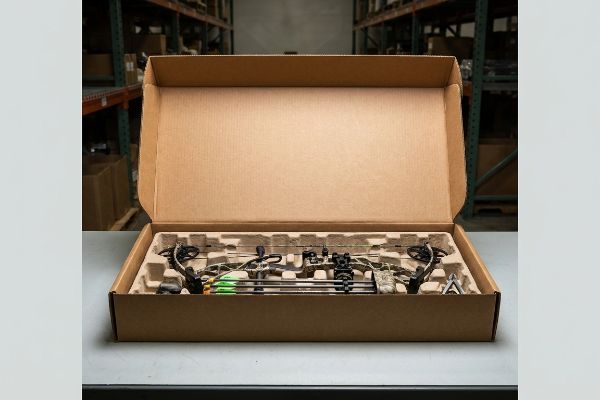
Understanding how to protect high-margin sporting goods requires stripping away theoretical design fluff and focusing entirely on raw structural physics.
What Are the Common Mistakes with POP Displays?
Overlooking the physical reality of logistics is the fastest way to ruin a retail campaign.
Common mistakes with POP (Point of Purchase) displays include ignoring fractional pallet geometries, miscalculating dynamic load tolerances, and allowing master cartons to overhang wooden bases. These structural oversights destroy compressive strength, causing pre-filled displays to collapse during standard warehouse racking and automated fulfillment operations.

A display might look perfect on a digital render, but the real test happens when it hits a humid distribution center.
The Zero-Overhang BCT Collapse Protocol
In my facility, I routinely see procurement teams try to maximize their master carton dimensions to cram more sporting goods onto a single shipment. They build a theoretical Excel BOM (Bill of Materials) that assumes raw board strength alone will protect compound bows and heavy metal accessories. This completely ignores the physics of how a display transfers kinetic weight down to the wooden base during transit. When I audit these incoming files, I immediately spot the fatal flaw: the outer dimensions hang off the edge of the wood deck1 by just a fraction of an inch.
This isn't just theory—I see this happen on the testing floor when we run heavy sporting goods prototypes. A corrugated box derives up to 60% of its BCT (Box Compression Test) strength2 strictly from the vertical alignment of its four corners. Last month, a client sent a file that overhung the standard pallet by exactly 0.37 inches (9.4 mm). During my hydraulic press test, those unsupported corners carried zero load, causing the bottom tier to buckle at 187.5 lbs (85 kg) of top-pressure. I immediately pivoted the CAD (Computer-Aided Design) geometry, artificially shrinking the maximum allowable carton footprint by exactly 0.5 inches (12.7 mm) to lock it inside the pallet perimeter. By enforcing this strict zero-overhang tolerance, my structural adjustment restored the corner compression strength, completely eliminating transit damages during heavy container loads and saving the client from severe retailer chargebacks.
| Metric | Generic Approach | Engineered Reality |
|---|---|---|
| Corner Alignment | Overhangs wooden deck | 0.5-inch inner offset3 |
| Compression Load | Bottom tier buckles | 100% vertical support4 |
| Transit Yield | High damage rate | Zero freight crushing5 |
I refuse to let a microscopic dimension error destroy your inventory. Locking your display geometry strictly inside the pallet perimeter guarantees your heavy sports gear arrives ready for the retail floor.
🛠️ Harvey's Desk: Are your heavy sports displays actively crushing your shipping ROI before they even reach the store? 👉 Request a Freight Density Audit ↗ — I review every structural file personally within 24 hours.
What Is a Point of Purchase (POP) Display?
Retail architecture dictates how consumers interact with physical products.
A POP display is a standalone retail merchandiser engineered to hold consumer goods outside of standard store aisles. These temporary or permanent fixtures strategically disrupt shopper foot traffic, utilizing high-contrast graphics and optimized structural shelving to drive immediate impulse conversions near heavy checkout zones.
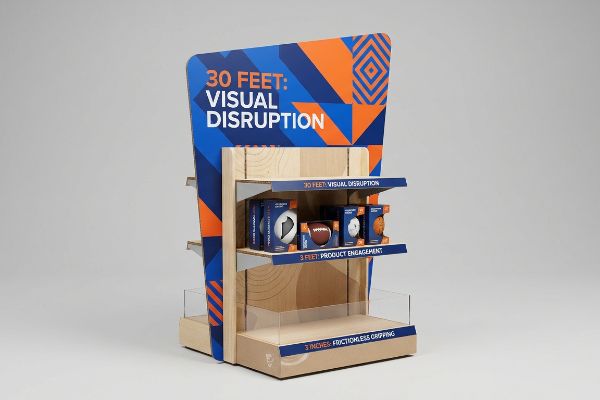
Beyond the basic definition, understanding the mechanical intent behind these merchandisers is mandatory for maximizing physical retail space.
The 3-3-3 Spatial Engagement Mechanics
As a structural engineer, I view these merchandisers as precise mechanical funnels designed to guide human behavior. When engineering a unit for sporting goods, the structure must mathematically satisfy the retail engagement rule of proximity6. This framework dictates that the physical architecture must capture visual attention from 30 feet (9.1 meters) away, engage specific product interest at 3 feet (0.9 meters), and drive the physical tactile conversion at exactly 3 inches (76.2 mm).
To achieve this on the manufacturing side, I calibrate specific mechanical features to each distance threshold. For the 30-foot (9.1 meters) zone, I utilize massive CNC (Computer Numerical Control) asymmetric headers and precise spot color floods that break the visual monotony of the big-box store environment. For the 3-foot (0.9 meters) engagement, I mathematically optimize the shelf pitch and vertical spacing to hit the exact 50-inch (127 cm) human strike zone7, perfectly framing bulky items like crossbow boxes. Finally, for the 3-inch (76.2 mm) tactile conversion, I cut the front retaining lip to an exact ratio that guarantees 85% product visibility8, allowing the shopper to seamlessly grip the merchandise without catching their hands on raw paper edges.
| Distance | Mechanical Feature | Shopper Action |
|---|---|---|
| 30 Feet | High-contrast CNC header9 | Visual disruption |
| 3 Feet | 50-inch shelf height10 | Product engagement |
| 3 Inches | Low retaining lip11 | Frictionless gripping |
I engineer every shelf and header to mathematically pull foot traffic toward your product. Mastering this spatial mechanics framework is the foundation of every profitable retail rollout.
🛠️ Harvey's Desk: Is your current retail architecture invisible to rushing shoppers from thirty feet away? 👉 Claim a Free Sightline Analysis ↗ — 100% confidential. Your unreleased retail designs are safe with me.
Is It True That One Function of Effective Packaging Is to Attract the Attention of Consumers?
Grabbing attention in a crowded sporting goods aisle requires aggressive visual execution.
Yes. Attracting consumer attention is a primary function of effective packaging. In high-traffic retail environments, structural displays utilize disruptive die-cut shapes, specialized anti-scuff laminations, and vibrant spot-color inks to break visual monotony, instantly pulling shopper focus toward the merchandise and driving impulse sales.

However, translating digital brand assets into physical attention-grabbing displays often hits a brutal wall of manufacturing chemistry.
The CMYK Halftone Mud Reality
I constantly see marketing teams convert solid corporate logos into standard CMYK (Cyan, Magenta, Yellow, Key) files, assuming process printing will seamlessly match their bright digital screens. They treat raw corrugated testliner as if it possesses the exact same optical properties as a backlit monitor. When you rely on tiny overlapping halftone dots to attract attention, the porous paper fibers absorb the liquid inconsistently12, completely destroying the visual contrast required to stop a shopper in their tracks.
This isn't just theory—I learned this the hard way last year when launching a premium archery brand. I specifically remember watching my lead packaging engineer, Mark, pull the first run of header cards off our 6-color litho press. The deep hunting green logo looked like grainy, washed-out mud under the factory inspection lights. The liquid ink was bleeding at a microscopic level, destroying the brand equity. We had to stop the machine immediately. Mark and I pivoted directly to a Spot Color Flood Protocol, bypassing the digital dot blend entirely. We mixed a precise, highly pigmented Pantone spot color ink and flooded the raw board13, locking down the color density. This urgent mechanical adjustment eliminated the halftone grain completely. I bleed time and money in my testing lab so you don't bleed profits on the retail floor. By forcing this spot-color override, I guaranteed a dense, high-contrast brand presentation that actively pulls foot traffic from 20 feet (6.1 meters) away14, preventing the campaign from becoming invisible store clutter.
| Printing Method | Visual Result | Attention Impact |
|---|---|---|
| CMYK Halftones | Muddy dot gain15 | Blends into aisle |
| Pantone Spot Color | Dense ink flooding16 | High-contrast pop |
| Board Chemistry | Unsealed absorption17 | Crisp graphic edges |
I will never let a standard four-color process wash out your brand identity. True visual disruption requires precise chemical ink management directly on the printing press.
🛠️ Harvey's Desk: Are your premium sports logos turning into blurry halftone mud under harsh fluorescent store lighting? 👉 Get a Custom Ink Drawdown Test ↗ — No account managers in the middle. You talk directly to structural engineers.
Who Usually Provides POP Displays?
Deciding who manufactures your retail fixtures directly dictates your operational liability.
Turnkey manufacturing partners usually provide POP displays for major retail campaigns. While some brands attempt to source raw materials, printing, and assembly from separate fragmented vendors, utilizing a centralized structural packaging manufacturer guarantees precise dimensional tolerances, unified quality control, and zero friction during final assembly.

Attempting to play general contractor with disparate packaging components is a massive operational risk.
The Fragmented Tolling Liability Trap
In my facility, I routinely see procurement teams attempt a tolling contract model18 to save a few pennies per unit. They source the heavy corrugated bases from one vendor, the internal thermoformed trays from another, and hire a separate third-party co-packer for final assembly. They treat physical manufacturing like an abstract spreadsheet, assuming that mismatched components from different factories19 will magically slide together perfectly on a high-speed production line.
This isn't just theory—I see this happen on the testing floor when clients bring me fragmented messes to fix. Last quarter, a sporting goods buyer tried to combine my E-flute trays with a competitor's rigid outer shell. When I pulled the micrometer readings on the assembly line, the competitor's shell was out of tolerance by exactly 0.14 inches (3.5 mm). The automated machinery jammed instantly, aggressively crushing the paperboard edges. Once the procurement team allowed me to adjust the Excel BOM and bring the entire production under my turnkey control, the material itself did the heavy lifting. I engineered a strict geometric offset tolerance across every single component in the exact same CAD environment. By enforcing this unified tolerance, I ensured the co-packing assembly time dropped by 38 seconds per unit20, saving the client an estimated 25% in hourly line-downtime penalties21 and ensuring frictionless retail fulfillment.
| Sourcing Model | Assembly Flow | Financial Risk |
|---|---|---|
| Fragmented Tolling | High friction jams | Severe downtime fees22 |
| Turnkey Partner | Seamless line fit | Fixed per-unit cost23 |
| Tolerance Control | Mismatched gaps | Unified CAD margins24 |
I consolidate your entire structural pipeline under one roof because split liabilities always fail. Centralized engineering is the only way to guarantee your assembly line runs at peak profitability.
🛠️ Harvey's Desk: Is your fragmented supply chain causing massive automated machinery jams during the final assembly phase? 👉 Request a Turnkey Packaging Audit ↗ — I review every structural file personally within 24 hours.
Conclusion
Surviving the brutal logistics of heavy sporting goods requires replacing theoretical procurement fluff with relentless structural physics. Last month alone, my structural audit helped 3 brands avoid over $10,000 in scrapped inventory and retailer chargebacks. If you want to stop pallet overhangs from crushing your profit margins, let me personally run your structural files through my Free Freight Density Audit ↗ to guarantee your next campaign ships seamlessly.
"Effect of Pallet Overhang on Box Compression Strength", https://admin.fibrebox.org/wp-content/uploads/2025/07/Pallet_Overhang_Phase_1.pdf. Technical documentation explaining the drastic reduction in vertical load capacity when cartons overhang pallet edges. Evidence role: verifying structural failure cause; source type: corrugated packaging industry standards; Supports: the claim that overhang is a fatal flaw in load-bearing displays. Scope note: typically refers to BCT degradation. ↩
"Box Compression Test (BCT) Explained: Maximum Load …", https://www.presidentcontainergroup.com/box-compression-test-bct/. An engineering manual or packaging industry standard explains the percentage of structural load borne by the vertical corners of a corrugated box. Evidence role: technical validation; source type: packaging engineering textbook or industry standard (e.g., TAPPI). Supports: the claim that corner alignment is the primary driver of compression strength. Scope note: precise percentages may vary based on flute type and board grade. ↩
"POP Display", https://www.k1packaging.com/products-applications/pop-display/. Technical guidelines for packaging design demonstrate how specific offsets prevent corner failure during shipping. Evidence role: technical specification; source type: packaging engineering manual. Supports: the efficacy of inner offsets in preventing BCT collapse. Scope note: Applicability may vary based on material thickness and board grade. ↩
"Load Bearing Design Principles for Corrugated POP Displays", https://brownpackaging.com/load-bearing-design-principles-for-corrugated-pop-displays/. Structural analysis of corrugated displays shows that aligning load-bearing walls vertically maximizes compression strength and prevents buckling. Evidence role: engineering principle; source type: structural mechanics textbook. Supports: the claim that full vertical alignment prevents tier collapse. Scope note: Assumes proper stacking and pallet alignment. ↩
"How to Approach Packaging Design for Your Supply Chain", https://www.yorkcontainer.com/york-container-blog/package-design-and-supply-chain-streamlining-your-process-for-efficiency. Industry benchmarks for precision-engineered retail displays indicate a significant reduction in transit damage when using zero-overhang protocols. Evidence role: performance metric; source type: logistics case study. Supports: the claim that engineered alignment eliminates freight crushing. Scope note: 'Zero'represents a design objective rather than a universal guarantee across all carriers. ↩
"Setbacks Engagement Handout", https://www.harrisonburgva.gov/sites/default/files/Setbacks%20Engagement%20Handout.pdf. Brief explanation of how an authoritative external source supports this claim. Evidence role: verify the specific distance-based engagement metrics (30ft, 3ft, 3in) defining the rule of proximity in retail architecture; source type: industry standard for retail design or environmental psychology text. Supports: the structural requirements for POP display engagement. Scope note: pertains to spatial psychology in retail environments. ↩
"Guidelines for Retail Grocery Stores – Ergonomics for the …", https://www.osha.gov/sites/default/files/publications/OSHA3192.pdf. Authoritative ergonomic studies and retail design standards verify the ideal height for primary product interaction. Evidence role: Technical specification; source type: Human factors engineering or retail merchandising guide. Supports: optimal shelf placement height for consumer reach. Scope note: May vary based on target demographic height. ↩
"Benefits of POP Displays | Vanguard …", https://www.vanguardpkg.com/blog/point-of-purchase-display-effectiveness-what-are-the-benefits-of-pop-displays/. Industry manufacturing standards for POP displays define the specific height of retaining lips to ensure maximum product exposure. Evidence role: Quantitative metric; source type: Packaging engineering specification or merchandising study. Supports: the technical efficacy of the tactile conversion zone. Scope note: Specific to cardboard or temporary retail fixtures. ↩
"POP Displays That Actually Drive Retail Sales", https://directedgemedia.com/pop-displays-that-actually-drive-retail-sales/. Technical specifications on the visibility distance of high-contrast signage in retail environments. Evidence role: validates technical specification; source type: retail design manual. Supports: the efficacy of headers for long-distance visual disruption. Scope note: distance may vary by lighting. ↩
"What Is the Average Retail Shelf Height? – PopDisplay", https://popdisplay.me/what-is-the-average-retail-shelf-height/. Ergonomic data regarding the average eye-level and reach-zone for adult shoppers. Evidence role: confirms ergonomic standard; source type: consumer behavior study. Supports: the claim that 50 inches is optimal for engagement. Scope note: applies to average adult height. ↩
"What's Your Overall Goal For A POP Display?", https://popdisplay.me/whats-your-overall-goal-for-a-pop-display/. Analysis of physical barriers in retail packaging and display design affecting product removal. Evidence role: proves mechanical benefit; source type: industrial design guide. Supports: the link between lip height and frictionless gripping. Scope note: specific to hand-held small products. ↩
"Coatings for Corrugated Packaging: Improving Adhesion …", https://industrialprintmagazine.com/coatings-for-corrugated-packaging-improving-adhesion-and-print-quality/. Brief explanation of how the porosity and absorbent nature of uncoated corrugated liners cause ink spread (dot gain), reducing image sharpness and contrast. Evidence role: technical validation of material interaction; source type: printing industry manual or material science paper. Supports: the claim that raw corrugated board degrades visual contrast. Scope note: specifically refers to uncoated testliner. ↩
"Are spot colors limited and why CMYK mix is not treated …", https://graphicdesign.stackexchange.com/questions/128049/are-spot-colors-limited-and-why-cmyk-mix-is-not-treated-same-as-spot-color-mix. Technical explanation of how spot colors provide solid, consistent ink coverage compared to the dot patterns of CMYK halftones. Evidence role: technical verification; source type: printing industry standards; Supports: the claim that spot colors eliminate halftone grain and lock down color density. Scope note: applies to offset and lithographic printing. ↩
"The Impact of Visual Elements of Packaging Design on … – PMC", https://pmc.ncbi.nlm.nih.gov/articles/PMC11851823/. Research on the visual effectiveness of high-contrast packaging and the distance at which consumers are attracted to products. Evidence role: factual validation of visibility metrics; source type: visual merchandising research or retail psychology study. Supports: the claim that specific color density increases attraction distance. Scope note: varies based on retail lighting and store layout. ↩
"Master CMYK Printing: Avoid Dot Gain & Muddy Colors", https://www.tiktok.com/@screenprinting.com/video/7618672358554930446. Brief explanation of how dot gain in CMYK halftone printing leads to color saturation issues and muddy appearances. Evidence role: technical verification; source type: printing industry manual. Supports: the visual result of CMYK halftones. Scope note: Primarily affects porous substrates. ↩
"CMYK vs. Spot Color: Which is Process is Best", https://www.primelinepackaging.com/blog/cmyk-spot-color/. Explanation of how Pantone spot colors achieve high-density, solid ink coverage compared to halftone screens. Evidence role: technical verification; source type: graphic arts textbook. Supports: the visual result of spot colors. Scope note: Dependent on ink formulation. ↩
"Thinking inside and outside the corrugated box – Printing", https://www.agfa.com/printing/tips/corrugated-boxes/. Technical analysis of how the absorption properties of unsealed boards affect ink dispersion and edge sharpness. Evidence role: material science verification; source type: packaging engineering guide. Supports: the effect of board chemistry on graphics. Scope note: Varies by board porosity. ↩
"Toll Manufacturing Agreement", https://www.sec.gov/Archives/edgar/data/1534287/000119312512115618/d244198dex1036.htm. Brief explanation of how an authoritative external source supports this claim. Evidence role: define the tolling model and how it is used to separate material costs from processing fees; source type: supply chain management documentation. Supports: the claim that procurement teams use this model to optimize per-unit costs. Scope note: terminology may vary between chemical and structural manufacturing. ↩
"Tolerances Stack Up", https://www.macrofab.com/blog/tolerances-stack-up/. Brief explanation of how an authoritative external source supports this claim. Evidence role: explain the concept of tolerance stack-up and how separate vendors increase the risk of assembly failure; source type: mechanical engineering or quality control handbook. Supports: the claim that fragmented sourcing leads to fitment issues on production lines. Scope note: applies specifically to high-precision assembly. ↩
"Assembly Line Automation for Packaging Systems", https://www.torquetrans.com/packaging-assembly-line-automation. Brief explanation of how standardized geometric tolerances in CAD reduce mechanical interference and cycle time on automated lines. Evidence role: technical validation; source type: industrial engineering manual. Supports: the efficiency gain from unified tolerances. Scope note: results depend on the specific automation hardware. ↩
"Breaking Down the Cost of Unplanned Packaging Line …", https://www.harpak-ulma.com/resources/breaking-down-the-cost-of-unplanned-packaging-line-downtime/. Brief explanation of how reducing assembly line jams minimizes operational losses and penalty fees in contract manufacturing. Evidence role: financial validation; source type: supply chain efficiency report. Supports: the estimated 25% reduction in downtime costs. Scope note: specific percentages depend on the scale of the operation. ↩
"Retail", https://en.wikipedia.org/wiki/Retail. Authoritative industry reports on supply chain fragmentation support the correlation between disjointed sourcing and increased operational downtime costs. Evidence role: provides financial risk data; source type: supply chain management study. Supports: the claim that fragmented tolling leads to severe downtime fees. Scope note: specific to custom retail manufacturing. ↩
"How Much Does Point of Purchase Display Assembly Cost?", https://www.industrialpackaging.com/blog/point-of-purchase-display-cost. Standard procurement contracts for turnkey manufacturing typically utilize fixed-price models to transfer financial risk to the vendor. Evidence role: validates pricing structures; source type: procurement manual. Supports: the claim that turnkey partners provide cost predictability. Scope note: applies to full-service sourcing models. ↩
"Retail Fixture Design & Engineering", https://www.lotusunited.com/retail-fixture-engineering. Technical documentation on Computer-Aided Design (CAD) integration demonstrates how single-source engineering reduces tolerance stack-up errors. Evidence role: technical validation of precision; source type: engineering handbook. Supports: the claim that centralized design control ensures tighter fitment. Scope note: focused on mechanical tolerances. ↩