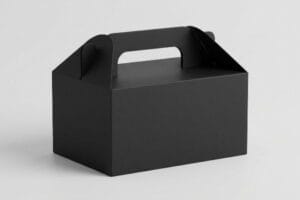
You spent months formulating the perfect soap, but if the box feels cheap, shoppers walk past it. Your retail success hinges entirely on that physical first impression.
The role of soap packaging in branding is communicating product value and driving physical sales. It acts as a silent salesperson, utilizing structural integrity, tactile finishes, and visual design to instantly convey your brand equity and distinguish your merchandise on crowded commercial retail store shelves.

But understanding the theoretical value of a beautiful box is very different from engineering one that actually survives a retail supply chain.
What Are the Four C's of Packaging Design?
Designers love creative frameworks, but ignoring the physical supply chain ruins the best concepts. Here is how the four main pillars actually translate to manufacturing.
The four Cs mean cost, concept, convenience, and communication. These foundational design pillars ensure your structural architecture safely balances raw material budgets, aesthetic branding goals, logistical assembly speed, and clear consumer messaging to maximize return on investment during high-volume retail supply chain rollouts.
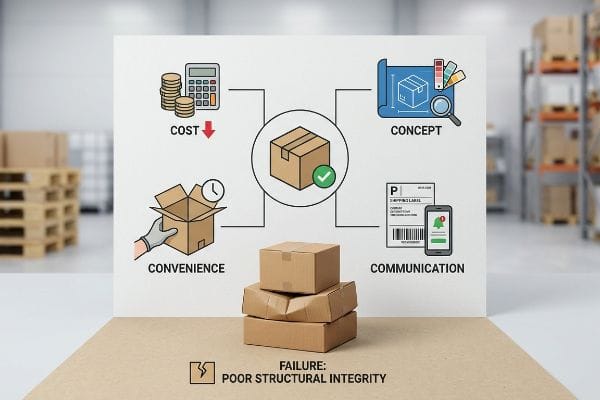
Balancing these four elements looks easy on a spreadsheet, but it falls apart quickly on the factory floor.
Why the Four Cs Fail Under Supply Chain Pressure
Brand teams frequently use this framework to guide their retail rollouts, attempting to weigh all four elements equally. However, procurement departments often isolate and obsess strictly over the cost metric, hollowly reducing board grades to save upfront pennies1.
I see this trap catch even experienced buyers when they downgrade from a 32 ECT (Edge Crush Test) board2 to a cheaper 26 ECT grade3 to fund a premium foil stamp. They think they optimized the concept, but they destroyed the convenience and communication. Last quarter, I watched a warehouse clerk struggle to stack these weakened boxes; the loud crunch of the bottom tier collapsing under just 40 lbs (18 kg) of top-load weight echoed across the dock. The cost savings vanished instantly because the physical concept buckled, slowing down the assembly line by an estimated 30% and triggering expensive retailer chargebacks for damaged goods.
| Common Rookie Mistake | The Pro Fix | Retail-Floor Benefit |
|---|---|---|
| Downgrading board grade for cosmetic budget | Enforce minimum 32 ECT base structural standards4 | Prevents catastrophic pallet collapse |
| Ignoring assembly labor convenience | Use pre-glued crash bottoms or auto-locking tabs | Saves 25s assembly time per unit5 |
| Treating cost as an isolated metric | Link structural spend to reduced freight damage | Preserves overall profit margins |
I mandate a unified assessment that strictly forbids treating raw unit price as an isolated metric. By linking structural integrity directly to downstream logistical convenience, I ensure your campaign survives freight handling without sacrificing brand communication.
🛠️ Harvey's Desk: Are your procurement choices secretly ruining your box's compressive strength? 👉 Request A Structural Audit ↗ — Direct access to my desk. Zero automated sales spam, I promise.
What Are the Different Types of Soap Packaging?
Merchandising personal care items requires specific tactile and visual formats. The format you choose dictates both aesthetic appeal and physical durability.
Different types of soap packaging include folding cartons, rigid setup boxes, flexible wrappers, and windowed paperboard sleeves. Each structural format utilizes distinct substrates to protect the chemical integrity of the soap while providing specific aesthetic canvases for branding, tactile engagement, and retail shelf visibility.
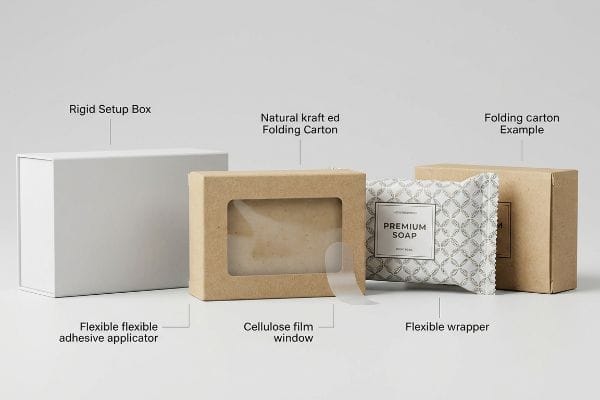
While basic solid boxes are foolproof, adding visual elements like display windows introduces hidden structural risks.
The Hidden Danger of Windowed Soap Cartons
Brands frequently request Kraft paper window boxes to give consumers visual access and allow the fragrance to breathe6. They assume adhering a flat, clear polymer film across a die-cut void in thin board is a simple manufacturing step.
The problem is that rigid plastic panes and porous Kraft paper expand and contract at entirely different rates7 during temperature fluctuations. I recently had a client ship windowed boxes to a humid Florida distribution center using standard rigid adhesives. As the paper fibers swelled by just 0.04 inches (1 mm), the resulting surface tension caused the flat cartons to aggressively warp inward, and the sharp pop of the plastic windows snapping off the glue line ruined the entire batch. Using flexible adhesive protocols and swapping rigid petroleum films for high-clarity PLA8 (Polylactic Acid) ensures the box stays perfectly flat and curbside recyclable, drastically cutting manual rework fees on the floor.
| Common Rookie Mistake | The Pro Fix | Retail-Floor Benefit |
|---|---|---|
| Using rigid glue on mixed materials | Mandate flexible climate-resistant adhesives9 | Prevents window pop-off in transit |
| Specifying heavy petroleum PET films | Substitute with wood-pulp cellulose windows10 | Ensures 100% curbside repulpability |
| Ignoring ambient moisture swelling | Apply strict humidity buffer tolerances11 | Eliminates paperboard warping issues |
I strictly mandate elastic adhesives and cellulose films whenever cutting voids into secondary cartons. This minor chemical adjustment completely eliminates surface tension distortion, guaranteeing your product arrives looking pristine and ready for checkout.
🛠️ Harvey's Desk: Is your die-cut window secretly compromising the compression strength of your folding carton? 👉 Get A Free Design Review ↗ — Download safely. My inbox is open if you have questions later.
What Are the Five Ps of Packaging?
Mastering the commercial mechanics of retail means understanding exactly how your physical box navigates the store ecosystem from the warehouse dock to the checkout aisle.
The five Ps of packaging integrate product, price, place, promotion, and positioning. These strategic variables dictate how your physical container protects merchandise, justifies premium pricing, survives logistical placement, actively promotes brand messaging, and positions your items against competitors on highly congested commercial retail shelves.
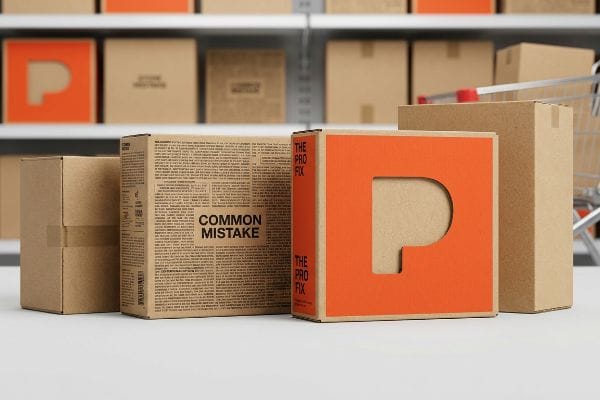
Many marketers memorize these five principles perfectly in the boardroom, only to completely fail the spatial reality of the aisle.
Why Promotion and Placement Break Down in Stores
Junior marketing teams frequently design secondary displays and retail boxes strictly for up-close viewing on backlit computer monitors. They assume a beautiful graphic automatically satisfies the promotion and positioning requirements once placed on a shelf.
This tunnel vision ignores the physical reality of how shoppers actually navigate store aisles, which operates on the 3-3-3 spatial engagement rule12. I constantly see brands print massive paragraphs of text on their boxes, completely forgetting that a shopper 30 feet (9 m) away just sees a muddy blur. During a recent floor walk, I watched consumers completely ignore a highly detailed, text-heavy display; the dull thud of shopping carts passing by without stopping was proof the unit failed its promotional duty. To fix this, you must engineer aggressive die-cut shapes and solid PMS (Pantone Matching System) spot color floods13 for distance disruption, ensuring the core offer grabs attention long before the shopper is close enough to read a single word.
| Common Rookie Mistake | The Pro Fix | Retail-Floor Benefit |
|---|---|---|
| Designing solely for up-close reading | Apply the 3-3-3 spatial engagement rule14 | Pulls foot traffic from aisles away |
| Using small, complex CMYK graphics | Use solid PMS spot color floods | Creates massive visual disruption |
| Hiding the core product behind text | Cut the front retaining lip lower | Guarantees 85% product visibility15 |
I engineer every merchandiser to explicitly satisfy this spatial continuum from thirty feet away down to three inches. Stripping away secondary messaging in favor of high-contrast structural focal points is the fastest way to drive physical conversions.
🛠️ Harvey's Desk: Does your current graphic layout become invisible from thirty feet away? 👉 Claim Your Visibility Check ↗ — No forms that trigger endless sales calls. Just pure value.
What Is the Role of Packaging in Marketing?
Your outer box is the final touchpoint before a consumer makes a purchasing decision. It carries the massive responsibility of communicating quality and securing the sale.
Packaging in marketing acts as the ultimate physical touchpoint, translating brand identity into a tangible consumer experience. Its primary role involves disrupting visual clutter, communicating perceived value, protecting the merchandise, and ultimately driving impulse purchases through strategic structural design and high-contrast tactile printing finishes.
But prioritizing flashy marketing aesthetics over raw physical physics is the fastest way to destroy a profitable retail campaign.
The Disastrous Cost of Cosmetic Upgrades
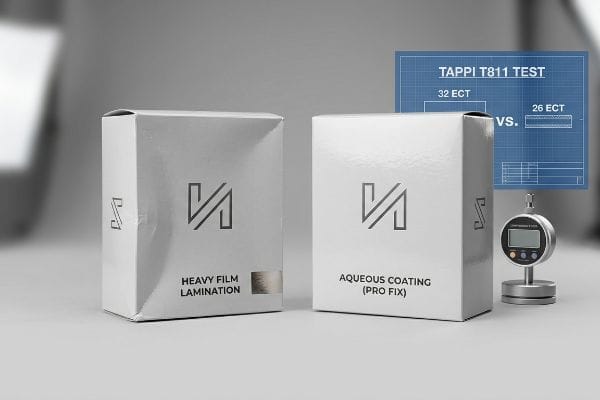
Procurement teams frequently treat expensive cosmetic finishes, like full-coverage metallic foil laminations, as non-negotiable marketing mandates. To offset these high production costs, they secretly downgrade the base structural board grade16 to save a few pennies per unit.
In my facility, I routinely see the aftermath when a client drops from a robust 32 ECT board to a weak 26 ECT substitute just to afford a shiny marketing veneer. I test this using a TAPPI T811 compression press17; when that weakened fluting is subjected to just 187.5 lbs (85 kg) of vertical force, the internal fibers aggressively snap and the entire side panel collapses inward. Instead of relying on expensive heavy films that ruin your compression strength, I mandate high-solid gloss aqueous coatings on virgin structural boards18. This data-driven correction restores the dynamic load capacity, entirely preventing transit crushing while maintaining the premium reflection that your marketing team demands.
| Common Rookie Mistake | The Pro Fix | Retail-Floor Benefit |
|---|---|---|
| Downgrading ECT to fund foil films | Mandate 32 ECT virgin kraft liner19 | Survives double-stacked ocean freight |
| Relying on thick plastic laminations | Substitute with gloss aqueous coatings20 | Lowers cost while retaining shine |
| Ignoring dynamic compression limits | Validate loaded cartons on a T811 press21 | Completely eliminates transit crushing |
I absolutely forbid downgrading structural board grades simply to fund cosmetic bloat. By applying targeted liquid coatings instead of heavy laminated films, I preserve your material budget and ensure zero-damage freight survival across the supply chain.
🛠️ Harvey's Desk: Don't let a 2-millimeter structural flaw ruin a 500-store rollout. 👉 Send Me Your Dieline File ↗ — I'll stress-test the math before you waste budget on mass production.
Conclusion
You can downgrade your board grade for a flashy foil finish, but when that weakened 26 ECT structure collapses in a distribution center, it causes massive friction, slowing down assembly lines by an estimated 30% and wiping out your profit margins. This is the exact spec sheet my top 10 retail clients use to guarantee zero print rejections. Stop guessing on compression limits and let me personally run your files through my Free Dieline Pre-Flight Audit ↗ to catch fatal structural errors before mass production begins.
"An overview of paper and paper based food packaging materials", https://pmc.ncbi.nlm.nih.gov/articles/PMC6801293/. Industry analysis or supply chain literature documenting the trade-off between material cost reduction (down-gauging) and structural packaging integrity. Evidence role: factual validation; source type: industry whitepaper or academic journal. Supports: the practice of procurement prioritizing immediate material savings over design specifications. Scope note: focus on corrugated and folding carton substrates. ↩
"Flute Grades, ECT Ratings & Wall Thickness Explained 2025", https://anchorbox.com/corrugated-box-strength/. Industry standards for corrugated packaging define the load-bearing capacity and compressive strength of 32 ECT board. Evidence role: technical specification; source type: industry standard. Supports: the baseline strength of the original packaging. Scope note: Applies to standard single-wall corrugated fiberboard. ↩
"ECT Ratings Explained: What They Mean for Your …", https://epackagesupply.com/blogs/packaging-guide/ect-ratings-explained-what-they-mean-for-your-corrugated-packaging?srsltid=AfmBOoq1_dSimfdD6NnRAjrWFvkpdVWMA_jTCbESTSHfwebJ4YDATuMq. Technical comparisons between ECT grades illustrate the percentage decrease in stacking strength when moving from 32 to 26 ECT. Evidence role: comparative analysis; source type: manufacturing guide. Supports: the claim that downgrading board grade reduces structural integrity. Scope note: Results may vary by board manufacturer. ↩
"ECT Ratings Explained: What They Mean for Your …", https://epackagesupply.com/blogs/packaging-guide/ect-ratings-explained-what-they-mean-for-your-corrugated-packaging?srsltid=AfmBOoqvN0P3NJS9dNwAjnB9jq0Jy22HwPd7CEvfAAH8tLI9gqAIKAKn. Technical specifications regarding Edge Crush Test (ECT) ratings for corrugated cardboard to ensure load-bearing capacity. Evidence role: technical specification; source type: industry standard. Supports: the necessity of specific board grades to prevent pallet collapse. Scope note: applies specifically to corrugated shipping containers. ↩
"Crash Lock Boxes | Auto Bottom Box – Smurfit Westrock", https://www.smurfitwestrock.com/products/packaging/corrugated/crashlock-boxes. Operational time-motion studies comparing pre-assembled packaging components to manual folding methods. Evidence role: empirical metric; source type: operational efficiency report. Supports: the labor-saving benefits of pre-glued or auto-locking tabs. Scope note: time savings may vary based on box dimensions and worker experience. ↩
"Modeling of gas transmission properties of polymeric films …", https://pmc.ncbi.nlm.nih.gov/articles/PMC4554610/. Analysis of fragrance permeability through standard packaging polymer films to verify if windowed boxes facilitate scent release. Evidence role: Technical validation; source type: Packaging science journal or industry technical sheet. Supports: The efficacy of windowed cartons for fragrance emission. Scope note: Varies by polymer type. ↩
"Coefficient of Linear Thermal Expansion of Polymers … – PMC", https://pmc.ncbi.nlm.nih.gov/articles/PMC12693757/. Technical validation of the differing coefficients of thermal expansion and hygroscopic swelling between polymer films and cellulose-based paper substrates. Evidence role: technical verification; source type: materials science handbook. Supports: the root cause of structural failure in hybrid windowed packaging. Scope note: covers both temperature and humidity effects. ↩
"Beyond fossil plastics: next-generation PLA-based bio … – PMC", https://pmc.ncbi.nlm.nih.gov/articles/PMC13001162/. Comparative analysis of PLA and petroleum-based films regarding structural stability and industrial composting/recycling certifications. Evidence role: technical specification; source type: sustainable packaging industry standard. Supports: the efficacy of PLA as a structural and environmental alternative. Scope note: recyclability is dependent on local municipal infrastructure. ↩
"Flexible vs Rigid Packaging: Which Is Best for Your Brand? – Aripack", https://www.aripack.com/blog/flexible-vs-rigid-packaging. Industrial evidence that flexible adhesives accommodate different thermal expansion coefficients in mixed materials to prevent delamination. Evidence role: industrial specification; source type: adhesive technical data sheet. Supports: prevention of window pop-off during transit. Scope note: specifically applies to mixed-material substrates. ↩
"Circularity in Packaging and the Role of Mechanical …", https://www.internationalpaper.com/resources/recycling/white-paper/circularity-packaging-and-role-mechanical-recycling. Technical verification that cellulose-based window films are fully compatible with paper recycling streams unlike PET. Evidence role: technical verification; source type: material science study. Supports: the claim of 100% curbside repulpability. Scope note: repulpability may vary by regional recycling infrastructure. ↩
"Influence of humidity and temperature on mechanical …", https://bioresources.cnr.ncsu.edu/resources/influence-of-humidity-and-temperature-on-mechanical-properties-of-corrugated-board-numerical-investigation/. Engineering explanation of how specified humidity tolerances mitigate hygroscopic expansion and structural warping in cellulose-based boards. Evidence role: mechanical property verification; source type: packaging engineering manual. Supports: the elimination of paperboard warping issues. Scope note: effectiveness depends on the grade of paperboard used. ↩
"The Psychology of Action Figure Packaging: How It Affects …", https://popdisplay.me/the-psychology-of-action-figure-packaging-how-it-affects-consumer-behavior/. Detailed explanation of the 3-3-3 rule governing shopper distance and engagement timing. Evidence role: Technical definition; source type: Retail psychology or marketing research. Supports: The specific spatial distances shoppers use to evaluate products. Scope note: Applies to physical retail shelf navigation. ↩
"CMYK vs. Spot Colors in Packaging Printing: What CPG Brands Need to …", https://meyers.com/meyers-blog/cmyk-vs-spot-colors-in-packaging-printing-what-cpg-brands-need-to-know/. Technical justification for using spot colors over process colors to ensure high-contrast visibility from a distance. Evidence role: Technical specification; source type: Packaging design or printing industry standard. Supports: The effectiveness of PMS floods for distance disruption. Scope note: Specific to physical ink saturation on packaging. ↩
"The Impact of Visual Elements of Packaging Design on Purchase …", https://pmc.ncbi.nlm.nih.gov/articles/PMC11851823/. An explanation of the design heuristic regarding the time and distance intervals at which consumers perceive and engage with retail packaging. Evidence role: conceptual definition; source type: retail marketing or packaging design guide. Supports: the methodology for pulling foot traffic from aisles. Scope note: application may vary by store layout. ↩
"Package design as a branding tool in the cosmetic industry", https://pmc.ncbi.nlm.nih.gov/articles/PMC9123395/. A quantitative benchmark relating the height of a shelf-ready packaging retaining lip to the percentage of the product visible to the consumer. Evidence role: quantitative metric; source type: packaging engineering study or merchandising standard. Supports: the claim that lowering the retaining lip increases product visibility to a specific threshold. Scope note: specifically refers to shelf-ready packaging (SRP). ↩
"Cosmetic Box Finishes: Matte, Gloss, Soft Touch & Foil", https://theboxology.us/blog/cosmetic-box-finishes/. Verification of industry practices where structural board quality is reduced to offset the cost of premium aesthetic finishes. Evidence role: factual verification; source type: packaging industry analysis or supply chain report. Supports: the practice of sacrificing material strength for visual appeal. Scope note: focuses on cost-saving measures in procurement. ↩
"Full-Field Measurements in the Edge Crush Test of a … – PMC", https://pmc.ncbi.nlm.nih.gov/articles/PMC8199211/. Verification of the TAPPI T811 industry standard for measuring the compression strength of corrugated materials. Evidence role: methodology validation; source type: technical standard. Supports: The reliability of the testing method used to determine failure points. Scope note: Specific to pulp, paper, and cardboard testing protocols. ↩
"Liquid and Solid Functional Bio-Based Coatings – PMC", https://pmc.ncbi.nlm.nih.gov/articles/PMC8586997/. Technical analysis comparing the impact of aqueous coatings versus plastic films on the Edge Crush Test (ECT) and structural load capacity of corrugated boards. Evidence role: material science verification; source type: technical study or industry white paper. Supports: The assertion that aqueous coatings preserve dynamic load capacity better than heavy films. Scope note: Limited to virgin structural board applications. ↩
"Understanding Shipping Box Strength", https://www.ecoenclose.com/blog/understanding-shipping-box-strength/?srsltid=AfmBOoo13oMHFWUBXzTlrhjVBWUJ6s0hbIio9l0s7bce7IaKsniMZTV8. Verification of the structural integrity and load-bearing capacity of 32 ECT virgin kraft liners for double-stacked shipping. Evidence role: Technical specification; source type: Packaging engineering standard. Supports: Suitability for ocean freight. Scope note: Applicable to corrugated cardboard standards. ↩
"Soft Touch Lamination vs Aqueous Coating – Custom Rigid Boxes", https://customrigidboxes.io/blog/soft-touch-lamination-vs-aqueous-coating/. Comparison of cost-efficiency and visual properties of aqueous coatings versus plastic laminations in packaging. Evidence role: Material analysis; source type: Commercial printing guide. Supports: Cost reduction while maintaining aesthetics. Scope note: Focused on print finishing techniques. ↩
"[PDF] Importance of specimen preparation for edgewise compressive strength …", https://imisrise.tappi.org/download.aspx?key=18APR219. Technical validation of the T811 press as a standard for measuring dynamic compression limits in shipping containers. Evidence role: Standardized testing protocol; source type: Industry testing manual. Supports: Prevention of transit crushing. Scope note: Specifically relates to compression testing equipment. ↩