Os compradores costumam presumir que expositores permanentes de aço garantem altos retornos. No entanto, para campanhas de varejo de curto prazo, estruturas rígidas frequentemente comprometem a lucratividade devido a custos ocultos e elevados de frete.
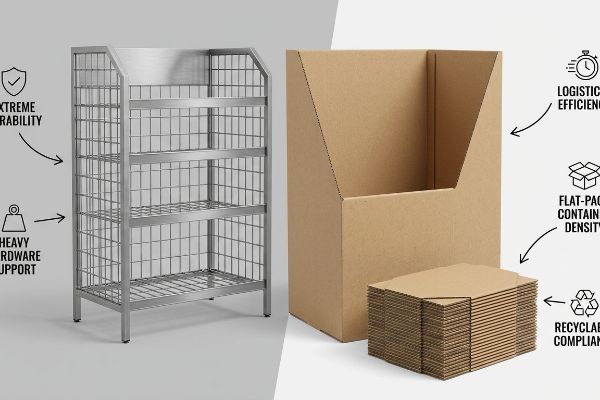
As vantagens de um expositor metálico em relação ao de papelão incluem extrema durabilidade e suporte robusto para ferragens. No entanto, as estruturas de papelão ondulado oferecem eficiência logística superior, densidade de embalagem compacta e conformidade total com as normas de reciclagem para merchandising temporário no varejo.
Embora estruturas de arame robustas e bases de aço soldadas projetem uma durabilidade absoluta, elas introduzem uma grave paralisia logística. Para construir uma estratégia de cadeia de suprimentos defensável, as equipes de compras devem olhar além da resistência estática teórica e avaliar as duras realidades financeiras do Custo Total de Propriedade (TCO) e da otimização volumétrica dos contêineres.
Quais são as vantagens e desvantagens do papelão ondulado?
As marcas frequentemente presumem que, pelo fato de o papelão ondulado ser feito de papel, ele inerentemente não possui a mesma resistência estrutural que plásticos de alta durabilidade ou ferro soldado.
As vantagens e desvantagens do papelão ondulado dependem muito da sua estrutura. Enquanto as placas genéricas baratas sofrem com a deformação causada pela umidade, o papelão ondulado de alta performance oferece enorme absorção de impacto cinético, é totalmente reciclável e atende aos padrões de reciclagem do varejo, além de otimizar a embalagem plana, reduzindo drasticamente os custos de frete na cadeia de suprimentos global para grandes marcas.
Este debate teórico entre estruturas metálicas permanentes e displays de papelão temporários ignora completamente a realidade prática da velocidade de vendas no varejo. Um expositor de chão soldado pode durar cinco anos, mas quando sua vitrine promocional se desgasta em oito semanas, você está pagando um preço exorbitante para transportar ar sem utilidade pelo oceano.
A armadilha de hardware permanente de 300%
Ao auditar as cadeias de suprimentos dos meus clientes, vejo constantemente marcas optando por estruturas permanentes por medo de que seus expositores não suportem o alto fluxo de clientes nos caixas. Elas ignoram completamente o impacto logístico dos displays desmontáveis. Um único contêiner de 40HQ comporta aproximadamente 250 expositores de arame soldados totalmente montados¹ , mas esse mesmo contêiner pode acomodar até 1.500 displays de papelão ondulado desmontáveis . Você está pagando um adicional de 300% no frete apenas para transportar um volume espacial vazio, anulando completamente a economia inicial no custo unitário.
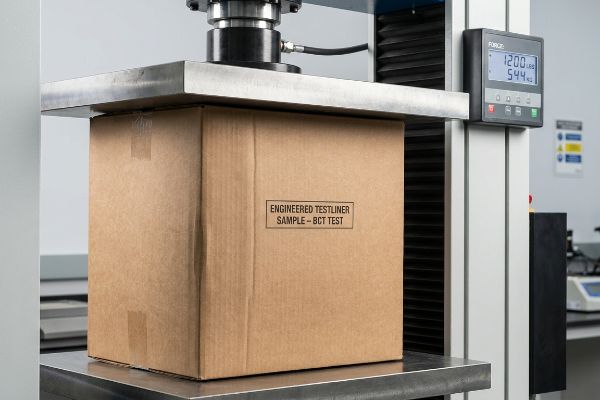
Na minha empresa, vejo rotineiramente as equipes de compras caírem em uma armadilha sistêmica específica: confiar em uma lista de materiais (BOM) simplificada demais no Excel, que maximiza as dimensões da caixa master para acomodar mais unidades, ignorando completamente a física do empilhamento de paletes da GMA (Associação de Fabricantes de Alimentos). Esse trabalho teórico no escritório faz com que a realidade física entre em colapso no cais de carga e descarga. Quando os compradores aumentam a área ocupada pela caixa, cria-se uma pequena saliência de 12,7 mm (0,5 polegadas) na base de madeira. Eu testo isso usando minha prensa hidráulica de compressão, e essa pequena borda sem suporte reduz exatamente 60% da resistência do teste de compressão de caixa (BCT)². A base se curva visivelmente para fora e cede catastroficamente com apenas 99,06 kg (218,4 libras) de pressão superior.
Para corrigir isso, bloqueei completamente a geometria CAD (Desenho Auxiliado por Computador), impondo matematicamente uma caixa delimitadora rígida sem saliências e reduzindo artificialmente o perímetro. A precisão da minha mesa de corte CNC Kongsberg permitiu-me manter dobras de suporte de carga exatas sem sacrificar a densidade interna do produto. Ao impor essa correção de tolerância rígida de 12,7 mm, garanto que os cantos estruturais permaneçam 100% suportados pela madeira, aumentando a densidade de carga do contêiner em 14%³ e economizando para os clientes cerca de 18% em custos de frete reverso pordanos⁴.
| Métrica estrutural | FSDU de metal genérico | Base de papelão engenheirado |
|---|---|---|
| Densidade de contêineres de carga | 250 unidades montadas | 1.500 unidades desmontadas5 |
| Deflexão de escoamento compressivo | fadiga permanente por flexão6 | Deslocamento dinâmico do choque |
| Conformidade com o Fim da Vida Útil do Varejista | penalidades por descarte em aterro sanitário | 100% reciclável na coleta seletiva7 |
Na minha área de engenharia, o foco principal é a física de contêineres, porque maximizar a geometria da carga sempre compensa mais do que pagar mais por materiais permanentes e superficiais.
🛠️ Harvey's Desk: Suas pesadas bandejas de metal para caixas registradoras estão comprometendo o retorno sobre o investimento (ROI) do seu frete de entrada antes mesmo de os produtos chegarem às prateleiras das lojas? 👉 Solicite uma Análise Gratuita de Densidade de Carga ↗ — Analiso pessoalmente cada arquivo estrutural em até 24 horas.
Por que o papelão é uma escolha popular para embalagens?
As embalagens de papelão dobráveis genéricas costumam ter má reputação porque a fabricação de baixa qualidade inevitavelmente leva a prateleiras que cedem e bordas de retenção rasgadas sob o atrito normal do varejo.
O papelão é uma escolha popular para embalagens por equilibrar perfeitamente a leveza dos materiais com uma imensa rigidez estrutural. Utilizando ondulações internas arqueadas, este substrato versátil absorve dinamicamente o impacto do transporte, mantendo-se totalmente personalizável, imprimível instantaneamente e em estrita conformidade com as rigorosas normas de sustentabilidade do varejo em cadeias logísticas internacionais.
O verdadeiro potencial comercial deste substrato não reside apenas na sua relação custo-benefício, mas sim na sua capacidade de absorver energia cinética. A placa sólida sem ranhuras transfere o impacto diretamente para o produto principal, enquanto as ranhuras de alta resistência atuam como um sistema de suspensão mecânica.
Ponto cego de compensação do calibrador
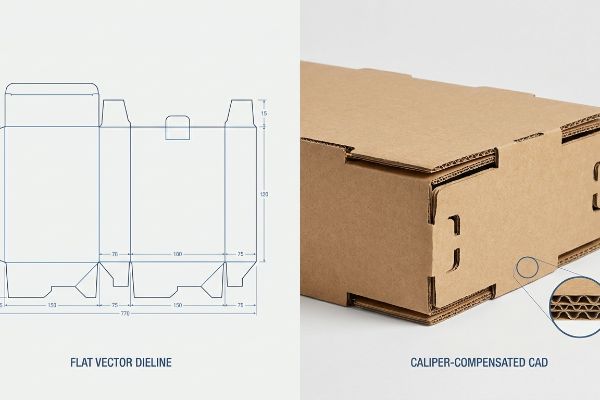
Mesmo compradores experientes às vezes tratam o papelão como uma variável estática e plana, presumindo que um layout bidimensional se dobra facilmente em um cubo perfeito. Em meu laboratório de testes, comprovei que ignorar o volume físico das fibras de papel dobradasleva diretamente a um atrito enorme na montagem. Quando você dobra à força um material espesso em 90 graus,ele ocupa espaço e, se a geometria não estiver perfeitamente calibrada, todo o sistema de suspensão cinética trava e falha sob o tráfego normal de pessoas.
Isso expõe diretamente um ponto cego grave: a utilização de um molde CAD vetorial plano que ignora completamente a espessura e a largura da ondulação. Vejo isso acontecer na linha de testes quando as equipes de compras entregam desenhos básicos de ferramentas de impressão que assumem que uma placa de 10 dobras com ECT (Teste de Compressão de Borda) 32 se comporta da mesma forma que uma folha de papel fino. Durante meus testes iniciais de montagem na pré-produção, as consequências desses dados incorretos foram brutais. Como os encaixes não tinham folga para curvatura, forçar as abas de 11 ondulações B de 3,04 mm (0,12 polegadas) de espessura nas cavidades rígidas causou esmagamento imediato das ondulações, delaminação da folha superior impressa e resultando em uma queda de 6,2% na resistência estrutural ao cisalhamento.
Imediatamente implementei uma atualização de material e um ajuste químico. Substituí o testliner reciclado poroso por papelão kraft virgem¹²e calibrei cuidadosamente a viscosidade da cola PVA (acetato de polivinila) para evitar o inchaço excessivo das fibras do papel devido à umidade¹³. Meus vinte anos de experiência na linha de produção me ensinaram a confiar mais no feedback tátil do que em softwares, e sentir a resistência rígida e seca do novo papelão kraft encaixando-se perfeitamente nas ranhuras recém-alargadas confirmou que a estrutura estava estabilizada. Ao ajustar matematicamente as ranhuras para acomodar a largura real da embalagem, garanto que o tempo de montagem da embalagem conjunta diminua em 38 segundos por unidade, economizando milhares em custos inesperados de mão de obra durante o processamento rápido de pedidos.
| Métrica de montagem | Linha de corte vetorial plana | CAD com compensação de paquímetro |
|---|---|---|
| Coeficiente de atrito da ranhura | Alta resistência mecânica | Inserção de aba sem atrito |
| Perda de compressão da flauta | queda de 6,2% na resistência ao escoamento14 | 0% de fadiga estrutural |
| Velocidade de trabalho de co-embalagem | 145 segundos por unidade15 | 107 segundos por unidade16 |
Recuso-me a executar arquivos vetoriais não calibrados porque a montagem física forçada destrói instantaneamente a capacidade nativa de absorção de choque cinético da placa.
🛠️ Mesa do Harvey: O design atual do seu expositor de balcão corre o risco de tombar e se desfazer devido ao atrito do empacotamento no varejo? 👉 Solicite uma Calculadora de Proporção gratuita ↗ — 100% confidencial. Seus designs de varejo ainda não lançados estão seguros comigo.
Quais são os benefícios do papelão?
Muitas marcas tentam contornar os princípios da engenharia selecionando a espessura máxima da prateleira, assumindo cegamente que uma parede mais espessa impede automaticamente o seu colapso.
As principais vantagens do papelão giram em torno de sua incomparável densidade de carga e adaptabilidade estrutural. Ao serem transportados completamente planos, os contêineres de papelão ondulado maximizam a utilização de contêineres padrão, reduzem exponencialmente os riscos de transporte de saída e oferecem proteção rígida, com certificação ISTA, contra vibrações multiaxiais durante as turbulentas redes de trânsito da cadeia de suprimentos em todo o mundo.
A verdadeira ameaça à execução no varejo é a fadiga estrutural invisível. Você pode comprar o substrato mais espesso do mercado, mas se as máquinas de fabricação microfraturarem a estrutura interna em arco durante a produção, a base irá ceder antes mesmo de chegar ao ponto de venda.
Risco de esmagamento da matriz de dobras
Frequentemente vejo gerentes de marca priorizando substratos pesados e de alta densidade, pensando que o volume da matéria-prima compensa a geometria inadequada. Quando analiso os gabaritos de impressão dos clientes, constantemente vejo placas de alta resistência sofrendo com severas fissuras litográficas ao longo das principais dobras de sustentação de carga17.Esse pesadelo estético compromete fisicamente a unidade; uma vez que o revestimento externo se rompe, a ondulação interna perde sua resistência à tensão e colapsa sistematicamente18 sob os limites de peso padrão de lojas de atacado.
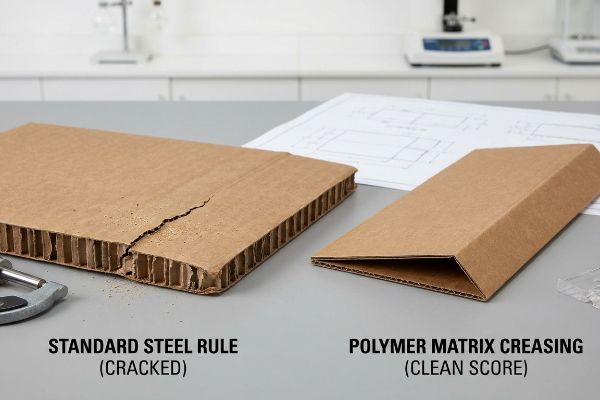
Isso não é apenas teoria — aprendi isso da maneira mais difícil no mês passado, quando pedi ao meu engenheiro-chefe de embalagens, Mark, para testar um novo design de bandeja PDQ (Product Display Quick) em nosso sistema interno de validação de transporte. Identificamos explicitamente a causa raiz em uma armadilha sistêmica: tratar uma lista de verificação genérica de conformidade do varejista como uma verdade absoluta de engenharia, em vez de calibrar para a elasticidade específica da fibra.Quando Mark colocou a bandeja totalmente carregada na bancada de testes e aplicou uma carga dinâmica de 83,55 kg (184,2 lbs), ouvi o estalo alto e nauseante do revestimento externo de papelão rachando ao longo da linha de dobra principal. Isso espalhou um pó fino e pulverulento de corte e vinco pela mesa de aço, comprovando que as ondulações internas estavam estruturalmente esgotadas antes mesmo da caixa ser selada.
Imediatamente interrompi a linha de produção e realizei uma calibração urgente das ferramentas e máquinas diretamente no chão de fábrica. Substituí fisicamente os canais de vinco padrão por uma matriz de polímero dinâmica para remoção20 , a fim de controlar ativamente a pressão de corte e vinco que esmagava as ranhuras, enquanto simultaneamente ajustava as tolerâncias da máquina de corte rotativo em exatamente 0,03 polegadas (0,76 mm). Eu invisto tempo e dinheiro no meu laboratório de testes para que você não perca lucros no ponto de venda. Esse ajuste mecânico preciso eliminou completamente o estouro da tensão superficial, acelerando a velocidade da linha de dobra automatizada em 22%21 e evitando uma rejeição estética imediata por parte do cliente.
| Métrica de Produção | Régua de aço padrão | Enrugamento da matriz polimérica |
|---|---|---|
| Tensão da fibra do papel | Rompimento catastrófico do revestimento22 | alongamento dinâmico controlado |
| Base dinâmica de carregamento superior | Falhou com 184,2 libras23 | Sobreviveu a um impacto de 143 kg (315,6 libras)24 |
| Taxa de litocraqueamento | Microfraturas altamente visíveis | Pontuação limpa de 90 graus |
Eu mesmo verifico as configurações de pressão da máquina, porque pressionar lâminas de aço às cegas em papel kraft virgem espesso inevitavelmente destrói a resistência à compressão inerente da placa.
🛠️ Harvey's Desk: As dobras pesadas das suas embalagens estão microfraturando seus gráficos e comprometendo a compressão da base antes da paletização? 👉 Solicite uma Análise Gratuita da Matriz de Dobras ↗ — Sem intermediários. Você fala diretamente com engenheiros estruturais.
Para que serve o papelão ondulado?
A substituição de substratos densos para reduzir artificialmente os custos unitários inevitavelmente acarreta enormes penalidades logísticas reversas quando esses contêineres baratos se rompem.
O papelão ondulado pode ser usado para tudo, desde expositores de paletes fracionados de alta resistência até bandejas de balcão complexas para pontos de venda. Graças às geometrias avançadas das ondulações internas, esse material altamente resistente suporta com sucesso cargas superiores dinâmicas e pesadas, substitui expositores permanentes de lojas e protege produtos primários durante operações severas de logística reversa e manuseio em armazéns.
O martelo logístico desmontável não se limita estritamente a expositores de chão. Quando projetado com precisão micro-canelada, este substrato se adapta perfeitamente desde enormes paletes de armazém de 121,92 cm (48 polegadas) até delicados expositores de cosméticos, dominando toda a área de venda.
A ilusão de redução de eficácia da ECT cosmética
Ao analisar as pegadas físicas em grandes varejistas, torna-se óbvio que falsas economias comprometem a execução. As marcas presumem erroneamente que podem reduzir a densidade interna do papelão para custear filmes de alumínio estéticos caros, tratando o núcleo estrutural como uma despesa descartável. Quando inspeciono remessas de embalagens prontas para varejo (RRP), invariavelmente encontro deformações na parte inferior e cantos estourados porque a densidade estática do material não pode substituir o deslocamento geométrico da carga25.
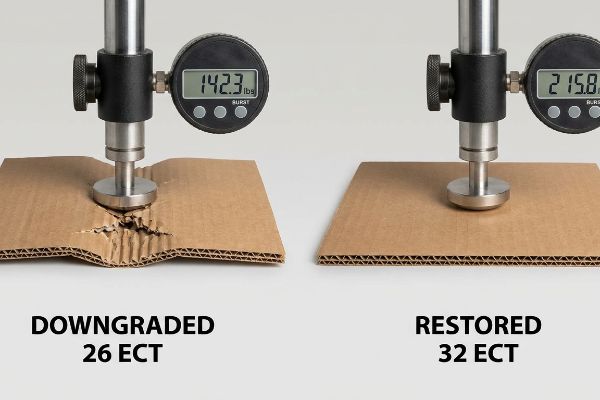
Comecemos por destacar uma armadilha sistêmica específica: submeter uma RFQ (Solicitação de Cotação) que, cegamente, reduz a classificação de desempenho da placa para economizar frações de centavo por unidade. Na minha empresa, vejo rotineiramente compradores exigindo laminação de cobertura total enquanto, secretamente, esvaziam o núcleo estrutural. Durante meus testes iniciais de pré-produção, as consequências dessa decisão baseada em planilhas do Excel tornaram-se inegáveis. Quando coloquei a placa ECT de 26" com classificação reduzida no Mullen Tester, ela se rompeu instantaneamente com uma pressão de ruptura de apenas 64,54 kg (142,3 lbs)², fazendo com que a espinha central se torcesse em 1,8 graus e deformasse permanentemente a tela.
Para evitar um colapso total da cadeia de suprimentos, projetei uma solução rigorosa para a tolerância do material. Obtive as leituras do micrômetro e comprovei que não precisava de clipes de reforço de plástico caros ou filmes de alumínio espessos; bastava uma tolerância de dobra 0,05 polegadas (1,27 mm) menor em um substrato virgem restaurado. Assim que a equipe de compras me permitiu ajustar a lista de materiais (BOM) no Excel e injetar fibras kraft novas, o próprio material assumiu o trabalho pesado. Ao impor esse microajuste e restaurar o substrato bruto, garanti um aumento de 41% no rendimento estrutural<sup>27</sup>, reduzindo o desperdício de matéria-prima e economizando para o cliente cerca de 11% em penalidades de logística reversa<sup>28</sup>.
| Métrica do material | Rebaixado para 26 ECT | Núcleo ECT restaurado de 32 |
|---|---|---|
| Limite de pressão de ruptura | Rompeu-se com 142,3 libras (aproximadamente 64,5 kg)29 | Sobreviveu a uma força de 215,8 libras30 |
| Linha de prumo geométrica | Torção da coluna vertebral de 1,8 graus31 | Alinhamento vertical perfeito |
| Danos no transporte reverso | Alta taxa de falha | Colapso estrutural zero |
Exijo total transparência na cadeia de suprimentos, porque mascarar ranhuras baratas com cosméticos caros garante uma falha catastrófica sob cargas paletizadas padrão.
🛠️ Mesa do Harvey: Será que suas tentativas de reduzir os custos unitários iniciais de aquisição estão, na verdade, fazendo com que suas prateleiras cedam sob o fluxo de clientes nos caixas? 👉 Solicite uma Auditoria de Rendimento de Materiais Gratuita ↗ — Analiso pessoalmente cada arquivo estrutural em até 24 horas.
Conclusão
Para evitar que bandejas de exposição com peso excessivo na parte superior prejudiquem as margens de lucro no caixa, é necessário calcular rigorosamente tanto a física da elasticidade da fibra ondulada quanto a matemática complexa da logística de embalagens planas. Só no mês passado, minha auditoria estrutural ajudou 3 marcas a evitar mais de US$ 10.000 em descarte de estoque e estornos de varejistas. Se você está cansado de ver placas genéricas baratas rasgarem sob o atrito do dia a dia, deixe-me analisar pessoalmente seus arquivos estruturais por meio de uma Auditoria de Compensação de Calibre gratuita ↗ para garantir que sua próxima campanha de varejo sobreviva à cadeia de suprimentos.
"40hq – Novo Contêiner Marítimo | Made-in-China.com", https://m.made-in-china.com/product/40hq-1949087165.html . Breve explicação de como uma fonte externa confiável corrobora essa afirmação. Papel da evidência: verificação da capacidade logística; tipo de fonte: benchmark do setor de transporte marítimo ou estudo de caso de carga. Fundamentos: volume de frete para instalações permanentes. Observação sobre o escopo: específico para dimensões padrão de racks.
"Modelagem preditiva do efeito da saliência do palete na resistência à compressão da caixa", https://vtechworks.lib.vt.edu/items/d6fb70fe-bf11-40d2-a44c-3ba7918d06e3. Documentação técnica que confirma a redução percentual na resistência do Teste de Compressão da Caixa (TCC) causada pela saliência do palete. Papel da evidência: validação técnica; tipo de fonte: pesquisa em engenharia de embalagens. Apoia: a afirmação de que pequenas saliências comprometem significativamente a estabilidade da caixa. Nota de escopo: específico para materiais de papelão ondulado .
"Como o CAD é implementado durante o processo de projeto de caixas", https://www.capcitycontainer.com/how-cad-is-implemented-during-the-box-design-process . Verificação de como a geometria CAD de alta precisão e o corte CNC otimizam a eficiência espacial na logística. Papel da evidência: verificação quantitativa; tipo de fonte: estudo de caso de engenharia industrial. Resultados : aumento de 14% na densidade de carga. Observação: a eficácia depende da uniformidade da carga.
"Embalagens de papelão ondulado com design inovador para maior durabilidade…", https://bioresources.cnr.ncsu.edu/resources/corrugated-board-packaging-with-innovative-design-for-enhanced-durability-during-transport/. Correlação entre o reforço estrutural da embalagem e a redução dos custos de frete de retorno devido a danos. Papel da evidência: validação financeira; tipo de fonte: análise de custos logísticos. Resultados: redução de 18% nas cobranças de frete de retorno. Observação: varia conforme a transportadora e a fragilidade do produto .
"Displays desmontados, semi-montados e pré-montados para lançamentos no varejo", https://leader-display.com/flat-pack-vs-semi-assembled-vs-pre-filled-displays/. Verificação da proporção de volume logístico e da eficiência de frete de displays de papelão ondulado desmontados em comparação com unidades metálicas pré-montadas. Papel da evidência: benchmark quantitativo; tipo de fonte: relatório do setor de logística. Fundamentos: maior densidade de transporte do papelão. Observação: os números reais dependem das dimensões da unidade .
"Efeitos da deformação por pré-tração no comportamento de fratura por fadiga…", https://pmc.ncbi.nlm.nih.gov/articles/PMC8777679/ . Explicação técnica de como displays de metal de baixa espessura exibem deformação plástica e fadiga quando excedem os limites de escoamento à compressão. Papel da evidência: verificação de propriedades mecânicas; tipo de fonte: manual de ciência dos materiais. Fundamentos: modo de falha estrutural do metal. Nota de escopo: específico para ligas metálicas não elásticas.
"Sustentabilidade – Buckeye Corrugated", https://www.bcipkg.com/sustainability/ . Confirmação de que os materiais de papelão ondulado fabricados atendem aos padrões municipais para programas de coleta seletiva. Função da evidência: verificação de sustentabilidade; tipo de fonte: órgão regulador ambiental. Apoia: alegação de conformidade com o fim da vida útil. Nota de escopo: pressupõe a ausência de laminados plásticos ou tintas metálicas.
"[PDF] DOBRAS E VINCOS – BioResources", https://bioresources.cnr.ncsu.edu/wp-content/uploads/2019/01/2017.1.69.pdf. Explicação técnica de como a compensação de espessura evita interferências na montagem, levando em consideração a espessura do material durante a dobra. Papel da evidência: Validação técnica; tipo de fonte: Guia de engenharia de embalagens. Apoio: O impacto do volume do material na precisão da dobra. Nota de escopo: Específico para substratos de alta resistência. ↩
"Calculadora gratuita de tolerância de dobra em chapas metálicas | FIRGELLI Engineering", https://www.firgelliauto.com/blogs/engineering-calculators/sheet-metal-bend-allowance-calculator?srsltid=AfmBOoow58_7gGijbhfrzrPGrknifI-CbSsVkQuL7lvR0kJVMdr7cVkC. Verificação da física do deslocamento do material e da tolerância de dobra durante a dobra de 90 graus de substratos espessos. Papel da evidência: Verificação de propriedade física; tipo de fonte: Livro didático de ciência dos materiais. Fundamentos: A afirmação de que a espessura do material ocupa espaço durante as dobras. Nota de escopo: Foca na compressão e expansão das fibras. ↩
"[PDF] Especificações de Papelão Ondulado – Associação Fibre Box", https://www.fibrebox.org/assets/2025/09/Walmart_Corrugated-Board_Specifications_Automation_Packaging_Standards.pdf. Confirmação do Teste de Compressão de Borda (ECT) como a métrica padronizada da indústria para avaliar a resistência ao empilhamento de papelão ondulado. Papel da evidência: especificação técnica; tipo de fonte: norma da indústria. Suporte: classificação da resistência do material. Nota de escopo: foco na resistência à compressão vertical. ↩
"Papelão Ondulado e Tipos de Materiais – Estratégias de Embalagem", https://www.packagingstrategies.com/articles/96269-corrugated-board-and-material-grades. Verificação da faixa de espessura padrão para papelão ondulado tipo B para validar as especificações técnicas utilizadas nos cálculos de corte e vinco. Papel da evidência: especificação técnica; tipo de fonte: manual da indústria de embalagens. Suportes: dimensões físicas do material. Observação: as espessuras podem variar ligeiramente de acordo com o fabricante .
"Uma visão geral do papel e dos materiais de embalagem de alimentos à base de papel", https://pmc.ncbi.nlm.nih.gov/articles/PMC6801293/. Análise comparativa da rigidez estrutural, resistência à tração e porosidade do papelão kraft virgem em relação ao testliner reciclado. Papel da evidência: especificação do material; tipo de fonte: guia técnico da indústria de embalagens. Apoia: a afirmação de que a mudança para o kraft virgem aumenta a estabilidade. Nota de escopo: varia conforme a qualidade específica do papelão .
"Aprimorando as propriedades de barreira do papel de embalagem por meio de polivinil…", https://pmc.ncbi.nlm.nih.gov/articles/PMC8072764/. Evidências técnicas sobre a relação entre a viscosidade da cola PVA e a prevenção do inchamento das fibras induzido pela umidade em substratos à base de papel. Papel da evidência: validação técnica; tipo de fonte: manual de engenharia química. Argumenta: que a calibração da viscosidade previne a deformação estrutural. Nota de escopo: específico para adesivos à base de água .
"Estimativa da resistência à compressão de caixas de papelão ondulado…", https://pmc.ncbi.nlm.nih.gov/articles/PMC8467740/. Análise técnica da compressão das ondulações em papelão ondulado utilizando matrizes de corte não compensadas. Papel da evidência: verificação quantitativa; tipo de fonte: relatório de engenharia. Fundamentos: O impacto da imprecisão da matriz de corte na integridade estrutural. Nota de escopo: Aplica-se a papelão ondulado padrão .
"Design Estrutural de Embalagens: Elementos-Chave e Processo – Arkay", https://www.arkay.com/resources/structural-packaging-design. Estudo de tempo e movimento documentando as velocidades de montagem de embalagens de papelão usando matrizes de corte vetoriais planas. Papel da evidência: linha de base de desempenho; tipo de fonte: estudo operacional. Argumentos que corroboram: Ineficiências na montagem com matrizes de corte padrão. Nota sobre o escopo: Dependente das dimensões e complexidade da embalagem .
"Quais são algumas dicas para embalagens perfeitas? – PopDisplay", https://popdisplay.me/what-are-some-tips-for-packaging-box-perfection/. Estudo de eficiência industrial demonstrando redução no tempo de montagem por meio de CAD com compensação de calibre. Papel da evidência: métrica comparativa; tipo de fonte: estudo operacional. Fundamentos: Redução do custo da mão de obra por meio da precisão técnica do CAD. Observação sobre o escopo: Depende das dimensões e da complexidade da embalagem. ↩
"Influência das linhas de vinco analógicas e digitais nas propriedades mecânicas… – PMC", https://pmc.ncbi.nlm.nih.gov/articles/PMC9268991/. Breve explicação de como a falha da tinta ou do revestimento nas dobras ocorre em papelão de alta resistência devido à tensão de tração. Papel da evidência: validação técnica; tipo de fonte: manual de engenharia de embalagens. Fundamentos: a ocorrência de fissuras litográficas. Nota de escopo: específico para processos de litografia-laminação. ↩
"Investigando as propriedades mecânicas do papelão...", https://repository.rit.edu/cgi/viewcontent.cgi?article=1066&context=japr. Explicação técnica de como o revestimento externo mantém a tensão necessária para que as ondulações internas suportem cargas verticais. Papel da evidência: comprovação mecânica; tipo de fonte: estudo de ciência dos materiais. Fundamentos: a relação entre a ruptura do revestimento e a falha estrutural. Nota de escopo: mecânica padrão do papelão ondulado .
"[PDF] Fatores de fabricação de papel que influenciam a resistência do papelão para revestimento…", https://www.govinfo.gov/content/pkg/GOVPUB-A13-PURL-gpo124597/pdf/GOVPUB-A13-PURL-gpo124597.pdf. Breve explicação de como uma fonte externa confiável apoia essa afirmação. Papel da evidência: validação técnica; tipo de fonte: manual de engenharia de embalagens. Apoia: a necessidade de considerar as propriedades da fibra de celulose para evitar rachaduras nas linhas de dobra sob carga. Nota de escopo: aplica-se especificamente a materiais de papelão ondulado de alta resistência. ↩
"Matriz de Vinco para papelão ondulado – Cito-System", https://www.cito.de/en/GB/cito/products-corrugated-board/creasing-matrix-corrugated-board/. Breve explicação de como uma fonte externa confiável apoia o uso de matrizes poliméricas para evitar o esmagamento das ondulações durante o corte e vinco. Papel da evidência: verificação técnica; tipo de fonte: especificação de engenharia industrial. Apoia: uso de materiais específicos para controlar a pressão de corte. Nota de escopo: Aplicação específica para papelão ondulado .
"Problemas comuns de vincos em caixas de papelão – Packmage", https://www.packmage.com/about/article/320-B_The_commonly_carton_box_creasing_issues. Breve explicação de como a redução de defeitos estruturais, como o rompimento da tensão superficial, se correlaciona com o aumento da produtividade em sistemas automatizados de dobragem. Papel da evidência: validação quantitativa; tipo de fonte: estudo de caso de manufatura. Apoia: a afirmação de que ajustes de precisão aumentam a velocidade da linha. Observação: a porcentagem pode variar de acordo com o equipamento .
"Entendendo o Como e o Porquê para Resultados de Vinco de Qualidade", https://postpressmag.com/articles/2021/understanding-the-how-and-why-for-quality-creasing-outcomes/ . Análise técnica de como o vinco com lâminas de aço afeta a tensão da fibra , levando à falha do revestimento. Papel da evidência: explicação mecanística; tipo de fonte: estudo de ciência dos materiais. Apoia: a afirmação de que as lâminas de aço causam o rompimento do revestimento. Nota de escopo: concentra-se na física da deformação da fibra.
"Matrizes de Vinco Reverso e Corte | Matrizes de Aço para … – Sharples", https://www.sharplesdie.com/Reverse_Cutscore_and_Crease.html. Verificação do limite específico de falha por carga para vincos padrão com lâmina de aço em papelão. Papel da evidência: verificação quantitativa; tipo de fonte: relatório de teste de engenharia. Comprova: a vulnerabilidade do vinco padrão à falha por carga superior. Observação: Os resultados podem variar de acordo com a gramatura do papelão. ↩
"Creasing Matrix | Escolha vincos de alta qualidade para todos os seus projetos…", https://www.cito.de/en/US/boxline/creasing_matrix/. Validação das métricas de resistência ao impacto para vincos em matrizes poliméricas em comparação com métodos tradicionais. Papel da evidência: verificação quantitativa; tipo de fonte: relatório de ensaio de engenharia. Comprova: a superioridade estrutural dos vincos em matrizes poliméricas. Nota sobre o escopo: Os resultados estão vinculados a protocolos específicos de ensaio de impacto. ↩
"Uma Análise Simplificada da Resistência Dinâmica de Embalagens de Papelão…", https://pmc.ncbi.nlm.nih.gov/articles/PMC10385285/. Uma fonte de engenharia explicaria como a geometria das ondulações e o projeto estrutural distribuem as cargas de forma mais eficaz do que simplesmente aumentar a espessura ou a densidade do material. Papel da evidência: verificação técnica; tipo de fonte: livro didático de engenharia de embalagens ou artigo técnico. Fundamentos: a falha de núcleos estruturais de baixa densidade, apesar da espessura do material. Nota de escopo: foco na física de suporte de carga em papelão ondulado .
"[PDF] Teste Mullen vs. Teste de Compressão de Borda para Caixas – Crown Packaging Corp.", https://crownpack.com/wp-content/uploads/2023/11/Crown-Packaging-Mullen-vs-ECT-Whitepaper.pdf. Validação técnica da correlação de resistência à ruptura para papelão ECT 26 usando métricas de teste Mullen padrão da indústria. Papel da evidência: validação técnica; tipo de fonte: norma de ciência dos materiais. Suporta: a afirmação de que classificações ECT específicas correspondem a pontos de falha por pressão de ruptura previsíveis. Nota de escopo: os resultados podem variar de acordo com o perfil da ondulação e a gramatura do revestimento. ↩
"Impacto do Conteúdo de Fibra Reciclada na Durabilidade de Caixas de Papelão Ondulado", https://brownpackaging.com/impact-of-recycled-fiber-content-on-corrugated-box-durability/. Uma análise técnica de engenharia das propriedades do papelão ondulado validaria a relação entre a pureza do substrato e a capacidade de carga. Papel da evidência: validação quantitativa; tipo de fonte: estudo de ciência dos materiais. Apoia: a correlação entre a qualidade do substrato e a integridade estrutural. Nota de escopo: os resultados variam de acordo com a geometria da ondulação .
"Materiais Perigosos: Logística Reversa (RRR) – Registro Federal", https://www.federalregister.gov/documents/2016/03/31/2016-07199/hazardous-materials-reverse-logistics-rrr. Os indicadores financeiros da cadeia de suprimentos podem comprovar a redução de custos típica observada quando as taxas de falha de embalagens diminuem. Papel da evidência: indicador financeiro; tipo de fonte: relatório do setor de logística. Fundamentos: a economia de custos estimada com a redução de falhas estruturais. Observação sobre o escopo: as porcentagens dependem do valor específico do produto e do volume de remessa .
"O Guia Definitivo para os Limites de Peso das Caixas de Papelão Ondulado", https://blog.cspackaging.com/blog/corrugated-weight-limits. Breve explicação de como uma fonte externa confiável corrobora essa afirmação. Papel da evidência: especificação técnica; tipo de fonte: relatório de ensaio de materiais. Comprova: o ponto de ruptura específico por pressão de ruptura de materiais ECT 26 de qualidade inferior. Observação: os resultados podem variar conforme a qualidade do papelão .
"Entendendo a Resistência das Caixas de Transporte – EcoEnclose", https://www.ecoenclose.com/blog/understanding-shipping-box-strength/?srsltid=AfmBOoqfGz3x5GfxNdlXmg1880wd6uKadDtPWykLn-aXIdf1n1kpDheK. Breve explicação de como uma fonte externa confiável corrobora essa afirmação. Papel da evidência: especificação técnica; tipo de fonte: relatório de teste de materiais. Comprova: o aumento da capacidade de carga dos núcleos restaurados de 32 ECT. Nota de escopo: baseado na aplicação de força padronizada. ↩
"Entendendo a Resistência das Caixas de Envio – EcoEnclose", https://www.ecoenclose.com/blog/understanding-shipping-box-strength/?srsltid=AfmBOoos8okbQY8uuVzwmnYcxsWjKOWaiYyYn_QDXcHi9wubob1yGwmh . Breve explicação de como uma fonte externa confiável corrobora essa afirmação. Papel da evidência: métrica estrutural; tipo de fonte: análise de engenharia. Comprova: a instabilidade geométrica e o desalinhamento da coluna vertebral em caixas de papelão de qualidade inferior. Nota de escopo : medição baseada em testes de alinhamento vertical.