Você está investindo pesado em espaço de varejo, mas se seus displays de ponto de venda desabarem sob o peso dos produtos ou não passarem nas rigorosas auditorias dos varejistas, esse orçamento de marketing evapora instantaneamente.
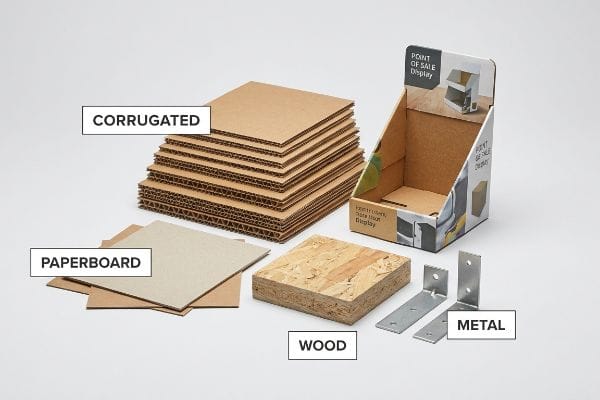
Os displays para pontos de venda são predominantemente fabricados com papelão ondulado e cartão, devido à sua versatilidade estrutural. As estruturas permanentes costumam usar plástico, madeira ou metal, enquanto as unidades temporárias dependem de substratos canelados para equilibrar eficazmente a capacidade de carga dinâmica com a impressão de alta qualidade para o varejo.
Antes de aprovar cegamente uma lista de materiais da sua equipe de compras, você precisa entender como esses substratos realmente se comportam quando submetidos à umidade do armazém e ao tráfego intenso de pessoas.
O que são materiais de ponto de venda (PDV)?
Escolher os materiais certos não é apenas uma questão de estética; é um mecanismo de defesa estrutural contra abusos na cadeia de suprimentos e cargas pesadas de merchandising.
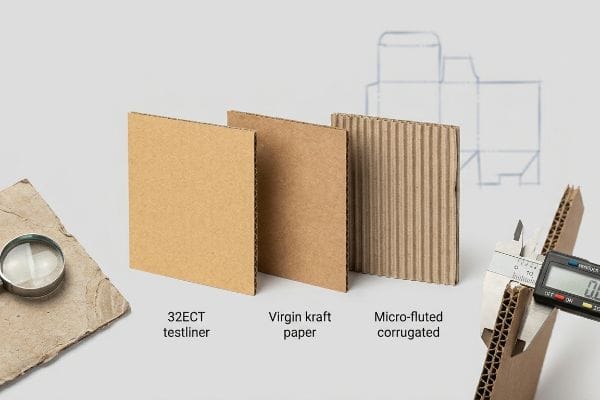
Os materiais de ponto de venda (PDV) são substratos físicos especializados, projetados especificamente para estruturas de marketing no varejo. Os componentes básicos mais comuns incluem testliner 32ECT, papel kraft virgem e papelão ondulado micro-ondulado, todos selecionados para maximizar a resistência ao empilhamento, mantendo-se leves para facilitar a logística global e a montagem rápida.
No entanto, simplesmente marcar a opção "papelão ecológico" é a maneira mais rápida de desencadear uma falha catastrófica no ponto de venda de uma grande loja de varejo.
O perigo oculto dos materiais de ponto de venda reciclados em excesso
A maioria das equipes de marcas presume que solicitar testliner 100% reciclado¹para seus expositores temporários é uma maneira infalível de atender aos rigorosos requisitos de sustentabilidade dos varejistas. Elas se baseiam em métricas teóricas de laboratório para validar suas escolhas de materiais. Infelizmente, essa estratégia de aquisição trata o papelão como um objeto estático, ignorando o estresse cinético dinâmico do transporte marítimo e do empilhamento depaletes².
É uma armadilha comum que pega até mesmo equipes de compras experientes. Sei que você está olhando para as especificações do seu material ecológico com confiança, mas quando eu passo essas placas pela minha prensa TAPPI T811 ECT (Teste de Compressão de Borda), a realidade muda. O processo de repolpação do papel encurta fisicamente as fibras de celulose³ . Após cinco ciclos de reciclagem, essas fibras ficam estruturalmente exauridas⁴ . Observo os funcionários das lojas tentando repor garrafas de bebidas pesadas , e é possível literalmente ouvir as ondulações internas rangendo e cedendo sob o peso, porque a placa reciclada não tem mais nenhuma rigidez. Para resolver isso, eu exijo uma abordagem de material híbrido, injetando exatamente 30% de fibra kraft virgem diretamente nas ondulações que suportam a carga. Isso restaura a resistência à compressão dinâmica necessária para ambientes de varejo pesados, reduzindo drasticamente a deformação da unidade e economizando milhares em possíveis estornos para os varejistas.
| Erro comum de iniciantes | A solução profissional | Benefício do piso de vendas |
|---|---|---|
| Especificando testliner 100% reciclado e exaurido | Injeção de 30% de kraft virgem em flautas5 | Impede o esmagamento da camada base |
| Ignorando o comprimento microscópico da fibra | Utilizando o teste dinâmico TAPPI T8116 | Elimina danos em cargas LTL |
| Baseando-se estritamente em números estáticos de laboratório | Engenharia de uma placa estrutural híbrida | Evita estornos dispendiosos no varejo |
Recuso-me terminantemente a construir expositores robustos com fibras recicladas totalmente esgotadas, porque um expositor que desaba no corredor quatro destrói instantaneamente o valor da sua marca, conquistado com muito esforço, e atrasa drasticamente as operações de reposição.
🛠️ Mesa do Harvey: As especificações dos seus materiais atuais estão escondendo fibras de papel estruturalmente desgastadas? 👉 Solicite uma Auditoria de Materiais ↗ — Acesso direto à minha mesa. Zero spam de vendas automatizado, prometo.
Quais materiais são usados para os expositores?
Os substratos que você selecionar devem suportar o manuseio implacável, desde as instalações de triagem de operadores logísticos terceirizados até a iluminação fluorescente intensa de um depósito atacadista.
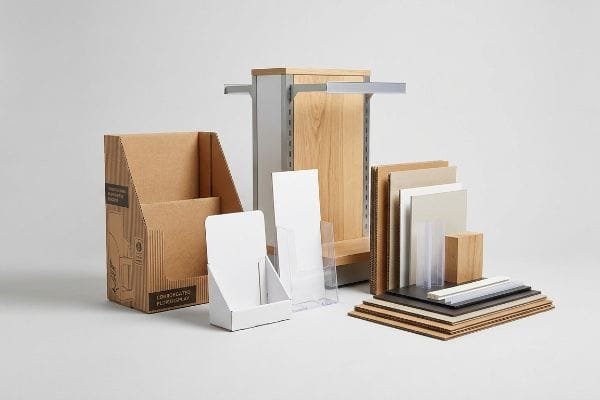
Os materiais utilizados para os expositores variam desde o papelão ondulado tipo E, leve, para unidades de balcão, até o papelão ondulado tipo B, de parede dupla e alta resistência, para expositores de chão paletizados. Acabamentos premium, como revestimentos aquosos de alto brilho, são frequentemente aplicados sobre a camada superior impressa para proporcionar resistência a riscos sem comprometer a integridade estrutural subjacente.
Embora adicionar acabamentos visuais de alta qualidade pareça uma jogada de marketing inteligente, muitas vezes isso desencadeia um compromisso perigoso nos bastidores.
Equilibrando Materiais Cosméticos e Integridade Estrutural
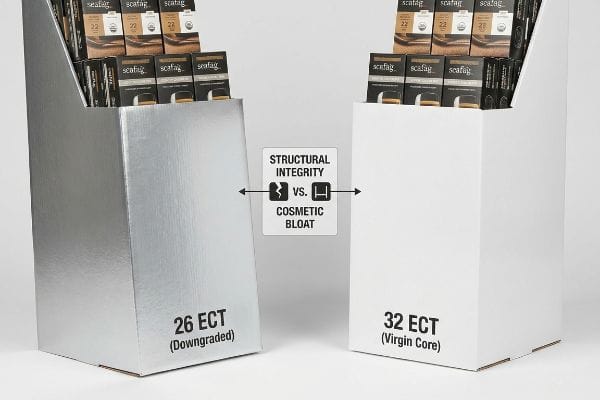
Ao elaborar o orçamento de uma nova campanha, os diretores de marketing costumam priorizar laminação cosmética cara — como películas metálicas de cobertura total7— para captar a atenção do consumidor. Para compensar esses altos custos visuais iniciais sem estourar o orçamento de aquisição, as equipes reduzem secretamente a resistência ao esmagamento das bordas do papelão ondulado base8.Elas presumem que um exterior brilhante compensará de alguma forma um núcleo interno mais frágil.
Vejo esse erro de cálculo acontecer constantemente quando as marcas tentam economizar em seus orçamentos. O resultado é um expositor de chão, mas, como a estrutura interna foi discretamente reduzida de um robusto 32 ECT para um frágil 26 ECT,o núcleo fica praticamente oco. Quando o palete de 121,9 x 101,6 cm chega à loja, a camada inferior está visivelmente curvada para fora. Já vi funcionários tentando remover cuidadosamente o plástico filme da embalagem, apenas para ver toda a estrutura revestida inclinar e ceder sob a carga de 68 kg. Minha regra é absoluta: nunca reduza a qualidade da estrutura do painel para financiar um visual mais estético. Em vez disso, restauro o material ao padrão original de 32 ECT e alcanço aquele reflexo premium usando revestimentos aquosos de alto brilho,garantindo tanto uma estética sofisticada quanto a resistência ao transporte sem danos.
| Erro comum de iniciantes | A solução profissional | Benefício do piso de vendas |
|---|---|---|
| Rebaixamento do ECT para financiar acabamentos metalizados | Exigindo núcleos virgens de 32 ECT | Suporta cargas úteis de 68 kg (150 lbs)11 |
| A resistência depende de películas cosméticas finas | Aumento da densidade interna da flauta12 | Impede a curvatura externa da camada inferior |
| Redução da densidade da matéria-prima para fins de custo | Trocar a folha cara por um brilho aquoso13 | Reduz drasticamente as taxas de danos à carga |
Priorizo a densidade estrutural do núcleo em detrimento das películas plásticas superficiais, porque um expositor perfeitamente brilhante é completamente inútil se ele se deformar fisicamente antes mesmo que o funcionário da loja consiga colocar o produto.
🛠️ Mesa do Harvey: Seu fornecedor reduziu silenciosamente a densidade das ranhuras internas para economizar centavos? 👉 Verifique a qualidade da sua placa ↗ — Baixe com segurança. Minha caixa de entrada está aberta caso tenha dúvidas posteriormente.
Como criar um expositor para ponto de venda?
Para projetar um expositor de sucesso, é necessário traduzir ilustrações digitais planas em uma estrutura tridimensional e resistente que possa ser montada em segundos.
A criação de displays para pontos de venda envolve o uso de software CAD paramétrico para projetar matrizes planas com tolerâncias de dobra precisas. O processo de fabricação inclui litografia, corte e colagem automatizada, garantindo que o material ondulado bruto se dobre perfeitamente em bandejas rígidas e intertraváveis, capazes de resistir aos ambientes agressivos do varejo físico.
Mas projetar uma estrutura elegante na tela de um computador é muito diferente de montá-la em uma linha de produção acelerada.
A armadilha da compensação de paquímetro na fabricação de displays
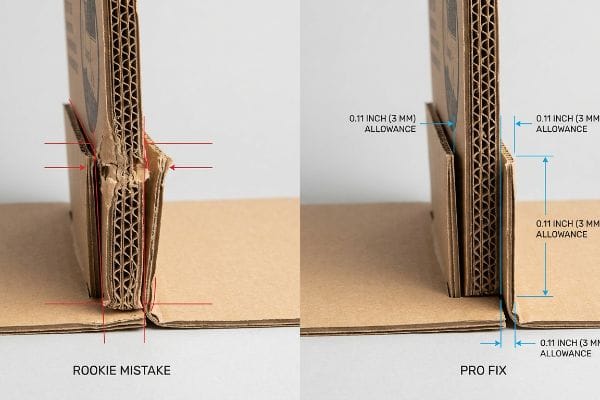
Os designers gráficos frequentemente criam abas de encaixe e ranhuras dobráveis usando software de ilustração digital, assumindo que uma ranhura desenhada com a mesma largura exata do painel correspondente deslizará perfeitamente. Eles tratam o arquivo plano como papel fino, ignorando completamente a espessura física — ou espessura — do papelão ondulado dobrado real14.
Imagine tentar fechar um livro grosso de capa dura com um lápis preso na lombada; a dobradiça precisa de espaço extra para dobrar. Mesmo designers experientes costumam ignorar esse ponto cego. Quando um painel de papelão ondulado tipo B de 3 mm (0,11 polegadas) de espessuradobra 90 graus, ele consome material e se expande para fora. Já estive na linha de embalagem e senti a resistência rígida e abrasiva do papelão kraft cru travando porque a abertura era muito estreita. A equipe de montagem acaba forçando as peças, amassando violentamente as ondulações e rasgando a folha superior impressa só para que a aba encaixe. Para eliminar esse atrito, aplico rigorosamente algoritmos automatizados de CAD (Desenho Auxiliado por Computador) para cada abertura, adicionando a folga de dobra exata necessária. Esse microajuste garante que os displays pré-montados sejam montados sem esforço, reduzindo o tempo de trabalho de embalagem em 25%.
| Erro comum de iniciantes | A solução profissional | Benefício do piso de vendas |
|---|---|---|
| Desenho de ranhuras de linha de corte na proporção 1:1 | Aplicação de algoritmos paramétricos de paquímetro CAD17 | Reduz drasticamente o tempo de montagem |
| Ignorando a espessura do material em curvas de 90° | Tolerâncias de curvatura específicas de engenharia18 | Impede que os funcionários rasguem os gráficos |
| Forçando abas grossas de papelão ondulado a se encaixarem | Alargamento de ranhuras com precisão milimétrica19 | Garante um empilhamento perfeitamente quadrado |
Eu reconstruo cada matriz de corte plana enviada para inserir essas tolerâncias de dobra microscópicas, porque obrigar a equipe do armazém a lidar com papelão rígido destrói completamente o retorno sobre o investimento (ROI) esperado na montagem.
🛠️ Harvey's Desk: Suas abas de encaixe estão secretamente sem as tolerâncias de dobra críticas? 👉 Obtenha sua correção de corte gratuita ↗ — Sem formulários que geram ligações intermináveis de vendas. Apenas valor puro.
Quais são exemplos de materiais para pontos de venda?
Os formatos padrão incluem tampas de extremidade temporárias, caixas de despejo independentes, bandejas PDQe saias de paletes de papelão ondulado que ocultam bases de transporte de madeira rústica.
Exemplos de materiais de ponto de venda abrangem diversos formatos físicos, como expositores de paletes fracionados, cabides laterais, divisórias de prateleira modulares e saias de paletes interligáveis. Essas unidades são estrategicamente posicionadas em diferentes zonas da loja para interromper o fluxo de clientes, maximizar a visibilidade dos produtos e armazenar o estoque com segurança dentro de limites espaciais restritos.
Mas conhecer a teoria não basta quando as máquinas começam a funcionar e esses formatos físicos interagem com ambientes logísticos adversos.
Por que as saias de paletes padrão falham no chão de fábrica
Um pedido muito comum que vejo é para saias de paletes de papelão— essencialmente um grande revestimento de papelão impresso projetado para camuflar paletes de logística feios e lascados em armazéns de atacado. Os designers normalmente projetam essas saias como revestimentos retangulares justos e planos, supondo que o papelão se adaptará naturalmente e perfeitamente à base de madeira de 48×40 polegadas (121,9×101,6 cm)20.
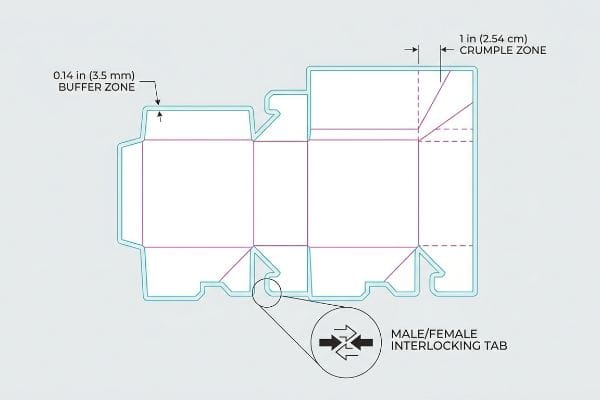
Montar um único display em pé em um laboratório é fácil, mas eis a dura realidade quando se envia 500 deles diretamente para paletes de madeira bruta. Em minhas instalações, vejo rotineiramente a dura realidade da madeira não polida usada em logística. Quando uma placa de 32ECT é esticada agressivamente contra esses cantos ásperos, as ranhuras internas prendem nas farpas afiadas da madeira. Durante o empacotamento em alta velocidade, ouve-se um som seco de rasgo quando a tensão faz com que a folha superior litografada se rompa instantaneamente, expondo o papel pardo cru. Para resolver isso, fiz as medições com micrômetro e comprovei que não precisávamos de uma placa mais grossa; precisávamos de uma folga de 3,5 mm (0,14 polegadas)²¹ e uma zona de deformação pré-cortada de 2,54 cm (1 polegada) projetada nos cantos. Ao impor essa tolerância precisa, o papelão desliza suavemente sobre as farpas ásperas, e as abas de encaixe macho/fêmea eliminam completamente a necessidade de fita adesiva. Isso reduz o tempo de montagem da embalagem conjunta em aproximadamente 35 segundospor unidade, mantendo os custos de mão de obra baixos e garantindo que sua marca tenha uma aparência impecável nas prateleiras.
| Erro comum de iniciantes | A solução profissional | Benefício do piso de vendas |
|---|---|---|
| Projetando saias de paletes perfeitamente niveladas | Projetando um buffer de 0,14 polegadas (3,5 mm)23 | Evita rasgos em farpas ásperas |
| Utilizando fita adesiva transparente para o fechamento da saia | Utilizando encaixes macho/fêmea | Reduz o tempo de montagem em 35 segundos24 |
| Envolvendo firmemente os cantos de madeira bruta | Adicionando uma zona de deformação programada de 2,54 cm (1 polegada)25 | Mantém a marca na parte inferior perfeitamente intacta |
Recuso-me a aprovar revestimentos de base extremamente justos, pois não levar em conta a abrasividade inerente à madeira durante a cadeia de suprimentos fará com que sua campanha premium pareça um lixo rasgado ao chegar ao destino.
🛠️ Mesa do Harvey: O design da sua saia de palete atual leva em consideração o atrito de farpas de madeira áspera? 👉 Envie-me seu arquivo de corte ↗ — Vou testar os cálculos antes que você desperdice seu orçamento com produção em massa.
Conclusão
Você pode tentar economizar no seu orçamento de marketing usando materiais de papelão de qualidade inferior, como o ECT 26, mas quando essa estrutura oca cede sob uma carga de 68 kg e se inclina para o corredor, isso resulta em rejeição imediata por parte do varejista e semanas de retrabalho manual dispendioso. Esta é a especificação exata que meus 10 principais clientes varejistas usam para garantir zero rejeições de impressão. Pare de adivinhar as tolerâncias estruturais e deixe-me auditar pessoalmente sua campanha com minha Auditoria Pré-Impressão de Dieline gratuita ↗ para identificar esses riscos fatais de esmagamento antes que cheguem à linha de produção.
"Papel Kraft vs. Testliner: Resistência, Custo e Sustentabilidade – LinkedIn", https://www.linkedin.com/posts/fahd-malik-54047a17_packagingindustry-kraftpaper-testliner-activity-7355463111815901184-7J57. Comparação técnica do comprimento da fibra e da resistência à tração entre testliner reciclado e virgem em embalagens de papelão ondulado. Papel da evidência: especificação técnica; tipo de fonte: manual de engenharia de embalagens. Fundamentos: O potencial de falha estrutural em materiais superreciclados. Nota de escopo: foco nas classificações ECT. ↩
"[PDF] Embalagens de papelão ondulado com design inovador para maior durabilidade…", https://bioresources.cnr.ncsu.edu/wp-content/uploads/2026/01/BioRes_21_1_2229_Tworzydlo_PSMPGG_Corrugated_Packaging_Design_Durability_Transport_25399.pdf. Documentação dos efeitos da umidade e da vibração na resistência à compressão do papelão reciclado durante o transporte marítimo. Papel da evidência: evidência empírica; tipo de fonte: estudo de engenharia logística. Fundamentos: A inadequação das métricas estáticas de laboratório para o transporte no mundo real. Nota de escopo: foco no frete marítimo internacional. ↩
"Efeito da adição de nanocelulose nas propriedades mecânicas de…", https://pmc.ncbi.nlm.nih.gov/articles/PMC10780965/. Explicação técnica de como o repolpamento mecânico e químico reduz o comprimento da fibra e enfraquece a estrutura molecular da celulose. Papel da evidência: explicação do mecanismo; tipo de fonte: periódico de ciência dos materiais. Apoia: a afirmação de que a reciclagem degrada a qualidade da fibra. Nota de escopo: aplicável à maioria dos processos de reciclagem de celulose .
"[PDF] O que acontece com as fibras celulósicas durante a fabricação e reciclagem de papel…", https://bioresources.cnr.ncsu.edu/BioRes_02/BioRes_02_4_739_788_Hubbe_VR_Recycling_Cellulosic_Fibers_Review.pdf. Dados quantitativos referentes à degradação da resistência à tração e da rigidez ao longo de múltiplas iterações de reciclagem de papel. Papel da evidência: limite quantitativo; tipo de fonte: relatório técnico da indústria. Fundamentos: o limite no qual o papelão reciclado perde a rigidez necessária. Nota de escopo: a contagem exata de ciclos pode variar com base na qualidade inicial da polpa. ↩
"[PDF] Um exame comparativo das propriedades físicas de materiais reciclados…", https://repository.rit.edu/cgi/viewcontent.cgi?article=1299&context=theses. Verificação da proporção específica de fibra kraft virgem necessária para aumentar a estabilidade estrutural e evitar o esmagamento da camada de base em displays de ponto de venda reciclados. Papel da evidência: validação técnica; tipo de fonte: manual de engenharia de embalagens. Fundamentos: alegações de reforço estrutural. Nota de escopo: específico para revestimento de papelão ondulado e composição da ondulação. ↩
"[PDF] Importância da preparação de amostras para compressão lateral…", https://imisrise.tappi.org/download.aspx?key=18APR219. Confirmação da metodologia da norma TAPPI T811 e sua aplicação na previsão ou eliminação de danos durante o transporte de cargas LTL. Papel da evidência: verificação da norma; tipo de fonte: norma técnica da indústria (TAPPI). Fundamentos: eficácia dos testes dinâmicos. Nota de escopo: foca em normas de tensão de materiais. ↩
"Folha de Toner Laminado Metálico Dourado #GLD-01 (Preço por Rolo)", https://www.binding101.com/gold-metallic-foil-fusing-rolls-price-per-roll?srsltid=AfmBOooS_3wSGgdS0Ceu5GFci0dSdOPOzbE4dZfoIzApKCA5gIc2ubqa. Dados de custos da indústria comparando laminação cosmética de alta qualidade, como folhas metálicas, com revestimentos padrão em displays de varejo. Papel da evidência: análise de mercado; tipo de fonte: guia de compras. Argumenta: que as folhas metálicas representam altos custos iniciais. Nota de escopo: específico para displays de ponto de venda de luxo ou de alta visibilidade .
"Nova configuração de teste de esmagamento de borda aprimorada com deformação de campo completo…", https://pmc.ncbi.nlm.nih.gov/articles/PMC8510352/. Documentação técnica que explica como as classificações do Teste de Esmagamento de Borda (ECT) determinam a resistência à compressão e os pontos de falha estrutural de embalagens de papelão ondulado. Papel da evidência: especificação técnica; tipo de fonte: norma de engenharia. Fundamentos: A relação entre a qualidade do papelão e a integridade estrutural. Nota de escopo: Refere-se a normas de papelão ondulado .
"Classificações ECT explicadas: o que elas significam para suas embalagens de papelão ondulado…", https://epackagesupply.com/blogs/packaging-guide/ect-ratings-explained-what-they-mean-for-your-corrugated-packaging?srsltid=AfmBOooH5024RZDLqqqChgJnV4UFK7p5grd2lwSiqLsLPtyH3XQRkv0g . A documentação técnica das normas de embalagem explica a diferença na resistência à compressão entre as classificações ECT 32 e 26. Papel da evidência: especificação técnica; tipo de fonte: norma da indústria. Argumentos: impacto da qualidade do papelão na integridade estrutural. Nota de escopo: específico para papelão ondulado.
"O que é revestimento aquoso para impressão e embalagem? – PopDisplay", https://popdisplay.me/what-is-aqueous-coating-for-printing-and-packaging/. Dados de ciência dos materiais sobre revestimentos aquosos usados na impressão comercial para fornecer proteção de superfície e acabamentos de alto brilho. Papel da evidência: validação da propriedade do material; tipo de fonte: ficha técnica. Apoia: uso de revestimentos para estética e durabilidade. Nota de escopo: aplica-se a substratos impressos. ↩
"[PDF] Especificações de Papelão Ondulado – Associação Fibre Box", https://www.fibrebox.org/assets/2025/09/Walmart_Corrugated-Board_Specifications_Automation_Packaging_Standards.pdf. Verificação da capacidade de carga e resistência à compressão para papelão ondulado virgem de 32 ECT. Papel da evidência: especificação técnica; tipo de fonte: manual de engenharia ou norma de embalagem. Suporta: capacidade de carga de núcleos de 32 ECT. Nota de escopo: A capacidade real depende da geometria de exibição. ↩
"Estimativa da resistência ao esmagamento das bordas do papelão ondulado usando…", https://pmc.ncbi.nlm.nih.gov/articles/PMC9961700/. Explicação técnica de como o aumento da densidade das ondulações previne a compressão vertical e a curvatura externa em displays de varejo. Papel da evidência: análise estrutural; tipo de fonte: periódico de ciência dos materiais ou guia de embalagens. Benefícios: prevenção da curvatura da camada inferior. Nota de escopo: Específico para distribuição de carga axial .
"O que é revestimento aquoso para impressão e embalagem?", https://www.customboxmakers.com/what-is-aqueous-coating/?srsltid=AfmBOordLocPfSktJfLBa_Eczz2CQgSXtcQFnUh2FgZ33IJzhvcQ6DFx . Análise comparativa de revestimentos de superfície e seu impacto na durabilidade durante o transporte. Papel da evidência: estudo comparativo; tipo de fonte: relatório da indústria ou estudo de caso de logística. Benefícios: redução das taxas de danos à carga. Nota de escopo: Foca na resistência à abrasão e ao descascamento da superfície.
"Projeto Ótimo de Embalagens de Papelão Ondulado de Parede Dupla – PMC", https://pmc.ncbi.nlm.nih.gov/articles/PMC8950760/. Guias de engenharia de embalagens de referência explicam como a espessura do material (calibre) exige tolerâncias específicas nas linhas de corte para garantir o encaixe das peças. Papel da evidência: especificação técnica; tipo de fonte: manual de engenharia. Fundamentos: a necessidade de considerar a espessura do material no projeto de displays de ponto de venda. Nota de escopo: aplicável a papelão ondulado .
"Papelão Ondulado e Tipos de Materiais – Estratégias de Embalagem", https://www.packagingstrategies.com/articles/96269-corrugated-board-and-material-grades. As normas da indústria de embalagens (como FEFCO ou TAPPI) definem a espessura nominal para materiais de papelão ondulado tipo B para garantir consistência técnica. Função da evidência: verificação factual; tipo de fonte: norma da indústria. Suporte: Especificações de materiais para cálculos de dobras. Nota: A espessura nominal pode variar ligeiramente de acordo com o fabricante .
"Calculadora Interativa de Tolerância de Dobra – Firgelli Automations", https://www.firgelliauto.com/blogs/engineering-calculators/bend-allowance-calculator?srsltid=AfmBOoqQsTdWIh5aiShhehFkg_Ijck4nvg6osXMIzd0mNhxTWnkM1NPp. Estudos de caso técnicos sobre montagem de embalagens enxutas demonstram que a redução do atrito do material e dos erros de encaixe diminui significativamente as horas de trabalho. Papel da evidência: validação quantitativa; tipo de fonte: estudo de caso da indústria. Apoio: Os ganhos de eficiência da compensação de folga. Nota de escopo: As melhorias percentuais variam de acordo com a complexidade da tela .
"O que é uma linha de corte em embalagens e impressão? – PopDisplay", https://popdisplay.me/what-is-a-dieline-in-packaging-print/. Documentação técnica sobre design paramétrico CAD explica como os algoritmos de calibragem ajustam a largura das ranhuras com base na espessura do material. Papel da evidência: verificação técnica; tipo de fonte: manual de engenharia. Apoia: uso de design paramétrico na fabricação de displays. Nota de escopo: Específico para a criação de linhas de corte digitais. ↩
"Determinação Analítica da Rigidez à Flexão de um Papelão Ondulado de Cinco Camadas…", https://pmc.ncbi.nlm.nih.gov/articles/PMC8777652/ . As normas de ciência dos materiais para papelão ondulado descrevem o cálculo das tolerâncias de curvatura para evitar falhas no material ou rasgos na impressão. Papel da evidência: especificação técnica; tipo de fonte: norma de fabricação. Fundamentos: necessidade de tolerâncias de curvatura. Nota de escopo: Aplica - se a substratos rígidos e semirrígidos.
"Estimativa da resistência à compressão de caixas de papelão ondulado…", https://pmc.ncbi.nlm.nih.gov/articles/PMC8467740/. As diretrizes da indústria para embalagens de papelão especificam faixas de tolerância para a largura das ranhuras, a fim de garantir a estabilidade estrutural e o empilhamento correto. Papel da evidência: padrão de qualidade; tipo de fonte: manual da indústria de embalagens. Suporte: alargamento preciso da ranhura para encaixe da aba. Nota de escopo: concentra-se na espessura do material ondulado. ↩
Paletes GMA "48×40" | Maior fabricante e fornecedor de paletes, https://www.palletone.com/products/gma-pallets/. Os padrões da indústria de logística e transporte confirmam que o palete de 48×40 polegadas é o tamanho padrão da GMA (Grocery Manufacturers Association) usado em operações de varejo e armazenagem na América do Norte. Função da evidência: validação técnica; tipo de fonte: padrão da indústria; suportes: dimensões padrão de paletes de madeira; nota de escopo: aplicável principalmente aos mercados da América do Norte .
"O Guia Definitivo para Caixas de Papelão Ondulado – Shorr Packaging", https://www.shorr.com/resources/blog/ultimate-guide-corrugated-boxes/. Verificação das normas de engenharia para folgas entre o papelão ondulado e as superfícies ásperas dos paletes, a fim de evitar rasgos no material. Papel da evidência: Especificação técnica; tipo de fonte: Guia de engenharia de embalagens. Fundamentos: A necessidade de tolerâncias específicas para papelão 32ECT. Nota de escopo: Especificamente para saias de paletes de papelão ondulado .
"Embalagens em Tubo vs. Fita e Carretel – ProEx", https://www.proex1.com/blog-1-copy-1-2/tube-vs-tape-and-reel-packaging . Evidências quantitativas comparando os tempos de montagem de designs com abas intertravadas versus fita adesiva em displays de varejo. Função da evidência: Métrica de desempenho; tipo de fonte: Estudo de caso de engenharia industrial. Fundamentos: Redução de custos de mão de obra. Observação sobre o escopo: A economia de tempo varia de acordo com o tamanho da unidade e a habilidade do operador.
"Saias para Paletes: O Guia Completo | Bennett Custom Displays", https://bpkc.com/blogs/blog/pallet-skirts-the-complete-guide. Verificação das tolerâncias padrão da indústria para saias de paletes de papelão ondulado, visando evitar rachaduras em lascas de paletes de madeira bruta. Função da evidência: validação técnica; tipo de fonte: manual de engenharia de embalagens. Baseia-se: o requisito específico de amortecimento de 3,5 mm. Observação sobre o escopo: aplicável a papelão ondulado padrão. ↩
"Fita adesiva ou adesivo termofusível para selar caixas de papelão? – Graco Inc.", https://www.graco.com/us/en/in-plant-manufacturing/solutions/articles/packaging-tape-vs-adhesive.html . Dados empíricos comparando a eficiência em termos de tempo de sistemas de encaixe macho/fêmea versus aplicação manual de fita adesiva para displays de varejo. Papel da evidência: prova quantitativa ; tipo de fonte: estudo de eficiência operacional. Argumenta: a alegação de redução de tempo de 35 segundos. Nota de escopo: baseado na montagem média por unidade.
"Quais produtos são mais adequados para exibição em saias de paletes? – PopDisplay", https://popdisplay.me/what-products-are-best-suited-for-a-pallet-skirt-display/. Diretrizes da indústria para adicionar folga na base das saias de paletes para pontos de venda, a fim de evitar rasgos por tensão e distorção da marca em cantos irregulares. Papel da evidência: especificação técnica; tipo de fonte: guia de design de displays de varejo. Suporte: recomendação de zona de deformação de 2,54 cm (1 polegada). Observação de escopo: padrão para bases de transporte de madeira. ↩