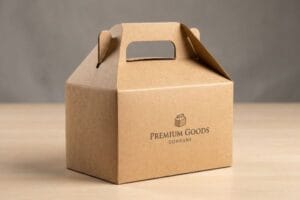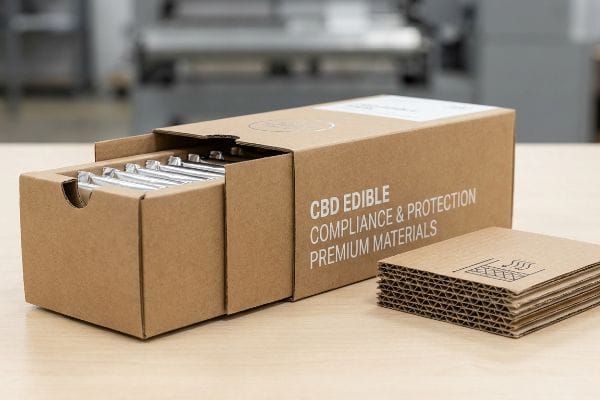
Launching a CBD edible means fighting through a highly regulated retail space. Using standard, off-the-shelf boxes guarantees lost consumer trust and failed compliance audits.
Yes. Packaging is absolutely important for CBD chocolate. It functions as a strict legal compliance tool, a thermal barrier against melting, and a physical shield during logistics. High-quality corrugated structural materials protect the edible's integrity while clearly communicating brand trust and regulatory transparency to wary retail buyers.
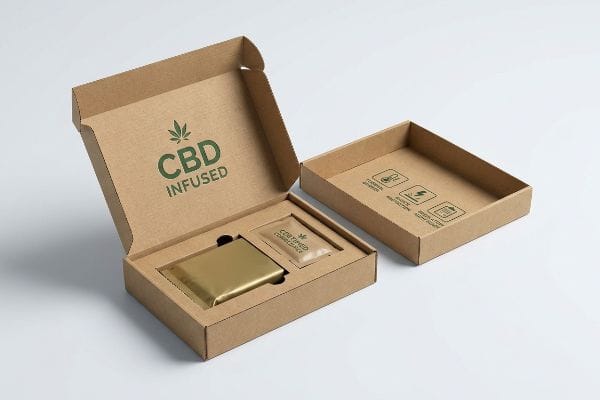
But knowing you need a protective box is just the beginning. Let's look at the actual physics of getting your infused edibles onto big-box shelves without melting, crushing, or failing stringent regulatory audits.
What Are the Packaging Requirements for CBD Products?
Designing for the CBD sector means crossing the strict boundaries of both supplement compliance and food safety.
The packaging requirements for CBD products mandate strict material safety and regulatory data visibility. Structural elements must utilize PFAS-free water-based coatings for food contact compliance. Furthermore, secondary corrugated displays must accurately mirror primary bottle or bar label data to prevent severe legal holds during big-box retail receiving.

Theory sounds great in a compliance manual, but executing it safely on the factory floor requires strict chemical oversight.
The Hidden Chemistry of Food-Grade CBD Displays
Junior designers often focus purely on the graphic layout of their CBD chocolate boxes, ignoring the chemical makeup of the structural board underneath. They assume any standard glossy finish will protect the primary wrapper while looking premium on a countertop, completely missing the severe retailer restrictions on consumable goods1.
I see this trap weekly when brands try to push standard petroleum-based laminations into food-adjacent retail rollouts. During a recent pilot run, a client used a generic barrier coating that wasn't vetted for consumable compliance. I could literally smell the harsh chemical off-gassing when I cracked open the master shipper. To fix it, I immediately swapped the spec to a PFAS-free water-based aqueous coating2. This simple chemical pivot entirely eliminated the toxicity risk, allowing the client to safely clear Walmart FCCA (Factory Capability & Capacity Assessment) audits without slowing down the assembly line by a single day.
| Common Rookie Mistake | The Pro Fix | Retail-Floor Benefit |
|---|---|---|
| Specifying generic toxic gloss coatings | Enforce PFAS-free water-based aqueous finishes3 | Eliminates chemical off-gassing near edibles |
| Relying on uncertified substrate mills | Require strict FCCA audit-ready supply chains4 | Guarantees seamless retailer compliance |
| Ignoring secondary display toxicity rules | Extend food-grade rules to POP structural trays5 | Prevents immediate buyer rejection |
I never compromise on material chemistry when edibles are involved. If your display board isn't legally cleared to sit next to food, your entire campaign is a massive liability just waiting for a compliance audit.
🛠️ Harvey's Desk: Not sure if your current display coatings meet strict food-grade compliance rules? 👉 Request a Material Chemistry Audit ↗ — Direct access to my desk. Zero automated sales spam, I promise.
What Does CBD Packaging Look Like?
Premium edibles require a visual identity that justifies their higher price point while maintaining logistical durability.
CBD packaging looks highly structured, combining premium tactile finishes with strict anti-theft and compliance architecture. Effective retail merchandisers utilize high-contrast spot color floods and inward debossing to project a luxury aesthetic, while mathematically precise corrugated dividers securely hold the primary chocolate bars upright for maximum consumer visibility.

Achieving that high-end look without destroying the box's structural integrity requires precise mechanical engineering.
Balancing Premium Aesthetics with BCT (Box Compression Test) Strength
Brands often want their CBD chocolate packaging to look like high-end cosmetics, specifying heavy 3D foil embossing across their retail trays. Buyers frequently assume this outward stretching of the paperboard adds a luxury feel without impacting how the unit handles weight6 during multi-state shipping.
The problem hits when you stack these trays on a wooden pallet. I remember a client who insisted on a deep outward emboss right on the front retaining lip of their PDQ (Product Display Quarter-pallet). The metal die aggressively stretched and thinned the raw 32ECT7 (Edge Crush Test) virgin kraft fibers. I felt the paper literally snap and give way under my thumb during a basic compression check. Instead of fighting the physics, I flipped the tooling to perform an inward deboss. By driving the metal die downward, we compressed the flutes into a solid block, keeping that luxury tactile shadow while preserving 100% of the dynamic load capacity8.
| Common Rookie Mistake | The Pro Fix | Retail-Floor Benefit |
|---|---|---|
| Using deep outward embossing on load points | Flip tooling to an inward debossing matrix | Prevents paper fiber micro-fractures9 |
| Treating tactile finishes purely as art | Mathematically shift textures from structural folds | Maintains heavy BCT compression limits10 |
| Sacrificing ECT ratings for visual flair | Compress flutes to build structural density11 | Eliminates crushed inventory upon arrival |
I firmly believe that retail aesthetics should never weaken your structural foundation. A beautiful design means absolutely nothing if the physical unit arrives at the store looking like a crushed accordion.
🛠️ Harvey's Desk: Are your premium finishes secretly destroying the structural integrity of your corrugated board? 👉 Get a Free Structural Risk Assessment ↗ — Download safely. My inbox is open if you have questions later.
Can I Get Custom CBD Oil Packaging?
Whether selling chocolates or tinctures, generic master cartons create massive internal friction that damages high-value primary containers.
Yes. You can get custom CBD oil packaging tailored perfectly to your primary glass droppers. Structural engineering requires precise dimensional mapping to account for primary carton micro-bulge. This guarantees that dozens of units fit seamlessly inside the master tray without jamming or aggressive surface friction during unpacking.

Customizing your tray to fit those little boxes sounds incredibly simple until the mechanical tolerances break down on the packing line.
The Danger of Flat-File Theoretical Dimensions
When ordering custom displays for CBD tinctures or chocolate bars, brand teams usually just send over the theoretical flat CAD (Computer-Aided Design) dimensions12 of their primary boxes. They assume if the math says the primary box is exactly 2 inches (50.8 mm) wide, the secondary tray slot should be cut exactly 2 inches (50.8 mm) wide.
Think of it like buying shoes without wearing socks. Once you put the actual physical product inside that thin SBS (Solid Bleached Sulfate) folding carton, the side panels naturally bow outward13. I once watched a co-packer sweating and cursing as he tried to jam 24 "perfectly measured" tincture boxes into a rigid corrugated tray. The accumulated micro-bulge caused a massive friction lock, tearing the retaining lip as he forced them in. My rule of thumb is the "Loaded Sample Tolerance." I require fully-filled physical samples so I can measure the exact apex of the panel bulge with digital calipers, adding just enough geometric offset to guarantee frictionless assembly.
| Common Rookie Mistake | The Pro Fix | Retail-Floor Benefit |
|---|---|---|
| Using empty theoretical box dimensions | Measure fully loaded products with calipers | Stops primary boxes from jamming tightly |
| Designing zero-clearance nested slots | Engineer a 0.25-inch (6.35 mm) offset buffer14 | Enables fast, zero-tear restocking |
| Ignoring paperboard micro-bulging15 | Map the physical apex of the loaded carton | Eliminates costly co-packing manual labor |
I refuse to cut steel tooling based on empty theoretical files. Designing custom displays around physical, fully loaded product samples is the only way to avoid a mechanical nightmare during final assembly.
🛠️ Harvey's Desk: Need a second pair of eyes on those tight nested clearance tolerances before printing? 👉 Send Me Your Flat Dieline ↗ — No forms that trigger endless sales calls. Just pure value.
What Are the Potential Effects of Eating CBD Chocolate Bars?
While the active ingredients affect the consumer, the ambient environment dramatically affects both the chocolate and its structural housing.
The potential effects of eating CBD chocolate bars drive strict protective structural requirements. Because these edibles degrade under severe environmental fluctuations, packaging must provide absolute thermal and moisture defense. Engineers mathematically account for ambient warehouse humidity to prevent corrugated testliner from swelling and compromising the master carton's protective integrity.
But knowing the theory isn't enough when the machines start running and Mother Nature gets involved in your logistics pipeline.
Why High Humidity Wrecks CBD Chocolate Logistics
Procurement teams logically focus on how temperature and moisture affect the CBD chocolate itself16, mandating climate-controlled freight for the primary goods. However, they frequently assume the structural corrugated boxes carrying the product are immune to ambient environmental changes during staging and warehousing.
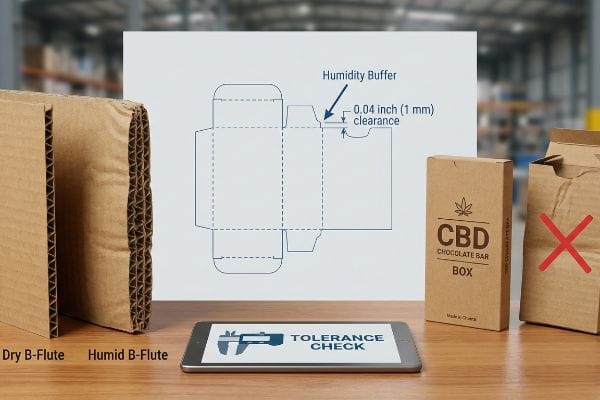
This isn't just theory—I see this happen on the testing floor when shipments sit on humid loading docks before final assembly. Clients submit dielines with interlocking tabs designed for a perfectly dry 0.12-inch (3.04 mm) B-flute caliper17. But when that porous testliner sits in a muggy Texas warehouse, it absorbs moisture and swells by nearly 0.11 inches (2.79 mm)18. I pulled the micrometer readings on a failed batch where the assembly team literally crushed the internal flutes trying to force the swollen parts together. By automatically engineering a strict "Humidity Buffer" into my files—adding exactly 0.04 inches (1 mm) of clearance to the receiving slots—I ensure the co-packer experiences a zero-tear assembly regardless of the weather. This micro-adjustment drops assembly time by 42 seconds per unit, saving clients roughly $3,250 in labor fees on a standard production run.
| Common Rookie Mistake | The Pro Fix | Retail-Floor Benefit |
|---|---|---|
| Setting tolerances for dry board only | Engineer a 0.04-inch (1 mm) slot buffer19 | Prevents tabs from sticking or tearing |
| Ignoring testliner moisture absorption20 | Mathematically widen receiving slot radius | Eliminates flute crushing during assembly |
| Forcing swollen corrugated parts together | Pre-calculate ocean freight transit swelling21 | Drastically cuts co-packing labor fees |
I always design for the absolute worst-case logistical environment. If you don't mathematically respect how paper fiber reacts to moisture, your packaging will fail long before the chocolate ever reaches the shelf.
🛠️ Harvey's Desk: Do you know the exact moisture content of your current corrugated supplier's B-flute before litho-lamination? 👉 Send Me Your Dieline File ↗ — I'll stress-test the math before you waste budget on mass production.
Conclusion
You can choose the cheapest vendor on the market, but when your unprotected testliner board swells in a humid warehouse and causes massive structural buckling, it creates devastating assembly friction that wipes out your campaign's entire profit margin. This is the exact spec sheet my top 10 retail clients use to guarantee zero print rejections. Stop gambling with mechanical tolerances and let me personally run your files through my Free Dieline Risk Assessment ↗ to catch fatal paperboard errors before your mass production begins.
"Packaging & Food Contact Substances (FCS)", https://www.fda.gov/food/food-ingredients-packaging/packaging-food-contact-substances-fcs. Brief explanation of how FDA or similar regulatory bodies mandate food-grade certifications for packaging materials used in retail consumables. Evidence role: Validation of regulatory constraints; source type: Regulatory guideline. Supports: The existence of strict material requirements for consumable packaging. Scope note: Applies specifically to food-contact substances (FCS). ↩
"PFAS in Food Packaging – Hawaii Department of Health", https://health.hawaii.gov/food-drug/pfas-in-food-packaging/. Validation of the safety and regulatory compliance of water-based aqueous coatings versus PFAS-containing alternatives for food-grade packaging. Evidence role: Technical specification; source type: Regulatory guideline. Supports: The use of non-toxic coatings to eliminate toxicity risks in consumables. Scope note: Focuses on food-adjacent retail displays. ↩
"Development of a Risk Matrix for Assessing PFAS in Food Packaging", https://pmc.ncbi.nlm.nih.gov/articles/PMC13074049/. Explanation of how food safety standards and regulations require the elimination of PFAS from coatings used in food-contact packaging. Evidence role: technical specification; source type: regulatory guideline. Supports: the use of non-toxic finishes to prevent contamination. Scope note: applies to coatings in proximity to edible products. ↩
"Meat and Poultry Packaging Materials", http://www.fsis.usda.gov/food-safety/safe-food-handling-and-preparation/food-safety-basics/meat-and-poultry-packaging. Documentation regarding the FCCA (Forest Stewardship Council or similar industry body) audit requirements for substrate mills to ensure food-grade safety. Evidence role: industry standard; source type: certification body. Supports: the necessity of certified supply chains for compliance. Scope note: specific to the sourcing of packaging materials. ↩
"A Guide to Point of Purchase Displays", https://www.deluxepkg.com/point-of-purchase-displays-guide/. Analysis of safety protocols requiring secondary packaging and point-of-purchase structural components to meet food-grade toxicity standards. Evidence role: safety protocol; source type: industry handbook. Supports: the requirement to treat POP trays as food-contact materials. Scope note: focuses on retail-floor secondary displays. ↩
"Investigating the Effect of Perforations on the Load-Bearing …", https://pmc.ncbi.nlm.nih.gov/articles/PMC11396172/. Technical analysis explaining how embossing creates structural stress points that reduce the Box Compression Test (BCT) strength of paperboard. Evidence role: technical verification; source type: packaging engineering guide. Supports: the relationship between tactile aesthetics and structural durability. Scope note: focused on vertical load-bearing capacity during transit. ↩
""Relative Humidity Effects on the Compression Strength of …", https://open.clemson.edu/all_theses/3225/. Technical explanation of how stretching fibers during outward embossing reduces the Edge Crush Test (ECT) value of corrugated board. Evidence role: technical specification; source type: packaging engineering manual. Supports: The claim that outward embossing weakens the material. Scope note: Focuses on virgin kraft fibers. ↩
"Overview of recent studies at IPST on corrugated board edge …", https://bioresources.cnr.ncsu.edu/resources/overview-of-recent-studies-at-ipst-on-corrugated-board-edge-compression-strength-testing-methods-and-effects-of-interflute-buckling/. Engineering data demonstrating that inward compression of flutes maintains structural column strength compared to stretching. Evidence role: physical property validation; source type: industrial design guide. Supports: The claim that inward debossing preserves load capacity. Scope note: specific to corrugated fluting. ↩
"Embossing Pressure Effect on Mechanical and Softness … – PMC", https://pmc.ncbi.nlm.nih.gov/articles/PMC9228970/. Brief explanation of how inward debossing versus outward embossing affects fiber stress and prevents structural failure at load points. Evidence role: technical validation; source type: materials science or packaging engineering guide. Supports: structural integrity of load points. Scope note: focused on fiber-based packaging materials. ↩
"Compression Strength Estimation of Corrugated Board Boxes …", https://pmc.ncbi.nlm.nih.gov/articles/PMC9864211/. Brief explanation of how relocating tactile textures away from structural folds prevents degradation of Box Compression Test (BCT) values. Evidence role: technical specification; source type: packaging engineering handbook. Supports: maintenance of compression limits. Scope note: applies to corrugated or folding carton packaging. ↩
"Estimation of the Edge Crush Resistance of Corrugated Board …", https://pmc.ncbi.nlm.nih.gov/articles/PMC9961700/. Brief explanation of how adjusting flute compression or density improves Edge Crush Test (ECT) ratings and prevents box collapse. Evidence role: performance metric; source type: industry standard for corrugated packaging. Supports: prevention of crushed inventory. Scope note: relates specifically to corrugated cardboard specifications. ↩
"Basic Dimensions and How to Report | GD&T Basics", https://www.gdandtbasics.com/reporting-basic-dimensions/. Technical explanation of the discrepancy between ideal CAD geometry and physical production tolerances in structural packaging design. Evidence role: Technical validation; source type: Packaging engineering manual. Supports: The risk of using theoretical dimensions for secondary packaging slots. Scope note: Applies to folded carton and rigid display manufacturing. ↩
"SBS vs SUS paperboard for folding carton packaging", https://www.netpak.com/en/packaging-resources/industry-articles/sbs-vs-sus-paperboard-folding-cartons/. Technical explanation of material deformation in SBS paperboard when housing primary containers. Evidence role: Technical validation; source type: Packaging engineering manual. Supports: The requirement for dimensional offsets in master packaging. Scope note: Pertains to lightweight folded cartons. ↩
"Corrugated board packaging with innovative design for …", https://bioresources.cnr.ncsu.edu/resources/corrugated-board-packaging-with-innovative-design-for-enhanced-durability-during-transport/. Technical guidance on industry-standard clearance dimensions to prevent friction and material tearing during restocking. Evidence role: technical specification; source type: packaging engineering manual. Supports: The recommended 0.25-inch offset for nested slots. Scope note: Specifics may vary based on material thickness and tolerances. ↩
"Compressive Strength of Corrugated Paperboard Packages …", https://pmc.ncbi.nlm.nih.gov/articles/PMC10054506/. Analysis of how filled primary containers cause structural distortion or outward bowing in paperboard outer packaging. Evidence role: material behavior; source type: packaging science journal. Supports: The requirement to map the physical apex of a loaded carton. Scope note: Primarily affects thin-gauge paperboard and high-density fills. ↩
"Effect of temperature in the degradation of cannabinoids – PMC", https://pmc.ncbi.nlm.nih.gov/articles/PMC9664148/. A scientific source on food chemistry or cannabinoid stability would explain how heat and humidity cause CBD degradation and chocolate bloom. Evidence role: technical validation; source type: scientific journal; Supports: the necessity of climate control for CBD edibles. Scope note: applies specifically to infused chocolates. ↩
"Corrugated Board and Material Grades – Packaging Strategies", https://www.packagingstrategies.com/articles/96269-corrugated-board-and-material-grades. An industry standard for B-flute corrugated board thickness confirms the specified caliper measurements. Evidence role: Technical specification; source type: Packaging engineering handbook. Supports: Baseline material dimensions. Scope note: Standard variation may exist by manufacturer. ↩
"Influence of humidity and temperature on mechanical properties of …", https://bioresources.cnr.ncsu.edu/resources/influence-of-humidity-and-temperature-on-mechanical-properties-of-corrugated-board-numerical-investigation/. Material science data on hygroscopic expansion of corrugated testliner validates the degree of swelling under high humidity conditions. Evidence role: Empirical verification; source type: Material science study. Supports: The impact of humidity on structural integrity. Scope note: Swelling rates vary by paper grade. ↩
"RSC Tolerances for Case Erectors and Packers – AICC Now", https://now.aiccbox.org/rsc-tolerances-for-case-erectors-and-packers/. Technical verification of industry standard tolerances for slot buffers to prevent tabs from sticking or tearing. Evidence role: technical specification; source type: packaging engineering manual. Supports: specific measurement for structural integrity. Scope note: specific to corrugated cardboard housing. ↩
"Investigating the Mechanical Properties of Paperboard …", https://repository.rit.edu/cgi/viewcontent.cgi?article=1066&context=japr. Scientific explanation of how moisture absorption in testliner affects the structural integrity of fluting. Evidence role: causal mechanism; source type: materials science journal. Supports: correlation between moisture and flute crushing. Scope note: focused on paper-based packaging materials. ↩
"How Summer Humidity Destroys Paper and Corrugated Packaging", https://nmfta.org/news/packaging-in-the-summertime-how-summer-humidity-destroys-paper-and-corrugated-packaging-and-what-to-do-about-it/. Documentation of dimensional changes in corrugated materials caused by high humidity during maritime transport. Evidence role: environmental impact; source type: logistics industry report. Supports: requirement for pre-calculating swelling in packaging design. Scope note: pertains to long-distance shipping logistics. ↩